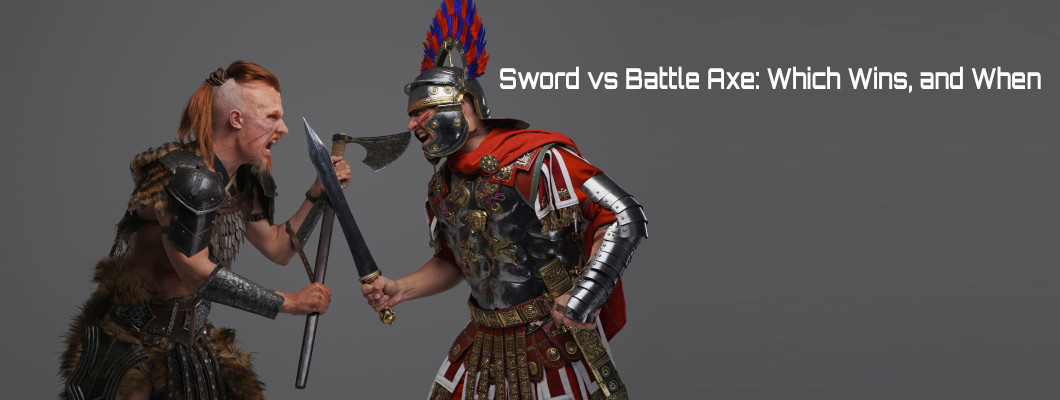
Sword vs Battle Axe: What Happens When They Actually Meet
The honest answer is that it depends on two things, and neither of them is the weapon: whether there is a shield, and whether there is armour. An axe concentrates its mass at the far end, so it hits far harder than a sword of the same weight, splits shields, and defeats armour that a cutting edge would slide off. A sword distributes its mass along the blade, so it recovers faster, defends itself, thrusts, and cuts along its whole length rather than at one point. That is the entire trade, and everything else follows from it. This is not about which weapon was better — it is about what each one does when steel meets steel.
The Physics: Where the Mass Sits
Pick up a sword and an axe of identical weight and they feel nothing alike, because the weight is in different places.
A sword's mass is spread along a metre of blade, with the balance point usually a few inches ahead of the guard. An axe's mass is almost entirely in the head, at the far end of a lever.
That difference does two opposite things at once. The axe delivers far more energy into a small area, because all that mass is travelling fastest at the moment of impact and it is concentrated behind a short edge. But the same mass out at the end makes the axe much harder to start, stop and redirect — physically harder, because rotating a mass at distance takes more effort than rotating one close in.
Every advantage each weapon has traces back to that one fact.
What the Axe Does Better
It breaks shields. This is the axe's real historical job and it is easy to underestimate. A sword cutting into a shield rim gets stuck or glances off. An axe splits the boards, and once a shield is split it stops being a shield.
It hooks. The upper horn of the head can catch a shield rim and drag it aside, opening a target for the next blow or for the man beside you. On a bearded axe the beard does the same job. This is a genuine tactical function that a sword simply cannot perform.
It defeats armour that resists cutting. Mail is excellent against a cutting edge and much less good against concentrated impact. A sword cut on maille may break bones without breaking rings; an axe does that harder and more reliably. Against plate, edges become almost irrelevant and percussive force is what remains.
It is forgiving of a bad angle. A sword cut delivered with poor edge alignment turns into a slap. An axe with all that mass behind a short edge still does something even when the technique is imperfect — which matters enormously for a man who has held one for three weeks rather than three years.
What the Sword Does Better
It recovers. More on this below, because it is the decisive one.
It defends. A sword has a metre of edge and a guard, so it can parry, bind, deflect and control an opponent's weapon as part of the same motion it attacks with. An axe has a cutting edge a few inches long and a wooden shaft; it can block, but the shaft is the part that gets hit and shafts get cut. That is why war axes and polearms carry langets — metal straps armouring the haft below the head, as covered in our guide to how polearms are hafted.
It thrusts. A point is a genuinely different attack, it is fast, it requires little commitment, and it finds gaps that no cut will. An axe has no equivalent.
It threatens along its whole length. Any part of a sword's edge can cut. An axe is dangerous in one small place, and if you are not in that place you are safe from it.
It is worn. A sword sits on a belt all day and comes out instantly. This is not a combat property but it is why the sword ended up as everyone's sidearm.
Recovery Time — the Concept That Decides It
If you take one idea from this article, take this one.
When you swing an axe and miss, the mass at the end keeps going. It pulls your arms with it, it turns your body, and for a moment — a real, measurable moment — you cannot do anything about what happens next. That interval is called recovery, and against a competent opponent it is the whole fight.
A sword's mass is close enough to your hands that you can stop it, reverse it, or turn a missed cut into a guard. A sword recovers into defence. An axe recovers into vulnerability.
This is why the popular framing — heavy weapon versus light weapon — misses the point. The axe is not slow to swing. It is slow to un-swing, and that is a much more dangerous kind of slow.
It is also why axe fighting in the historical sources is so often paired with a shield. The shield covers the recovery. Take the shield away and the axeman has to buy that time some other way, usually with distance.
The Shield Changes Everything
Almost every serious discussion of sword versus axe is really a discussion about shields, whether or not the people having it realise.
Both sides with shields: the axe is arguably ahead. It breaks the thing protecting the opponent, it hooks it aside, and its own recovery problem is solved by the shield on the axeman's arm.
Neither side with shields: the sword pulls ahead sharply. Now recovery matters at every exchange, the sword's ability to defend with the same motion it attacks with becomes decisive, and the thrust is available.
One side with a shield: the shield decides it, more or less regardless of what the other hand is holding.
The shield, not the weapon, is the variable that swings the outcome — which is a large part of why the shield disappears from European warfare only when armour becomes good enough to replace it.
Armour Changes It Again
As armour improved through the medieval period, cutting became progressively less useful, and weapons that deliver concentrated force gained ground. Axes, hammers and picks all rose for the same reason.
But the sword did not simply lose. It adapted, and the adaptations are among the most interesting things in European martial history. Fighters learned to grip the blade in one hand for leverage and precision at close quarters — half-swording — turning the sword into a short, controllable spear aimed at the gaps in a harness. And they learned to invert it entirely, gripping the blade and striking with the crossguard or pommel as a hammer.
That last technique tells you everything. When a fully armoured opponent stood in front of him, a swordsman turned his sword into an axe.
The real answer to armour was neither weapon on its own. It was the poleaxe, which put an axe head, a hammer face and a spike on a haft and combined all three answers at once.
The Dane Axe: the Axe Without a Shield
The two-handed breiðøx is the interesting exception, because its user has deliberately given up his shield.
What he bought with it is reach, leverage and a genuinely frightening blow — a long thin-bladed axe on a five-foot haft delivers force that no one-handed weapon matches. What he gave up is any defence except distance and the length of his own haft.
The sources suggest this was understood at the time. Huscarls with two-handed axes appear working alongside shielded men rather than in isolation, which is exactly what you would expect: someone else covers the recovery.
It is the same trade as the greatsword, made two centuries later and for the same reasons.
What People Actually Carried
The framing of the question is modern. Almost nobody chose between a sword and an axe.
A Norse fighter carried a spear or an axe and, if he could afford one, a sword on his hip as well. A medieval man-at-arms carried a polearm into the line and a sword at his side. The primary weapon and the sidearm were different objects doing different jobs, and the sword was overwhelmingly the second of those.
That is the same conclusion our post on the spear and the sword reaches from a different direction, and it is worth stating plainly: the sword was rarely anyone's primary battlefield weapon anywhere in the world. It was what you drew when your first weapon was gone, or when you were not expecting a battle at all. The axe and the spear were the weapons of the battle. The sword was the weapon of the man.
Compared
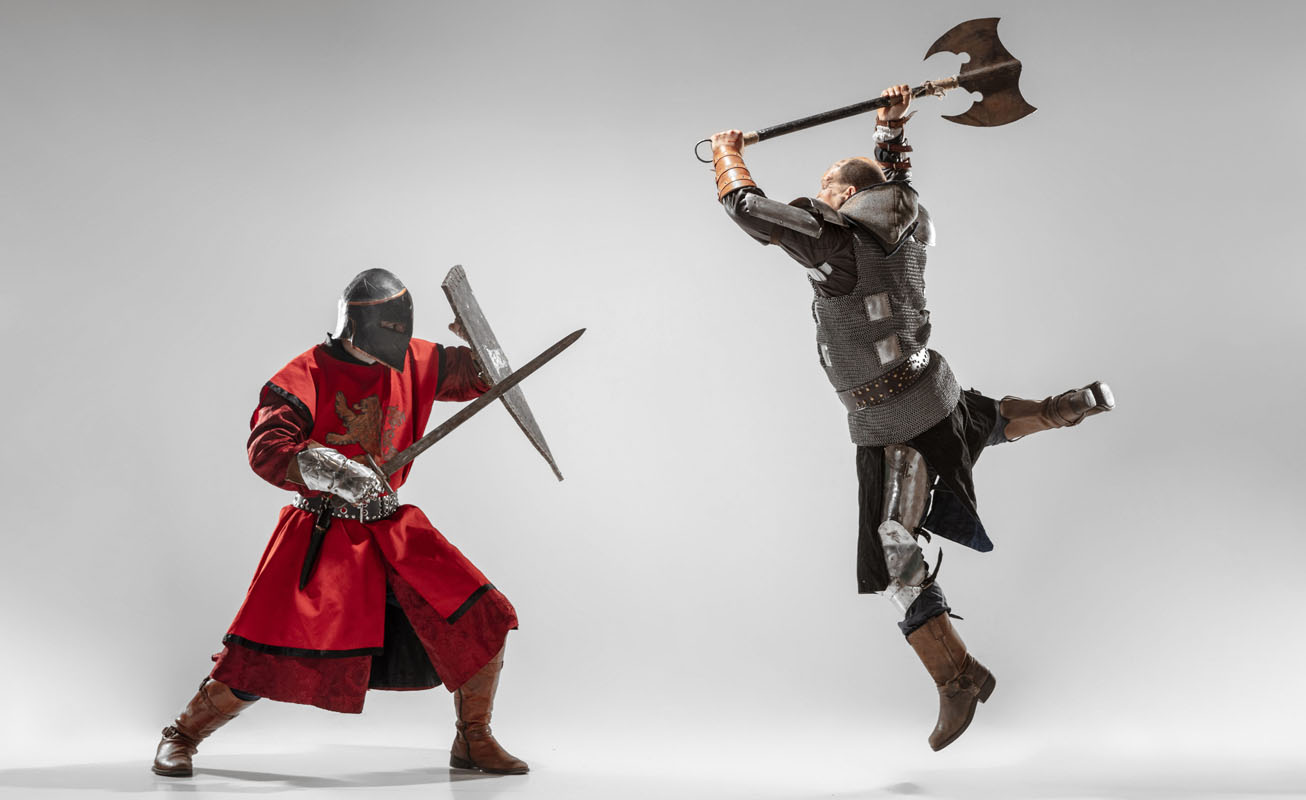
A dramatic staging of medieval combat: a knight in red tabard prepares a shield block against a leaping overhead strike from a battle axe warrior.
| Battle axe | Sword | |
|---|---|---|
| Where the mass is | At the far end | Along the blade |
| Impact energy | Much higher, concentrated | Lower, spread over an edge |
| Recovery after a miss | Slow — the weakness | Fast — the strength |
| Defence | Poor; the haft gets cut | Excellent; parries and binds |
| Against shields | Splits and hooks them | Struggles |
| Against mail and plate | Strong — force, not edge | Requires half-swording |
| Thrust | None | Available and fast |
| Training needed | Weeks | Years |
| Historical role | Primary weapon | Sidearm and status |
For Collectors and Reenactors Today
None of this decides what you should own, but it does explain how each will feel in your hands.
An axe feels alive and forward, and it wants to go somewhere. It is immediately satisfying to handle and it is the more physical object. It also doubles as a tool, which no sword does.
A sword feels balanced and answerable. It rewards technique in a way an axe does not, which is why sword arts have a literature and axe arts largely do not.
If you are building a historically coherent kit rather than choosing a favourite, the honest pairing is both — an axe or spear as the primary weapon, and a sword at the hip. That is what a Viking, a huscarl and a man-at-arms all actually carried, and it is a far more interesting display than either alone.
Axe, Sword, or the Pair They Actually Carried
We forge both in Kathmandu from 5160 spring steel — Norse and bearded axes, historical and fantasy swords, and commissions built to your specification. Head weight, blade length, haft length and engraving all to order.
Request a Custom Build →Frequently Asked Questions
Is an axe better than a sword in a fight?
It depends almost entirely on shields and armour rather than on the weapons. With shields on both sides the axe is arguably ahead, since it splits and hooks the shield while its own recovery problem is covered by the shield on the axeman's arm. Without shields the sword pulls ahead sharply, because recovery matters at every exchange and the sword defends with the same motion it attacks with.
Why does an axe hit harder than a sword?
Because of where the mass sits. A sword's weight is spread along a metre of blade, while an axe's is almost entirely in the head at the end of a lever. All that mass is travelling fastest at the moment of impact and it is concentrated behind a short edge, so the energy delivered into a small area is far higher. The same physics is what makes the axe harder to start, stop and redirect.
What is recovery time and why does it matter?
Recovery is the interval after a swing during which you cannot do anything about what happens next. When an axe misses, the mass at the end keeps going, pulling your arms and turning your body. A sword's mass sits close enough to the hands that a missed cut can be stopped, reversed or turned into a guard. The axe is not slow to swing; it is slow to un-swing, which is a far more dangerous kind of slow.
Could a sword cut through an axe handle?
It is a real risk, which is precisely why war axes and polearms carry langets — flat metal straps running down the haft from the head and riveted through, armouring the most vulnerable stretch. A haft without them is the axe's weak point in a weapon-on-weapon exchange, and it is one of the clearest signs of whether an axe was built for war or for wood.
Which weapon is better against armour?
The axe, in general terms. Mail resists cutting well and concentrated impact much less well, and against plate the edge becomes almost irrelevant while force still matters. But the sword adapted rather than losing: fighters gripped the blade for leverage at close quarters, called half-swording, and inverted the sword to strike with the crossguard or pommel. The real answer to armour was the poleaxe, which combined both.
Why did Vikings use axes instead of swords?
Mostly cost. A sword took many times the iron and a specialist smith, while an axe used a fraction of the material and was already in every household for timber and boatbuilding. But the framing is misleading, since it was rarely an either-or. A man who owned a sword carried it alongside his axe or spear, using one as his primary weapon and the sword as his sidearm.
What is a Dane axe and why give up a shield for one?
A two-handed axe with a wide thin blade on a haft of four to five feet. Giving up the shield buys reach, leverage and a blow no one-handed weapon matches, at the cost of any defence except distance and the haft itself. The sources suggest this was understood: two-handed axemen appear working alongside shielded men who could cover their recovery, exactly as you would expect.
Did warriors choose between a sword and an axe?
Almost never. The choice is a modern framing. A Norse fighter carried a spear or an axe and, if he could afford one, a sword on his hip as well. A medieval man-at-arms took a polearm into the line and wore a sword at his side. The primary weapon and the sidearm were different objects doing different jobs, and the sword was overwhelmingly the second.