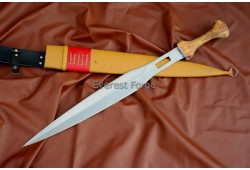
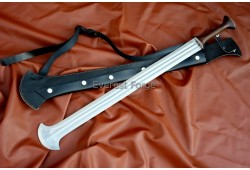
African Swords for Sale — Hand-Forged Tribal Blades from the Congo Basin
Hand-forged African swords for sale at Everest Forge — Konda machete-swords, curved Ngombe Ngulu prestige blades and leaf-shaped Boa-Zande warrior swords of the Central African Congo basin. Every blade is forged by hand in 5160 high-carbon spring steel, oil-tempered for real strength, and ships worldwide with duties and taxes prepaid (DDP). Browse the seven African swords below, or commission a custom blade built to your own specification.
Forged in Nepal since 2010
5160 spring steel, oil-tempered
Full-tang construction
Worldwide shipping, duties prepaid
What Are African Swords?
African swords are the traditional hand-forged bladed weapons of Africa's many peoples. Across the continent every culture forged its own form — the straight Saharan cavalry blades of the Tuareg, the deeply curved Ethiopian sabres, the leaf-shaped warrior blades of Central Africa and the dramatically hooked ceremonial prestige weapons of the Congo basin. An African sword was rarely just a weapon: it carried social rank, spiritual meaning and tribal identity, and many blades doubled as ritual objects, executioners' swords or marks of office. The result is one of the most visually varied sword traditions in the world.
Today, the African swords most sought by collectors are the traditional tribal blades of Central Africa — the Konda, Ngombe, Mongo, Boa and Zande patterns of the Congo basin — which is exactly what Everest Forge specialises in forging.
Traditional African Swords — A Regional Overview
African sword history spans the whole continent and goes back thousands of years. To make sense of the field, it helps to break the ancient African weapons tradition down by region:
West African Swords
West Africa and the Sahel produced the Takouba, a long straight-edged cavalry sword carried by Tuareg horsemen and noble warriors across the Saharan caravan routes, alongside a family of regional short swords and machete-like blades known among the Hausa, Igbo and neighbouring West African peoples. These West African swords typically carry leather-covered crossguards and engraved decoration. Everest Forge does not currently forge West African blades, but the tradition runs in parallel with the Central African work we focus on.
East African Swords
East Africa's most recognisable sword is the Shotel, a dramatically curved blade of the Ethiopian highlands shaped to reach around an opponent's shield and associated with the Christian warriors of the Abyssinian Empire. Alongside it sit the straight-bladed Kaskara of the eastern Sudan and the Seme of the Maasai. We treat these East African swords as historical context rather than current stock.
Central African Swords (Congo Basin)
Central Africa, and in particular the Congo basin, produced the most varied and visually distinctive African sword tradition. The Konda, Ngombe, Mongo, Boa, Zande and Yaka peoples forged broad cutting blades, leaf-shaped warrior swords, hooked sickle prestige weapons and the famous Mambele throwing iron. The Ikakalaka — a leaf-bladed Central African short sword — belongs to the same metalworking world. Almost every African sword Everest Forge forges today comes from this Congo-basin lineage, which gives the collection a tight cultural coherence: every blade is a true Central African or Congolese sword from one connected metalworking tradition, rather than a scattered continent-wide grab-bag.
Which African Swords Does Everest Forge Forge?
Seven hand-forged blades, organised across three Congo-basin families. Each is forged to its own documented historical pattern, so no two compete for the same role in a collection. Tap any product to see full specifications, photography and ordering.
Konda Blades — Hand-Forged Congo Cutting Swords
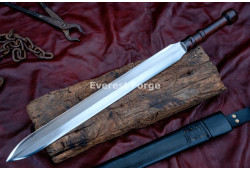
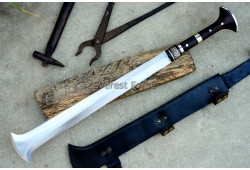
The Konda people of the Democratic Republic of Congo gave their name to a family of broad, forward-curving cutting blades — closer in feel to a heavy machete than a European sword, but carried, owned and named as a warrior's sword. Everest Forge forges three Konda lengths, so collectors can pick by reach and presence:
Ngulu & Ngombe Prestige Blades — African Ceremonial Swords
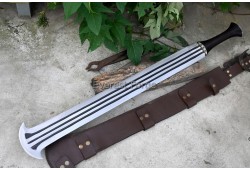
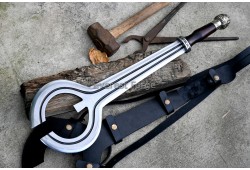
The Ngombe and Mongo peoples of the Congo forged the Ngulu — a dramatically curved prestige sword historically tied to rank, ceremony and ritual rather than the battlefield. The silhouette is unmistakable: a sweeping hooked profile that recalls a sickle as much as a sword, and one of the most arresting forms in African metalwork. Everest Forge forges two interpretations:
Boa-Zande Warrior Blades — Leaf-Shaped Central African Swords
The Boa and Zande peoples of Central Africa carried a leaf-shaped warrior blade with a distinctive widening profile — the blade broadens noticeably toward the tip, giving it both presence and chopping authority. Everest Forge forges two 22-inch interpretations of this Central African pattern:
Compare the African Swords Collection
| Blade | Length | People & Region | Character | Best For |
|---|
| Konda Sword | 25 in | Konda, Congo | Balanced machete-sword | Collection flagship |
| Konda Machete-Sword | 30 in | Konda, Congo | Full-length statement blade | Big-blade collectors |
| Konda Machete | 18 in | Konda, Congo | Compact chopping blade | Hands-on display |
| Ngombe Ngulu Prestige | 18 in | Ngombe / Mongo, Congo | Curved prestige blade | Ceremonial collectors |
| Double Ngulu Sickle | 18 in | Ngombe, Congo | Twin-sickle ceremonial form | Statement display |
| Boa Zande Warrior | 22 in | Boa / Zande, Congo | Leaf-shaped warrior blade | Historical collectors |
| Boa-African Sword | 22 in | Boa / Zande, Congo | Leaf-shaped tribal blade | Entry collectors |
Find Your African Sword — A Quick Decision Guide
African Curved & Ceremonial Swords
If you are drawn to the curved and ceremonial side of African metalwork rather than a straight cutting blade, two patterns in this collection stand out — and both are in stock right now.
The Ngombe Ngulu is the definitive African ceremonial sword. Its sweeping, hooked silhouette was historically a prestige and ritual object among Ngombe nobility, associated with rank, display and, in some accounts, ceremonial execution. The Double Ngulu Sickle Blade takes the same prestige form into a rarer twin-sickle profile — one of the most visually arresting African swords ever forged, and a true statement display piece.
For a curved African sword with a fighting character rather than a ceremonial one, the Konda family — particularly the 25-inch Konda Sword and the 30-inch Konda Machete-Sword — carries a sweeping forward curve closer to a true cutting weapon. The same curved African blade tradition, in a different role.
Why Buy African Swords from Everest Forge?
Everest Forge has been hand-forging blades in Tokha-3, Kathmandu, since 2010. The African swords in this collection are made by the same Kami-caste blacksmiths who forge our military-grade kukris — a forge whose credentials include BSI Service No. 1 to the British Gurkha Army (2008), the Nepal Army (2015–2018) and the Nepal Police (2016–2017). We are not a reseller. We forge every blade ourselves, photograph every blade ourselves and ship every blade ourselves.
What that means for the buyer:
- Real steel. Every African sword is forged from 5160 high-carbon spring steel (leaf spring) — the same alloy in our battle-ready historical swords, not soft display steel.
- Real heat treatment. Every blade is oil-tempered, not water-quenched or left untempered. Oil produces a tougher, more shock-resistant edge that holds up to real handling.
- Real construction. Every blade is full-tang, with the tang running the full length of the handle for structural integrity.
- Forged one at a time. No two African swords are identical. Each one carries the marks of the hand that made it, and the photograph on the product page is taken on the workshop bench before the blade ships.
- Worldwide, duties prepaid. Every blade ships DDP (Delivered Duty Paid). Customs, duties and import taxes are prepaid at checkout, so there is nothing extra to pay when your African sword arrives.
- Honest history. We treat the tribal and ceremonial heritage of these blades with care. We sell them as collector pieces, display swords and historical reproductions — not as anything else.
How These African Swords Are Forged
Every blade in this collection follows the same hand-forging process at Everest Forge:
- Leaf-spring 5160 steel is heated, hammered and folded by hand to the historical pattern.
- The blade is normalised, hardened and oil-tempered in sequence — the same heat-treatment regime used on our battle-ready swords.
- Handles are carved from hardwood and fitted to the full-tang blade by hand.
- Each blade is finished, sharpened, photographed on the bench, then packed and shipped DDP to anywhere in the world.
The result is a hand-forged African sword that looks the part on a wall, handles the part in the hand, and carries the genuine craftsmanship of a Nepali blacksmith forge — not a polished factory finish.
African Swords — Frequently Asked Questions
What are African swords?
African swords are the traditional hand-forged bladed weapons of Africa's many peoples — highly individual forms that served as weapons, status symbols and ritual objects. This collection focuses on the curved and leaf-shaped tribal blades of the Central African Congo basin: the Konda, Ngombe Ngulu and Boa-Zande patterns.
What types of African swords are there?
African swords break down by region. West Africa produced the straight Takouba of the Tuareg and Sahelian short swords. East Africa produced the deeply curved Ethiopian Shotel and the straight Sudanese Kaskara. Central Africa, and especially the Congo basin, produced the most varied family of all — the Konda cutting blades, the Ngombe Ngulu prestige swords, the Boa-Zande leaf-shaped warrior blades, the Yaka, the Ikakalaka and the Mambele throwing iron. Everest Forge specialises in this Central African Congo-basin tradition.
What is the most famous African sword?
Two contenders. The Ethiopian Shotel is the most famous African sword by silhouette — its dramatic curve is iconic. The Central African Ngulu is the most famous African ceremonial sword, with a hooked sickle-like profile tied historically to prestige and ritual among the Ngombe people. Everest Forge forges the Ngulu in two interpretations: the Ngombe Ngulu Prestige Sword and the Double Ngulu Sickle Blade.
What is the curved African sword called?
Two of the best-known curved African swords are the Ethiopian Shotel — a deeply curved sabre designed to slice around shields — and the Central African Ngulu, a hooked sickle-curved prestige sword of the Ngombe people. The Konda machete-sword of the Congo also carries a strong forward curve, giving the collection three distinct curved African sword traditions on a single page.
What is a Konda sword?
A Konda sword is a broad, forward-curving cutting blade named for the Konda people of the Democratic Republic of Congo. Everest Forge forges it in three lengths — an 18-inch machete, a 25-inch sword and a 30-inch machete-sword — so you can match the blade to the role you want it to play in your collection.
What is a Ngulu sword?
The Ngulu is a dramatically curved prestige sword of the Ngombe and Mongo peoples of the Congo, historically tied to ceremony, rank and ritual rather than the battlefield. Its hooked, sickle-like silhouette is one of the most distinctive in African metalwork. See the Ngombe Ngulu Prestige Sword.
What is a Boa-Zande sword?
A leaf-shaped warrior blade of the Boa and Zande peoples of Central Africa, recognisable by a widening profile that broadens toward the tip. Everest Forge forges two 22-inch interpretations — the Boa Zande Warrior Sword and the Boa-African Sword.
Are these African swords functional or display-only?
Both. They are fully functional, forged from 5160 high-carbon spring steel and oil-tempered like our battle-ready historical swords — but Everest Forge sells them as collector pieces, display swords and historical reproductions for collectors, reenactors and enthusiasts of African material culture.
What steel are these African swords made from?
Every blade in this collection is forged from 5160 high-carbon spring steel (leaf spring) and oil-tempered. It is the same steel and heat treatment Everest Forge uses on its battle-ready historical swords — tougher and more shock-resistant than the soft stainless steels common in display-only blades.
Where are these African swords forged?
Every African sword in this collection is hand-forged in Everest Forge's own workshop in Tokha-3, Kathmandu, Nepal, by Kami-caste blacksmiths — the same forge behind our military-issue kukris.
Do you ship African swords internationally?
Yes. Everest Forge ships worldwide on a DDP (Delivered Duty Paid) basis. Customs duties, import taxes and clearance fees are prepaid at checkout, so there is nothing extra to pay when your African sword arrives at your door.
Can I order a custom African sword?
Yes. Everest Forge forges one-off African swords to your specification — choose the pattern, the length, the handle and the fittings. Start with a Custom Forge request and we work the build with you from sketch to finished blade.
Want a One-Off African Sword?
Everest Forge builds custom African swords to your own pattern, length and fittings — hand-forged in Nepal and shipped worldwide, duties prepaid.
Request a Custom Forge
Hand-Forged in Nepal Since 2010
Every Everest Forge blade is forged one at a time by Kami-caste blacksmiths in Tokha-3, Kathmandu — the same hands behind our military-issue kukris for the British Gurkha Army.
Meet the Forge