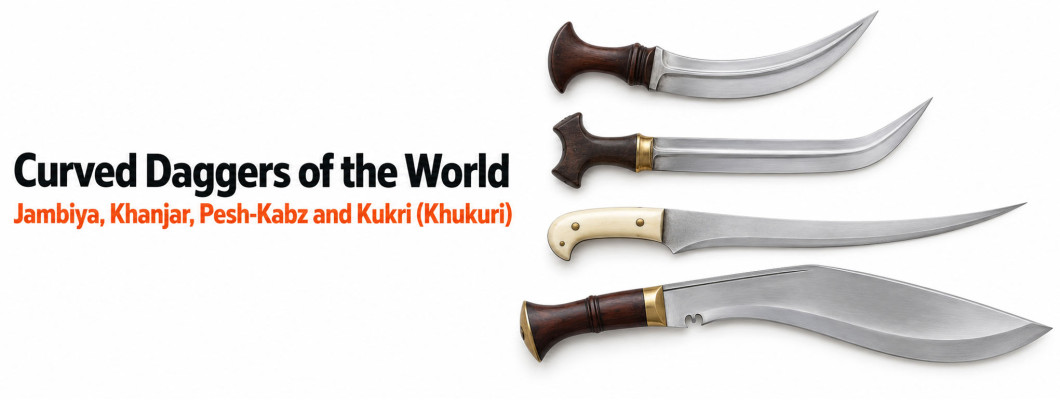
Nepal has given the world three things its people instantly recognise: Mount Everest, the Buddha, and the kukri. Of the three, only the kukri is something a person can hold. The forward-curved Nepali blade is at once a working tool, a soldier's weapon, a household guardian, a sacred object worshipped during Dashain, a wedding heirloom, a regimental emblem, and the most widely-recognised cultural symbol Nepal has ever produced. It appears in folk songs, on military badges, in temple iconography, and on the national emblem itself. It is given to honoured guests, to retiring soldiers, to grandchildren. It is the only Nepali object you will find equally at home on a farmer's belt and a king's coronation altar.
This page is the cultural reference for the kukri — the rituals, the symbolism, the regimental traditions, the myths (and which of them are accurate), and the role the blade plays in Nepali identity. If you have ever wondered why a knife means so much to a country, this is the answer.
The Kukri at Dashain — The Annual Worship of the Blade
Dashain is the largest Hindu festival in Nepal — a 15-day celebration in autumn honouring the goddess Durga and her victory over the demon Mahishasura. It is also the one time each year when every Nepali household formally worships its kukri.
On the ninth day of Dashain — Maha Navami — kukris across Nepal are taken out of their scabbards, cleaned, oiled, and placed on the household altar alongside the family's other sacred objects. The blades are blessed with red tika, draped with marigold flowers, sprinkled with holy water, and offered incense. In rural Nepal, the Maha Navami kukri then performs ritual animal sacrifice — traditionally a goat or buffalo — to honour Durga and seek her protection for the coming year. The blood-touched blade is considered especially blessed.
The cultural meaning of the Dashain blessing runs deeper than the ritual surface. By worshipping the kukri annually, the household acknowledges three things at once: that the blade has protected them through the year past, that they ask for its protection through the year coming, and that the blade itself is sacred — not merely a tool, but a household guardian deserving of respect. This is why, in traditional Nepali culture, you do not step over a kukri, you do not draw one in anger, and you do not let a stranger handle one without permission. The kukri is treated more like a household member than a piece of equipment.
For a household with multiple kukris — working kukri, ceremonial kukri, perhaps an heirloom from a grandfather — every blade is worshipped during Dashain. The Kothimora kukri (silver-scabbard ceremonial) is typically the centrepiece of the altar.
The Trishul on the Blade — The Spiritual Meaning of the Cho
Every authentic Nepali kukri carries a small notch near the base of the cutting edge — called the cho or kaudi. The notch is functional (it interrupts cracks that might propagate up the blade) and practical (it stops blood and fluids reaching the handle), but its deepest meaning is religious.
The cho is interpreted in traditional Hindu Nepali culture as a stylised trishul — the three-pronged trident that is the weapon of Shiva, the destroyer and transformer in the Hindu trinity. By including the trishul on every kukri, the smith dedicates the blade to Shiva's protective purpose. Some traditions also interpret the cho as a representation of a cow's hoof — the cow being sacred in Hindu belief — meaning the blade is consecrated to preserve and protect life, not to take it indiscriminately.
This is not a decorative choice. A kukri without a cho is, in traditional Nepali eyes, an unconsecrated blade — functionally a knife but spiritually empty. This is part of why authentic Kami smiths have never produced kukris without the notch, and it is part of why mass-produced reproductions that omit the cho are dismissed by Nepali users as "not real kukris" regardless of how well they cut. The trishul is not optional; it is part of what makes the object a kukri.
For the full anatomy of the cho and its three layered meanings (practical, functional, spiritual), see our kukri terminology guide.
The Gurkha Oath — Bonding Soldier and Blade
The relationship between the Gurkha soldier and the kukri is not symbolic — it is ceremonial and binding. Every Gurkha recruit accepted into the British Brigade of Gurkhas or the Indian Gorkha Regiments receives a kukri during their basic training. The blade is presented with formality: in some regiments, a senior officer or pipe major personally hands it to the recruit; in others, it is issued at a regimental ceremony attended by family. The moment is treated with the gravity of an oath.
The kukri then stays with that soldier through their entire service. It is the only personal weapon a Gurkha is permitted to retain after retirement — every other piece of issued kit goes back to the regiment, but the kukri goes home. Retired Gurkhas keep their service kukris for life; many pass them down to children and grandchildren as heirlooms. The blade is the physical embodiment of the soldier's service, and to lose one or be careless with one is considered a serious dishonour.
The British Army's current Gurkha service blade — the Service No. 1, specified under BSI 2008 — is forged to a written standard that has barely changed in over a century. The 10.5-inch blade, the 5160 spring steel, the water-tempered edge, the water-buffalo horn handle, the hand-stitched scabbard with karda and chakmak — these specifications carry forward the unbroken tradition of the kukri as the Gurkha's blade. Everest Forge has been one of the workshops contracted to supply blades to this specification. See our current-issue military kukri collection for the same specification available to civilians.
The regimental insignia of the Brigade of Gurkhas — the famous crossed kukris emblem — has been worn on the cap badges, shoulder flashes, and unit colours of Gurkha regiments since the 19th century. The same crossed-kukris device appears on the badges of the Indian Gorkha Rifles, the Royal Brunei Gurkha Reserve Unit, and historically the Singapore Police Gurkha Contingent. There is no other knife in modern military history that has been chosen as the central symbol of multiple armies across three continents.
The Kothimora — Kukri as Gift of Honour
The Kothimora is the ceremonial kukri — a working-quality blade housed in a silver-mounted scabbard, often decorated with traditional Nepali motifs in repoussé silver work. Kothimora kukris descend directly from the Shah-era royal court tradition (the Shah dynasty ruled Nepal from 1768 to 2008) of presenting kukris as gifts of honour to nobles, foreign envoys, and military officers being elevated in rank.
The Kothimora tradition continues today in three principal contexts:
- Military retirement and promotion. Senior Gurkha officers are presented with Kothimora kukris on retirement, promotion to general rank, or appointment to honorary positions. The presentation acknowledges both the soldier's service and the silver-mounted blade's status as the highest form of the Gurkha weapon. British, Nepali, and Indian regiments all maintain this tradition.
- Diplomatic and state occasions. Nepal historically presents Kothimora kukris to visiting heads of state, ambassadors, and dignitaries. The blade is offered as a gift of friendship and respect — a tangible piece of Nepali culture that physically embodies the country's identity. Several Kothimora kukris are recorded in foreign state collections including those of the British royal family and senior US military commanders.
- Major family occasions. Wealthy Nepali families commission Kothimora kukris for weddings, milestone birthdays, retirement gifts to fathers and grandfathers, and to mark significant family achievements. The silver work allows the blade to be personalised — engraved with family names, dates, dedications, or coats of arms.
What distinguishes a Kothimora from a working kukri is the silver scabbard, not the blade itself — the underlying blade is a full-quality Bhojpure or service-pattern kukri, identical in steel, temper, and craftsmanship to the working blades. The Kothimora is a working kukri elevated by its mounts, not a decorative object that happens to look like a kukri. This is important: a Kothimora can be drawn and used like any other kukri, and traditionally has been — historical Kothimora kukris show genuine signs of use alongside their ceremonial decoration.
Kothimora ceremonial kukris from Everest Forge
Hand-forged Bhojpure and service-pattern blades mounted in worked silver scabbards. Suitable for military presentation, diplomatic gifting, wedding gifts, and family heirlooms. Free text personalisation. Custom silver engraving available on request.
The Kukri in Gurkha Weddings
The kukri in Gurkha wedding ceremonies — a living tradition.
In traditional Gurkha and broader Nepali wedding ceremonies, the kukri appears as both a sacred object and a guardian symbol. The groom typically wears or carries a kukri during the wedding rites — either tucked into his waist sash in the traditional daura suruwal attire, or worn at the side in a ceremonial scabbard. The blade represents the groom's commitment to protect his bride, his honour, and the new household being formed.
In Gurkha-specific traditions, the kukri at a wedding often carries additional military symbolism. A serving or retired Gurkha may wear his service kukri at his own wedding as a public statement of his identity and regiment. At weddings of Gurkha officers, regimental brothers may form an honour guard with crossed kukris over the couple as they leave the ceremony — a martial tradition adapted to celebrate a moment of life rather than war.
The wedding kukri is sometimes a Kothimora, especially when family means allow. The silver scabbard reflects the ceremonial weight of the occasion, and the blade often becomes a permanent family heirloom — passed to the couple's first son when he marries, and his son after him.
The "Must Draw Blood" Tradition — What's True and What's Myth
Among the most widely-repeated stories about the kukri is the claim that once drawn, the blade must taste blood before being re-sheathed — that to draw a kukri and put it away unbloodied is forbidden by Gurkha tradition and would dishonour the owner. This story appears in tourist literature, military history popular accounts, video games, and films. It is essentially everywhere.
It is also, in the literal version usually told, a myth.
The actual cultural tradition is more nuanced. The Nepali religious context holds that drawing a kukri in anger is a serious act that should not be casually undone. Historically, when a kukri was drawn in genuine confrontation, the act needed symbolic completion — often understood as a small nick to the user's own thumb or finger, providing a token blood-touch without actual violence. This is the kind of cultural practice that gets badly translated when it crosses languages and centuries: "must draw blood" lost the qualifier about anger and the option of self-nicking, and emerged in English as a blanket rule about every draw.
Modern Gurkha veterans, regimental historians, and the Brigade of Gurkhas itself have repeatedly noted that the literal version is overstated. A Gurkha soldier draws his kukri routinely during cleaning, sharpening, inspection, drill, and demonstration — and re-sheathes it without ceremony. The blade is also drawn for entirely peaceful purposes — cooking, household work, ceremony, presentation — and re-sheathed normally. The "must taste blood" rule, taken literally, would make routine military use impossible.
What remains true in the modern tradition: the kukri is treated with respect, it is not drawn carelessly for show, and it is not drawn in anger without conviction. Those cultural restraints are real and serious. The horror-movie version that the blade physically demands blood every time it leaves the scabbard is folklore.
The Kukri as Symbol — Tattoo, Logo, and Emblem
The kukri appears throughout Nepali and Gurkha-diaspora visual culture as a symbolic shorthand for a specific cluster of values: courage, loyalty, protection, Nepali identity, military service. People who carry these meanings personally — Nepali-heritage Diaspora, serving and retired Gurkhas, family members of Gurkhas, kukri owners and enthusiasts — frequently incorporate the blade into tattoos, jewellery, badges, and home displays.
The kukri tattoo
A kukri tattoo is among the most-asked-about symbolic uses of the blade. The meaning depends on context: among Nepali and Nepali-Diaspora wearers, a kukri tattoo often marks cultural heritage and identity. Among Gurkha veterans and their families, a kukri tattoo (frequently the crossed-kukris regimental device) marks military service. Among general kukri enthusiasts, the tattoo expresses an affinity with the blade's values — courage, working capability, traditional craftsmanship. Common variations include the single blade, the crossed-kukris device, the kukri with regimental motto banners, and the kukri combined with the Nepali flag.
The crossed-kukris regimental emblem
The crossed-kukris device — two kukris crossed at the blade, points outward — is the central symbol of the Brigade of Gurkhas in the British Army and of multiple Gorkha regiments in the Indian Army. The emblem dates to the 19th century and appears on cap badges, shoulder flashes, regimental colours, and headquarters insignia. The crossed-kukris is one of the most recognisable military regimental symbols globally and is the visual shorthand for "Gurkha" in any military or civilian context.
National and institutional use
Crossed kukris also appear on the national emblem of Nepal in modified form, and on the badges of Nepali institutions including the Nepali Army, the Nepal Police, and various government departments. The blade's role as a national symbol means it appears informally throughout Nepali civic life — on tourism marketing, exported product branding, sports team logos, and educational materials.
The Kukri Naach — Living Performance Tradition
The Kukri Naach (kukri dance) is a traditional Nepali performance form in which dancers — typically men, often serving or retired Gurkhas in military contexts — perform choreographed movements with a kukri or paired kukris. The dance demonstrates traditional handling skill, physical conditioning, and the dancer's control over the blade. It is performed at Gurkha regimental celebrations, Nepali cultural festivals (including Dashain and Tihar), and at international cultural events where Nepali diaspora communities present their heritage.
The Kukri Naach is one of several ways Nepali culture has incorporated the kukri into living artistic tradition rather than treating it solely as a working object. Along with the wedding-ceremony kukri, the Dashain altar kukri, and the regimental presentation kukri, the dance form is a reminder that the blade is not only — or even principally — a fighting weapon. It is a cultural object that operates in many registers, of which combat is only one.
Nepal's Greatest Cultural Export
Few small countries have produced a single object that the world recognises as universally theirs. Switzerland has its watches, Japan has its katana, Scotland has its tartan — and Nepal, a Himalayan country of around 30 million people, has the kukri. The blade is recognised globally not because Nepal exported it deliberately, but because the world encountered it on the hands of Gurkha soldiers, in the work of trekking porters, in the displays of museums, and in the homes of returning travellers who brought a piece of Nepal home with them.
What makes this remarkable is that Nepal has never been colonised. Unlike India, Sri Lanka, Myanmar, or its other neighbours, Nepal was never absorbed into a European empire — and so the kukri reached the world not as the captured artefact of a conquered people, but as the diplomatic gift, military issue, and trade object of a country that retained its sovereignty. When you hold a hand-forged kukri made in Kathmandu, you are holding an object whose history runs unbroken from the ancient Indian subcontinent, through the medieval Nepali kingdoms, through the Anglo-Nepalese War of 1814–1816 (which Nepal arguably lost militarily but won culturally — the British so admired the Gurkha kukri that they began recruiting the soldiers carrying it), through every Gurkha campaign of the 20th century, and into the workshop of Kami smiths still forging blades to the same essential design today.
For owners of a hand-forged Nepali kukri, this lineage is part of what you are taking on. The blade is yours to use, to maintain, to pass down — but it is also a cultural object that carries its meaning forward through you. The respect with which Nepali tradition treats the kukri is not folklore to be smiled at; it is the framework that has kept the object meaningful for 1,400 years and counting. To own a kukri respectfully — to know its terminology, maintain it properly, and understand its place — is to enter that tradition.
Continue Learning About the Kukri
- Kukri (Khukuri) Guide — Complete buyer's reference for the kukri.
- Origin of the Kukri — The 2,500-year history from the Greek kopis to the modern blade.
- How a Kukri Is Forged — Inside the Kathmandu workshop.
- Kukri Terminology Guide — Every part, pattern, and term.
- Kukri Handling Guide — Safe drawing, working grips, carry positions.
- Kukri Maintenance Guide — Sharpening, oiling, storage.
- Kukri FAQ — Quick answers to common buyer questions.
Frequently Asked Questions
What does the kukri mean in Nepali culture?
The kukri is the national knife of Nepal and one of the country's most important cultural symbols — at once a working tool, a soldier's weapon, a sacred household object worshipped annually during Dashain, a wedding heirloom, and the central emblem of Gurkha military identity. It represents a specific cluster of Nepali values including courage, loyalty, household protection, craftsmanship, and identification with Nepali heritage. It is the only Nepali object that appears equally on a farmer's belt, a soldier's uniform, a wedding altar, and a king's coronation.
Is it true that a kukri must draw blood every time it is unsheathed?
No, this is a widely-circulated myth, not actual Gurkha tradition. The literal version — that the blade physically demands blood every time it is drawn — has been repeatedly debunked by Gurkha veterans and regimental historians. The actual cultural tradition is more nuanced: drawing a kukri in genuine anger was historically considered a serious act requiring symbolic completion, sometimes through a small self-nick to provide a token blood-touch. Routine drawing (for cleaning, sharpening, drill, ceremony, or household use) requires no such completion. Gurkha soldiers draw their kukris regularly without ceremony and re-sheathe them normally.
What is the symbol on a kukri blade?
The most important symbol on a kukri is the cho or kaudi — the small notch hammered into the blade near the base of the cutting edge. The cho is interpreted in Hindu Nepali tradition as a stylised trishul (Shiva's trident) or as a representation of a cow's hoof, both sacred in Hindu belief. The trishul dedicates the blade to a protective spiritual purpose. Every authentic Nepali kukri carries a cho; reproductions that omit it are considered unconsecrated. Ceremonial Kothimora kukris also carry additional decorative engraving on the blade and silver scabbard, often including religious motifs, family crests, and dedicatory inscriptions.
What does a kukri tattoo mean?
A kukri tattoo can mean different things depending on the wearer's context. Among Nepali and Nepali-Diaspora wearers, it usually marks cultural heritage and identity. Among Gurkha veterans and their families, it commonly marks military service — frequently using the crossed-kukris regimental device. Among general enthusiasts, it expresses affinity with the blade's values: courage, loyalty, protection, traditional craftsmanship. Common variations include the single blade, the crossed-kukris emblem, the kukri with regimental motto banners, and the kukri combined with the Nepali flag.
Why is the kukri worshipped during Dashain?
Dashain is the largest Hindu festival in Nepal — a 15-day autumn celebration honouring the goddess Durga's victory over the demon Mahishasura. On the ninth day, Maha Navami, Nepali households worship their kukris on the family altar, blessing them with tika, marigold flowers, and incense. The ritual acknowledges the blade as a household guardian, asks Durga's protection for the year ahead, and honours the kukri's role as a sacred object. In rural Nepal, the Maha Navami kukri historically performed ritual animal sacrifice. The Dashain blessing is the most important annual cultural use of the kukri in Nepal.
What is the crossed-kukris emblem?
The crossed-kukris is two kukris crossed at the blade with points outward, forming an X-shape with the handles at the bottom. It is the central regimental symbol of the British Army's Brigade of Gurkhas and of multiple Gorkha regiments in the Indian Army, and dates to the 19th century. The emblem appears on cap badges, shoulder flashes, regimental colours, and unit headquarters insignia. It is one of the most recognisable military regimental symbols globally and is the visual shorthand for "Gurkha" in any military or civilian context.
What is a Kothimora kukri?
A Kothimora is a ceremonial kukri housed in a silver-mounted scabbard, often decorated with traditional Nepali motifs in repoussé silver work. The underlying blade is a working-quality Bhojpure or service-pattern kukri identical in steel and craftsmanship to non-ceremonial blades — what distinguishes the Kothimora is the silver mounts, not the blade itself. Kothimora kukris descend from the Shah-era royal court tradition of presenting kukris as gifts of honour and continue today in three main contexts: military retirement and promotion, diplomatic and state occasions, and major family events including weddings. See our Kothimora ceremonial kukri collection.
Is the kukri used in Nepali weddings?
Yes. The kukri appears in traditional Gurkha and broader Nepali wedding ceremonies as both a sacred object and a symbolic guardian. The groom typically wears or carries a kukri during the wedding rites, representing his commitment to protect his bride and the new household. At weddings of serving or retired Gurkhas, regimental brothers may form an honour guard with crossed kukris. The wedding kukri often becomes a permanent family heirloom, passed to the couple's first son when he marries.
What is the national weapon of Nepal?
The kukri (khukuri) is the national knife of Nepal — the official ceremonial blade of the Nepali state and the central object on the national emblem in modified crossed-kukris form. It is the standard-issue service blade of the Nepali Army, Nepal Police, and various government institutions, and it remains the most recognised cultural object of Nepal globally. While the kukri is sometimes referred to colloquially as a sword, it is more accurately a forward-curved single-edged knife — historically a working tool that became a national weapon through its association with Gurkha military service.
Why are Gurkha soldiers given a kukri?
The kukri is the standard-issue personal blade of every Gurkha soldier in the British Brigade of Gurkhas, the Indian Gorkha Regiments, and the Royal Brunei Gurkha Reserve Unit. The blade is issued during basic training in a ceremonial presentation that bonds the soldier to the weapon. It is the only personal issued weapon a Gurkha retains after retirement — all other kit goes back to the regiment, but the kukri goes home. The practice dates to the early 19th century when Gurkha recruitment began after the Anglo-Nepalese War of 1814-1816, and has continued unbroken since.
What is the Kukri Naach?
The Kukri Naach (kukri dance) is a traditional Nepali performance form in which dancers — typically men, often serving or retired Gurkhas in military contexts — perform choreographed movements with a kukri or paired kukris. The dance demonstrates traditional handling skill and physical conditioning. It is performed at Gurkha regimental celebrations, Nepali cultural festivals including Dashain and Tihar, and at international cultural events where Nepali diaspora communities present their heritage.
Has Nepal ever been colonised?
No. Nepal is one of the very few countries in South and Southeast Asia that was never colonised by a European power. Unlike its neighbours India, Sri Lanka, and Myanmar, Nepal retained full sovereignty throughout the colonial era. Following the Anglo-Nepalese War of 1814-1816, Nepal lost some territory under the Treaty of Sugauli but remained an independent country with its own monarchy. This historical fact is part of why the kukri reached the world as a diplomatic and military object rather than as the captured artefact of a conquered people.
What does the trishul symbol on a kukri mean?
The trishul is the three-pronged trident that is the weapon of the Hindu deity Shiva, the destroyer and transformer in the Hindu trinity. The cho notch on a kukri blade is interpreted in traditional Nepali culture as a stylised trishul, dedicating the blade to Shiva's protective purpose. The trishul appears throughout Nepali religious art and iconography and is one of the most widely-recognised Hindu sacred symbols. Some traditions also interpret the cho as a cow's hoof, the cow being sacred in Hindu belief — both interpretations consecrate the blade to a protective religious purpose.
Carry forward the tradition
Every Everest Forge kukri is hand-forged by Kami-caste smiths in Kathmandu, in unbroken descent from the workshops that have made these blades for Nepali households and Gurkha regiments for generations. For ceremonial occasions, family heirlooms, wedding gifts, and military presentations, our Kothimora collection mounts the same hand-forged blade in worked silver. Free text personalisation. Custom engraving available. Photo approval before shipping.
Kothimora ceremonial kukris → All hand-forged kukris → Current-issue military kukris →