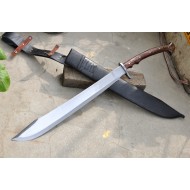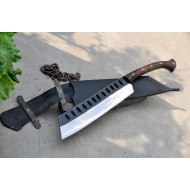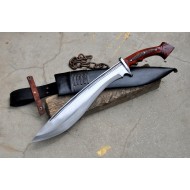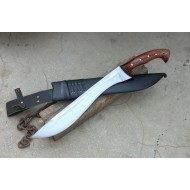
- Model: SINGLE EDGED SWORD
- Product Code: Nimcha24
- Location: Kathmandu, Nepal
Available Options
A Hand-Forged Moroccan Nimcha With a Drooping Quillon
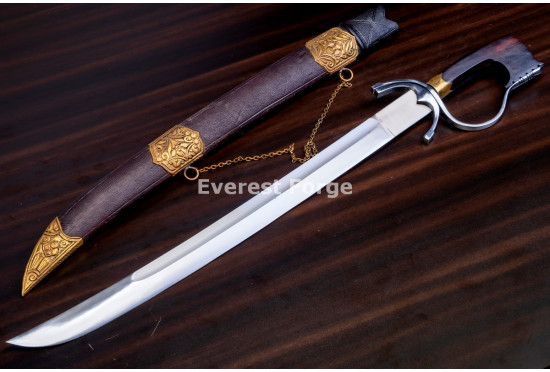
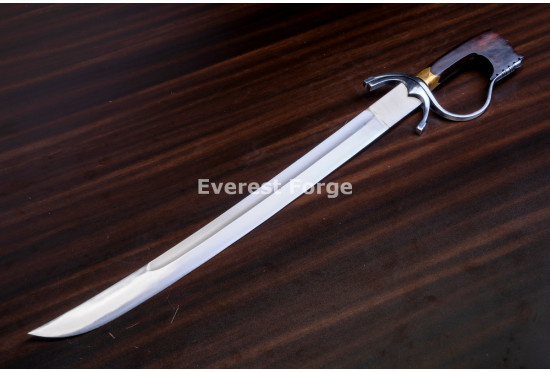
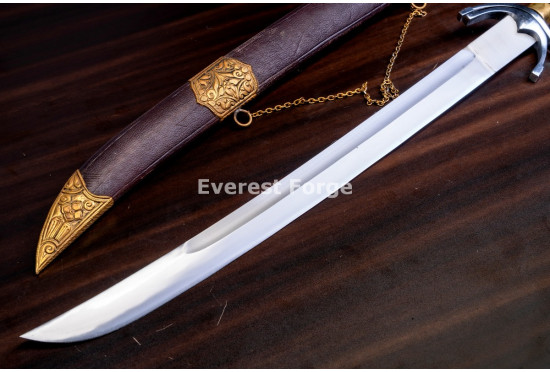
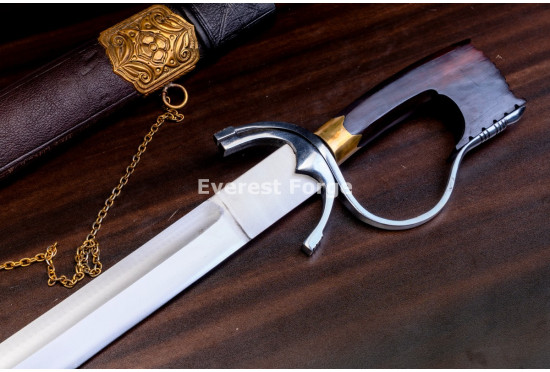
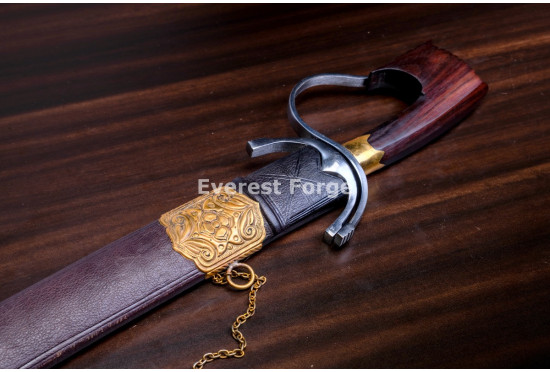
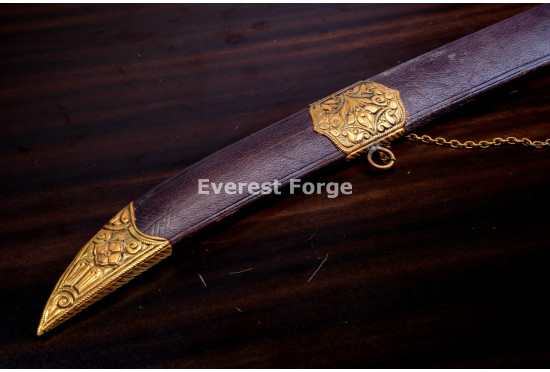
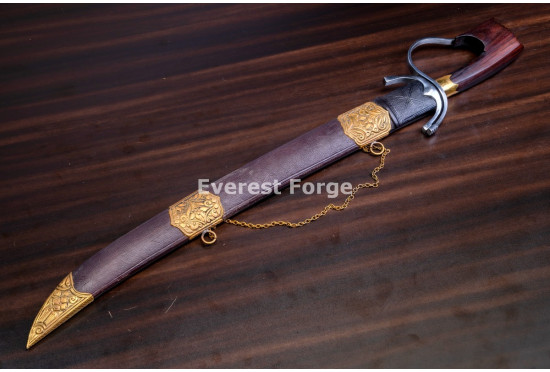
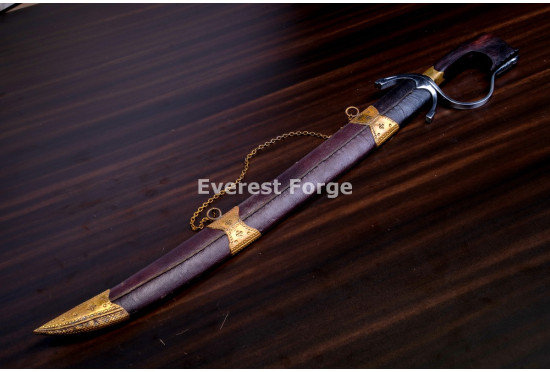
This is a nimcha, the sword of the Maghreb, hand-forged in Tokha-3, Kathmandu, Nepal from 5160 high-carbon steel, oil-quenched and tempered. The blade runs 24.5 inches, single-edged and gently curved, with a narrow fuller following the spine and a long clipped point, satin polished across the flats. The hilt carries the guard that names the type: a quillon drooping forward and down over the blade, a second quillon reaching back, and a knuckle bow sweeping up to meet a shaped rosewood grip. Overall it stands 31.5 inches. It ships sharpened, in a brown leather scabbard dressed with embossed brass-toned mounts at the throat, the middle and the chape, hung on a brass chain.
An honest note. Two things worth stating plainly. This is a working interpretation of the Maghrebi nimcha rather than a copy of a specific museum piece, and the pommel is where it departs most: surviving nimchas usually carry a distinctive down-angled block or hooked terminal at the end of the grip, and this one is simpler. The guard, with its drooping forward quillon and knuckle bow, is the diagnostic part and it is right. Second, the word itself is loose — nimcha is a European collectors' label rather than a Maghrebi one, and the swords were locally called saif, which simply means sword. We use nimcha because that is what people search for, and we would rather tell you where the name comes from than pretend it is native.
Want a Specific Nimcha Pattern?
Our smiths will build to a museum reference — the down-angled pommel block, three drooping quillons, a straight European-style trade blade rather than a curved one, or a particular scabbard mount scheme. Send a photograph or a drawing and we will quote it.
Start a Custom Build →Why This Nimcha Is Built the Way It Is
Full Specifications
How You Can Configure It
Is This the Right Sword for You?
Buy This If You Want
- A North African sword, a region most collections skip entirely
- The drooping quillon guard that makes the type recognisable
- Real forged 5160 with a proper heat treatment
- A fully mounted scabbard with chain suspension, not plain leather
- A curved blade that still has a usable point
- A smith who will build to a museum reference if you supply one
Look Elsewhere If You Want
- A strict museum copy — the pommel is simpler than most surviving pieces
- Certified solid brass mounts; ours are brass-toned
- A heavy chopper; a nimcha is a moderate, handy sidearm
- A straight blade as standard, though we build one to order
- A stainless blade that needs no oiling or care
- Identical units; every piece is forged and mounted by hand and varies
How to Order
Who This Nimcha Suits
- Collectors of North African and Islamic arms, a field far less crowded than European or Japanese collecting.
- Barbary coast and corsair enthusiasts, for whom this is the signature sword of the period.
- Display buyers after a piece where the mounted scabbard is half the object.
- Reenactors and living-history groups covering the Mediterranean and Maghreb.
- Collectors filling geographic gaps who already own European, Ottoman and Persian pieces.
What Is Included
- One hand-forged Moroccan nimcha, sharpened and ready to use
- Brown leather scabbard with embossed brass-toned mounts and chain suspension
- Care and oiling instructions
- Everest Forge manufacturer warranty against defects in forging and heat treatment
Other Hand-Forged Curved Swords
Shipping, Returns and Care
Shipping. Standard builds dispatch in 2 to 3 business days. Custom builds take 4 to 6 weeks. We ship worldwide by DHL or FedEx, 7 to 14 business days, fully tracked. Sword laws vary by country and by state — please check what applies where you live before ordering, as we cannot deliver into a restricted address.
Returns. Standard builds can be returned unused and in the original scabbard within 30 days. Custom builds, altered dimensions and etched pieces are made to your specification and cannot be returned unless there is a fault in forging or heat treatment.
Care. Three materials, three routines. The blade is high-carbon steel: wipe it dry after handling and keep a thin film of oil on it in storage, running a cloth corner along the fuller. The brass-toned mounts need a soft dry cloth only — metal polish strips the finish and packs into embossed work where you cannot lift it out again, and there is a great deal of embossed work on this scabbard. The chain traps dust and will mark leather if it is left lying against it, so lift it clear when the sword is stored flat. The rosewood grip wants a hard wax or furniture oil once or twice a year. Do not store the blade sheathed for long periods.
Frequently Asked Questions
What does the word nimcha actually mean?
Not much, and that is the honest answer. Nimcha is a European collectors' term rather than a Maghrebi one — it derives from a Persian word meaning something like half or small sword, and it was applied from outside to a family of North African swords that their own makers and users simply called saif, the ordinary Arabic word for sword. You will also see the same or closely related hilts described as Algerian, Moroccan, Zanzibari or Arab sabres depending on which collection catalogued them and when. None of this makes the term useless: it is what the market searches for, it points at a recognisable hilt family, and pretending otherwise would help nobody. But it is worth knowing that you are buying a sword whose name was given to it by nineteenth-century European collectors rather than by anyone who carried one.
Why were so many North African swords fitted with European blades?
Because for several centuries it was easier and cheaper to buy a good blade than to make one, and there is no shame in that — it was how a great deal of the world armed itself. Blade smithing at scale requires consistent steel, large-scale fuel supply and specialised furnaces, and a handful of European centres, above all Solingen in Germany and the workshops of northern Italy, had all three and exported aggressively. Blades travelled the Mediterranean and the Saharan trade routes in bulk, and local makers — in Morocco, Algeria, the Sudan, Arabia and beyond — hilted and mounted them to their own patterns. The result is that a great many surviving nimchas carry a straight or curved European trade blade, sometimes with the original maker's marks still on it, in a hilt made thousands of miles away. This tells you something important about how to read these swords: the HILT carries the cultural identity and the BLADE often does not. It is exactly why the drooping quillon and the knuckle bow are what make this a nimcha rather than the shape of the blade. We build ours entirely in-house, blade and hilt both, but we offer a straight European-pattern blade as an option precisely because that is the more historically common arrangement.
How close is this to a museum piece?
Right on the guard, simpler on the pommel. The drooping forward quillon, the rear quillon and the knuckle bow are the diagnostic parts of the hilt and they are all present and correctly arranged. Where surviving nimchas usually differ is at the other end of the grip: most carry a distinctive down-angled block or hooked terminal, sometimes quite pronounced, and this piece finishes more plainly. Many originals also carry three drooping quillons rather than two. Both of those are available on a custom build if you want to move closer to a specific example — send us a museum photograph and our smiths will work to it.
What steel is it and how is it heat treated?
5160 high-carbon spring steel, oil-quenched and then tempered back. 5160 holds a working edge and flexes under load rather than snapping, which suits a moderate single-edged sword meant to be carried and used rather than displayed alone. It is also the steel family Nepali smiths have traditionally drawn from vehicle leaf spring, so our forge reads it by colour and by sound at the anvil rather than by instrument alone.
Does it arrive sharp?
Yes. It ships with a working edge, sharpened by hand and ready out of the scabbard. It is not a blunt wall-hanger with a sword-shaped profile ground into it. If it is going into a display case, a costume or a reenactment group whose rules require blunt kit, ask for it blunted in the order note before we ship and we will finish it that way at no extra cost.
Is the tang full length?
Yes. The tang runs the full length of the hilt with the guard, ferrule and grip fitted to it, so the assembly is held by steel rather than by adhesive. On this hilt it matters for a specific reason: the knuckle bow is anchored at both ends, so any load that lands on it is transmitted through the tang rather than absorbed locally, and a short or partial tang would show that as movement at the guard long before anything else went wrong.
Are the mounts solid brass?
They are brass-toned rather than certified solid brass, and we would rather be exact than let the photographs imply otherwise. The throat, the middle band, the chape and the ferrule are cast and embossed to a brass appearance. In practice this affects one thing above all: cleaning. Use a soft dry cloth and keep metal polish away entirely, because polish packs into embossed relief and dries to a white residue in every hollow, and there is a great deal of relief on this scabbard. If solid brass matters to you, ask us before ordering and we will tell you what the custom forge can do.
What is the chain for?
Suspension. The chain runs between rings on the scabbard mounts and carries the sword from a belt or a shoulder rig, and on Maghrebi and wider Islamic scabbards it is a common alternative to leather straps. It has a practical advantage in a hot dry climate: leather straps dry, crack and eventually fail where a chain does not, and a chain also lets the scabbard swing and settle rather than being held rigid. It is also, plainly, decorative — a mounted scabbard on a chain reads as a sword belonging to someone of standing. If you would rather have a leather belt frog, we fit one instead on request.
Can I have it made longer or shorter?
Yes. Blade length is selectable, and beyond the listed options our smiths will forge to a dimension you specify. Surviving nimchas vary considerably, from short sidearms up to longer cavalry blades, so there is no single correct length to work toward. The curve is redrawn rather than stretched when the length changes, because a curve scaled without redrawing puts the balance in the wrong place and the sword feels dead in the hand.
Is the scabbard included?
Yes. The brown leather scabbard with embossed brass-toned mounts at the throat, middle and chape, on its chain, comes with the sword and is cut around this specific blade profile. A curved blade only fits a scabbard made to its own curve, so this is not a generic sleeve. Plain leather, different mounts or a belt frog instead of the chain can all be specified, and if you change the blade dimensions on a custom build the scabbard is made to match.
Will every sword look exactly like the photograph?
No, and on this piece the mounts are where you will see it. Every blade is drawn out under a hammer, so the curve and the width at the point of the clip differ slightly. The scabbard mounts are cast and then chased by hand, so the crispness of the embossed pattern varies from piece to piece. Rosewood is a natural timber, so grain and colour differ on every grip, and leather takes dye differently on every hide. Weights and dimensions vary by a few percent. What is consistent is the steel, the heat treatment, the construction and the edge.
Where is it made and by whom?
Hand-forged in Tokha-3, Kathmandu, Nepal, by our own smiths. Everest Forge is a working forge rather than a reseller putting a name on imported blanks — the steel is cut, drawn, quenched, tempered and ground, the guard shaped and fitted, the grip turned, the mounts cast and chased, and the scabbard cut and stitched, all under one roof. The mounts are worth a note: Nepal has a long tradition of embossed and chased metalwork, which is why the scabbard fittings on this sword are made in the same workshop as the blade rather than bought in.
| Specification | |
| Blade: | 24.5 inches. Hand forged from 5160 carbon steel |
| Total Length: | 31.5 inches |
| Handle: | 7 inches total with a 4 inch grip, full tang, drooping forward quillon, rear quillon and knuckle bow, shaped rosewood grip |
| Weight: | 1450 grams approx, as shipped with the scabbard |
| Note: | handmade variation in weight, dimensions and finish may occur; keep blade lightly oiled when not in use |