- Model: Signature Kukri/Khukuri
- Product Code: DGuardKUKRI0014
- Location: Kathmandu, Nepal
Available Options
Hand-Forged D-Guard Kukri Knife — Sawback Spine and Knuckle Bow
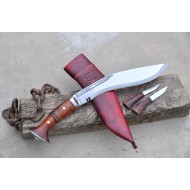
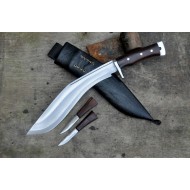
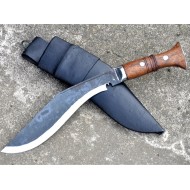
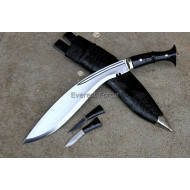
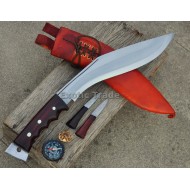
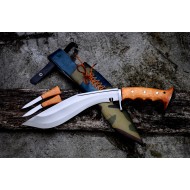
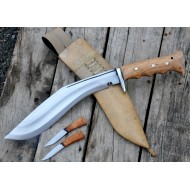
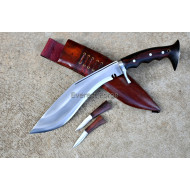
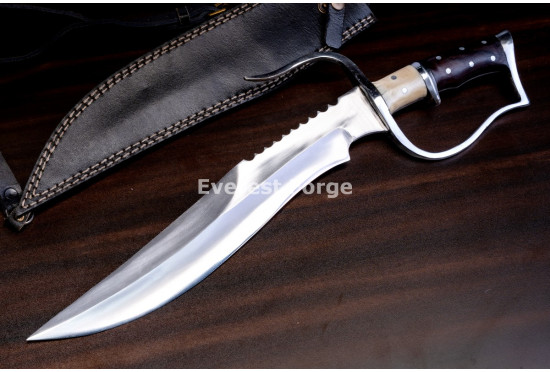
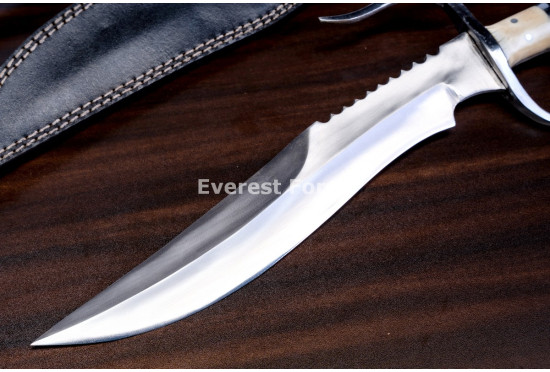
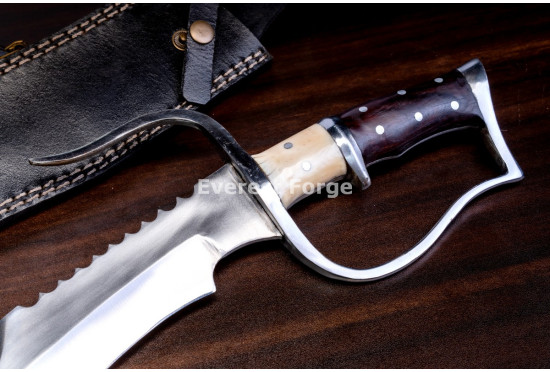
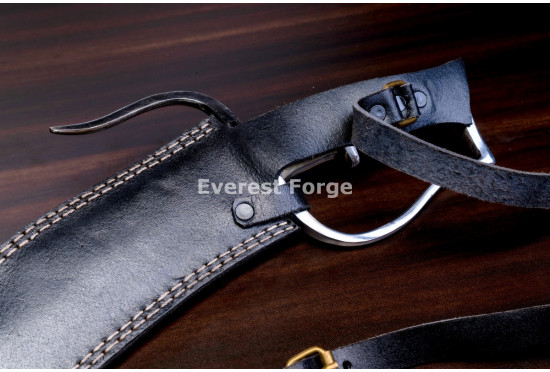
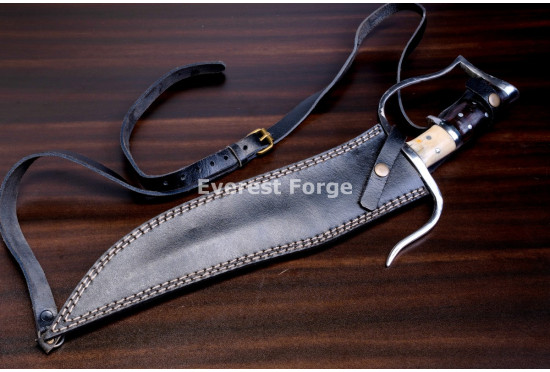
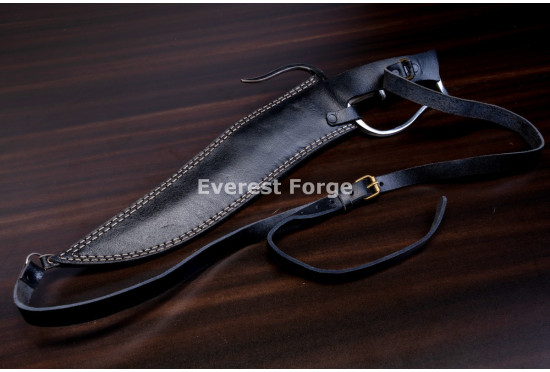
This is a hand-forged, fully functional modern kukri — the forward-curved Nepali blade fitted with a full D-guard knuckle bow, forged at our workshop in Kathmandu from 5160 high-carbon spring steel, oil-tempered, full tang, and sharpened to a true edge. The blade carries the traditional cho notch at its root, a sawback section along the spine, and a sharpened false edge running back from the point. The handle is jointed bone and rosewood, pinned through the tang, wrapped by a polished steel guard that sweeps from the bolster all the way to the butt. It ships with a black leather sheath with contrast stitching.
This is the most protective kukri we build and the furthest from a village pattern. The D-guard means your hand is enclosed rather than exposed, which changes both what the knife can do and how it has to be held. Everything forward of the guard is a genuine kukri; everything around it is Western.
An honest note. This is a modern hybrid and we would rather label it clearly than let it pass as Nepali. The blade is genuine — forward-curved, deep-bellied, with a proper cho at the root and forged from leaf-spring steel by Nepali smiths. The D-guard is not: a knuckle bow is European and American furniture, best known from Confederate D-guard bowies of the American Civil War, and no traditional kukri has ever carried one. The sawback spine is a modern addition too. If you are collecting Gurkha or traditional Nepali blades this is the wrong knife and we will happily point you at the right one — our Bhojpure, Chainpure and Ang Khola patterns are the traditional builds.
Bespoke Service
Forge a Kukri to Your Own Design
Want a traditional bolster instead of the D-guard, a plain spine without the saw, or a different handle material? Our Custom Forge service builds to your spec, by hand in Kathmandu.
Request a Custom Forge →What Makes This Kukri Different
Three features, none of them Nepali. The D-guard is a full knuckle bow running from the bolster to the butt cap, enclosing the hand completely — the single most protective arrangement you can put on a knife, and something no traditional kukri has. The sawback is a toothed section cut along the spine near the bolster. And the back of the blade is sharpened as a false edge running some way down from the point, so the knife cuts on the return stroke as well as the forward one. Underneath all of that the blade is a real kukri: the forward bend that puts mass where the cut lands, the wide belly, and the cho notch at the root that separates a genuine kukri from a recurved chopper wearing the name.
Specifications
Customize Your Kukri
Every kukri is forged to order. Set your options before you add to cart:
Hand-Forged, Not a Souvenir Kukri
This Kukri
- Hand-forged 5160 high-carbon spring steel
- Oil-tempered, hard edge and flexible spine
- Full tang with the grip pinned through it
- Cho cut properly, guard formed and fitted by hand
- Sharpened, balanced, forged in Nepal by Nepali smiths
A Souvenir Kukri
- Unhardened mild steel or stainless
- No real heat treatment, edge rolls on first use
- Stick tang glued into a hollow handle
- Guard cast in pot metal or spot-welded on
- Blunt, made for a shelf
How It Is Made
Who It Is For
- Buyers who want maximum hand protection on a large chopping blade
- Collectors of modern and tactical interpretations rather than traditional patterns
- Anyone drawn to the D-guard bowie lineage who wants it on a kukri blade
- Display and collection buyers — this is the most striking kukri we make
- Gift buyers personalizing a blade with a name or engraving
- Not for traditional Nepali collecting — see our Bhojpure, Chainpure and Ang Khola instead
What Is Included
- One hand-forged D-guard kukri, built to your chosen spec
- Black leather sheath with contrast stitching
- Jointed bone and rosewood handle pinned through the tang, with polished steel D-guard
- Any personalization or engraving you ordered
- A sharpened blade with a traditional cho, sawback spine and false edge
- Everest Forge manufacturer warranty
Explore More Hand-Forged Blades
Shipping, Returns & Care
Shipping
In-stock specs dispatch within 2 to 3 business days; fully custom builds take roughly 4 to 6 weeks to forge before dispatch. We ship worldwide by DHL or FedEx in 7 to 14 business days, tracked. Import and blade laws vary by country, and a sharpened back edge counts as a double-edged blade in some jurisdictions, so please check your local rules before ordering.
Returns & Warranty
Every blade is backed by the Everest Forge warranty against forging and material defects. If something is wrong with your order, we will repair, replace, or refund it. Personalized and custom-engraved blades are made to order, so please confirm your spec carefully before purchase.
Care
Wipe the blade clean and dry after use and keep a light film of oil on it — 5160 is carbon steel and sap from green wood is acidic enough to mark it overnight. The sawback teeth need particular attention, because they trap debris and moisture in every gap and a cloth will skate straight over them; use a brush. Give the bone and rosewood a wipe with oil every few months and keep it away from radiators and direct sun. Do not store the kukri inside its sheath for long periods.
From The Forge
Build a Kukri That Is Yours Alone
Beyond the options here, our Custom Forge service will build this blade with a traditional bolster instead of the D-guard, a plain spine, a service size, or the full karda and chakmak set. Roughly 4 to 6 weeks from order.
Start a Custom Forge →Frequently Asked Questions
What is a D-guard, and where does it come from?
A D-guard is a knuckle bow — a bar of steel sweeping from the front of the handle all the way back to the butt, forming a D-shaped loop that encloses the hand. It is European in origin, appearing on hangers, cutlasses and naval swords from the seventeenth century onward, and its most famous outing on a knife was the Confederate D-guard bowie of the American Civil War, where Southern blacksmiths turned out enormous fighting knives with heavy brass or iron bows because a guard was cheap protection and easy to forge. It offers considerably more than a crossguard does: a cross stops your hand sliding onto the edge, but a D-guard also protects the back and sides of the hand from anything coming at it. Nothing about it is Nepali. Putting one on a kukri is a modern idea and this knife is a deliberate hybrid.
Does the D-guard change how the kukri is used?
Yes, and it is the trade-off you are actually making. What you gain is protection — your hand is enclosed, so a slip, a glancing blow or a branch snapping back cannot reach it. What you lose is grip flexibility, and on a kukri that costs more than it would on a straight knife. You cannot choke up and slide your hand forward onto the bolster for carving or fine work, because the bow is in the way. You cannot reverse the grip. You cannot easily change hands with gloves on. And the bow adds weight behind the hand, which pulls the balance back from where a kukri normally sits. For a chopper used two-handed or a display piece none of that matters much. For someone who wants a kukri as a versatile camp tool, our bushcraft pattern will serve better. Buy this one for the protection and the look, knowing what it costs.
What is the sawback spine for?
The honest answer is that sawbacks look more useful than they are, and we would rather say so than sell you on it. The idea is to give you a saw without carrying one, and on soft green wood, cord, plastic and bone the teeth do work. What they will not do is saw seasoned timber to any depth, because the teeth are shallow, they are not set — bent alternately left and right the way real saw teeth are, which is what stops a saw binding — and there is no way to apply proper pressure with a blade that is also a chopper. Sawbacks appear on a great many modern survival and military knives for exactly this reason: they are genuinely handy for light work and genuinely disappointing if you expect a saw. They also trap dirt and are a nuisance to clean and sharpen. If you would rather have a plain spine, that is a no-cost custom option and it makes the knife easier to live with.
Is the back edge sharpened, and what does that change?
Yes — the back is ground as a sharpened false edge running down from the point, so the knife cuts on the return stroke as well as the forward one. On a forward-curved blade that is a real capability, because the natural recovery movement after a chop already sweeps the spine back through the same space. What it costs you is the ability to use the spine safely: you cannot baton the blade through wood by striking the back, you cannot rest a thumb on it for control, and you cannot press down on it with your off hand. It also makes the knife legally a double-edged blade in several countries, which matters more than most people expect for import — some jurisdictions restrict double-edged blades regardless of length. We will leave the back unsharpened on request at no extra cost, and if you are ordering into a restrictive country that is the version to choose.
Is this a traditional kukri?
No, and it is worth being direct about it. The blade is genuine: forward-curved with a wide belly, a proper cho notch cut at the root, forged from leaf-spring steel by Nepali smiths in Kathmandu. The bone and rosewood jointed handle follows real Nepali practice too. But the D-guard is European furniture with no place in Nepali blade-making, the sawback is a modern addition, and a sharpened false edge is not something a village kukri carries. This is a kukri blade dressed in Western fittings. If you want the real article we build three traditional patterns — the Bhojpure for chopping weight, the Chainpure for finish, the Ang Khola for toughness — and any of them will serve a traditional collection better than this one.
How does this differ from your other kukris?
It is the most protected and the least traditional of the range. The D-guard is unique to it — no other kukri we make has any guard at all beyond a bolster, let alone a full knuckle bow — and so are the sawback and the sharpened back edge. Our Bhojpure, Chainpure and Ang Khola are the traditional patterns, each with a bolster and a plain spine. Our bushcraft kukri is the practical modern one with a contoured grip and a belt sheath. Our battle kukri is the heaviest, with sculpted fittings. Our fullered fantasy kukri has a two-hand grip and a swept guard, which is the closest thing to this in spirit but still nowhere near as enclosed. Buy this one for the guard.
Is this a real, functional kukri?
Yes. It is hand-forged from 5160 high-carbon spring steel, oil-tempered, sharpened, and built on a full tang with the handle pinned through it. The D-guard is formed steel fitted to the bolster and butt, not a cast piece stuck on. It will chop green wood and clear brush like any kukri, with the grip limitations described above. Do not use it on stone, metal, nails hidden in old timber, or seasoned hardwood knots, and do not baton it — the sharpened back edge makes that unsafe.
What steel is it, and is it oil-tempered?
The blade is forged from 5160 high-carbon spring steel, the same alloy used in heavy-duty truck leaf springs, prized for toughness and edge retention. It is oil-tempered for a hard cutting edge backed by a flexible, shock-absorbent spine. Nepali smiths have forged kukris from vehicle leaf spring for generations, long before anyone in Nepal was quoting an alloy number — it became the traditional material because it was available and because a chopping blade needs to absorb shock without chipping far more than it needs extreme hardness.
Is it full tang, and how is the handle built?
Full tang, with jointed sections of bone and rosewood fitted over it and pinned straight through from both sides, so the handle is mechanically fastened to the steel rather than held by adhesive. The D-guard anchors at the bolster and again at the butt cap, which means it also acts as a structural member tying the two ends of the handle together — an incidental benefit of the design. Because bone and rosewood are natural materials, colour and grain vary between pieces and no two handles are identical.
What is the scabbard like?
A black leather sheath with contrast stitching, cut and stitched by hand to fit the blade you order. It is a modern sheath rather than a traditional dap — there is no wooden core and no companion pockets, because this kukri ships without a karda and chakmak. Note that a D-guard makes any sheath bulkier than it would otherwise be, since the guard has to clear the mouth. As with any leather, store the kukri outside the sheath for the long term: leather is tanned with acids and holds damp against carbon steel.
Does it arrive sharpened, and what can I change?
Yes, sharpened to a working edge along the belly and on the false edge, finished by hand; the area near the cho is traditionally left unsharpened, which is normal. Choose the display-blunt option if you need it unsharpened for display or import rules, at no extra charge. As for changes — the three features that define this knife are all optional. A traditional bolster instead of the D-guard, a plain spine instead of the sawback, and an unsharpened back edge are each available at no extra cost, and ordering all three gives you a straightforward modern working kukri. Size, handle material and companion blades are adjustable too.
Do you ship worldwide, and how long does it take?
Yes. We ship worldwide from Nepal by DHL or FedEx in 7 to 14 business days with tracking. In-stock specs dispatch within 2 to 3 business days; fully custom builds take roughly 4 to 6 weeks to forge first. Import and blade laws vary by country, and the sharpened back edge makes this a double-edged blade in several jurisdictions, which is restricted more tightly than a single edge — order the unsharpened-back version if that applies where you live.
| Specification | |
| Blade: | Hand forged from 5160 carbon steel, forward-curved with cho notch, sawback spine and sharpened false edge |
| Handle: | Full tang with jointed bone and rosewood pinned through it, full D-guard knuckle bow from bolster to butt |
| Note: | As every piece is forged by hand, slight variation in weight, dimensions and finish may occur. Bone and rosewood are natural materials, so colour and grain differ in every handle. Guard, spine and back edge are all selectable options. Keep the blade lightly oiled when not in use. |