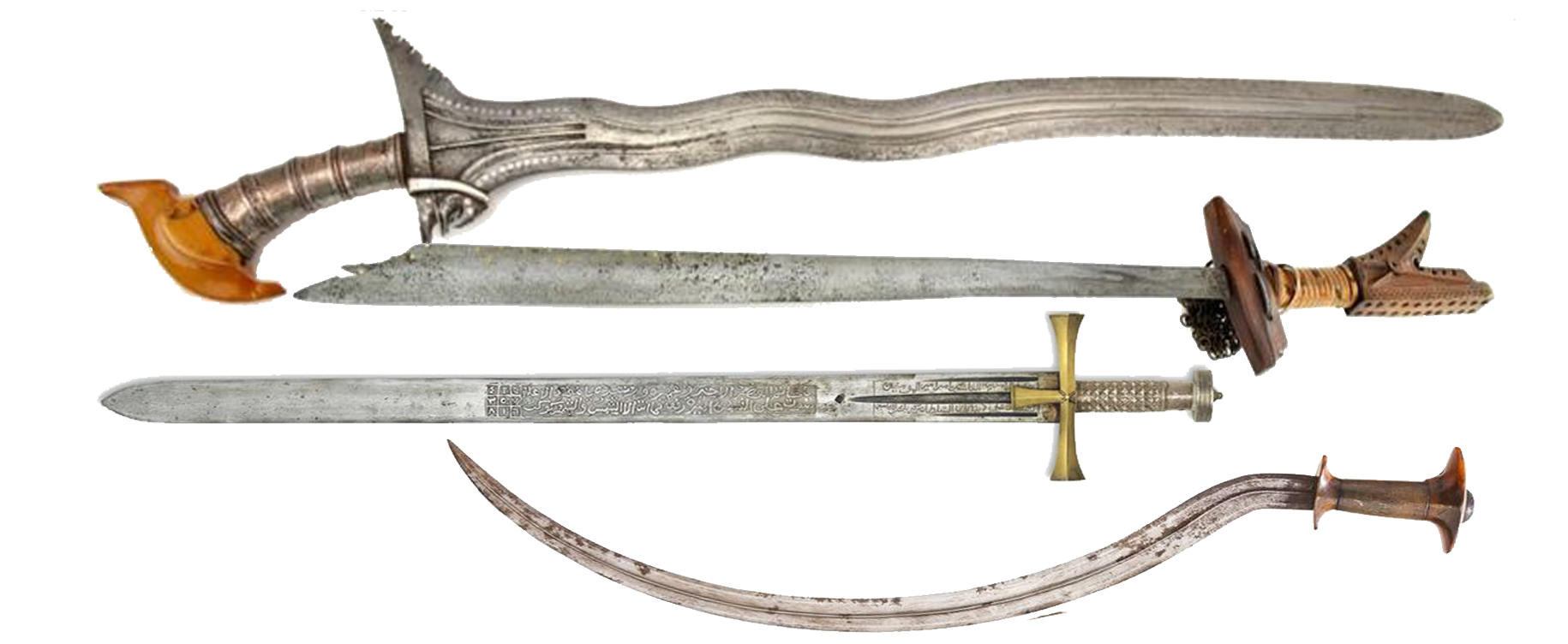
57 types of swords, from the first bronze blades to the katana and the kukri/khukuri
The sword is the one weapon nearly every culture made its own. This guide follows it from the copper blades of 3300 BC to the swords still carried and forged today, grouped by region with dates, countries and blade shapes for every type. Filter by culture, country, era or blade shape, or tap the timeline to jump to a sword.
Every entry links to the matching sword at Everest Forge where we make one. 45 of the 57 types are in our range, and the rest can be forged to order in Nepal.
Swords through time
Arslantepe Sword · c. 3300-3000 BC Khopesh · c. 2000-1100 BC Bronze Age Leaf Sword · c. 1300-600 BC Hallstatt Leaf Sword · c. 800-450 BC Xiphos · c. 800-300 BC Jian · c. 600 BC-today Kopis · c. 500-100 BC Falcata · c. 500-50 BC La Tène Sword · c. 450-50 BC Gladius · c. 200 BC-AD 250 Dao · c. 100 BC-today Spatha · c. AD 1-600 Seax · c. 400-1100 Zulfiqar · Legend from the 7th century Viking Sword · c. 750-1050 Tachi · c. 900-1600 Arming Sword · c. 1050-1500 Falchion · c. 1200-1550 Longsword · c. 1250-1600 Baselard · c. 1300-1500 Kilij · c. 1300-1900 Khanda · c. 1300-1850 (older roots) Nodachi · c. 1300-1600 Kris · c. 1300s-today Messer · c. 1350-1550 Claymore · c. 1400-1700 Katana · c. 1400-today Cinquedea · c. 1460-1550 Zweihänder & Flamberge · c. 1500-1650 Side Sword · c. 1500-1650 Shamshir · c. 1500-1900 Scimitar · c. 1500-1900 Talwar · c. 1500-1900 Wakizashi · c. 1500-1876 Kampilan · c. 1500-1900 Takoba · Centuries old-today Kaskara · c. 1500-1920 Rapier · c. 1550-1700 Sabre · c. 1600-1918 (ceremonial today) Firangi · c. 1600-1800 Kukri/Khukuri · 1600s-today Shotel · c. 1600-1900 Cutlass · c. 1650-1940 Kora · Since at least 1674 Shashka · c. 1700-today (ceremonial) Kindjal · c. 1700-1920 (older roots) Khyber Knife · c. 1700-1900 Ram Dao · Traditional, 18th century and earlier Parang & Golok · Traditional-today Flyssa · c. 1700-1900 Nimcha · c. 1700-1900 Butterfly Sword · c. 1800-today Barong · c. 1800-1950 Seme · c. 1800-today Konda · c. 1800-1950 Ngulu · c. 1800-1950 Zande & Boa Sword · c. 1800-1950
3000 BC 2000 BC 1000 BC AD 1 500 1000 1500 1800 Today
Ancient & Classical European & Medieval Middle Eastern, Indian & Himalayan Chinese & Japanese Southeast Asian & African
Each mark shows when a sword type first appears. The scale widens after AD 500 so the crowded later centuries stay readable.
Dawn of the Sword - Ancient & Classical Swords The sword began as a dagger that kept growing. Copper, then bronze, then iron let smiths make longer, stronger blades, and each civilisation shaped them for the way it fought: the Egyptian sickle-sword, the Greek hoplite's leaf blade, the Iberian falcata and the Roman legionary's gladius.
10 sword types · Explore ancient and classical swords
Arslantepe Sword
Earliest known swords · c. 3300-3000 BC
The oldest swords yet found: arsenical-copper blades from the palace at Arslantepe in eastern Turkey.
Country Turkey
Culture Early Anatolian (Uruk period)
Blade Straight, double-edged, one-handed. Blade c. 45-60 cm Found with spearheads in a palace complex, some inlaid with silver. They mark the moment the dagger grew into a true sword.
Related at Everest Forge: Bronze Age swords
Khopesh
Sickle-sword · c. 2000-1100 BC
The sickle-shaped bronze sword of New Kingdom Egypt, carried by pharaohs and elite troops. Tutankhamun was buried with two.
Country Egypt
Culture Ancient Egyptian & Canaanite
Blade Sickle / recurved, single-edged, one-handed. Blade c. 50-60 cm Developed from earlier Mesopotamian sickle-swords. The cutting edge is on the outer curve; the hooked end could pull a shield aside.
Also at Everest Forge: Egyptian Khopesh Sword , Khopesh, Deep Recurve
Bronze Age Leaf Sword
Naue II type · c. 1300-600 BC
The cut-and-thrust bronze leaf blade that spread from Central Europe to Greece and Egypt at the end of the Bronze Age.
Country Germany, Austria, Greece
Culture Late Bronze Age Europe
Blade Leaf-shaped, double-edged, one-handed. Blade c. 60-80 cm Its flanged hilt was cast in one piece with the blade, making it far stronger than earlier riveted swords.
Also at Everest Forge: Bronze Age Sword Replica , Bronze Age Leaf Blade Sword
Hallstatt Leaf Sword
Celtic leaf sword · c. 800-450 BC
Long bronze and early iron leaf blades of the first Celtic culture, named after the Hallstatt salt-mine cemetery in Austria.
Country Austria, Germany, France
Culture Celtic (Hallstatt culture)
Blade Leaf-shaped, double-edged, one-handed. Blade c. 60-85 cm Often fitted with a winged chape and a hat-shaped pommel; the bridge between Bronze Age and Iron Age swords.
Also at Everest Forge: Historical Celtic Leaf Sword , Celtic Leaf Sword, 20 in
Xiphos
Greek hoplite sword · c. 800-300 BC
The hoplite's leaf-bladed sidearm, drawn when the spear broke in the press of the phalanx.
Country Greece
Culture Ancient Greek
Blade Leaf-shaped, double-edged, one-handed. Blade c. 45-60 cm Worn on a baldric under the left arm. Spartan versions were famously short for close fighting.
Also at Everest Forge: Museum Reproduction Xiphos , Spartan Hoplite Short Xiphos
Kopis
Machaira · c. 500-100 BC
A forward-curved chopping sword. Xenophon advised cavalrymen to carry the machaira rather than the straight xiphos.
Country Greece
Culture Ancient Greek & Macedonian
Blade Forward-curved, single-edged, one-handed. Blade c. 48-65 cm Its weight sits near the tip, the same principle as the falcata and the Nepalese kukri/khukuri.
Also at Everest Forge: Simple Kopis Sword , Large Greek Kopis
Falcata
Iberian sword · c. 500-50 BC
The forward-curved sword of the Iberians, often with a bird- or horse-head hilt. Roman writers praised the quality of Iberian steel.
Country Spain, Portugal
Culture Iberian
Blade Forward-curved, single-edged, one-handed. Blade c. 35-55 cm Forged from several layers of steel, single-edged with a sharpened back near the point for thrusting.
Also at Everest Forge: Falcata, Horse-Head Pommel , Falcata, 24 in
La Tène Sword
Celtic Iron Age sword · c. 450-50 BC
The iron sword of the Gauls and Celts, named after the lake-shore site in Switzerland. Blades grew longer over time for slashing.
Country France, Switzerland, Germany
Culture Celtic (La Tène culture)
Blade Straight, double-edged, one-handed. Blade c. 60-90 cm Scabbards were often decorated with dragon-pair and lyre designs.
Also at Everest Forge: La Tène Sword , Celtic Tène Sword
Gladius
Roman short sword · c. 200 BC-AD 250
The short stabbing sword of the Roman legions, adopted from Iberia in the 3rd century BC. The Mainz, Fulham and Pompeii types followed.
Country Italy
Culture Roman
Blade Straight, double-edged, one-handed. Blade c. 45-68 cm Built for close-order fighting behind the large scutum shield, thrusting rather than slashing.
Also at Everest Forge: Mainz-Type Gladius , Pompeii Gladius , Republican Delos Gladius
Spatha
Roman long sword · c. AD 1-600
The longer Roman cavalry sword that replaced the gladius by the 3rd century and became the ancestor of the Migration-era and Viking swords.
Country Italy, Germany
Culture Roman & Germanic
Blade Straight, double-edged, one-handed. Blade c. 65-80 cm Carried by auxiliary cavalry first, then by the infantry of the late empire.
Related at Everest Forge: Viking & Medieval swords
Age of Chivalry - European & Medieval Swords From the pattern-welded Viking sword to the knight's arming sword, the two-handed longsword, the Highland claymore and the Renaissance rapier, European swords changed with armour, law and fashion. Single-edged messers, falchions, cutlasses and sabres served the common soldier, the sailor and the cavalryman.
16 sword types · Explore medieval and European swords
Seax
Scramaseax · c. 400-1100
The single-edged knife-sword of the Saxons, Franks and Vikings; long seaxes of the 9th-10th century were true swords.
Country England, Germany, Denmark
Culture Anglo-Saxon & Germanic
Blade Straight, single-edged, one-handed. Blade c. 8-75 cm The broken-back blade, with an angled spine near the tip, is the classic late Anglo-Saxon form.
Also at Everest Forge: Anglo-Saxon Long Seax , Long Seax, Broken-Back
Viking Sword
Norse sword · c. 750-1050
The prized sword of the Viking Age, often pattern-welded or inscribed. Some of the best carry the Ulfberht name.
Country Norway, Sweden, Denmark
Culture Norse
Blade Straight, double-edged, one-handed. Blade c. 70-80 cm A wide fuller lightened the blade; lobed pommels and short guards are typical of Petersen's types.
Also at Everest Forge: 9th-Century Viking Sword , Norseman Pommel Viking Sword , Transitional Viking Sword
Arming Sword
Knightly sword · c. 1050-1500
The single-handed cross-hilted sword of the knight and crusader, used with a shield.
Country France, England, Germany
Culture Medieval European knighthood
Blade Straight, double-edged, one-handed. Blade c. 70-80 cm Classified by Ewart Oakeshott into types X to XIV, from broad cutting blades to stiffer, more pointed ones.
Also at Everest Forge: Oakeshott Type XII Sword , Arming Sword, Trumpet Quillons
Falchion
Medieval cleaver-sword · c. 1200-1550
A broad, single-edged chopping sword, from the cleaver-like Conyers falchion to slimmer, clipped-point forms.
Country England, France, Germany
Culture Medieval European
Blade Curved (sabre), single-edged, one-handed. Blade c. 70-80 cm Cheaper to make than a knightly sword and a favourite of infantry.
Also at Everest Forge: Falchion Sword , Single edge swords
Longsword
Hand-and-a-half / bastard sword · c. 1250-1600
The two-handed knightly sword taught in the fight books of Johannes Liechtenauer and Fiore dei Liberi.
Country Germany, Italy, England
Culture Late medieval European
Blade Straight, double-edged, two-handed. Blade c. 85-110 cm A long grip for two hands, used against plate armour with half-swording thrusts as well as cuts.
Also at Everest Forge: Double Fuller Medieval Longsword , Bastard Sword
Baselard
Basel dagger · c. 1300-1500
A short sword or long dagger with an I-shaped hilt, named after the city of Basel and worn by soldiers and townsmen.
Country Switzerland, Germany
Culture Late medieval European
Blade Straight, double-edged, one-handed. Blade c. 30-60 cm Hans Holbein's Dance of Death drawings show it as a civilian status weapon.
Messer
Langes / Grosses Messer · c. 1350-1550
The 'knife' sword of German commoners: a single-edged blade with a knife-style hilt and a nagel spike to guard the hand.
Country Germany, Austria, Czech Republic
Culture German-speaking lands
Blade Straight, single-edged, one-handed. Blade c. 70-90 cm It let townsmen carry a sword where only knives were allowed. The two-handed Grosses Messer was a war weapon.
Also at Everest Forge: Grosses Messer, Shell Nagel , Long Messer, Fullered
Claymore
Claidheamh mòr · c. 1400-1700
The great two-handed sword of the Highlands, with forward-sloping quillons ending in quatrefoils.
Country Scotland
Culture Scottish Highland
Blade Straight, double-edged, two-handed. Blade c. 100-110 cm In the 18th century the name also passed to the basket-hilted broadsword.
Cinquedea
'Five fingers' · c. 1460-1550
A civilian short sword named for its blade, five fingers wide at the hilt, often etched and gilded.
Country Italy
Culture Italian Renaissance
Blade Straight, double-edged, one-handed. Blade c. 35-55 cm Worn horizontally at the back of the belt by Italian gentlemen.
Zweihänder & Flamberge
Doppelhänder · c. 1500-1650
The huge two-handed sword of the Landsknechts, used to break pike blocks; wavy flamberge blades were a showpiece variant.
Country Germany, Switzerland
Culture Landsknecht & Swiss
Blade Straight, double-edged, two-handed. Blade c. 120-140 cm A leather-wrapped ricasso and parrying hooks let the soldier choke up on the blade.
Also at Everest Forge: Flamberge, Downturned Cross
Side Sword
Spada da lato · c. 1500-1650
The Renaissance cut-and-thrust sword with a complex hilt of rings and bars, worn at the side with civilian dress.
Country Italy, Spain
Culture Renaissance European
Blade Straight, double-edged, one-handed. Blade c. 80-95 cm The link between the medieval arming sword and the rapier.
Rapier
Degen / espada ropera · c. 1550-1700
The long, slender thrusting sword of the duellist, often used with a parrying dagger in the off hand.
Country Spain, Italy, France
Culture Renaissance & Baroque European
Blade Straight, double-edged, one-handed. Blade c. 90-110 cm Swept and cup hilts protected the hand in fencing systems such as Spanish Destreza.
Also at Everest Forge: German Degen Sword , Parrying Dagger, Main Gauche
Sabre
Saber / cavalry sword · c. 1600-1918 (ceremonial today)
The curved cavalry sword that spread west from the Hungarian hussars, up to famous patterns such as the British 1796 light cavalry sabre.
Country Hungary, Poland, United Kingdom, France
Culture European cavalry
Blade Curved (sabre), single-edged, one-handed. Blade c. 80-90 cm Still carried by officers on parade; sport sabre fencing descends from it.
Also at Everest Forge: Hungarian Saber , Swiss Sabre, Side Ring Guard
Cutlass
Naval hanger · c. 1650-1940
The short, heavy sailor's sabre, used for boarding actions and cutting rope; the pirate's sword of popular legend.
Country United Kingdom, France, Netherlands
Culture European naval
Blade Curved (sabre), single-edged, one-handed. Blade c. 60-75 cm Navies kept it in service into the 20th century.
Also at Everest Forge: Pirate Cutlass Machete , Bushwhacker Cutlass
Shashka
Cossack sword · c. 1700-today (ceremonial)
The guardless, slightly curved sword of the Caucasus, adopted by Cossacks and the Russian army (pattern 1881).
Country Russia, Georgia
Culture Circassian & Cossack
Blade Curved (sabre), single-edged, one-handed. Blade c. 75-85 cm Worn edge-up in its scabbard for a fast draw-and-cut.
Kindjal
Qama · c. 1700-1920 (older roots)
The straight double-edged short sword of the Caucasus, worn with the shashka by Circassian and Cossack horsemen.
Country Russia, Georgia, Azerbaijan
Culture Caucasus
Blade Straight, double-edged, one-handed. Blade c. 30-50 cm Blades often have offset fullers on each face.
Curves of the Crescent - Middle Eastern, Indian & Himalayan Swords Curved blades rule this region. The Turkic kilij and Persian shamshir shaped the sabre, the Indian talwar and khanda carried Rajput and Mughal pride, and in the Himalaya the forward-curved kukri/khukuri and kora became the national blades of Nepal.
11 sword types · Explore Middle Eastern and Indian swords
Zulfiqar
Dhu al-Fiqar · Legend from the 7th century
The legendary sword of Ali ibn Abi Talib, shown in later art with a split, forked tip.
Country Saudi Arabia, Iran, Turkey
Culture Islamic tradition
Blade Curved (sabre), double-edged, one-handed. Blade c. 70-80 cm The forked image is a symbol on banners and amulets rather than a battlefield pattern; modern pieces are artistic interpretations.
Kilij
Turkish sabre · c. 1300-1900
The Ottoman sabre, recognisable by its yelman: a widened, sometimes double-edged last third that adds force to the cut.
Country Turkey
Culture Turkic & Ottoman
Blade Curved (sabre), single-edged, one-handed. Blade c. 70-85 cm Its design influenced the Polish and Hungarian sabres and the Mameluke sword.
Also at Everest Forge: Kilij Sword, Ottoman Saber , Kilij Sword
Khanda
Indian broadsword · c. 1300-1850 (older roots)
The straight, broad Indian sword with a spatulate tip and a basket hilt with a spike, shown in medieval temple sculpture.
Country India
Culture Rajput, Maratha & Sikh
Blade Straight, double-edged, one-handed. Blade c. 75-90 cm The khanda is also a Sikh emblem of divine power.
Related at Everest Forge: Nepalese swords & talwars
Shamshir
Persian scimitar · c. 1500-1900
The slender, deeply curved Persian sword made for drawing cuts from horseback, often forged from wootz steel.
Country Iran
Culture Persian (Safavid to Qajar)
Blade Curved (sabre), single-edged, one-handed. Blade c. 75-90 cm Its Persian name means 'lion's claw'.
Also at Everest Forge: Custom Shamshir
Scimitar
Western name for eastern sabres · c. 1500-1900
The European word for the curved swords of the Middle East and North Africa: the shamshir, kilij, talwar and nimcha.
Country Turkey, Iran, Morocco
Culture Middle East & North Africa
Blade Curved (sabre), single-edged, one-handed. Blade c. 70-85 cm Use it as a family name rather than a single pattern.
Also at Everest Forge: Arabian Scimitar , Custom Scimitar
Talwar
Tulwar · c. 1500-1900
The classic curved sword of the Indian subcontinent, with a disc pommel that locks the hand in place for a draw cut.
Country India, Pakistan, Nepal
Culture Mughal & Rajput
Blade Curved (sabre), single-edged, one-handed. Blade c. 75-85 cm Carried from the Mughal court to Nepal; the same hilt appears on some early kukri/khukuri.
Also at Everest Forge: Talwar, Indo-Nepalese Sabre , Brass Hilt Talwar
Firangi
'Foreigner' sword · c. 1600-1800
A long straight sword built on imported European blades and fitted with an Indian basket hilt; favoured by the Marathas.
Country India
Culture Maratha
Blade Straight, single-edged, one-handed. Blade c. 90-100 cm Its name means 'foreigner', after the European blades.
Kukri/Khukuri
Khukuri, khukri · 1600s-today
Nepal's national blade: forward-curved, with the notch (kaudi) near the hilt. Carried by Gurkha soldiers for over two centuries.
Country Nepal, India
Culture Gorkhali & Gurkha
Blade Forward-curved, single-edged, one-handed. Blade c. 25-45 cm (sword-length longer) The earliest khukuri in Nepal's National Museum is attributed to the 1500s, though its date is disputed. Long, narrow sirupate patterns reach sword length.
Also at Everest Forge: All kukri/khukuri , Military kukri/khukuri timeline
Kora
Khora · Since at least 1674
Nepal's war sword: forward-curved and widening to a broad, notched tip. Two have been in the Royal Danish Kunstkammer since 1674.
Country Nepal
Culture Gorkhali & Magar
Blade Forward-curved, single-edged, one-handed. Blade c. 45-60 cm Used alongside the khukuri in the Gorkhali unification wars; today a ceremonial and temple blade.
Also at Everest Forge: Traditional Nepali Kora , Little Kora
Khyber Knife
Salawar yataghan · c. 1700-1900
The Afghan straight sword with a thick T-section spine tapering to a sharp point, carried on the North-West Frontier.
Country Afghanistan, Pakistan
Culture Pashtun
Blade Straight, single-edged, one-handed. Blade c. 35-75 cm Grips of horn or bone without a guard; long examples are true swords.
Also at Everest Forge: Khyber Sword
Ram Dao
Sacrificial sword · Traditional, 18th century and earlier
The heavy, forward-weighted ritual sword of Nepal and eastern India, used in Dashain and Durga Puja sacrifices.
Country Nepal, India
Culture Nepal, Bengal & Assam
Blade Forward-curved, single-edged, two-handed. Blade c. 50-70 cm Often marked with an 'eye' near the tip; some are fitted with a D-guard.
Also at Everest Forge: Ram Dao, Ganesh D-Guard , Largest Ram Dao
Blades of the East - Chinese & Japanese Swords China gave the world the straight jian, "the gentleman of weapons", and the single-edged dao, "the general of weapons". Japan refined the curved, differentially hardened blade into the tachi, katana and wakizashi carried by the samurai.
7 sword types · Explore Chinese and Japanese swords
Jian
Chinese straight sword · c. 600 BC-today
China's double-edged straight sword, 'the gentleman of weapons'. The bronze Sword of Goujian (5th century BC) still shines today.
Country China
Culture Chinese
Blade Straight, double-edged, one-handed. Blade c. 70-80 cm Still taught in tai chi and Wudang martial arts.
Also at Everest Forge: Chinese Jian 'Wudang'
Dao
Chinese sabre · c. 100 BC-today
The single-edged Chinese sabre, 'the general of weapons', from the Han ring-pommel dao to the Ming and Qing willow-leaf dao.
Country China
Culture Chinese
Blade Curved (sabre), single-edged, one-handed. Blade c. 60-80 cm The everyday sword of Chinese soldiers for two thousand years.
Also at Everest Forge: Chinese Dao Saber , Zhibeidao Dao Sword
Tachi
Japanese long sword · c. 900-1600
The deeply curved early Japanese sword, slung edge-down from the belt by mounted samurai.
Country Japan
Culture Japanese (Heian to Muromachi)
Blade Curved (sabre), single-edged, two-handed. Blade c. 70-80 cm The ancestor of the katana; many old tachi were later shortened into katana.
Related at Everest Forge: Samurai katana
Nodachi
Ōdachi · c. 1300-1600
An oversized field sword, often carried on the back or by an attendant; huge examples were made as shrine offerings.
Country Japan
Culture Japanese
Blade Curved (sabre), single-edged, two-handed. Blade over 90 cm Used against cavalry in the wars of the 14th and 15th centuries.
Katana
Uchigatana · c. 1400-today
The curved, differentially hardened sword of the samurai, worn edge-up through the sash for a quick draw.
Country Japan
Culture Japanese (samurai)
Blade Curved (sabre), single-edged, two-handed. Blade c. 60-73 cm The hamon line shows where the clay-coated edge was hardened.
Also at Everest Forge: Samurai-Inspired Katana
Wakizashi
Companion sword · c. 1500-1876
The short companion to the katana; the pair formed the daishō, the badge of the samurai class until the 1876 sword ban.
Country Japan
Culture Japanese (samurai)
Blade Curved (sabre), single-edged, one-handed. Blade c. 30-60 cm Worn indoors when the katana was left at the door.
Butterfly Sword
Hudiedao · c. 1800-today
Short, broad single-edged swords from southern China, used in pairs and taught in Wing Chun.
Country China
Culture Southern Chinese (Wing Chun)
Blade Straight, single-edged, one-handed. Blade c. 30-40 cm A small D-guard protects the knuckles; both swords sheath together in one scabbard.
Island Warriors - Southeast Asian & African Swords The wavy kris of Java, the kampilan and barong of the southern Philippines, the cross-hilted takoba and kaskara of the Sahara and Sudan, and the striking prestige blades of the Congo basin: swords of ritual, rank and heritage as much as war.
13 sword types · Explore Southeast Asian and African swords
Kris
Keris · c. 1300s-today
The asymmetric, often wavy blade of Java and the Malay world, forged with pamor pattern-welding. UNESCO recognised the Indonesian kris in 2005.
Country Indonesia, Malaysia, Brunei, Philippines
Culture Javanese & Malay
Blade Wavy, double-edged, one-handed. Blade c. 30-60 cm The number of waves (luk) is usually odd; long Moro kris of the Philippines are full swords.
Also at Everest Forge: Kris Flame Sword
Kampilan
Moro sword · c. 1500-1900
The long, single-edged sword of the southern Philippines, widening towards the tip, with a forked crocodile-jaw pommel.
Country Philippines
Culture Moro (Maguindanao, Maranao)
Blade Straight, single-edged, two-handed. Blade c. 90-100 cm Often has a small spike on the back near the tip.
Takoba
Tuareg sword · Centuries old-today
The straight, cross-hilted sword of the Tuareg, still carried by men of the Sahara as part of formal dress.
Country Niger, Mali, Algeria
Culture Tuareg
Blade Straight, double-edged, one-handed. Blade c. 75-90 cm Many old blades were imported from Europe and re-hilted.
Kaskara
Sudanese sword · c. 1500-1920
The long cross-hilted sword of Sudan, carried by the Mahdist forces against the British in the 1880s and 1890s.
Country Sudan, Chad
Culture Sudanese (Beja & Baggara)
Blade Straight, double-edged, one-handed. Blade c. 80-95 cm Worn in a leather scabbard with a broad, flared tip.
Shotel
Ethiopian sword · c. 1600-1900
The sickle-shaped sword of Ethiopia, said to reach around an opponent's shield.
Country Ethiopia, Eritrea
Culture Abyssinian
Blade Sickle / recurved, double-edged, one-handed. Blade c. 75-100 cm A plain hilt of horn and a strongly curved, double-edged blade.
Related at Everest Forge: Khopesh swords (sickle family)
Parang & Golok
Working sword · Traditional-today
The everyday jungle sword of the Malay world, used to clear forest and, when needed, as a weapon.
Country Malaysia, Indonesia
Culture Malay & Indonesian
Blade Forward-curved, single-edged, one-handed. Blade c. 30-50 cm Thick spine, forward weight and a short handle.
Also at Everest Forge: Golok Parang Machete
Flyssa
Kabyle sword · c. 1700-1900
The long, very slender Kabyle sword of Algeria, with engraved brass decoration and a beaked pommel.
Country Algeria
Culture Kabyle (Berber)
Blade Straight, single-edged, one-handed. Blade c. 60-90 cm Built for thrusting; a striking silhouette with no guard.
Nimcha
North African sabre · c. 1700-1900
The curved sword of Morocco and the Arabian coast, with drooping quillons and a knuckle bow.
Country Morocco, Oman
Culture Moroccan & Arabian
Blade Curved (sabre), single-edged, one-handed. Blade c. 70-85 cm Many used European blades fitted with local hilts.
Barong
Barung · c. 1800-1950
The leaf-shaped chopping sword of the Tausug people of Sulu, famed in the Moro wars.
Country Philippines
Culture Tausug (Sulu)
Blade Leaf-shaped, single-edged, one-handed. Blade c. 30-50 cm Its weight sits forward of centre; the hilt often has a cockatoo-head pommel.
Also at Everest Forge: Regal Barong Machete
Seme
Maasai sword · c. 1800-today
The leaf-bladed short sword of the Maasai, worn in a red leather sheath.
Country Kenya, Tanzania
Culture Maasai
Blade Leaf-shaped, double-edged, one-handed. Blade c. 35-50 cm Still part of traditional dress and herding life.
Konda
Congo chopping sword · c. 1800-1950
A broad, forward-weighted chopping sword of the central Congo basin.
Country DR Congo
Culture Central Congo basin
Blade Forward-curved, single-edged, one-handed. Blade c. 40-60 cm A working and fighting blade, often with fullers and incised lines.
Also at Everest Forge: Konda Machete-Sword
Ngulu
Executioner's sword · c. 1800-1950
The sickle-headed prestige sword of the Ngombe and their neighbours, carried as a sign of rank.
Country DR Congo
Culture Ngombe, Doko & Poto
Blade Sickle / recurved, double-edged, one-handed. Blade c. 40-60 cm Its curved head and pierced openwork make it one of Africa's most recognisable blades.
Also at Everest Forge: Double Ngulu Sickle Blade
Zande & Boa Sword
Central African leaf sword · c. 1800-1950
Leaf-shaped swords of the Zande and Boa peoples of the Uele region, often with a fluted ridge.
Country DR Congo, Central African Republic
Culture Zande & Boa
Blade Leaf-shaped, double-edged, one-handed. Blade c. 40-60 cm Iron work of high prestige, traded and given as gifts.
Also at Everest Forge: Boa Zande Warrior Sword
No sword matches these filters. Clear filters
Legacy of the Blade
Firearms ended the sword's rule on the battlefield, but not its place in culture. Officers still carry sabres on parade, the kukri/khukuri is still issued to Gurkha soldiers, the kris and the takoba are still worn with formal dress, and martial arts from kendo and tai chi to historical European fencing keep the old techniques alive.
For collectors and re-enactors, a well-made replica keeps that history in the hand. At Everest Forge every blade is hand-forged in Nepal from high-carbon steel, and each replica is marked as an Everest Forge reproduction, never with false period stamps.
Military kukri/khukuri timeline: 43 patterns Free research paper on the military kukri/khukuri (PDF) Swords by culture Kukri/khukuri terminology guide
Sword types: common questions
What are the main types of swords? Swords are usually grouped by blade shape and by culture. Straight double-edged swords include the xiphos, gladius, Viking sword, longsword, jian and takoba. Curved single-edged swords include the sabre, shamshir, kilij, talwar, dao and katana. Forward-curved blades such as the kopis, falcata and kukri/khukuri put their weight near the tip, and sickle swords such as the khopesh and shotel curve the other way. This guide covers 57 types across five regions.
What is the oldest type of sword? The oldest known swords are the arsenical-copper blades found at Arslantepe in eastern Turkey, dated to about 3300 BC. Bronze swords spread across Europe, the Near East and China over the following two thousand years, and iron took over from around 1200 BC.
What is the difference between a straight and a curved sword? A straight sword is good at thrusting and at cutting with either edge, which suits fighting on foot with a shield. A curved sword concentrates the edge into a slicing draw cut, which is why cavalry across Asia and Europe adopted sabres such as the kilij, shamshir and talwar.
Is the kukri/khukuri a sword? The standard kukri/khukuri is a large knife with a 25-40 cm blade, but long, narrow patterns such as the sirupate reach sword length, and Nepal's kora is a true sword. Our military kukri/khukuri timeline covers 43 military patterns in detail.
Can Everest Forge make a sword that is not listed? Yes. Every sword in this guide can be forged to order in Nepal from your drawings, photos or a museum reference. Send the length, the steel and the hilt you want through our custom forge page.
Written and researched by Deepak Sunar, Everest Forge. Dates are approximate and follow museum collections and standard reference works; where a type was used over a long period, the range shows its main period of use.