- Model: SINGLE EDGED SWORD
- Product Code: SwissSabre29
- Location: Kathmandu,Nepal
Available Options
A Hand-Forged Swiss Sabre With a Side Ring Hilt
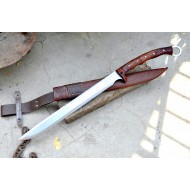
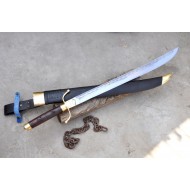
This is a hand-forged Swiss sabre with a 29 inch single-edged blade, an 8 inch hilt carrying a full side ring, and a fluted disc pommel, 37 inches overall and 1,220 grams. It is forged from 5160 high-carbon spring steel in our workshop in Tokha-3, Kathmandu, and comes with a leather scabbard on a two-strap hanger with brass buckles. Nothing is held in stock: the sword is forged after your order arrives, which is why the curve, the grip length, the pommel and the edge specification are all yours to set at no extra cost.
The hilt is the reason this sword exists. A straight cross with knobbed, fluted terminals, and standing off the flat of it, a full ring. That ring is not decoration and it is not a finger ring. It closes the opening a plain cross leaves when a fencer puts a finger over the quillon for point control, and it is the first move in the sequence that produces, over the next hundred years, the swept hilt and then the basket. Sixteenth-century Swiss and south German smiths built dozens of variations on this idea and mounted them on single-edged blades, and that combination is what museums now call the Schweizersäbel.
The blade is straight, single-edged, of even width, with a narrow fuller set high toward the back and an angled clip running down to the point. Twenty-nine inches is a serious cutting length, and 1,220 grams is a sensible weight to carry it.
An honest note. Three things a knowledgeable buyer will spot, so we will say them first. The blade is straight, and the type as museums define it has a slightly curved blade — that is a real deviation, and we will forge the curve at no extra cost if you ask. Second, it is heavier per inch of blade than the period article: this sword runs about 42 grams per inch of blade against roughly 33 for a Swiss sabre in the Metropolitan Museum, which is around 28 per cent stouter. Nothing wrong with that in a sword you intend to use, but it will feel less lively than an original. Third, the grip: 5.5 inches is short for a type whose whole selling point was a hilt long enough for one hand or two, and it is rosewood jointed to whitewood, which is a trade term for a range of pale, softer timbers rather than a species. Both are free to change. What we will not do is stamp reproduction arsenal or inspection marks on it.
Why It Is Built This Way
Full Specifications
Figures are taken from the sword shown. Hand-forged work varies a little from piece to piece, so read these as close rather than exact. If a dimension matters, tell us before we start and we will build to it and measure the finished sword for you.
Build It Your Way
None of this costs extra, because none of it is made before you ask for it. Work down these six and put what you want in the order note.
Want the hilt built further out?
A second side ring, a knuckle bow, a linking bar, a full swept hilt, a lion's head pommel, a curved blade at period mass. This form was designed by people who kept adding to it, and we are happy to keep going. Send us a drawing or a photograph of the original you have in mind and we will quote before anything goes on the fire.
Start a Custom Forge Request →What It Does Well, and What It Does Not
What it does well
- A genuinely uncommon hilt form. Few outside the specialist makers offer a side-ring sword, and most who do cannot tell you what the ring is for.
- Real cutting geometry: single edge, full stock behind it, a high-set fuller, and 29 inches of reach on a sword you can still handle in one hand.
- Hilt furniture that is forged rather than cast, which is where a cheap sword of this shape gives itself away.
- A hilt open to development. Second ring, knuckle bow, longer grip, lion's head pommel, all of it free.
- Total mass in the right region for the length, 1,220 grams, not the 2 kilogram wall-hangers that dominate this shape.
- Honest materials. Mono-steel 5160, forged steel fittings, real leather scabbard and hanger, no plating standing in for solid metal.
What it does not do
- The blade is straight and the type is defined as curved. This is the one real deviation and we would rather you ordered the curved build than discovered it later.
- It is heavier per inch of blade than the period article, by roughly 28 per cent against a Metropolitan Museum example. Stouter and more forgiving, but less lively.
- The 5.5 inch grip is short for the type. Usable with two hands at a pinch; not the comfortable one-or-two hold that surviving examples were built for.
- It is not an exact reproduction of a numbered museum piece, but a correct hilt form on a correct blade family, assembled as our own sword.
- Half the grip is whitewood, which is softer and lighter than the rosewood beside it and will mark sooner. For a sword you mean to use, order the all-rosewood grip; it costs nothing.
- It is not stainless. 5160 rusts if you leave it wet and it needs oiling.
How to Order
Who It Is For
- Collectors of Renaissance and transitional hilts, who will recognise a side ring as the moment the compound hilt begins.
- Historical fencers and students of the German and Swiss sources, for whom a finger over the quillon is normal and the ring is therefore not decoration.
- Reenactors and living-history people — order the curved blade and the longer grip, both free, to bring it properly into type.
- Buyers wanting a single-edged sword that is not a falchion, a messer or a katana, and struggling to find one.
- Stage combat and theatrical armourers, who can order this sword rebated and round-tipped at no extra cost.
- Anyone who would rather buy from people who can say what the ring is for than from people who call it a Schweizerdegen.
What Is Included
- The Swiss sabre, hand-forged in Tokha-3, Kathmandu, Nepal.
- A leather scabbard with a two-strap hanger and brass buckles.
- A protective coat of oil on the blade for transit, wiped off before handling.
- Care instructions covering oiling, storage and surface rust.
- Everest Forge manufacturer warranty against defects in materials and workmanship.
Order the curve. It costs nothing.
If you are buying this sword for reenactment, living history, or because you care that it is the type it says it is, the single most useful thing you can do is ask for the period curve and a longer grip. Both are free, both take it closer to the surviving examples, and neither adds a day to the lead time. Tell us what the sword is for and we will tell you what we would build.
Talk to the Forge →Other Blades and Reading From the Forge
Shipping, Returns and Care
Dispatch and transit. Standard builds leave the workshop in 2 to 3 business days. Genuinely custom work — a curved blade, a longer grip, a lion's head pommel, extra guard bars — runs 4 to 6 weeks depending on the queue. We ship by DHL or FedEx with tracking, typically 7 to 14 business days from Kathmandu. The sword travels sheathed and braced, with the scabbard and hanger packed separately so nothing bears on the blade in transit.
Duties, import and edge law. Import duty and local taxes are the buyer's responsibility and vary by country. Swords are regulated differently in different places, and a sharpened false edge on the clipped back can change how the whole sword is classified in some jurisdictions regardless of how short that edge is — which is why we leave it blunt as standard. Please check what applies where you live before ordering. If an unsharpened build would make the difference, we will supply one at no extra cost.
Returns and warranty. Because every sword is forged after the order, a custom build cannot be restocked, so please make sure the specification is right before you confirm. Anything that arrives damaged in transit, or that shows a defect in materials or workmanship, is covered by the Everest Forge manufacturer warranty and we will repair or replace it. Photograph the packaging as well as the sword if something has gone wrong on the way.
Care. 5160 is a high-carbon steel and it is not stainless. Wipe the transit oil off before handling, and put a light film of oil back on before the sword goes away. Fingerprints are acidic and will etch a polished blade if left on it for weeks, so wipe the blade down after handling it. Do not store the sword in the scabbard for long periods: leather holds moisture against steel. Light surface rust comes off with oil and fine steel wool; nothing abrasive on a polished finish. Check the pommel and hilt furniture for movement now and then.
Questions About the Swiss Sabre
What is a Swiss sabre, and is this one?
A Swiss sabre is a single-edged sword of the sixteenth and early seventeenth centuries on a Swiss or south German compound hilt — a cross with rings, sometimes knuckle bows, and a grip long enough for one hand or two. They were carried by Swiss soldiers and the mercenaries who served across half of Europe, and they sit where the longsword hilt starts growing the bars that become the basket.
This piece has the hilt: cross with knobbed terminals, a full side ring, a disc pommel, a 5.5 inch grip. What it lacks is the curve. The type as museums define it has a slightly curved blade, and this one is straight. Worth saying in the first answer rather than the last; FAQ 2 deals with it properly.
Swiss sabres are curved. Why is this blade straight?
Because that is how this one was forged, and we would rather tell you than hope you do not notice. Every scholarly description of the type specifies a slightly curved blade. Ours is straight, the back running unbroken until it falls away in an angled clip to the point. In every other respect it belongs to the family.
If you want the curve, we will forge it at no extra cost. Say so in the order note: a gentle sweep of an inch or so over 29 inches is what most surviving examples show, and what we will build if you leave the amount to us. The curved blade makes this a far more defensible piece for a reenactor or a collector who cares about type.
What does the side ring actually do?
It covers the hole. A plain cross protects your hand only while the hand stays behind it. Put a finger over the quillon for point control, as fencers of this period did constantly, and that finger sits outside the guard, exposed to anything sliding down your opponent's blade. The side ring is a loop standing off the cross that closes that opening.
It is the first step in a long development. Through the sixteenth century smiths kept adding bars to the same problem: one ring becomes two, then rings plus a knuckle bow, then a swept hilt, then a basket. A side-ring hilt is that argument caught early.
Did anyone in the sixteenth century call it a Schweizersäbel?
No, and almost every retailer selling one gets this wrong. Schweizersäbel is a modern museum term, coined in 1914 by Eduard Achilles Gessler, curator at the Swiss National Museum, in a study of how the type developed. A useful label, and we use it, but a scholar's word applied four centuries on.
The contemporary word was Schnepf, or Schnaepf — snipe — apparently because the long, slightly hooked blade resembled the bird's beak. Worth knowing for a second reason: much trade copy confuses Schweizersäbel with Schweizerdegen, which is a different weapon entirely, the short Swiss sword or sword-dagger. You will find that error repeated across several well-known sword retailers. They are not the same thing.
How do I tell a Swiss hilt from a German one?
Look at the cross-section of the bars, not their shape. This is the cleanest single test and it works on any photograph. Swiss-style hilts have guard bars of circular or diamond section — round or lozenge at a cut end. German hilts of the same period tend to a flattened ribbon section, wider than it is thick.
The two traditions produced very similar hilts, and most surviving examples are German, which is why the distinction vanishes from sales copy. It is also a fair test to apply to us: the bars on this hilt are of round section with knobbed, fluted terminals, and you can check that in the photographs rather than take our word for it.
What is the grip made of?
Rosewood jointed to whitewood — the rosewood is the dark, dense section at the guard end, the whitewood the pale section running up to the pommel. Worth knowing what the second word means: whitewood is a timber-trade term, not a species. It covers a range of pale, light, relatively soft woods, and is a materially different thing from rosewood in hardness and density.
That gives a handsome two-tone grip and one thing to watch. Two timbers of different density meeting at a joint move at slightly different rates as humidity changes, and the softer section marks and wears faster. None of that matters on a sword that hangs on a wall. On one you mean to handle hard, ask for rosewood throughout, or leather over timber — both free. It is 5.5 inches either way, hand-and-a-half and short for the type; we will build it longer for nothing.
How does the weight compare with a museum original?
Honestly? It is heavier, and here is the arithmetic rather than an adjective. This sword is 1,220 grams with a 29 inch blade, 37 inches overall. The Metropolitan Museum holds a Swiss sabre that weighs about 1,191 grams with a 36.25 inch blade and 42.9 inches overall. Almost the same mass, over seven more inches of blade.
Per inch of blade we are at 42 grams against the original's 33, about 28 per cent heavier for the same length of steel. Stouter and more forgiving, less lively in the hand. If you want period mass, ask for more pronounced distal taper. We will do it, and tell you what it costs in durability.
What steel is it, and how is it heat treated?
5160 high-carbon spring steel, which we use across the whole range. The blade is forged to shape, quenched, and then tempered back by hand as a separate operation afterwards. Those are two distinct processes and the second one is what matters: quenching alone leaves a blade hard and brittle, and tempering trades a little of that hardness for the toughness that lets a 29 inch blade take a hard stop without cracking.
5160 is not stainless and is not meant to be. It rusts if left damp, and in exchange takes and keeps an edge far better than any stainless we could sensibly forge. We do not make pattern-welded or Damascus blades at all, by choice.
Does it arrive sharp, and is the clipped back sharpened?
The main edge ships sharpened unless you tell us otherwise. The clipped back — the angled run from spine to point — is left blunt as standard. On period single-edged swords a sharpened false edge there is common but not universal, and it has consequences: it makes the point cut on the back stroke, and in some jurisdictions a second sharpened edge changes how the whole sword is classified regardless of how short it is.
So we make it a choice. Ask for the false edge sharpened, or for the whole sword unsharpened for display or an awkward import. A stage combat build — rebated edge, rounded tip — is available on the same terms. None of it costs extra.
Where does it balance?
We do not publish a single point-of-balance figure, because hand-forged blades vary and a number two inches out is worse than none. What we can tell you is the shape of it: a 29 inch single-edged blade of this section, with a disc pommel and a side ring behind it, balances a few inches ahead of the cross, which is where a cutting sword of this period belongs.
If the figure matters, ask before dispatch and we will measure the actual sword we are sending you, from the cross, and send the number. Our sword balance guide explains what point of balance and centre of percussion mean and why the measurement is worth asking any seller for.
How is this different from a falchion or a messer?
All three are single-edged European swords and they are constantly confused, including by people selling them. The distinction that matters is hilt construction, not blade shape. A falchion has a conventional sword hilt: a tang running through to a fitted pommel. A messer is built like a knife — a flat slab tang with riveted scales, usually with a Nagel, a stud projecting from the cross to shield the hand.
This sword is built the first way, with a proper pommel, so it is not a messer whatever the blade looks like. Nor is it a falchion, because a falchion broadens toward the point where this one keeps an even width and clips off. We forge all three, so if you want one of the others, ask.
Can I have period-correct fittings, and do you stamp arsenal marks?
Fittings, yes. The most authentic option for a late sixteenth century Swiss sabre is a lion's head pommel, which is what the specialised hilt forms of that period carry, and we will forge one instead of the disc. Longer grip, curved blade, second ring, knuckle bow, blackened or silvered furniture — all available, none charged extra.
Arsenal marks, no. We do not stamp reproduction arsenal, inspection or armoury marks on new blades, and we will decline if you ask. A marked blade eventually leaves the person who commissioned it, and at that point a stamp ordered as decoration is indistinguishable from one meant to deceive. Maker's marks, initials, dedications and dates are all fine.
| Specification | |
| Blade: | 29 inches. Hand forged from 5160 carbon steel |
| Total Length: | 37 inches |
| Handle: | 8 inches. Full tang, 5.5 inch rosewood and whitewood grip, side ring guard, disc pommel |
| Weight: | 1220 grams the sword, 1630 grams with the scabbard |
| Note: | Handmade variation in weight, dimensions and finish may occur. Keep blade lightly oiled when not in use. |