- Model: Heavy Cleaver
- Product Code: CHOPPER12KO
- Location: Kathmandu, Nepal
Available Options
A Hand-Forged Heavy Chopper With an Upswept Point and Fullered Blade
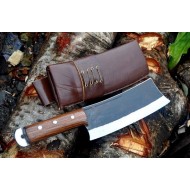
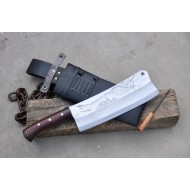
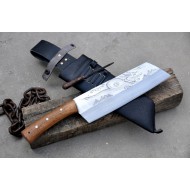
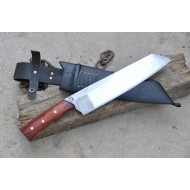
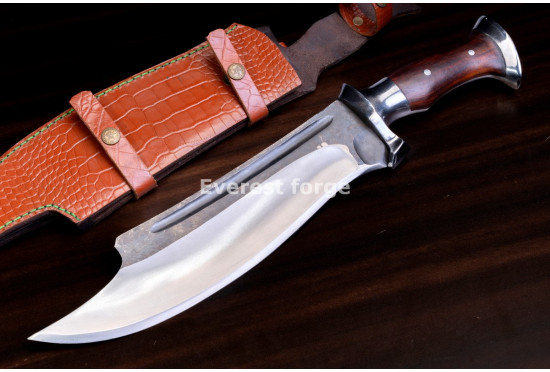
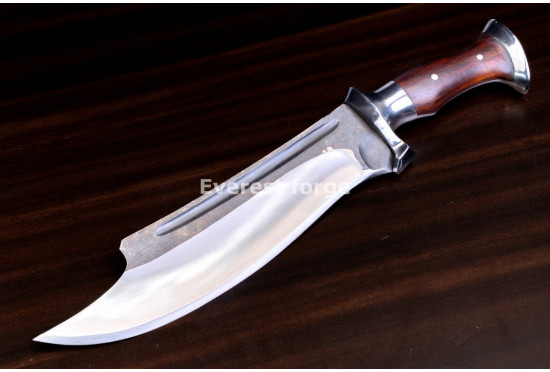
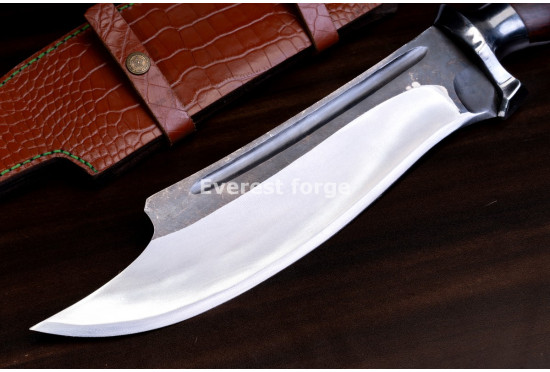
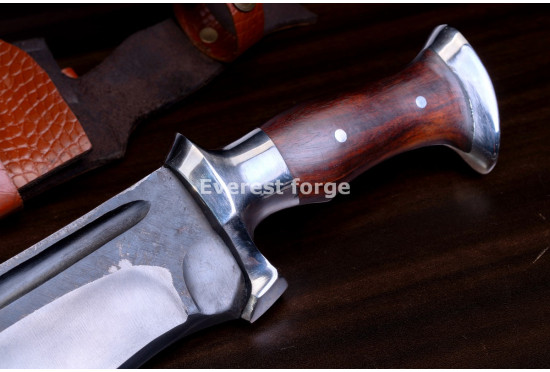
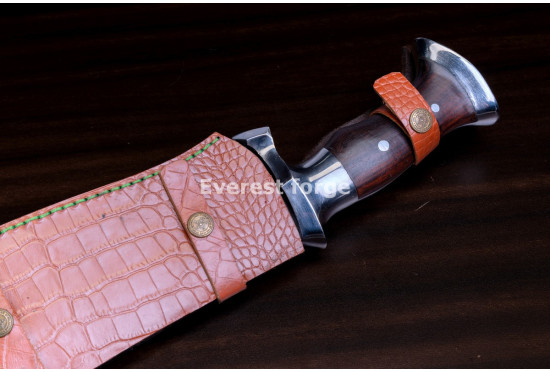
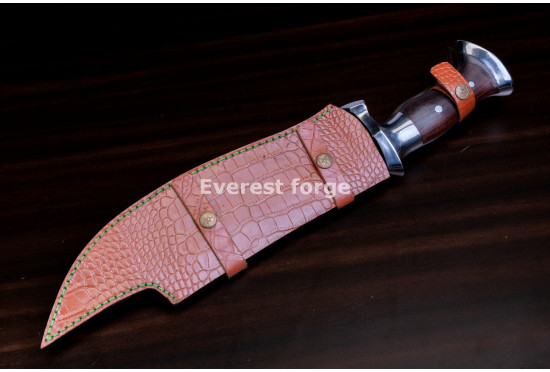
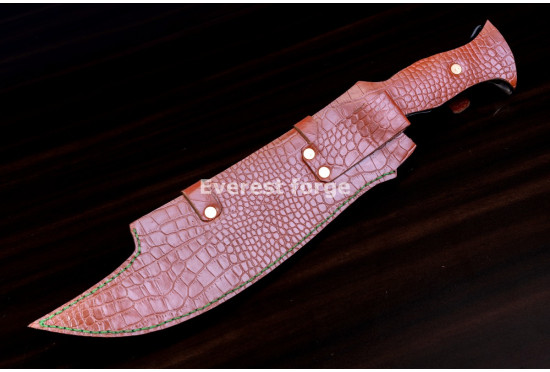
This is a 12 inch hand-forged heavy chopper: a broad deep blade with a narrow fuller running the upper length, a long belly and a point that sweeps upward above the line of the spine. The hilt is contoured rosewood pinned through a full tang between a heavy stepped steel bolster and a flared steel pommel cap, with a finger notch cut into the ricasso. Overall length is 18 inches. It is made from 5160 high-carbon steel in Tokha-3, Kathmandu, and ships in a crocodile-embossed leather sheath stitched in green, on a studded belt rig.
An honest note. The sheath is embossed cowhide, not crocodile skin. The pattern is pressed into ordinary leather, which is why it repeats evenly and runs off the edge of the panel where real skin would not. We say so plainly because a good many sellers do not, and because genuine crocodile is CITES-listed, which would make importing this into most countries a permit conversation rather than a purchase. Embossed leather has none of that and looks very good, but it is not the same thing and you should know which you are buying. Second point: the weight figure on this piece is under review. We have not printed it below because we would rather leave a row blank than publish a number we are still checking.
Have This Chopper Forged Your Way
Blade length, spine thickness, point geometry and the sheath are all decided at the forge. Tell us what you are cutting and our smiths will tell you what to order.
Start a Custom Forge Order →Why This Chopper Is Built the Way It Is
Specifications
Build Options
Is This the Right Blade for You?
Buy This If You Want
- Serious chopping mass in a blade short enough to work close in
- A long curved cutting edge, which the upswept point gives you more of
- Full tang with heavy steel at both ends of the grip
- A finger notch, so you can choke up for controlled work
- A sheath that looks like an exotic skin and is honestly described as not being one
Look Elsewhere If You Want
- A strong tip for prying or hard thrusting — an upswept point is the thinnest of the three geometries
- Reach; twelve inches works close, and a long machete clears far more ground per swing
- Genuine crocodile or any protected skin, which we do not work in
- Something light to carry all day, since this is among the heaviest blades we forge for its length
- A stainless blade needing no care, since 5160 is carbon steel and will rust if left wet
Tell Us What You Are Cutting
Spine thickness, blade length and point geometry should follow the work rather than a catalogue. Describe your ground and our smiths will tell you what to order.
Talk to the Forge →How to Order
Who This Chopper Is For
- Campers and bushcrafters who want chopping power without a long blade to swing
- Smallholders working in tight ground where a full-length machete keeps catching
- Anyone processing game or carcasses, where a long curved belly does more than a straight edge
- Collectors of large forged blades who want mass and a distinctive profile
What Is Included
- One hand-forged heavy chopper, sharpened and ready to work
- Fitted crocodile-embossed leather sheath on a studded belt rig
- Certificate of hand-forging from the workshop
- Everest Forge manufacturer warranty against defects in forging and heat treatment
Explore the Collection
Shipping, Returns and Care
Every piece is prepared at the forge in seven to ten days, and shipping adds a further seven to ten days. Orders to the USA and Canada travel with FedEx; everywhere else ships on a DDP service, which means duties and taxes are settled before the parcel moves so there is nothing to pay on delivery. Every piece carries the Everest Forge manufacturer warranty against defects in forging and heat treatment.
Large fixed blades are restricted in some countries and in some states and provinces within them. It is your responsibility to check that this chopper may lawfully be imported and possessed where you live before ordering, because a parcel seized by customs cannot be returned to us and cannot be refunded. Ask us before you buy if you are unsure and we will tell you what we know about your destination.
5160 is a high-carbon steel and it will rust if left wet or stored damp. Wipe the blade dry after use and keep a light film of oil on it, paying attention to the fuller and to the angles of the ricasso notch, which are the two places a cloth will not reach. Do not store the chopper in the sheath for long periods. The rosewood scales take an occasional coat of oil, and the embossed leather takes ordinary leather conditioner — it needs no special treatment, being cowhide.
Frequently Asked Questions
What does an upswept point do?
It gives you more curved cutting edge and a weaker tip, and that trade is the whole of it. On this blade the point rises above the line of the spine rather than sitting on it or dropping below it, which means the belly — the curved section that does the actual slicing — runs longer and further round toward the end of the blade. That matters for any cut where you draw the edge through material rather than chopping straight down: skinning, breaking down a carcass, cutting through hide and hair, working around bone. It is why the shape is standard on skinning knives, at much smaller sizes. What you give up is the tip. A point that curves upward has steel removed from underneath it, so it is thinner and less supported than a drop point or a spear point and it will not take prying or a hard thrust into anything solid. Our camp knife with the spear point is the opposite choice, and our crossguard bowie is the third: a drooping point that keeps mass forward for chopping. Three different answers to what the front third of a blade should be for.
Is the sheath real crocodile?
No. It is cowhide with a crocodile pattern embossed into it, and we would rather you heard that from us than assumed otherwise. You can tell by looking: on the sheath the scale pattern repeats at regular intervals and runs straight off the cut edge of the panel, where genuine skin has scales that vary in size across the hide, change direction along the belly line, and cannot be cut through mid-scale without it showing. There are two reasons we use embossed leather and neither is that we are hiding something. It looks very good and it costs a fraction of the alternative. And genuine crocodile is listed under CITES, the international convention on trade in endangered species, which means it needs permits to cross borders and would turn a straightforward parcel into a customs file for both of us. We do not work in protected skins at all. If you want the plain vegetable-tanned version instead, that is a free change.
Why is there no weight on this page?
Because the figure we have is under review and we would rather leave the row blank than print something we are checking. The number recorded for this piece would make it by some distance the densest blade in our whole catalogue for its length, and while the stock is genuinely thick and the fittings are heavy, a figure that far outside the rest of the range is worth confirming on a second set of scales before it goes on a listing that people make buying decisions from. It will be added once it has been re-weighed. If you want the exact weight before ordering, email us and we will put the piece on the scale and tell you the answer rather than an estimate.
What is the notch cut into the ricasso?
A finger notch, and it does two useful things. It gives you somewhere to put your index finger when you choke up onto the blade for controlled work — carving a point, opening a carcass, anything where you want the edge close to your hand rather than out at the end of a swing. And it acts as a stop, because the notch sits behind the sharpened edge so your finger has something to sit in rather than sliding forward. On a chopper it matters more than on a small knife, because the whole point of a heavy short blade is that it does both jobs: swing it for the heavy work, choke up on it for the fine work. Without the notch the second half of that is uncomfortable. It also creates a natural end to the sharpened edge, which is why the sharpening stops where it does rather than running back to the bolster.
What does the fuller do on a blade this thick?
Less than it would on a thin one, and the honest answer is that it is mostly appearance here. A fuller removes metal from the middle of the blade face, where it contributes least to stiffness, so on a thin blade it saves useful weight without much cost in strength. On stock as thick as this one, a narrow fuller takes out a small fraction of a large amount of steel. It does slightly stiffen the section by leaving a raised area either side of the channel, and it does look like the hand-grinding it is. But if you want a lighter chopper the answer is a thinner spine, which is a build option above and will change the weight by an order of magnitude more than any fuller. We would rather say that than let a groove in the blade stand in for a specification.
How is it different from your other twelve inch blades?
By what the front of the blade does. We forge three blades at twelve inches and they are three different answers to the same question. This one has an upswept point: the longest curved belly of the three, best for drawing cuts and processing, weakest tip. Our Crossguard Hilt bowie has a drooping point that falls below the handle line, which keeps mass forward for chopping and puts a full steel cross between your hand and the edge. Our Book of Eli inspired machete has a forward curve with no cho and a contoured grip, built purely around mass close in. If you are choosing, ask what the last three inches of blade will be doing. If the answer involves hide, meat or long slicing cuts, take this one.
What steel is it, and how is it heat treated?
5160 high-carbon spring steel, brought to temperature in the forge, quenched in oil and tempered back so the edge is hard while the body of the blade stays springy. It is the leaf-spring steel our smiths have worked for generations and it suits a chopper well: tough enough to take repeated impact without chipping, and soft enough at our temper that the edge rolls rather than breaking when it finds grit or a nail. A rolled edge comes back with a file or a steel in a minute; a chip is a repair. It is not stainless, deliberately, because the stainless grades that genuinely resist rust give up the toughness a chopping blade depends on.
Is it full tang?
Yes. The tang is the full width and shape of the grip with rosewood scales pinned through it, and the line of steel shows between the scales along the outline of the handle. On a blade of this mass it is the only construction we would fit. The heavy stepped bolster at the front and the flared cap at the back are doing structural work as well as looking the part: they clamp the scales and spread the shock of a hard chop across the whole hilt rather than concentrating it at the pins. A hidden tang, where a narrow spike runs into a solid handle, works loose at the shoulder under repeated impact and is the standard failure point on inexpensive heavy blades.
Can I baton with it?
Yes. The spine is thick, flat and unsharpened, the tang is full width, and the fittings spread the load, which is everything batoning asks for. Strike over the belly rather than out near the tip, keep the blade square in the cut so it does not twist, and use a wooden baton rather than a rock. The one caution specific to this blade is the upswept point: do not use the tip to lever a split apart once the blade is buried, because a point that sweeps up is the thinnest part of an already thin section and it is the part most likely to go. Drive it through and start again rather than twisting.
How sharp does it arrive?
Sharp and ready to work, with a convex working edge put on by hand at the forge. We do not send choppers out with a fine polished edge, because it is the wrong edge for the job and will be gone within an hour of real cutting; a slightly coarser edge bites better into green wood and survives contact with grit and soil far longer. If you would prefer it shipped blunt — for display, for a gift, or because of the rules where you live — say so in the order comments and we will send it unsharpened at no extra cost.
How do I sharpen it?
A mill file for the straight section and a round or half-round file for the curved belly and the upswept tip, which is where most people go wrong. A flat file bridges across a tight curve and only touches the high points, so the belly ends up with flat spots and the tip ends up rounded off after a few sharpenings. Follow the curve with a smaller file or a rounded stone, work in one direction along the bevel until you feel a burr along the full length, then turn the blade over and take the burr off with lighter strokes. Two or three minutes restores a working edge. The upswept point in particular wants care: it is easy to shorten it by degrees without noticing until the profile has changed.
Where is this made, and by whom?
In our own workshop in Tokha-3 on the northern edge of Kathmandu, Nepal, by around ten smiths, most from families that have forged blades for generations. Everest Forge has operated since 2010, and we forge, grind, heat treat, fit the scales and cut the leather in the same building. This is a modern working design rather than a traditional pattern from anywhere, and we would rather say that than imply a heritage it does not have. What it does have behind it is a forge where heavy chopping blades are made and used every day.
| Specification | |
| Blade: | 12 inches. Hand forged from 5160 carbon steel |
| Total Length: | 18 inches |
| Handle: | 6 inches. Full tang with contoured rosewood scales pinned through, heavy stepped steel bolster and flared steel pommel cap |
| Weight: | 1300 grams |
| Note: | Some variation in weight, dimensions and finish may occur as each piece is hand forged. Keep the blade lightly oiled when not in use |