Menu
Your Cart

Hand-Forged Bowie Knife, Crossguard Hilt

Hand-Forged Bowie Knife, Crossguard Hilt
$154.99
Ex Tax: $154.99
  • Model: Bowie Knife
  • Product Code: Bowie0016
  • Location: Kathmandu,Nepal

Available Options

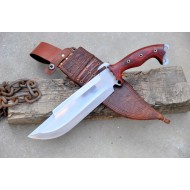
A Large Hand-Forged Bowie Knife With a Steel Crossguard and Fullered Blade

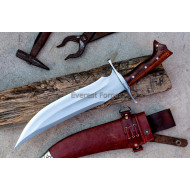
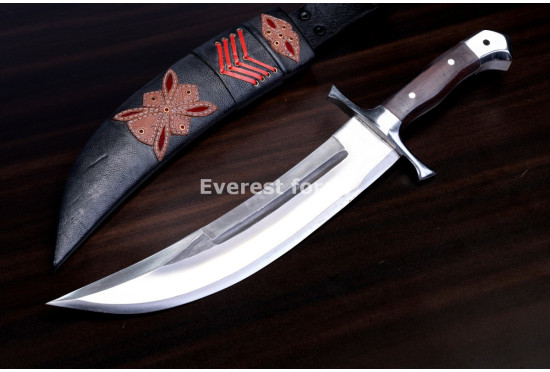
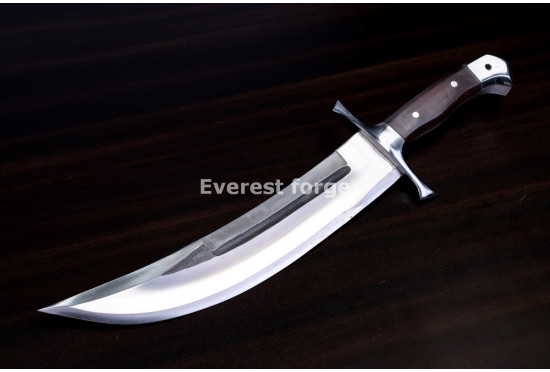
This is a 12 inch hand-forged bowie knife with a deep sweeping belly, a fullered blade and a polished steel crossguard, mounted on a full-width tang through riveted rosewood scales. Overall length is 18.5 inches and the knife weighs approximately 1170 grams, so it carries real chopping mass rather than the light stamped weight of a factory camp knife. It is forged from 5160 high-carbon steel, oil-quenched and tempered, sharpened and ready to work, and it ships in a black leather sheath hand-tooled with oxblood applique by the same workshop that forged the blade. Every piece is made to order in Tokha-3, Kathmandu, Nepal.

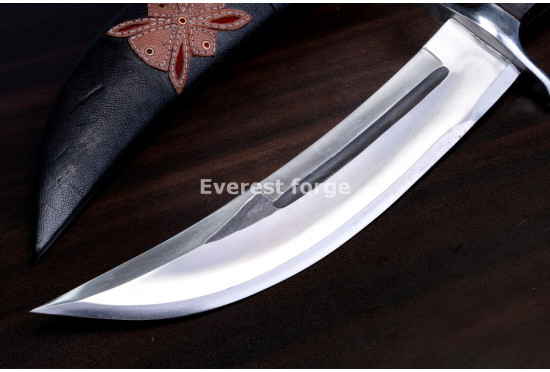
An honest note. The blade on this knife does not have a clip point. On a classic Bowie the spine runs straight and is then clipped back so the point sits level with the centre line of the blade. On this one the spine curves down through its whole length and the point drops below the line of the handle, which is sabre geometry rather than clip-point geometry. We call it a bowie because that is what the pattern has come to mean in the trade — a large guarded fighting and camp knife — and because it is the honest description of what the knife is for. If you want a true clipped spine, our smiths will forge one to the same hilt and sheath; it is the first option below.

Made to your specification

Have This Bowie Forged Your Way

Blade length, point geometry, grip material and finish are all changed at the forge before your knife is made. Send us a sketch, a photograph or a description and our smiths will quote it.

Start a Custom Forge Order →

Why This Knife Is Built the Way It Is

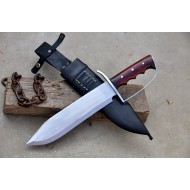
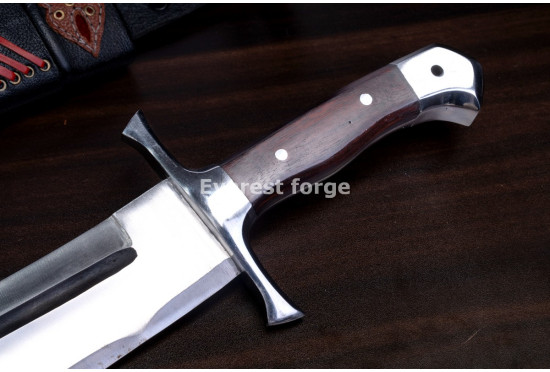
A Guard That Actually Stops the HandMost large knives in this price bracket stop at a bolster. This one carries a full steel cross with a quillon drooping forward over the blade and a second flaring back over the hand, so a thrust that meets bone cannot run your fingers onto the edge.
Full-Width Tang, Three PinsThe tang runs the whole width and length of the handle with rosewood scales pinned through it, capped at both ends in polished steel. There is no glued stick tang inside this grip, which is the exact place cheap chopping knives fail.
Forged, Not Ground From Bar StockThe blade is drawn out under the hammer from 5160 high-carbon steel, then oil-quenched and tempered. It is finished by hand, sharpened, and sent out as a working knife rather than a wall piece.

Specifications

Blade Length12 inches
Handle Length6.5 inches, of which 4 inches is grip
Overall Length18.5 inches
Blade Steel5160 high-carbon spring steel, oil-quenched and tempered
Blade ProfileSingle-edged, deep sweeping belly, edge on the outer curve, point dropping below the handle line
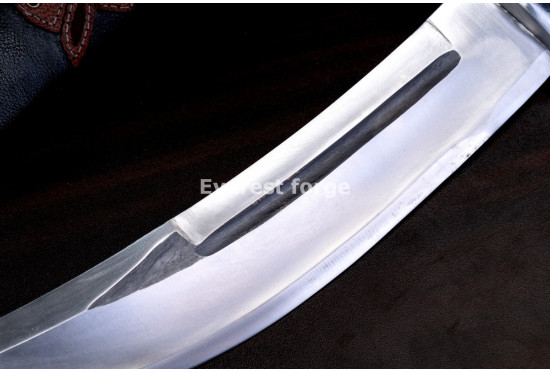
FullerBroad fuller running the working length of the blade
GuardPolished steel crossguard, forward-drooping quillon over the blade with a rear quillon over the hand
ConstructionFull-width tang, three pins through the scales
FittingsPolished steel bolster and hooked butt cap with lanyard hole
Standard BuildSatin finish, rosewood scales — size, finish and grip material are selectable above
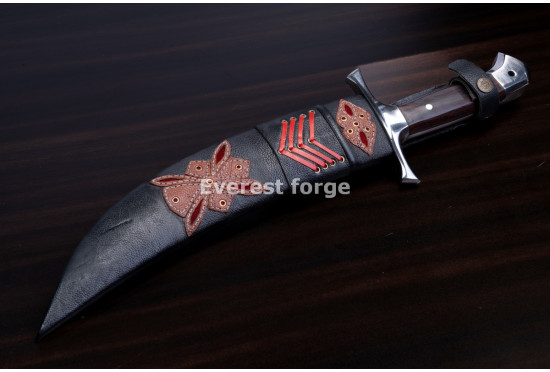
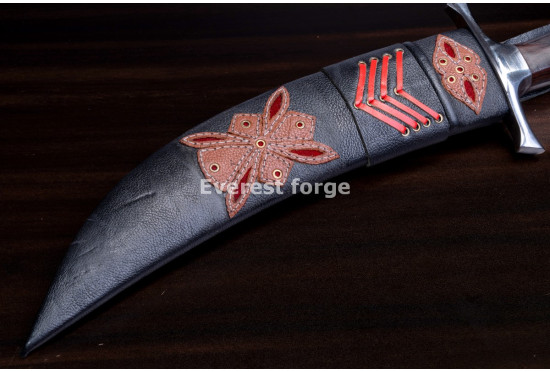
SheathBlack leather, hand-tooled oxblood applique, belt carry
WeightApproximately 1170 grams for the knife, 1420 grams with the sheath
OriginHand-forged in Tokha-3, Kathmandu, Nepal

Build Options

True Clip PointA straight spine clipped back to a level point, which is the classic American bowie profile. Same hilt, same sheath, same steel. This is the most requested change on this pattern.
Blade LengthShorter at 9 or 10 inches for a knife you will actually wear on a belt all day, or longer at 14 inches if you want a chopper. The hilt scales with the blade.
Grip MaterialRosewood as standard. Water buffalo horn, stacked leather washers and micarta are all forged and fitted in the same workshop.
Blade FinishSatin as standard. A dark forge finish, a mirror polish or a stonewashed working finish are available at no change to the geometry.
Guard FormThe double quillon shown, a single forward quillon, a plain straight cross, or an S-curved guard. This is a forged fitting, so the shape is open.
SheathThe tooled black and oxblood sheath shown, a plain black or brown belt sheath, or a dangler rig. Tell us how you carry.

Is This the Right Knife for You?

Buy This If You Want

  • A large knife with genuine chopping mass that will split kindling, limb a branch and clear scrub
  • A guard between your hand and the edge, which most fixed blades this size do not give you
  • Full-width tang construction you can see through the pinned scales rather than take on trust
  • A high-carbon working edge you can bring back with a stone in the field
  • A piece with real presence on a wall or a belt, hand-tooled sheath included

Look Elsewhere If You Want

  • A skinning or field-dressing knife — 12 inches is far too much blade for that work, and our 9 inch bolstered hunting knife is the right tool
  • A stainless blade that needs no care; 5160 is carbon steel and will rust if you leave it wet
  • A light knife to carry all day, since this one is over a kilogram before the sheath
  • A true clip-point bowie off the shelf; that is a custom order here, not the standard build
  • A folding or pocket knife of any kind
Fifteen years at the anvil

Your Design, Forged by Our Smiths

Everest Forge has forged blades in Kathmandu since 2010. Ten smiths, one workshop, no outsourcing. If the knife you want does not exist yet, send us the idea.

Talk to the Forge →

How to Order

Choose your blade length, finish and grip material from the options above the description.
Add any note about the point geometry, guard form or sheath in the order comments.
We confirm your build by email and start forging. Custom work takes four to six weeks.
Your knife ships tracked by DHL or FedEx and arrives in seven to fourteen business days.

Who This Knife Is For

  • Campers and bushcrafters who want one knife that will do the heavy jobs a small blade cannot
  • Collectors of large fixed blades looking for a hand-forged piece rather than a production run
  • Re-enactors and film and stage armourers who need a knife that photographs like a weapon and holds up to handling
  • Anyone giving a serious gift — the tooled sheath makes this one of the better-presented pieces we make

What Is Included

  • One hand-forged bowie knife, sharpened and ready to use
  • Fitted black leather sheath with hand-tooled oxblood applique
  • Certificate of hand-forging from the workshop
  • Everest Forge manufacturer warranty against defects in forging and heat treatment

Explore the Collection

Shipping, Returns and Care

Stock pieces are dispatched within two to three business days. Custom builds take four to six weeks at the forge before they ship. Everything travels tracked with DHL or FedEx and typically arrives in seven to fourteen business days. Every knife carries the Everest Forge manufacturer warranty against defects in forging and heat treatment.

A large fixed blade is restricted in some countries and in some states and provinces within them. It is your responsibility to check that this knife may lawfully be imported and possessed where you live before ordering, because a parcel seized by customs cannot be returned to us and cannot be refunded. If you are not sure, ask us before you buy and we will tell you what we know about your destination.

5160 is a high-carbon steel and it will rust if it is left wet or stored in a damp sheath. Wipe the blade dry after use, keep a light film of oil on it, and store the knife out of the leather if you are putting it away for a season. The edge is put on by hand at the forge and comes back with a stone or a strop; there is nothing exotic about maintaining it.

Frequently Asked Questions

Is this a true Bowie knife?

Not by the strict definition, and we would rather say so than let you find out when it arrives. A Bowie is defined by its clip point: the spine runs straight for most of the blade and is then clipped back, straight or concave, so the point ends up level with the centre of the blade. That clipped section is often sharpened as a false edge and it is what makes a Bowie thrust well. This blade has no clip at all. The spine curves down continuously from the guard and the point finishes below the line of the handle, which is sabre geometry — the same family as a Persian shamshir or a light cavalry sabre, cut down to knife length. What it does share with a Bowie is the role: a large single-edged knife with a guard, heavy enough to chop, big enough to defend yourself with. That is what most people mean when they use the word today. If you want the historical article, we forge a true clipped spine on the same hilt as a custom order.

What is the crossguard actually for?

It stops your hand travelling forward onto the edge. That sounds obvious until you notice how few large knives have one. A kitchen knife or a skinning knife has no guard because it is never driven point-first into anything hard, and a bolster alone is enough to index the hand. A knife you might thrust with is different: when a point meets bone, a rib, a knot in green wood or the ground, the knife stops and your hand does not, and a wet or bloody grip does nothing to prevent it. A cross is the fix, and it is why every fighting knife pattern from the Roman pugio to the trench knives of 1916 has one. The double quillon on this knife adds a second function. The forward quillon droops over the blade and can catch and hold another edge sliding down toward your hand; the rear quillon gives your thumb something to press against when you push the point through resistance. It is a fighting hilt, not a decorative one.

How can I tell a forged fuller from a milled one?

Look at the ends and look at the surface. A fuller pressed in with a hammer and a fullering tool while the steel is hot has soft, slightly irregular ends that fade out rather than stopping dead, and the metal on either side of the groove is displaced outward, so the blade is very slightly wider along the fullered section. The surface inside it follows the hammer, not a cutter. A fuller cut on a mill or a grinder after the blade is finished has hard square ends, perfectly even width and depth from one end to the other, and often visible parallel tool marks running along it. Neither is dishonest and a milled fuller is not weak. But a forged one tells you the blade was worked hot and shaped rather than carved out of a flat bar, and on a hand-forged knife that is part of what you are paying for. On this blade the fuller is put in at the forge, which is also why no two of these knives have a fuller in quite the same place.

What steel is it, and how is it heat treated?

5160 high-carbon spring steel, which is the same steel family used for vehicle leaf springs and is the traditional stock of Nepali forges for exactly that reason. It holds a working edge, it is tough enough to take impact without chipping, and it is forgiving to sharpen with ordinary stones. Blades are brought to temperature in the forge, quenched in oil and then tempered back so the edge is hard and the spine stays springy. Our smiths judge the heat by colour, as they were taught to, which is why a hand-forged blade is never quite identical to the last one. It is not stainless. That is a deliberate trade: stainless steels that resist rust well tend to give up either edge retention or toughness, and for a chopping knife toughness is the property you want.

How sharp is it when it arrives?

Sharp enough to work with straight out of the sheath. Every blade is put on a stone by hand before it leaves the forge and is finished with a working edge rather than a razor polish, because a slightly coarser edge bites better into rope, hide and green wood and lasts longer between touch-ups. If you want a finer edge you can put one on in ten minutes with a fine stone and a strop. If you would prefer it shipped blunt — some customers do, for display, for a gift, or because of what customs is like where they live — ask in the order comments and we will send it unsharpened at no extra cost.

What is the decoration on the sheath?

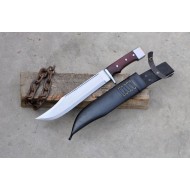
It is hand-cut leather applique, stitched and riveted on by the same workshop that forges the blades. The black body is a single piece of leather formed over a shaped core, and the oxblood pieces — the four-petal rosette, the lozenges and the barred panel at the throat — are cut, skived, laid on and sewn through by hand, with brass eyelets set into the centres. It is the same tradition of leatherwork our smiths use on kukri scabbards, applied to a Western blade shape. That means it will never be perfectly symmetrical and the stitch lines will show a hand behind them. We consider that the point. If you would rather have a plain working sheath with no decoration, that is a free swap.

Is it full tang?

Yes. The tang is the same width as the handle and runs its whole length, with rosewood scales pinned through it in three places and steel fitted at both ends. You can see the tang as a line between the scales along the top and bottom of the grip, which is how you check any knife that claims full tang construction. The alternative, and the reason we say this plainly, is a stick tang: a narrow spike glued or epoxied into a hole drilled in a solid handle. Stick tangs are cheaper and faster and they are perfectly adequate on a small knife, but on a heavy chopping blade the tang works loose at the shoulder under repeated impact and the handle eventually comes off in your hand. It is the single most common failure on inexpensive large knives.

Over a kilogram sounds heavy. Is that a problem?

It depends entirely on what you are doing with it. For chopping, the weight is the tool: a heavy blade carries its own momentum through wood and you can let the knife do the work instead of forcing it. For anything requiring control — carving a stake, preparing food, working close to your other hand — it is genuinely too much knife, and you will feel it in your forearm within a few minutes. We would rather you knew that before ordering than after. If you want the same pattern in something you can carry and use all day, take the blade down to 9 or 10 inches; that removes a surprising amount of weight because you lose it at the far end of the blade where it counts for most.

Can I use this for hunting and field dressing?

Honestly, no, and we would rather route you to the right knife than take the order. Skinning and field dressing are done with a short blade, roughly three and a half to four and a half inches, with a broad curved belly you can steer with your fingers close behind the edge. Twelve inches of blade with a guard on it gets in the way of every part of that job, and you cannot choke up on it. This knife is a camp and chopping knife: it will build your shelter, process your firewood and clear your path, and then you take out something small to do the animal. Our 9 inch bolstered hunting knife is closer to a general field knife, and a shorter skinner on the same hilt and sheath as this bowie is a straightforward custom order. Several customers have taken the pair.

How is this different from your Curved Fullered Hunting Knife?

They are closer than they look in a photograph, so the difference is worth stating. The Curved Fullered Hunting Knife has a 15 inch blade, no guard at all, a plain brown belt sheath and a hilt that runs bolster to butt cap in a single sweep. This bowie has a shorter 12 inch blade, a full steel crossguard with two quillons, and a decorated black and oxblood sheath. The practical difference is the guard: the hunting knife is a pure working blade you use in a controlled forward grip, and the bowie is built as a fighting pattern that also works. If you are choosing between them, ask whether you want length or protection. If you want length, take the hunting knife. If you want a knife you would be comfortable thrusting with, take this one.

Can you forge a matched pair?

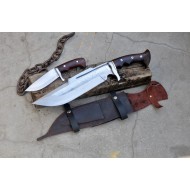
Yes, and it is one of the better things we make. A long knife and a short one built with the same scales, the same steel fittings and sheaths cut from the same hide look like a set rather than two knives, and the pair covers work that neither does alone. The usual combination is this bowie at full length with a four to five inch skinner or camp knife alongside it, either in separate sheaths or in one sheath with a second pocket in the Nepali manner. Tell us in the order comments or through the custom forge page and we will quote the pair together.

Where is this knife made, and by whom?

In our own workshop in Tokha-3 on the northern edge of Kathmandu, Nepal, by around ten smiths, most of whom came to us from families that have forged blades for generations. Everest Forge has operated since 2010. We do not outsource forging, we do not buy in finished blades and put our name on them, and the leatherwork for the sheaths is done in the same building. This matters commercially because a great deal of what is sold as Nepali hand-forged is neither, and it matters practically because when you ask for a change to a knife, the person who reads your message can walk to the anvil and ask.

Specification
Blade: 12 inches. Hand forged from 5160 carbon steel
Total Length: 18.5 inches
Handle: 6.5 inches (4 inch grip). Full-width tang with three pins through rosewood scales, polished steel bolster and butt cap
Weight: approx. 1170g knife, 1420g with sheath
Note: Some variation in weight, dimensions and finish may occur as each piece is hand forged. Keep the blade lightly oiled when not in use

Write a review

Note: HTML is not translated!
Bad Good
Captcha