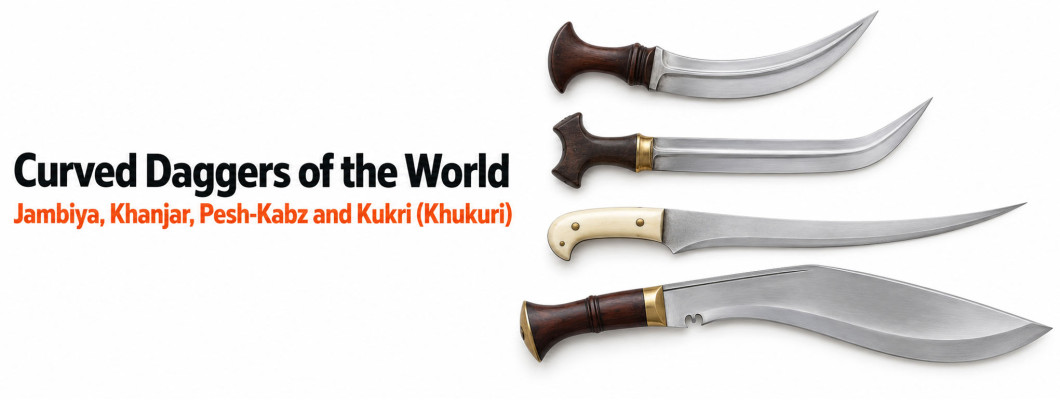
A hand-forged Nepali kukri is built to last decades — but only if you take care of it. The blade is forged from 5160 high-carbon spring steel, which is the steel specified by the British Ministry of Defence for Gurkha service blades because it absorbs impact and holds an edge. It is also the steel that will spot-rust within hours if left wet, dull within months if left unused, and pit permanently if stored in a damp leather scabbard. None of that is hard to prevent — but you do need to know what you're doing.
This guide is the maintenance reference for a hand-forged kukri, written specifically for the steel and construction you actually own: 5160 spring steel, water-tempered cutting edge, water-buffalo horn or hardwood handle (or micarta/G10 on a full-tang blade), and a hand-stitched leather scabbard. The instructions are kukri-specific because generic "how to care for a knife" guidance does not apply — a water-tempered carbon-steel blade has different care requirements than a stainless kitchen knife or a factory-stamped utility blade. Follow this routine and your kukri will outlive you.
Why 5160 High-Carbon Steel Needs Specific Care
5160 spring steel is roughly 0.6% carbon, 0.7% manganese, and 0.8% chromium — and the small amount of chromium is critical to understand. Stainless steels typically contain at least 10–13% chromium, which forms a passive oxide layer that prevents rust. 5160's 0.8% chromium is nowhere near enough for that protection. The steel will rust, and the only thing preventing it is a thin protective film of oil that you maintain.
This is not a flaw. It is the trade-off that gives 5160 its working performance: stainless steels cannot match 5160's shock absorption, edge retention under heavy impact, or differential temper. The British Army accepts the maintenance commitment because nothing else performs as well in the field. As a kukri owner, you accept the same trade-off — and the maintenance work involved is genuinely minimal once you have the routine.
The second thing to understand: your kukri is differentially tempered. The cutting edge is water-quenched to hard steel; the spine is left softer. This means the edge holds sharpness but is more vulnerable to chipping if abused, and the spine absorbs impact but is more vulnerable to bending if pried. Maintenance respects this — you sharpen the edge, you don't pry with the spine, and you protect both with regular oiling.
The Maintenance Schedule: Daily, Weekly, Long-Term
Most owners overcomplicate kukri maintenance. The actual schedule is shorter than people expect:
- After every use (30 seconds) — Wipe the blade clean with a dry cloth. If the blade has been wet, dry it completely. Apply a thin film of oil to the blade. Re-sheathe.
- Weekly if in regular use, monthly otherwise (2 minutes) — Inspect the blade for any spot rust starting to form. Reapply oil if the previous film has thinned. Check the handle and scabbard for damage.
- Every 6 months (10 minutes) — Touch up the cutting edge with the supplied chakmak steel or a fine whetstone. Inspect the scabbard stitching. Wipe natural-material handles (horn, hardwood) with a light coat of mineral oil.
- Annually (30 minutes) — Full inspection: edge, tang, handle fit, scabbard. Full sharpening if the edge is heavily worn. Replace any worn leather components. For ceremonial or collection blades, this is the polish-and-display routine.
- Long-term storage (set up once) — If a kukri will not be used for months, apply a heavier oil coat and store the blade outside the leather scabbard. Leather absorbs and holds moisture; storing a blade inside a sheath long-term is the single most common cause of pitting.
That is the entire routine. The blade asks for less than two minutes a week to stay in working condition.
How to Oil a Kukri Blade
The single most important maintenance habit is keeping a thin film of oil on the blade. The right oils to use:
- Mineral oil — Food-safe, neutral smell, available at any pharmacy or hardware store. The default recommendation. Works on the blade and on natural-material handles.
- Camellia oil (Japanese tsubaki oil) — Traditional choice for Japanese and other carbon-steel knife maintenance. Slightly more expensive but excellent corrosion protection and a clean light scent.
- 3-in-1 oil — Widely available, works well, slightly heavier smell. Fine for working kukris.
- Mustard oil or coconut oil — The traditional Nepali choice in rural workshops. Effective but slightly heavier and can leave a residue. Use what's available; traditional smiths have used mustard oil for centuries.
- Gun oil — Works well, but be aware some gun oils contain solvents that can degrade horn or wood handles over time. Apply to the blade only.
What to avoid: Cooking oils that go rancid (olive oil, vegetable oil — they polymerise and gum up), WD-40 (it's a water displacer, not a protective oil — fine for drying a wet blade but does not protect long-term), and any silicone-based sprays (they don't penetrate or protect carbon steel adequately).
How to apply: Put 3–5 drops of oil on a clean lint-free cloth. Wipe the entire blade — spine, belly, edge, ricasso, tang exposure — with light pressure. The goal is a thin film, not a coating. The blade should look slightly damp, not greasy. Excess oil attracts dust and migrates onto the scabbard lining where it does no good.
How to Sharpen a Kukri with a Chakmak
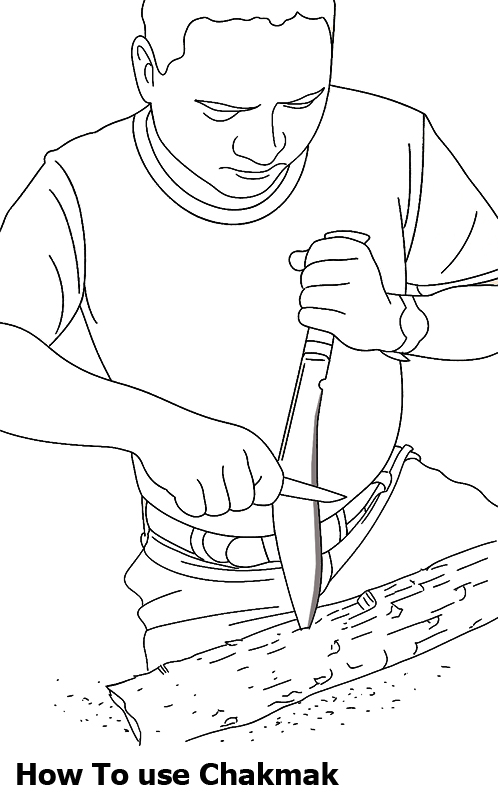
Using the chakmak — the traditional sharpening steel supplied with every authentic Nepali kukri.
Every authentic Nepali kukri ships with two small companion blades tucked into pockets on the scabbard. The chakmak is a small sharpening steel — a flat rod of hardened high-carbon steel, used to maintain the edge between full sharpenings. The karda is a small utility knife for fine work. The chakmak is what you use for daily and weekly edge touch-ups; the whetstone is what you use for full re-edging.
The chakmak technique:
- Hold the kukri firmly with the spine resting on a flat surface, cutting edge facing up. A wooden table or chopping block is ideal — never a hard surface like stone or metal, which can chip the edge.
- Hold the chakmak at roughly 20–25 degrees against the cutting edge. This matches the kukri's existing edge angle. Too steep an angle (40+ degrees) creates a rolled edge; too shallow (under 15 degrees) wastes effort.
- Draw the chakmak along the edge from the handle toward the tip in one smooth motion. Use light pressure — the steel does the work. The motion should feel like buttering bread, not scrubbing.
- Repeat on the same side for 6–10 strokes, then turn the kukri over and do the other side the same number of strokes.
- Test the edge by drawing it gently across a piece of paper or shaving a small section of hair on your forearm. A sharpened edge cuts paper cleanly without tearing.
The chakmak does not create a new edge — it realigns and polishes the existing edge as it dulls from use. For a fully dull or damaged edge, you need a whetstone. The chakmak is for the maintenance work between major sharpenings.
Full Edge Sharpening with a Whetstone
For a fully dull edge or after chip damage, the chakmak is not enough. You need a fine whetstone. The procedure:
- Soak a water stone for 10–15 minutes before use (oil stones do not need soaking). A medium grit (600–1,000) is right for re-establishing the edge; a fine grit (3,000+) finishes it.
- Match the existing edge angle — typically 20–25° per side for a working kukri, 15–20° for a slicing-focused blade. If you can see the existing bevel, hold the blade so the bevel sits flat on the stone.
- Push the blade across the stone in a sweeping motion from heel to tip, maintaining the angle throughout. Light pressure; the stone does the work.
- Alternate sides after every few strokes to keep the edge even.
- Check for a burr — a tiny rolled lip along the edge that indicates you've removed enough metal. When you can feel a burr along the full length of the edge, switch to the finer grit and repeat.
- Finish on the fine stone with even lighter pressure until the edge polishes and the burr disappears.
- Strop the edge on a leather belt or strop charged with polishing compound to remove any micro-burr and bring the edge to working sharpness.
A full sharpening on a 10-inch kukri takes 15–30 minutes the first time, less as you learn the angle. The chakmak then maintains the edge for months between full sharpenings.
Removing Rust from a Kukri Blade
Despite best efforts, rust will sometimes appear on a 5160 kukri — especially if the blade has been left in a humid environment, stored wet in the scabbard, or simply not oiled for too long. Removal technique depends on severity:
- Light surface tarnish (grey or brown haze, no pitting) — Wipe the blade with a clean cloth and a few drops of oil. Apply firm pressure. Most light tarnish lifts off into the cloth. Reapply protective oil afterwards.
- Moderate rust spots (orange-brown spots, slight roughness) — Use a fine-grit (#0000) steel wool pad or a copper scouring pad with a few drops of oil. Rub in the direction of the blade's length, never across. The steel wool removes the rust without scratching the underlying steel. Wipe clean, then re-oil thoroughly.
- Deeper rust or staining (dark patches, slight surface pitting) — A rust eraser block (sold by woodworking and knife-care suppliers) is the right tool. Work with light pressure along the blade. For stubborn spots, a paste of baking soda and water applied for 15 minutes then scrubbed with steel wool will lift heavier oxidation.
- Pitted blade (deep pits where rust has eaten into the steel) — This is permanent damage. The blade can still be used, but the pits will not polish out without removing significant metal. For a working blade this is cosmetic only; for a collection blade you may want professional restoration.
What to avoid: Wire brushes (too aggressive, scratch the polish), power-tool sanders or grinders (remove too much metal and risk overheating the temper), and aggressive household chemicals like bleach or strong acids (damage both steel and any nearby handle material).
After any rust removal, the steel is more vulnerable than before because the protective patina has been disturbed. Re-oil immediately and check daily for the following week to catch any new rust early.
Why You Should Never Store a Kukri Wet in the Leather Scabbard
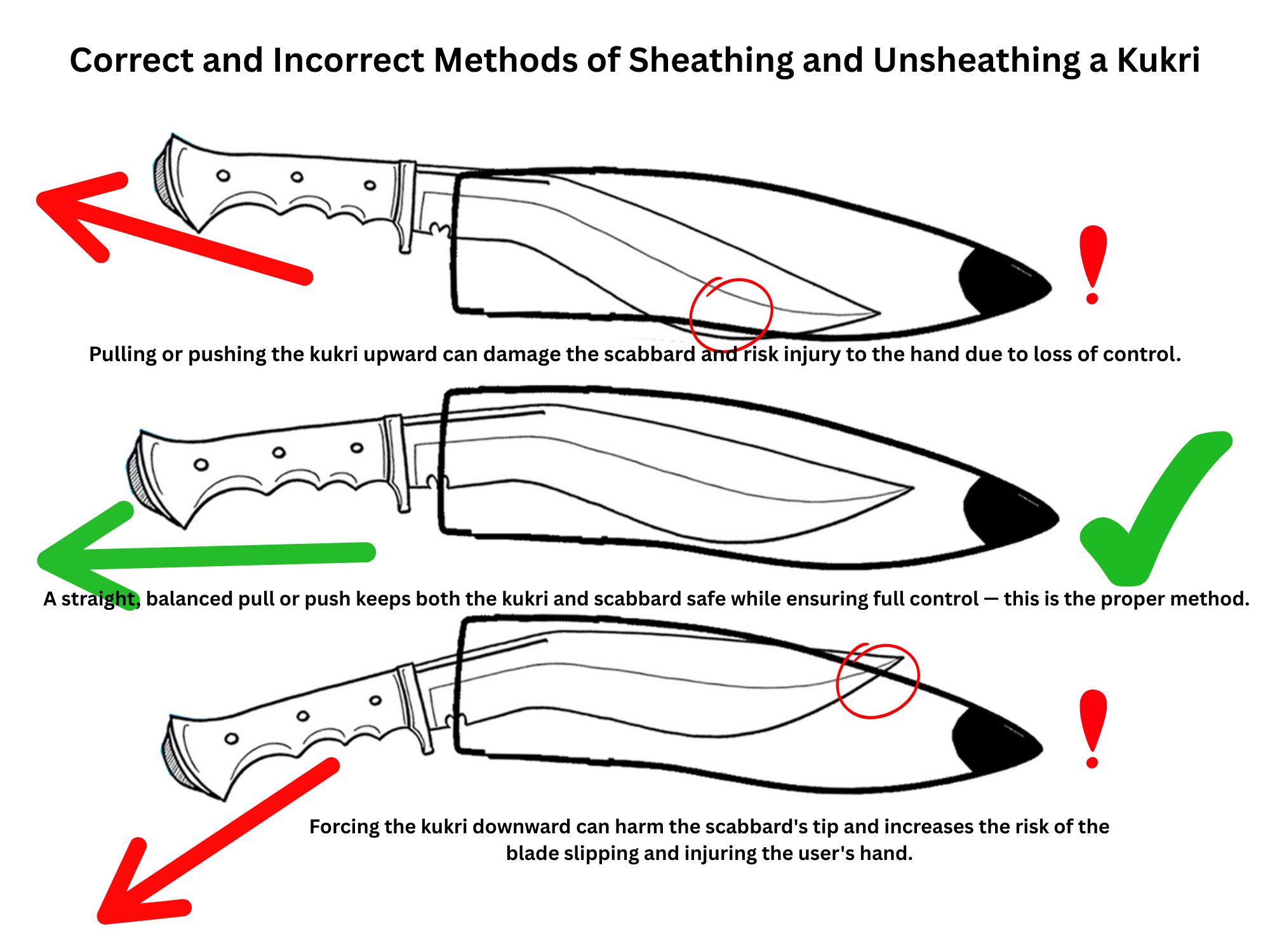
Three drawing methods compared: (1) Upward pull stresses the scabbard throat and risks cutting through the front lining. (2) Balanced straight pull — the correct method, protects the scabbard tip and lining. (3) Downward pull damages the scabbard tip over time. How you draw your kukri affects both your safety and the lifespan of the scabbard.
This is the single most common cause of avoidable kukri damage. Water-buffalo leather scabbards absorb and hold moisture — that's part of what makes leather a comfortable carrying material. But a damp leather scabbard against a 5160 blade creates exactly the corrosion conditions you spend the rest of your maintenance routine preventing.
The damage sequence:
- Kukri used in damp conditions (rain, wet vegetation, sweat from carrying).
- Blade re-sheathed without being fully dried.
- Moisture transfers from blade to scabbard lining, where it sits trapped.
- Within 24–72 hours, surface rust forms along the blade in a pattern matching the scabbard lining.
- Without intervention, the rust deepens into pitting within weeks.
The fix is simple: never sheathe a wet or damp blade for storage. After any wet use, wipe the blade thoroughly dry, leave it out of the scabbard for an hour or two to ensure full drying, oil it, and only then re-sheathe. For long-term storage (months or longer), store the kukri completely outside the scabbard — hang it on a wall mount, lay it on a shelf, or wrap it in oiled cloth. The scabbard can be stored separately.
Caring for the Handle and Scabbard
The blade gets most of the attention, but the handle and scabbard need their own light routine:
- Water-buffalo horn handles — Wipe with a clean cloth and a light coat of mineral oil every few months. This keeps the horn from drying and cracking. Avoid prolonged direct sunlight, which fades and cracks horn. Don't soak the handle.
- Hardwood handles (rosewood, sissoo) — Same treatment as horn: light mineral oil application every few months. Hardwood can also benefit from a thin coat of beeswax or furniture wax once a year for added protection.
- Micarta and G10 handle scales (on full-tang kukris) — Essentially maintenance-free. Wipe with a damp cloth if dirty. No oiling needed.
- Leather scabbard — Apply a small amount of leather conditioner (mink oil, neatsfoot oil, or commercial leather balm) once or twice a year, especially if the leather is exposed to dry climates that cause cracking. Don't over-condition — the goal is supple leather, not saturated leather.
- Brass fittings and silver scabbards (Kothimora) — Polish gently with a soft cloth. For brass, a small amount of brass polish removes tarnish. For silver, use a silver polishing cloth or mild silver cream. Don't use abrasive polishes that scratch decorative engraving.
The Karda and Chakmak Explained
Every traditional kukri scabbard has two small pockets on the back side holding the karda and the chakmak. Many new owners don't know what these blades are for. They are not decorations — they are working tools:
- The karda — A small utility knife (typically 3–5 inches blade length) used for fine work that the main kukri is too large for: skinning game, food preparation, carving notches, cutting cordage, opening packages. It is forged from the same 5160 steel as the main blade and is essentially a small kukri with a straight or slightly curved profile.
- The chakmak — A small hardened steel rod (typically 4–6 inches long) with two purposes. Primarily, it is a sharpening steel for maintaining the kukri's edge between full sharpenings — the technique covered above. Secondarily, the chakmak's hardened spine can be struck against a flint or quartz stone to produce sparks for fire-starting, which is why traditional Nepali soldiers and travellers carried it as part of their basic survival kit.
Both companion blades need the same basic care as the main kukri — keep them dry, oil them periodically, and sheathe them back in their scabbard pockets after use. If your kukri shipped with a karda and chakmak, look after them — replacement sets are available but the originals match the main blade's steel batch.
How a Hand-Forged Kukri Ages
A new kukri leaves our workshop polished, bright, and shiny. After a few years of use, it will not look like that — and that is exactly how it should look. A hand-forged kukri ages, and the ageing is part of its character. What's normal versus what's damage:
- Patina on the blade — A grey-blue or grey-brown surface tone that develops over time as the steel oxidises in a controlled way. Patina is NOT rust. Patina is the steel's own protective surface, and it makes the blade more rust-resistant over time, not less. Many traditional users encourage patina formation. Don't try to polish it off.
- Edge thinning — Over years of sharpening, the cutting edge gradually moves up the blade as metal is removed. This is normal blade life. A well-maintained kukri can lose 1–2mm of edge depth over a lifetime of regular sharpening without affecting performance.
- Handle darkening — Horn and hardwood handles darken with skin oils and hand contact over years. This is desirable — the darker tone is the mark of an owned and used blade.
- Leather softening — A new leather scabbard is stiff. After months of use it softens and conforms to the blade. This is good — supple leather grips the blade more securely.
- Small dings and edge marks — Working blades pick up small dings on the spine and tiny edge nicks. These are normal. They do not affect performance and can be left alone or polished out at the next major sharpening.
A well-aged hand-forged kukri tells the story of how it was used. A pristine 10-year-old kukri usually means an unused 10-year-old kukri — which is also fine if you bought it for collection or display, but the working blades that have served their owners properly always show the marks of that service.
When to Send a Kukri Back for Restoration
Most maintenance can be done at home. Some situations call for professional restoration:
- Cracked or split handle — Replace the handle. A failing handle is a safety issue. We re-handle our own blades on request; for blades from other makers, any competent knife-maker can do this work.
- Bent blade — A bent kukri can sometimes be straightened cold by a smith, but the safer route is professional re-tempering. Don't attempt to straighten a bent blade at home — you can crack it.
- Cracked tang — End of the blade's working life. The blade can be retired to display but should not be used for any task that puts load on the handle.
- Severe edge damage (large chips, sections of edge missing) — A skilled smith can re-grind a damaged edge back to working condition, removing the damaged section and re-profiling. This shortens the blade slightly but extends its working life.
- Antique or heirloom restoration — Old kukris in poor condition can often be restored to working order by a smith experienced with Nepali blades. The work is usually worth doing if the blade has sentimental or historical value.
For Everest Forge kukris, contact us before sending anything — we can often advise whether the work can be done at home, what it will cost if you send it to us, and what the realistic outcome will be. We do not charge for the conversation.
Maintenance and the Hand-Forged Difference
A hand-forged 5160 kukri rewards maintenance in a way factory-stamped blades cannot. The differential temper means a worn edge can be fully restored without compromising the spine's shock absorption. The traditional rat-tail or full-tang construction can be re-handled and re-fitted decades later. The hand-stitched scabbard can be rebuilt around the blade as the leather wears. A correctly-cared-for hand-forged kukri is a multi-generation tool — the same blade your grandfather carried can be the blade your grandson uses.
Factory blades, by contrast, are largely disposable. The grain structure cannot be repaired. The handle is fitted to a generic mould that does not accept replacement work. The blade is hardened uniformly so re-grinding the edge changes its temper. Maintenance on a stamped kukri-shaped object is essentially polishing what you have until you replace it.
The maintenance commitment that comes with a hand-forged kukri is the trade-off for a blade that improves with age and survives generations. Read more about the testing every Everest Forge blade passes in our Everest Forge battle-ready standard, and read about how every Everest Forge blade is made for the construction details these maintenance instructions reflect.
Continue Learning About the Kukri
- Kukri Handling Guide — Safe drawing, working grips, and carry positions.
- How a Kukri Is Forged — Inside the Kathmandu workshop, the steel and tempering behind your blade.
- Kukri (Khukuri) Guide — Blade patterns, tang construction, military heritage.
- Origin of the Kukri — The 2,500-year lineage from kopis to khukuri.
- Kukri Terminology Guide — Every part and pattern named.
- Honor of the Kukri — Cultural and Gurkha military tradition.
- Kukri FAQ — Quick answers to common buyer questions.
For a complete rust-prevention reference covering all our blade types, see our blog post on how to prevent rust on swords, kukris, machetes, and knives.
Frequently Asked Questions About Kukri Maintenance
How often should I oil my kukri?
After every use if the blade has been wet, sweated on, or used in humid conditions. For a kukri in storage or occasional use, check the oil film every 1–4 weeks depending on local humidity, and reapply when the film looks thin or dry. The goal is a continuous thin film of oil on the blade at all times — the steel is unprotected the moment that film is gone.
What oil should I use on a kukri?
Mineral oil (food-safe, neutral, available at any pharmacy or hardware store) is the safest default choice. Camellia oil is the traditional carbon-steel choice if you want premium protection. 3-in-1 oil works well. Traditional Nepali workshops still use mustard oil and coconut oil. Avoid cooking oils like olive or vegetable oil (they go rancid and gum up), WD-40 as a long-term protectant (it's a water displacer, not a protective oil), and silicone sprays (they don't protect carbon steel adequately).
How do I sharpen a kukri with the chakmak?
Hold the kukri firmly with the cutting edge facing up. Hold the chakmak at 20–25 degrees against the edge — matching the kukri's existing edge angle. Draw the chakmak smoothly from handle toward tip with light pressure, repeat 6–10 strokes on one side, then turn the kukri over and do the same on the other side. The chakmak realigns and polishes the existing edge between full sharpenings — it does not create a new edge on a fully dull blade. For that, you need a whetstone.
How do I sharpen a kukri properly with a whetstone?
Soak a water stone for 10–15 minutes. Use a medium grit (600–1,000) to re-establish the edge, then a fine grit (3,000+) to finish. Match the existing edge angle (typically 20–25° per side for working kukris). Push the blade across the stone in a sweeping motion from heel to tip, alternating sides. Continue until you feel a small burr along the full edge length, then switch to the finer grit. Finish by stropping on a leather belt to remove the micro-burr. Full sharpening takes 15–30 minutes for a 10-inch kukri.
My kukri has surface rust spots. How do I remove them?
For light tarnish, wipe firmly with a cloth and a few drops of oil — most light oxidation lifts off into the cloth. For moderate rust spots, use #0000 fine steel wool with oil, rubbing in the direction of the blade's length. For deeper rust, a rust eraser block (from knife-care suppliers) is the right tool, or a baking soda paste applied for 15 minutes and scrubbed with steel wool. After any rust removal, re-oil immediately — the steel is more vulnerable than before until a new protective film is established.
My kukri got stained. Will it come off?
It depends on what caused the staining and how deep it has gone. Light staining from sap, food acids, or surface oxidation usually wipes off with oil and a cloth. Moderate staining responds to #0000 steel wool with oil. Deeper staining that has actually pitted the steel is permanent — the pits cannot be polished out without removing significant metal. For working blades, deep staining is cosmetic and does not affect performance. For collection blades, contact us about professional restoration.
Can I leave my kukri in the leather scabbard for storage?
Not for long-term storage. Water-buffalo leather absorbs and holds moisture, and a blade stored in a damp leather scabbard will pit within weeks. For short-term storage (days or a few weeks) and assuming the blade and scabbard are both dry when stored, leather sheathing is fine. For long-term storage (months or longer), oil the blade heavily and store it outside the scabbard — wall-mounted, on a shelf, or wrapped in oiled cloth.
How do I care for the water-buffalo horn handle?
Wipe the handle with a clean cloth and a light coat of mineral oil every few months. This keeps the horn from drying out and developing surface cracks. Avoid prolonged direct sunlight, which fades and cracks horn. Don't soak the handle in water or leave it in damp conditions. With this minimal care, a water-buffalo horn handle will last decades and develops a beautiful darker patina with age.
What are the karda and chakmak in the scabbard pockets?
The karda is a small utility knife (3–5 inch blade) used for fine work the main kukri is too large for — skinning, food prep, carving, cutting cordage. The chakmak is a small hardened steel rod used as a sharpening steel for maintaining the kukri's edge between full sharpenings. The chakmak can also be struck against flint to produce sparks for fire-starting, which is why traditional Nepali travellers and soldiers carried it. Both are forged from the same 5160 steel as the main blade.
How do I prevent rust on my kukri?
Three habits prevent essentially all rust: wipe the blade dry after every use, especially if it has been wet or sweated on; maintain a thin film of oil on the blade at all times; never store the blade in a damp scabbard. Storage environment matters too — keep kukris in dry, ventilated areas, not in humid basements or near windows where condensation forms. For comprehensive rust-prevention information across all our blade types, see our blog post on how to prevent rust on swords, kukris, machetes, and knives.
Is patina on a kukri the same as rust?
No. Patina is a controlled grey-blue or grey-brown surface oxidation that forms slowly over time. It is the steel's own protective surface and actually makes the blade more rust-resistant, not less. Rust is reddish-brown, often appearing as raised spots, and it actively damages the steel by eating into it. Patina is good and should not be polished off; rust is bad and should be removed promptly. Many traditional kukri users encourage patina formation as part of the blade's character.
Can a damaged kukri be repaired or restored?
Yes, most damage is repairable. A worn edge can be re-ground. A damaged or cracked handle can be replaced. A worn scabbard can be re-stitched or rebuilt. A bent blade can sometimes be straightened by a skilled smith. Even severe edge damage can be ground back to a working profile that shortens the blade slightly but restores function. The exception is a cracked tang, which ends the blade's working life. For Everest Forge kukris, contact us before any major repair — we can advise on home repair versus sending the blade back to us.
Should I polish my kukri to keep it shiny?
For working kukris, no — let the natural patina develop. For ceremonial, display, or Kothimora kukris where appearance matters, use a fine-grit polishing compound (metal polish, jeweller's rouge) with a soft cloth, applied with light pressure in the direction of the blade's length. Avoid aggressive polishing compounds, power tools, or coarse abrasives — they remove metal and damage the decorative finish. For silver scabbards on Kothimora kukris, use silver polishing cloth or mild silver cream, not aggressive metal polish.
Looking for another kukri?
If you've maintained your first kukri well and you're thinking about a second blade — a different pattern for different work, or a gift for someone — every Everest Forge kukri is hand-forged in Kathmandu, water-tempered to the British Gurkha Army specification, and built to be maintained for generations. Free text personalisation. Photo approval before shipping. 30-day refund guarantee.
All hand-forged kukris → Commission a custom kukri → Kothimora ceremonial kukris →