A hand-forged kukri is a working tool, not a martial-arts weapon that requires special training. Nepali hill farmers, household guards, and Gurkha soldiers have used the kukri for over 1,400 years through the simple act of picking it up and using it — there is no certification course, no formal grip school, no secret technique. What there is, however, is a small handful of practical habits that protect your blade, your fingers, and the people around you. This guide covers those habits.
If you are reading this before buying your first kukri, the short answer is: kukris are easier to use than they look. If you can swing a hatchet, you can swing a kukri. Read the safety section, learn the safe-drawing technique, get comfortable with the hammer grip, and you will be using the blade competently within a few hours. If you are reading this after buying one, scroll to the sections on grip, carry, and first-time mistakes — those are the bits that will keep your blade sharp and your hands intact.
Is a Kukri Hard to Use?
No. A kukri is a forward-curved working knife that performs three jobs — chopping like an axe, slicing like a knife, clearing brush like a machete — and it does each of them with the same basic motion: a controlled overhead or sideways swing that lets the weighted belly of the blade do the cutting work. The forward curve concentrates mass toward the front of the blade, so the cutting edge arrives at the target with momentum and speed at the same moment. This is why kukri users don't need brute strength — the blade's geometry does the work.
The kukri has been the standard household and field tool across Nepal's hill regions for centuries, used by people who never received any formal training in its use. Children grow up around kukris and learn to use them safely by watching adults. The combat reputation comes from Gurkha military service, but the day-to-day reality of the kukri in Nepal is closer to a kitchen cleaver than a sword — a working tool you grab when you need to split firewood, harvest sugarcane, or process meat.
The handling skills that actually matter are: how to draw the blade safely from the scabbard, which grip suits which task, how to carry the blade when you're not using it, and how to protect the edge from damage. None of these take more than a few minutes to learn.
Safety Basics: Four Habits That Protect You
- Keep the blade sharp. Counterintuitive, but true: a sharp kukri is safer than a dull one. A dull edge requires more force to cut, the blade is more likely to slip off the target, and the slip ends up on your leg or hand. Touch up the edge with the supplied chakmak sharpening steel after each working session, and do a full sharpen with a fine stone every few months. See our kukri maintenance guide for full sharpening technique.
- Maintain a firm, dry grip. Wet or oily hands slip on horn and hardwood handles. If you're working in rain, sweat, or after handling food, wipe your hands dry before picking up the kukri. For sustained wet work, wear cotton or leather work gloves with textured palms.
- Know where the blade will go on a miss. Before every swing, look at the path the blade will travel if it misses the target or glances off. If that path crosses your leg, your foot, or another person — reposition. The kukri's forward weight makes follow-through hard to stop mid-swing.
- Store properly. Always sheathe the kukri when you're not using it, even for a few seconds. A bare kukri left on a workbench is a hazard. Keep blades out of the reach of children and visitors. Check the scabbard regularly for splits or worn stitching.
How to Draw a Kukri Safely from the Scabbard

Correct (safe) and incorrect (dangerous) ways to draw a kukri from the scabbard. The spine — not the edge — must stay in contact with the scabbard's inner back wall.
The single most common kukri-handling injury happens during drawing. The blade is curved and the edge is on the inside of the curve, so a careless draw can drive the cutting edge through the front of the scabbard — and into the hand holding the scabbard. The technique below prevents this entirely:
- Hold the scabbard correctly. If you're right-handed, the left hand grips the back of the scabbard (the spine side), palm wrapped around the back surface. Your fingers and thumb stay on the back and sides — they do not wrap around to the front (the edge side) of the scabbard. If your hand strays to the front, a sharp edge cutting through the scabbard lining will cut you.
- Tilt the scabbard slightly downward. A small downward angle (15–20°) makes the draw smoother and lets gravity help the blade slide free.
- Grip the handle in a closed fist. Right hand wraps the handle in a hammer grip, thumb on top or wrapped around — whichever feels secure. Don't pinch the handle; grip it.
- Keep the spine in contact with the back wall of the scabbard. Pull the kukri out smoothly, letting the spine slide along the inner back surface of the scabbard. The edge stays clear of the front lining throughout. This is the single rule that matters: spine touches back, edge stays clear of front.
- Re-sheathe the same way. When putting the kukri back, lower the spine first and let it follow the inner back of the scabbard. The edge slides in last, clear of the front lining.
This drawing technique is the same one taught in Gurkha regiments and is the way Kami smiths in Nepal teach new kukri users in the workshop. Practice it five or six times with a sheathed blade before any field use.
Three Working Grips You'll Actually Use

The two most-used working grips: the basic hammer grip for chopping, and the thumb-up grip for controlled cutting.
Forget any list of seven or ten grips you'll see in martial-style guides. For actual working use, you only need three grips, and most users will use only two of them most of the time:
- Hammer grip. Closed fist wrapped around the handle with the thumb on top of the grip or wrapped around — like holding a hammer. Hand at the rear of the grip for maximum leverage. This is the grip for chopping: firewood, branches, brush, crops. It is the grip you will use 80% of the time. The wrist stays loose; the swing comes from the elbow and shoulder, not from snapping the wrist.
- Thumb-up control grip. Same hammer grip, but the thumb is extended along the spine of the handle. This adds precision and reduces over-rotation on the swing. Use this grip for controlled slicing: cutting rope, slicing thick vegetables, trimming branches you don't want to fully separate. The thumb on the spine acts like a guide rail.
- Choked-up grip. Hand slides forward on the handle, sometimes even onto the blade ricasso (the unsharpened section just in front of the handle). This shortens the effective blade length and gives you maximum control for fine work: skinning, food prep, carving, detail work. Used the same way you'd choke up on a chef's knife.
Adjust your grip to the task, not the other way around. If you're chopping and the swing feels weak, drop your hand back on the handle for more leverage. If you're carving and the blade feels uncontrollable, choke up. The kukri is forgiving — it doesn't punish grip changes, and you'll naturally find what works through a few hours of use.
How to Carry a Kukri Day-to-Day
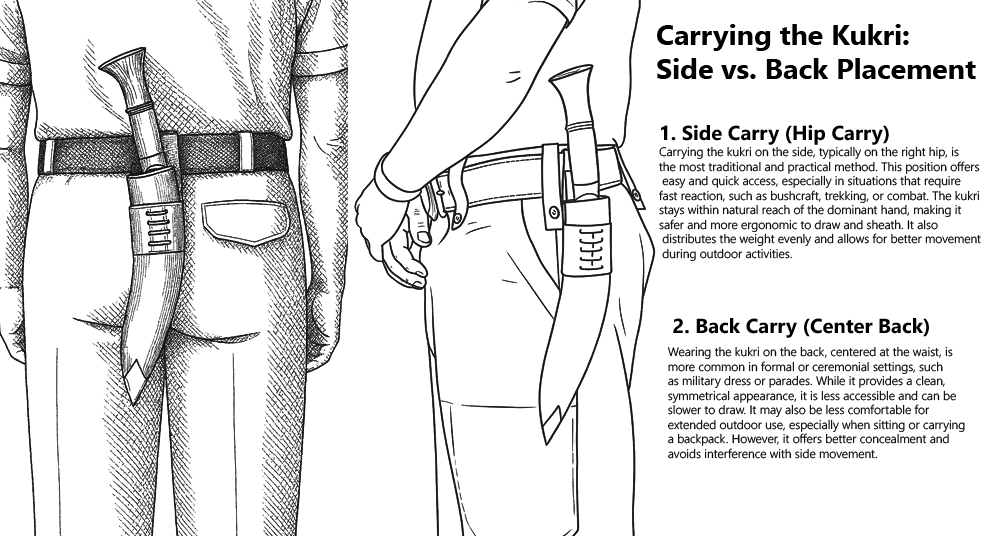
Two traditional carry positions: side carry for field use and daily work, centred-back carry for ceremonial and parade contexts.
The way you carry a kukri depends on what you're doing with it. The traditional and practical carry positions:
- Side carry (left hip for right-handed users). The most common carry position for field use, trekking, hunting, and bushcraft. The scabbard hangs on the left waist, allowing the right hand to draw across the body. This position keeps the blade out of the way of your arm swing when walking and lets you sit or kneel without the scabbard fouling. Most modern kukri scabbards include belt loops or webbing attachments for this position.
- Centred back carry. The kukri sits horizontally or vertically across the lower back. This is the traditional Gurkha ceremonial and parade carry, where both hands need to be free for drill movements. It also works for trekkers carrying a backpack, where the side position would conflict with a hip belt. The trade-off is slower drawing time, but for non-emergency working use this rarely matters.
- Vertical thigh carry. The scabbard hangs down the outside of the thigh, suspended from the belt by a drop loop. Useful for fieldwork where you're constantly bending — kneeling, gardening, processing game — because the scabbard moves with your hip rather than fouling on your waist.
- Backpack attachment. For trekkers and bushcrafters carrying multiple tools, lashing the scabbard to the side of a pack works well. Use webbing loops or paracord to secure the scabbard so it doesn't shift, and orient the handle for easy single-handed access without removing the pack.

Modern adaptations: horizontal scout-style carry, back-shoulder carry for trekking, and front-chest carry for guided access during fieldwork.
One traditional carry method worth noting because it appears in older photographs: many Nepali hill farmers historically wore the kukri tucked into the waist wrap of their daily dress without a belt — the cloth wrap held the scabbard secure. This is still common in rural Nepal today and is the simplest possible carry method for anyone wearing a cloth sash or wide belt.

Limbu men on their way to the haat bazaar (weekly market) in Myanglung — kukris tucked into the cloth waist wrap, a centuries-old daily-carry method.
Working with a Kukri: Common Tasks
The kukri replaces three tools — axe, machete, knife — so the working tasks you'll do with it cover all three:
- Splitting kindling and small firewood — Hammer grip, full overhead swing, let the weighted belly do the work. For thicker logs, use the kukri to baton (lay the blade across the log and strike the spine with a wooden stick to drive the blade through).
- Clearing brush, vines, and undergrowth — Hammer grip with a sweeping side-to-side motion. The inward curve catches and slices vegetation on the draw stroke. Don't chop straight down into ground-level brush — you'll dull the edge on rocks and soil.
- Bushcraft and shelter work — Choked-up grip for notching, feather-sticking, and detail work. Hammer grip for cutting poles and shelter staves.
- Field food preparation — Choked-up grip on a stable cutting surface. The flat side of the kukri makes a passable cleaver for processing game and food prep.
- Garden and farm work — Same techniques as Nepali farmers use: hammer grip for harvesting bamboo, sugarcane, corn, and millet; choked-up grip for trimming and pruning.
One rule applies across all tasks: cut into wood, never into ground. The kukri is heat-treated for cutting fibrous material — wood, vegetation, food. Striking soil, gravel, or rocks chips and rolls the edge fast. If you're processing wood on the ground, use a chopping block (a flat log section, end-grain up) underneath your work.
Match the kukri to the task
For bushcraft, splitting, and heavy outdoor work, a full-tang working kukri in 10–13 inches is the right tool — see our heavy-duty working kukri collection. For belt-carry and lighter utility work, a compact kukri in 6–9 inches handles like a large knife — see our small EDC kukri collection. For oversized chopping, see our 15-inch and larger kukri collection.
First-Time User Mistakes to Avoid
Most kukri-related accidents and blade damage come from a small list of repeated mistakes. Avoiding these protects your fingers and your edge:
- Drawing the kukri with your hand wrapped around the front of the scabbard. Already covered — the edge can cut through the lining into your hand. Hand on the back only.
- Chopping into ground that hides rocks or grit. One strike against a rock can chip the edge in a way that needs serious grinding to repair. Use a chopping block.
- Swinging too hard. The kukri's weight does the work. New users often swing as if they're using a much lighter knife, which leads to over-swing, missed targets, and exhausted shoulders. Let the blade fall; don't force it.
- Leaving the blade in the leather scabbard for long-term storage. Leather absorbs and holds moisture, which pits high-carbon steel. For long storage, oil the blade and leave it out of the scabbard. See storage and oiling guidance.
- Trying to baton through a knot. Wood knots are far harder than surrounding grain. Batoning through a knot can damage the edge or even crack the blade. Work around knots.
- Using the kukri as a pry bar. A kukri is a cutting tool, not a lever. Twisting or prying with the blade buried in wood is the fastest way to crack a tang or break a handle.
- Storing the kukri vertically (point down) in the scabbard. Over time, the blade's weight pushes the tip into the scabbard's stitching at the bottom. Store kukris horizontally or hung point-up.
Why a Hand-Forged Kukri Handles Differently
A hand-forged 5160 spring-steel kukri handles differently from a factory-stamped kukri-shaped blade, and the difference matters for technique:
- The balance point is forward. Hammering the curve into the blade aligns the grain along the cutting line and concentrates mass at the belly. This is why a hand-forged kukri "wants" to chop — the weight pulls the cutting edge into the target. Stamped blades have flat grain structure and a balance point closer to the handle, which feels lighter but cuts less efficiently.
- The spine flexes; the edge bites. Water-tempering hardens only the cutting edge, leaving the spine softer and shock-absorbent. In practice this means the blade absorbs impact through the spine without transferring shock into your wrist, and the hard edge bites the work without rolling. A uniformly-hardened factory blade transmits more shock and is more prone to chipping on hard targets.
- The handle is fitted for the blade's specific weight. Each Everest Forge kukri is balanced individually because each blade is a slightly different weight after forging. Mass-produced kukris use the same handle for every blade regardless of variation, which is why the balance feels generic.
If you've handled cheaper factory kukris before and found them awkward, that's not because kukris are awkward — it's because mass production can't replicate the balance characteristics of hand-forging. A correctly hand-forged kukri feels alive in the hand. Read about the Everest Forge battle-ready standard for the testing every blade passes before shipping.
Cultural and Ceremonial Considerations
The kukri is more than a working tool in Nepali culture — it is a sacred object that appears in religious ceremonies, household rituals, and life events. If you own a kukri and want to handle it respectfully in cultural contexts, a few traditional practices to know:
- Don't step over a kukri. In traditional Nepali households the kukri is treated as a living object; stepping over one is considered disrespectful.
- Don't draw a kukri in anger. Tradition holds that a kukri drawn in anger must be ceremonially "fed" — historically with blood — before being re-sheathed. The practical version of this rule today is: don't draw the blade unless you intend to use it.
- Don't gift a kukri without including a small coin or note. The traditional Nepali custom is that a kukri given as a gift should never be passed for free — the recipient gives the giver a small symbolic payment (a coin, a banknote, a token) in return. This prevents the gift from "cutting" the relationship between giver and receiver.
- During Dashain, the kukri may be placed on an altar and worshipped with red tika, marigold flowers, and incense as part of household puja. If you receive a kukri as a gift during festival season, this is the traditional way to receive it.
For the deeper cultural and oath-taking significance of the kukri in Gurkha tradition, see our Honor of the Kukri page.
Continue Learning About the Kukri
- Kukri Maintenance Guide — Sharpening, oiling, scabbard care, long-term storage.
- Kukri (Khukuri) Guide — Blade patterns, tang construction, military heritage.
- How a Kukri Is Forged — Inside the Kathmandu workshop, from 5160 spring steel to finished blade.
- Origin of the Kukri — The 2,500-year lineage from kopis to khukuri.
- Kukri Terminology Guide — Every part, pattern, and term explained.
- Honor of the Kukri — Cultural and Gurkha military tradition.
- Kukri FAQ — Quick answers to the most common buyer questions.
Frequently Asked Questions About Kukri Handling
Is a kukri hard to use for a beginner?
No. A kukri is a working tool that has been used by Nepali hill farmers and households for over 1,400 years without formal training. If you can swing a hatchet or use a chef's knife, you have all the basic skills needed. The forward-curved blade does most of the cutting work through its weight and geometry — beginners don't need brute strength or special technique. The most important skills to learn first are: how to draw the blade safely from the scabbard (spine against the back wall), and the basic hammer grip for chopping. Both can be learned in under an hour.
How do I draw a kukri safely from its scabbard?
The single rule is: the spine of the blade must stay in contact with the inner back wall of the scabbard during drawing. For right-handed users, the left hand grips the back of the scabbard (palm and fingers on the back, never wrapped around to the front edge side), the right hand grips the handle in a closed fist, and the blade is drawn out smoothly with the spine sliding along the back of the scabbard. This keeps the cutting edge away from the front lining of the scabbard, preventing the edge from cutting through and into your hand. Re-sheathe the same way: spine first, edge clear.
What grip do I use for chopping wood with a kukri?
The hammer grip — a closed fist around the handle with the thumb either on top of the grip or wrapped around. Position your hand at the rear of the handle for maximum leverage. Keep your wrist loose; the swing comes from the elbow and shoulder, not from snapping the wrist. Let the weighted belly of the blade do the work — kukris are designed so chopping power comes from blade geometry, not arm strength. For thicker logs, baton by laying the blade across the log and striking the spine with a wooden stick.
How do I carry a kukri?
The most common carry position is side carry at the waist — for right-handed users, on the left hip, with the scabbard suspended from a belt loop or webbing. This allows easy cross-body drawing and keeps the blade out of the way during normal arm movement. Other traditional carry positions include centred back carry (used in Gurkha ceremonial parades), vertical thigh carry (useful for fieldwork involving frequent kneeling), and backpack attachment (for trekkers). Many rural Nepali users still carry the kukri tucked directly into a cloth waist wrap without a belt — the simplest possible method for anyone wearing a sash.
How heavy is a kukri and how does that affect handling?
A standard 10–12 inch working kukri weighs roughly 500–800 grams (1.1–1.8 lbs), with the balance point typically 2–3 inches forward of the handle. Large blade kukris (15"+) can weigh 1–1.5 kg. The forward balance is intentional — the weight sits in the belly of the blade so the cutting edge arrives at the target with momentum, doing the cutting work that would otherwise require arm strength. This is why kukris feel "alive" in the hand compared to straight knives, and why even small users can chop effectively with a properly-balanced blade.
Can children or smaller adults use a kukri?
Yes — with appropriately-sized blades. Nepali children grow up using small kukris (6–8 inch blade) for household and farm tasks, and the forward-curved design means even users with limited grip strength can chop effectively. For smaller hands or first-time users, choose a compact kukri in the 6–9 inch blade range — see our small EDC kukri collection. Adult supervision is recommended for any user under teenage years, but the kukri is not inherently a "large adult" tool.
Why does my kukri's edge chip when I chop?
Almost always because of one of three things: striking hidden grit, rocks, or soil; cutting through a wood knot; or hitting another piece of metal (a hidden nail, a wire fence). Always use a chopping block under your work, and inspect targets for hidden materials before swinging. If the chip is small, it can be ground out during the next sharpening — see our kukri maintenance guide for re-edging technique. If the chip is severe and the blade is a recent purchase, contact us — we cover edge damage caused by manufacturing flaws under our 30-day guarantee.
What is batoning and is it safe with a kukri?
Batoning is a wood-splitting technique where you lay the blade across a log and strike the exposed spine with a wooden baton (a sturdy stick) to drive the blade through the wood. It is safe with a hand-forged 5160 kukri, which is designed to absorb impact through the spine. The technique is widely used in bushcraft for splitting kindling without the noise and effort of full swinging. Avoid batoning through wood knots, which can damage the edge, and use a wooden baton — never a metal hammer, which can shock the blade.
How do I avoid blisters from extended kukri use?
Extended chopping work raises blisters at the base of the thumb and the heel of the palm — the contact points where the handle rubs during repeated swings. To prevent: wear lightweight cotton or leather work gloves with textured palms, take breaks every 15–20 minutes during sustained work, and don't grip the handle harder than you need to (over-gripping is the main blister cause). For users who do a lot of kukri work, a moulded micarta or G10 grip on a full-tang kukri is more blister-friendly than a smooth horn or hardwood handle — see our working kukri collection for full-tang options.
Can I use a kukri in wet conditions?
Yes, but plan to dry and re-oil the blade afterwards. The 5160 high-carbon steel will start to spot-rust within hours of sustained exposure to water or sweat, and the cutting edge is the first surface to corrode. After wet use: wipe the blade thoroughly dry with a clean cloth, apply a thin film of mineral oil, camellia oil, or 3-in-1 oil to all metal surfaces, and store outside the leather scabbard until fully dry. Leather scabbards retain moisture and will accelerate corrosion if the blade is sheathed wet.
How long does it take to learn to use a kukri well?
The basic skills — safe drawing, hammer grip, controlled swing — are learned in the first hour of use. Building real proficiency at chopping efficiency, accurate cuts, and minimum-effort technique takes around 10–20 hours of practical field use. After 50 hours of regular use, the kukri starts to feel like an extension of your hand. There is no advanced "kukri mastery" curriculum beyond this point — it is a working tool, and proficiency comes from working with it, not from drilling techniques.
Should I wear gloves when using a kukri?
Gloves are recommended for sustained chopping work (to prevent blisters and improve grip in wet conditions) but not strictly necessary for occasional use. Choose cotton or leather work gloves with textured palms — avoid smooth-faced gloves that reduce grip security. For wet or cold-weather use, gloves significantly improve safety. For fine work (food prep, carving, detail tasks), bare hands give better feel and control.
Is a kukri safe for everyday carry (EDC)?
The blade itself is safe to carry — the scabbard fully encloses the edge and traditional retention prevents accidental falls. The legal question is more nuanced: most jurisdictions restrict public fixed-blade carry, and a kukri with a 10+ inch blade is generally considered a large fixed-blade for legal purposes. Compact kukris in the 6–9 inch blade range are more commonly used for genuine EDC in jurisdictions where fixed-blade carry is permitted. Always check local knife laws before carrying. See our small EDC kukri collection for compact options.
Choose the right kukri for your use
You now know the handling basics. The next step is matching the kukri to the work you'll do with it. Every Everest Forge kukri is hand-forged in Kathmandu, water-tempered to take a working edge, photographed for your approval before shipping, and backed by a 30-day refund guarantee.
Heavy-duty working kukris → Small EDC kukris → All hand-forged kukris →