Menu
Your Cart

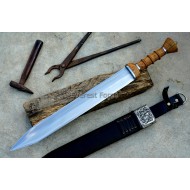
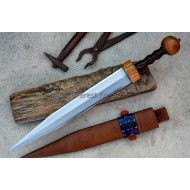
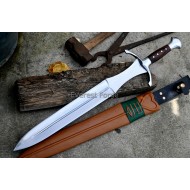
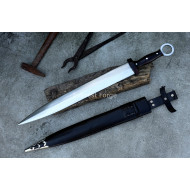
Hand-Forged Pompeii Gladius Sword, Ball Pommel

Hand-Forged Pompeii Gladius Sword, Ball Pommel
$164.99
Ex Tax: $164.99
  • Model: GLadius Dagger
  • Product Code: Gladiusdagger017
  • Location: Kathmandu,Nepal

Available Options

Hand-Forged Pompeii Gladius Sword — Broad Blade with Ball Pommel

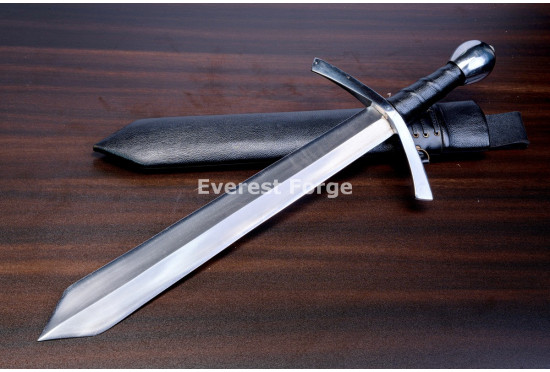
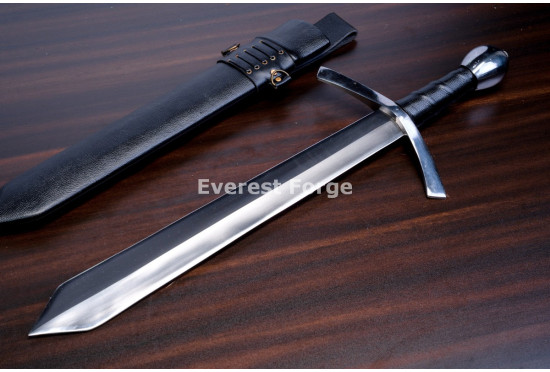
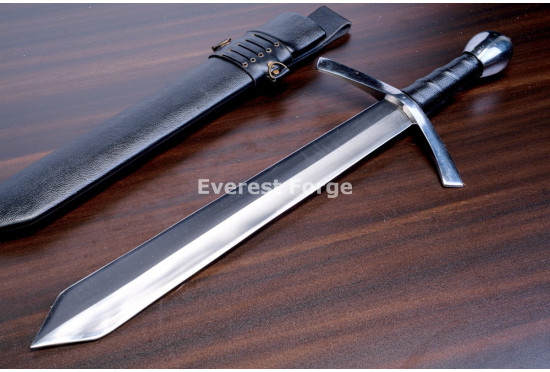
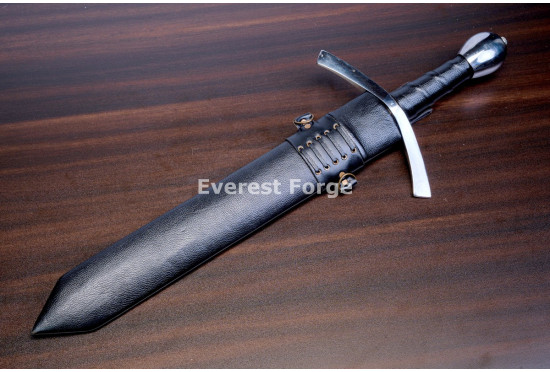
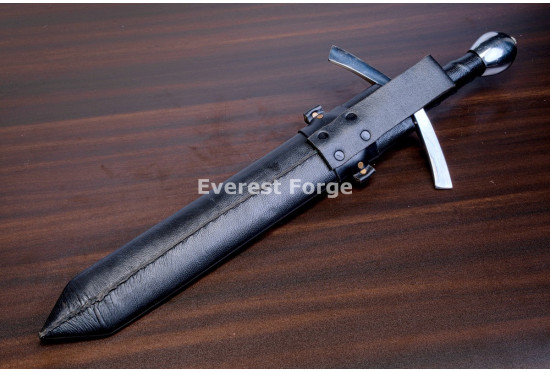
This is a hand-forged, fully functional gladius in the Pompeii pattern — a broad, straight, double-edged blade with parallel edges running to a short triangular point, forged in Nepal from 5160 high-carbon spring steel, oil-tempered, full tang, and sharpened to a true edge. The blade is finished satin. The hilt is European rather than Roman: a swept steel cross with curved quillons, a black leather-wrapped grip, and a large polished ball pommel. It ships with a black leather scabbard with laced detail. Every sword is made to order in your chosen length, finish, and engraving.

The standard blade is 17 inches on a 6-inch hilt with a 3.7-inch grip, for an overall length around 23 inches at about 1.21 kg. That grip is short by modern sword standards and deliberately so — a Roman gladius held the hand snugly between guard and pommel, and it is the proportion that makes the sword work. The oil-tempered 5160 steel and full tang make it a working sword, not a cast wall-hanger.

An honest note. The blade is Roman; the hilt is not. A Pompeii gladius blade is exactly this — broad, straight, parallel-edged, ending in a short triangular point — and the proportions here follow the type closely. But a Roman hilt was a very different object: a wooden or bone grip with deep finger grooves, a rounded wooden guard, and a large spherical pommel, all of it wood, bone or ivory rather than steel, and no crossguard in the medieval sense at all. This one carries a swept steel cross and a steel ball pommel, which are European medieval furniture. It is a hybrid and we would rather say so. If you want a properly Roman hilt with a grooved grip and wooden fittings, we will build one.

Bespoke Service

Forge a Gladius to Your Own Design

Want a correct Roman hilt with a grooved grip, a Mainz or Fulham blade, a different pommel, or your own engraving? Our Custom Forge service builds swords to your spec, by hand in Kathmandu.

Request a Custom Forge →

What Is a Pompeii Gladius?

The gladius was the sword of the Roman legionary, and modern scholarship sorts it into four main patterns named after the places their best-known examples were found. The Hispaniensis is the earliest and longest, with a waisted blade. The Mainz type is shorter with a pronounced waist and a long tapering point. The Fulham sits between Mainz and Pompeii, with a straighter blade and a slightly shorter point. And the Pompeii — named for examples recovered from the town buried by Vesuvius in AD 79 — is the last and by far the most common: parallel edges running straight down the blade, no waist at all, and a short triangular point. It was the simplest of the four to make, which is a large part of why it became standard. This sword follows that pattern.

Real Forged BladeHand-forged 5160 spring steel, full tang, oil-tempered and sharpened.
Pompeii PatternParallel edges and a short triangular point — the standard legionary blade.
Broad SectionA wide blade built to thrust hard and cut when it has to.
5160 Spring SteelTruck leaf-spring steel — tough, shock-resistant, holds an edge.
Ball PommelLarge polished steel pommel above a swept cross with curved quillons.
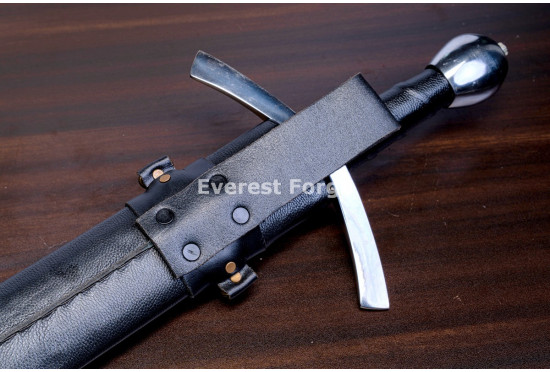
Laced ScabbardBlack leather scabbard with laced detail and belt fittings.

Specifications

TypeHand-forged gladius, Pompeii blade pattern with European hilt
Blade Length17 inches standard (custom lengths to order)
Handle Length6 inches overall, 3.7-inch grip section
Overall LengthApprox 23 inches at standard blade size
WeightApprox 1210 g total, 930 g blade
Blade Steel5160 high-carbon spring steel (truck leaf spring)
Heat TreatmentOil-tempered — hard edge, flexible spine
Blade StyleDouble-edged, broad with parallel edges, short triangular point, satin finish, sharpened
TangFull tang, secured at the pommel
HandleWood core under a black leather wrap
FittingsPolished steel swept cross and large ball pommel
ScabbardBlack leather with laced detail and belt fittings, included
OriginHand-forged in Tokha-3, Kathmandu, Nepal

Customize Your Gladius

Every sword is forged to order. Set your options before you add to cart:

Blade PatternPompeii as standard, or a waisted Mainz, or the transitional Fulham.
Blade LengthStandard 17 inches, or order a shorter or longer blade to your spec.
Hilt StyleEuropean cross and ball pommel as standard, or a correct Roman grooved grip.
Blade FinishSatin as standard, or polished, dark forge finish, or antiqued.
Grip WrapBlack leather as standard, or brown, oxblood, or a bare wooden grip.
EngravingAdd a name, date, or your own pattern to the blade or scabbard.

Hand-Forged, Not a Wall-Hanger

This Gladius

  • Hand-forged 5160 high-carbon spring steel
  • Oil-tempered, hard edge and flexible spine
  • Full tang secured at the pommel
  • Blade geometry forged and ground, with a real distal taper
  • Sharpened, balanced, made to your spec

A Wall-Hanger

  • Cast stainless, brittle under load
  • No real heat treatment
  • Rat-tail tang that snaps at the guard
  • Flat plate blade with no taper and no section
  • Blunt, display-only

How It Is Made

You set the spec — blade pattern, length, hilt style, finish, wrap colour and engraving.
A smith forges the blade from a 5160 leaf-spring billet, drawing the parallel edges and the triangular point.
The blade is oil-tempered, then polished to a satin finish and hand-sharpened along both edges.
We fit the cross and ball pommel, wrap the grip, secure the tang, build the scabbard, and ship worldwide tracked.

Who It Is For

  • Collectors of Roman arms who want the Pompeii pattern specifically rather than a generic gladius
  • Buyers who like the Roman blade but prefer European hilt furniture
  • Cutting practitioners who want a short, broad, controllable blade
  • Reenactors, though those wanting period accuracy should order the Roman hilt option
  • Larp and costume users, who should order the display-blunt option
  • Gift buyers personalizing a blade with a name, date, or engraving

What Is Included

  • One hand-forged Pompeii-pattern gladius, built to your chosen spec
  • Black leather scabbard with laced detail and belt fittings
  • Leather-wrapped grip with polished steel cross and ball pommel
  • Any personalization or engraving you ordered
  • A satin-finished, sharpened blade
  • Everest Forge manufacturer warranty

Explore More Hand-Forged Swords

Shipping, Returns & Care

Shipping

In-stock specs dispatch within 2 to 3 business days; fully custom builds take roughly 4 to 6 weeks to forge before dispatch. We ship worldwide by DHL or FedEx in 7 to 14 business days, tracked. Import and blade laws vary by country, and double-edged blades face tighter restrictions than single-edged ones in a number of places, so please check your local rules before ordering.

Returns & Warranty

Every blade is backed by the Everest Forge warranty against forging and material defects. If something is wrong with your order, we will repair, replace, or refund it. Personalized and custom-engraved blades are made to order, so please confirm your spec carefully before purchase.

Care

Wipe the blade clean and dry after handling, and apply a light coat of oil before storage to protect the high-carbon steel from moisture. Pay attention to the join where the blade meets the cross, which traps moisture and is easy to miss. Treat the leather wrap and scabbard with a conditioner two or three times a year, and do not store the sword inside the scabbard for long periods.

From The Forge

Build a Gladius That Is Yours Alone

Beyond the options here, our Custom Forge service will build a properly Roman hilt with a grooved grip and wooden fittings, a Mainz or Fulham blade pattern, or a sword matched to an archaeological reference you send us. Roughly 4 to 6 weeks from order.

Start a Custom Forge →

Frequently Asked Questions

What is a Pompeii gladius?

The gladius was the Roman legionary's sword, and modern scholarship sorts it into four patterns named after the sites their best-known examples came from. The Hispaniensis is the earliest and longest, with a waisted blade. The Mainz is shorter with a pronounced waist and a long tapering point. The Fulham falls between Mainz and Pompeii, straighter with a shorter point. And the Pompeii — named for finds from the town buried by Vesuvius in AD 79 — is the last and most common: parallel edges running straight down the blade with no waist at all, and a short triangular point. It was also the easiest of the four to forge, which is a good part of why it became the standard issue.

Why was the gladius so short?

Because of how it was used, not because Romans were short of steel. A legionary fought behind a scutum, a large curved rectangular shield, packed shoulder to shoulder with the men either side of him. In that formation there is no room to swing — a long sword would foul on your own shield, the man beside you, or both. What there is room for is a short, hard thrust past the edge of the shield into whoever is pressed against the other side of it. The gladius is built for exactly that: broad enough to make a wide wound, short enough to work in a press, and pointed enough to punch through. Roman writers were explicit that the thrust was preferred to the cut, and the sword reflects it. It is also worth remembering the gladius was the secondary weapon — the pila, the heavy throwing spears, came first.

Which side did Romans wear the gladius on?

The right, for most of the imperial period, which surprises people every time. A modern or medieval sword hangs on the weak side and is drawn across the body, but a legionary's left arm was occupied by a large shield, and reaching across it to draw would have opened his guard and taken time he did not have. Wearing the gladius high on the right hip let him draw straight down and out with the sword hand alone, in one short movement, without moving the shield at all. It works precisely because the blade is short — try it with a longsword and you cannot clear the scabbard. Centurions are generally shown wearing theirs on the left, which is usually read as a mark of rank rather than a different fighting method.

What replaced the gladius?

The spatha. It was originally the longer sword of Roman cavalry — a horseman needs reach that an infantryman in a formation does not — and over the second and third centuries AD it spread to the infantry as well, until the gladius largely disappeared from the legions. The reasons are debated, but the shift in how Roman armies fought is the usual explanation: as formations opened up and cavalry grew more important, reach mattered more than compactness. The spatha then went on to become the direct ancestor of the migration-period and early medieval European sword, which is why a Viking-age blade looks far more like a spatha than like anything Roman infantry carried. If you want a spatha, ask through Custom Forge.

Is this a historically accurate gladius?

The blade is; the hilt is not. The Pompeii blade pattern — broad, parallel-edged, short triangular point — is correct for the type, and the proportions are right. The hilt is where it departs. A Roman gladius hilt was assembled from a wooden or bone grip with deep finger grooves, a rounded wooden guard and a large spherical wooden pommel, sometimes in ivory on an officer's sword, and it had no crossguard in the medieval sense at all. This one has a swept steel cross with curved quillons and a steel ball pommel, which is European medieval furniture on a Roman blade. It is a hybrid, deliberately, and we would rather label it plainly. A correct Roman hilt is available as a custom build.

How does this differ from your other gladius swords?

Blade pattern and fittings. This one is the Pompeii pattern — parallel edges, no waist, short triangular point — on a European hilt with a swept cross and a ball pommel. Our Fulham gladius follows the transitional Fulham pattern instead, with a slightly narrowing blade and a longer point, and it is the closer of the two to a documented Roman type. Our fantasy gladius pairs a Roman blade with a disc-pommel medieval hilt and a banded scabbard, and leans furthest from historical. Buy the Fulham if you want the most accurate blade, this one if you prefer the broad parallel-edged Pompeii shape, and the fantasy version if the look matters more than the classification.

Is this a real, functional sword?

Yes. It is hand-forged from 5160 high-carbon spring steel, full tang, oil-tempered, and sharpened to a true cutting edge before it ships. The cross and pommel are solid steel and the tang is secured at the pommel rather than glued or threaded into a stub. It handles tatami mats, water bottles and light green targets well. Do not use it on bone, metal, seasoned hardwood, or anything you would not put a good knife through.

What steel is it, and is it oil-tempered?

The blade is forged from 5160 high-carbon spring steel, the same alloy used in heavy-duty truck leaf springs, prized for toughness and edge retention. It is oil-tempered for a hard cutting edge backed by a flexible, shock-absorbent spine. Roman smiths were chasing the same property with pattern-welding and selective carburising, using the materials available to them — a blade hard enough to hold an edge but tough enough not to shatter. Modern spring steel reaches it far more reliably than any bloomery iron could.

Is it full tang, and how short is the grip really?

Full tang, secured at the pommel, so the cross and grip are mechanically captured on the tang itself rather than glued or threaded onto a stub. As for the grip — 3.7 inches sounds very short and it is, by modern standards, but it is correct rather than a compromise. A Roman gladius grip held the hand snugly between the guard and a large pommel, with the pommel actually resting against the heel of the hand. That is what gives the sword its control on a thrust: your hand cannot shift on the grip, so the point goes where you send it. If you have only handled medieval swords it feels cramped for the first few minutes and then stops feeling like anything at all.

What are the grip, fittings and scabbard made of?

The grip is a shaped wooden core under a black leather wrap. The swept cross and the ball pommel are polished steel — solid, not cast alloy or plated pot metal. The scabbard is black leather with laced detail and belt fittings, made by hand to fit the blade size you order. Because leather is a natural material, colour and finish vary slightly between pieces. A Roman scabbard would have been a wood-cored, leather-covered affair with bronze or tinned fittings and often decorative plates, which we can build to order if you want the whole sword taken in that direction.

Does it arrive sharpened, and can I order a Roman hilt?

It arrives sharpened as standard along both edges and the point, finished by hand. Choose the display-blunt option if you need it unsharpened for reenactment, larp, display, or to satisfy import rules where you live, at no extra charge. And yes to the Roman hilt: a grooved wooden or bone grip, a rounded guard and a large spherical pommel, which turns this into a properly Roman sword rather than a hybrid. We will also forge the Mainz or Fulham blade patterns if you want a different type. Send us an archaeological reference if you have one and we will tell you honestly how close we can get.

Do you ship worldwide, and how long does it take?

Yes. We ship worldwide from Nepal by DHL or FedEx in 7 to 14 business days with tracking. In-stock specs dispatch within 2 to 3 business days; fully custom builds take roughly 4 to 6 weeks to forge first. Import and blade laws vary by country and double-edged blades face tighter restrictions than single-edged ones in a number of places, so please check your local rules carefully before ordering.

Specification
Blade: 17 inches. Hand forged from 5160 carbon steel
Total Length: 23 inches long in total
Handle: 6 inches overall with a 3.7 inch grip section. Full tang secured at the pommel, wood core under a black leather wrap, with polished steel swept cross and ball pommel
Weight: Approx 1210 grams total (blade approx 930 grams)
Note: As every piece is forged by hand, slight variation in weight, dimensions and finish may occur. Leather colour varies slightly between pieces. Keep the blade lightly oiled when not in use.

Write a review

Note: HTML is not translated!
Bad Good
Captcha