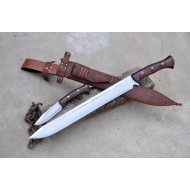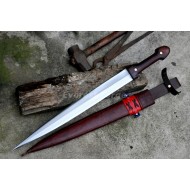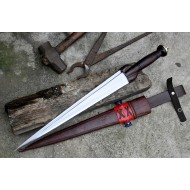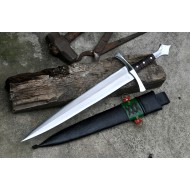
- Model: Fantasy Dagger
- Product Code: KUNAI0015
- Location: Kathmandu,Nepal
Available Options
Hand-Forged Ninja Kunai Dagger — Ring Pommel and Winged Blade
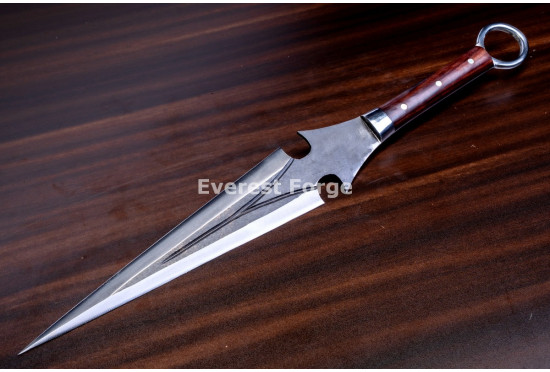
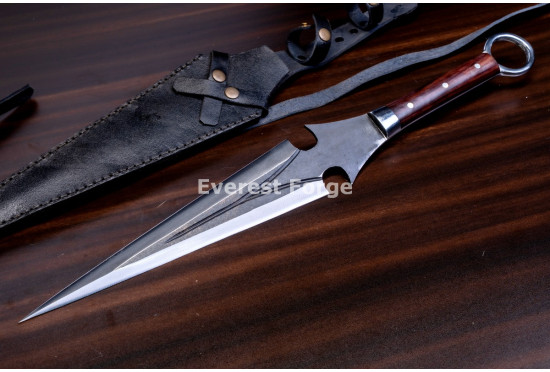
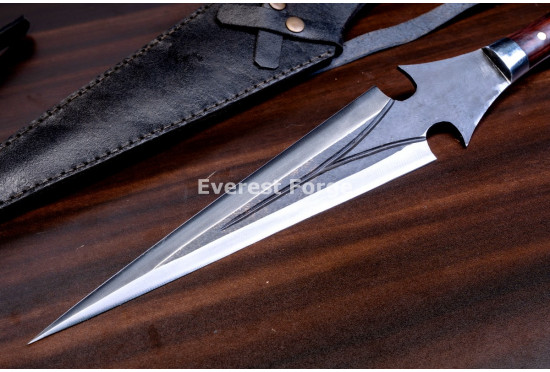
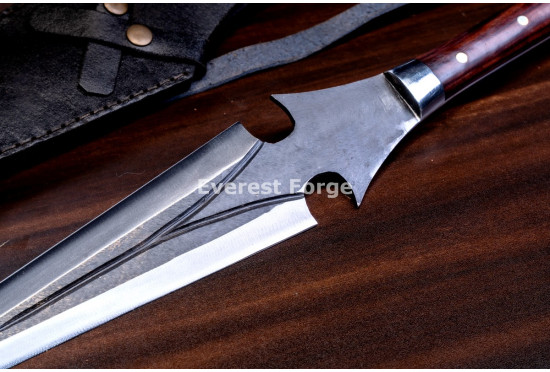
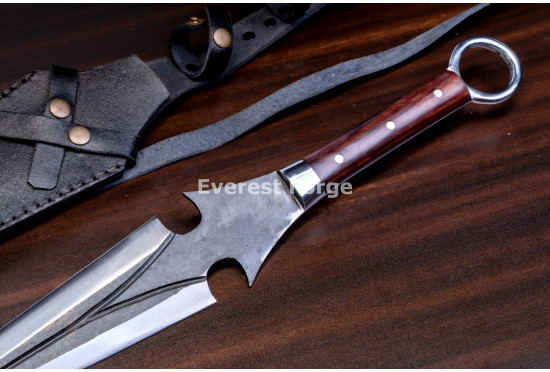
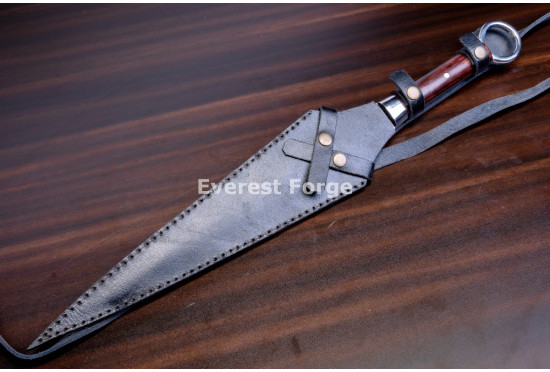
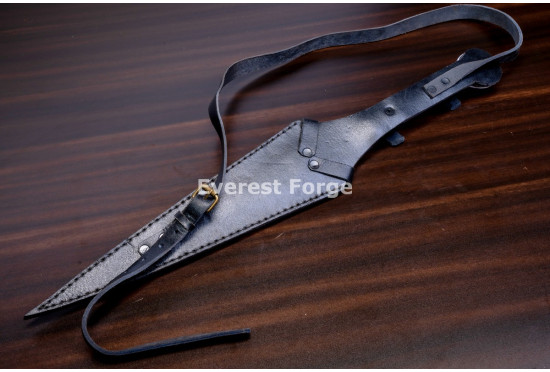
This is a hand-forged, fully functional kunai-pattern dagger — a symmetrical leaf blade running to an acute point, forged in Nepal from 5160 high-carbon spring steel, oil-tempered, full tang, and sharpened to a true edge. The blade carries a darkened finish across the flats with the bevels ground bright against it, and swept cut-outs at the base that give it its winged silhouette. The hilt is plain and purposeful: a shaped grip pinned through the tang, a polished steel ferrule, and a steel ring at the butt in the manner of a true kunai. It ships with a black leather sheath with riveted straps.
The standard build gives a 15-inch blade on an 8-inch hilt with a 5-inch grip, around 23 inches overall, at about 1.11 kg. That is far larger than any historical kunai and it is meant to be — this is a fantasy interpretation built at display scale, with the ring, the leaf profile and the plain hilt taken from the real thing.
An honest note. A real kunai was a tool, not a weapon. It was a farming and masonry implement — trowel-shaped, used for digging, gouging out plaster and mortar, and prying — and the ring at the butt existed so it could be tied to a cord or lashed to a pole. The idea of the kunai as a ninja's throwing knife comes overwhelmingly from twentieth-century fiction rather than from anything documented, and a genuine one was neither balanced for throwing nor especially sharp. This piece takes the recognisable shape and builds it as a large fantasy dagger: sharpened, at display scale, with cut-outs no working tool ever had. We would rather tell you that than sell you a myth.
Bespoke Service
Forge a Dagger to Your Own Design
Want a historically proportioned kunai, a plain blade without the cut-outs, a matched pair, or your own engraving? Our Custom Forge service builds to your spec, by hand in Kathmandu.
Request a Custom Forge →What a Kunai Actually Is
The kunai belongs to the Japanese tool tradition rather than the weapon tradition. It was a stout, leaf-shaped implement with a soft iron body and a hardened point, used by farmers, builders and masons to dig, gouge, chisel out mortar and lever things apart — closer to a mason's trowel or a garden dibber than to a knife. The edges were usually left blunt because sharpening them would have weakened a tool meant to take prying loads, and the ring at the end of the handle was there so it could be tied to a cord, hung from a belt, or lashed to a pole to make a reach tool. That it also worked as an improvised weapon is unremarkable; so did every other agricultural implement in every farming culture. What is remarkable is how completely fiction has replaced the reality. This dagger keeps the silhouette and the ring, and is honest about being a modern interpretation of it.
Specifications
The figures above are the standard build. Blade size, blade finish and grip material are all selectable options — set them before you add to cart and the piece you receive will match what you choose.
Customize Your Dagger
Hand-Forged, Not a Wall-Hanger
This Dagger
- Hand-forged 5160 high-carbon spring steel
- Oil-tempered, hard edge and flexible spine
- Full tang with the grip pinned through it
- Cut-outs and ring formed and finished by hand
- Sharpened, balanced, made to your spec
A Wall-Hanger
- Cast stainless, brittle under load
- No real heat treatment
- Rat-tail tang glued into a hollow grip
- Flat plate profile with no taper, dead in the hand
- Blunt, display-only
How It Is Made
Who It Is For
- Collectors of fantasy and Japanese-inspired blades who want forged steel rather than cast
- Costume and cosplay users, who should order the display-blunt option
- Buyers who want a striking display dagger with a distinctive silhouette
- Anyone building a matched pair — order two and we will match them
- Gift buyers personalizing a blade with a name or engraving
- Not for anyone wanting a historically accurate kunai — order the tool-proportioned version instead
What Is Included
- One hand-forged kunai-pattern dagger, built to your chosen spec
- Black leather sheath with riveted straps
- Shaped grip pinned through a full tang, with polished steel ferrule and ring pommel
- Any personalization or engraving you ordered
- A sharpened double-edged leaf blade with darkened flats
- Everest Forge manufacturer warranty
Explore More Hand-Forged Blades
Shipping, Returns & Care
Shipping
In-stock specs dispatch within 2 to 3 business days; fully custom builds take roughly 4 to 6 weeks to forge before dispatch. We ship worldwide by DHL or FedEx in 7 to 14 business days, tracked. Import and blade laws vary by country, and double-edged blades face tighter restrictions than single-edged ones in a number of places, so please check your local rules before ordering.
Returns & Warranty
Every blade is backed by the Everest Forge warranty against forging and material defects. If something is wrong with your order, we will repair, replace, or refund it. Personalized and custom-engraved pieces are made to order, so please confirm your spec carefully before purchase.
Care
Wipe the blade clean and dry after handling, and apply a light coat of oil before storage. The bright ground bevels have no protection at all and are the first place rust will appear, so give them particular attention; the darkened flats resist corrosion a little better but still want oiling. Do not attempt to polish the dark areas back to bright — the finish will not return evenly. Clean around the cut-outs and inside the ring, both of which trap moisture. Store the dagger outside its sheath rather than in it.
From The Forge
Build a Dagger That Is Yours Alone
Beyond the options here, our Custom Forge service will build a historically proportioned kunai with a soft body and a hardened point, a matched pair with a double sheath, or a blade to a design you send us. Roughly 4 to 6 weeks from order.
Start a Custom Forge →Frequently Asked Questions
What is a kunai?
A kunai is a Japanese hand tool, not a weapon — and that surprises almost everyone. It was a stout leaf-shaped implement with a soft iron body and a hardened point, used by farmers, builders and masons for digging, gouging out mortar and plaster, chiselling and prying. Think of it as closer to a mason's trowel or a garden dibber than to a knife. The edges were usually left blunt, because sharpening them would have weakened a tool meant to take levering loads, and the body was deliberately soft so it would bend rather than snap under stress. The ring at the end of the handle was for a cord: it let the tool hang from a belt, be tied to the wrist, or be lashed to a pole to extend its reach. Genuine examples run from around 20 to 60 centimetres and most are unremarkable-looking objects.
Were kunai actually ninja throwing weapons?
Mostly not, and the honest answer is more interesting than the myth. The image of the kunai as a ninja's throwing knife comes overwhelmingly from twentieth-century fiction — films, manga, video games — rather than from any documented practice. A real kunai is badly suited to throwing: the weight sits toward the handle end because of the ring, the body is soft iron rather than hardened steel, and the edges are blunt. Nothing about it is set up to fly point-first and stick. What is true is that shinobi are recorded using ordinary tools as improvised weapons and as climbing and digging aids, which is unremarkable — the same is true of agricultural implements in every farming culture, and the Japanese martial tradition has several weapons that began life as farm tools. The kunai's fame as a throwing knife is genuinely modern, and we would rather say so.
What is the ring pommel for?
On a genuine kunai the ring is a cord attachment, and it is the feature that identifies the type more reliably than the blade shape does. A cord through it let the tool hang from a belt or a pack, kept it tethered to the wrist so it could not be dropped while working at height, and allowed it to be lashed to a pole to make a longer reach tool for digging or gouging out of arm's length. On this dagger it serves the same practical purposes — a lanyard point, a hanging point, and a positive stop for the heel of the hand at the end of the grip, which is genuinely useful on a blade this long. It also happens to be the single most recognisable thing about a kunai's silhouette. A plain cap is available if you would rather have it without.
Is this a historically accurate kunai?
No, and it is not trying to be. The ring, the leaf profile and the plain hilt are all drawn from the real thing, but everything else is a modern interpretation. It is far larger than a working kunai, it is sharpened along both edges where a real one was blunt, it is forged from hardened spring steel rather than soft iron, and the swept cut-outs at the blade root are pure fantasy — no tool ever had them, and they would have been a weakness in something used for prying. Treat it as a fantasy dagger built on a recognisable shape. If you want a historically proportioned kunai with a soft body and a hardened point, we will build one through Custom Forge, and it will look considerably less dramatic.
How does this differ from your other daggers?
Entirely, in shape. Our two quillon daggers are medieval European: straight double-edged blades with cruciform crosses, one with a knotwork disc pommel and one with a plain barrel pommel. Our hunting dagger is a broad European hunting blade with a squared guard. This one has no crossguard at all, a symmetrical leaf blade with cut-outs at the root, a ring pommel and a darkened finish — it shares nothing with the others beyond being double-edged and forged from the same steel. Buy this one if the silhouette is what appeals to you; buy a quillon dagger if you want a historical European piece.
Is this a real, functional dagger?
Yes. It is hand-forged from 5160 high-carbon spring steel, full tang, oil-tempered, and sharpened along both edges before it ships. The ferrule and ring are steel and the grip is pinned through the tang rather than glued around a stub. It is stiff, it cuts, and it will take normal handling. Do not throw it — nothing about this blade is balanced for throwing, and a hardened point that lands wrong on a hard surface will chip. Do not use the point as a pry bar either, which is ironic given what the original was for, but this blade is hardened where a real kunai was deliberately soft.
What steel is it, and is it oil-tempered?
The blade is forged from 5160 high-carbon spring steel, the same alloy used in heavy-duty truck leaf springs, prized for toughness and edge retention. It is oil-tempered for a hard cutting edge backed by a flexible, shock-absorbent spine. Worth noting the contrast with the original: a working kunai was made of soft iron precisely so it would bend rather than break under prying loads, with only the point hardened. This is built the other way round, as a blade rather than a tool.
Is it full tang?
Yes. The tang runs the full length of the handle with the grip pinned straight through it, so the handle is mechanically fastened to the steel rather than held by adhesive. There is no rat-tail and nothing glued into a hollow grip. On a symmetrical blade with no crossguard this matters more than usual: there is nothing at the front of the handle taking load off the assembly, so everything the blade does travels straight into the grip and the pins.
What is the darkened finish?
The flats of the blade are finished dark and the bevels are then ground back to bright steel, so you get a black blade with clean bright lines following both edges. It gives the blade depth and makes the leaf profile read clearly at a distance, which is why it suits this shape. Care is specific and worth reading: oil the whole blade, but pay particular attention to the bright bevels, which are bare carbon steel with no protection at all and will show rust first. Do not try to polish the dark areas back to bright — whatever you remove will not go back on evenly and you will end up with a patchy blade. A full satin or polished finish is available if you would rather have one tone throughout.
What are the grip and sheath made of?
The grip is shaped rosewood, pinned through the tang and left bare rather than wrapped, with a polished steel ferrule where it meets the blade and the steel ring closing the butt. The sheath is black leather with riveted straps, cut and stitched by hand to fit the blade size you order — which is why a custom blade length always means a custom sheath and adds to the lead time. Because rosewood is a natural material, grain and colour vary between pieces. A cord-wrapped grip is available if you want something closer to a Japanese treatment.
Does it arrive sharpened, and can I order a matched pair?
Yes, sharpened along both edges as standard, finished by hand. Choose the display-blunt option if you need it unsharpened for cosplay, stage use, display, or to satisfy import rules where you live, at no extra charge — and for costume work the blunt is the sensible choice. As for pairs: yes, and it is worth considering, because this silhouette works better as a matched two than alone. Order two and we will build them to match and supply a double sheath. Blade size, finish, grip material and the cut-outs are all adjustable.
Do you ship worldwide, and how long does it take?
Yes. We ship worldwide from Nepal by DHL or FedEx in 7 to 14 business days with tracking. In-stock specs dispatch within 2 to 3 business days; fully custom builds take roughly 4 to 6 weeks to forge first. Import and blade laws vary by country and double-edged blades face tighter restrictions than single-edged ones in many places, so please check your local rules carefully before ordering.
| Specification | |
| Blade: | Hand forged from 5160 carbon steel, symmetrical double-edged leaf blade with acute point and swept cut-outs at the root |
| Total Length: | 15 inch blade, 8 inch hilt with 5 inch grip, approx 23 inches overall |
| Handle: | Full tang with the grip pinned through it, polished steel ferrule and ring pommel |
| Weight: | Approx 1110 grams total at standard build (blade approx 810 grams) |
| Note: | As every piece is forged by hand, slight variation in weight, dimensions and finish may occur. Blade size, blade finish and grip material are all selectable options - the figures above describe the standard build. Keep the blade lightly oiled when not in use. |