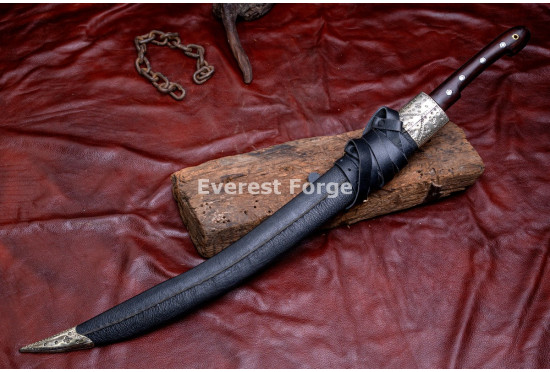
- Model: Russian Sword
- Product Code: Shashka028
- Location: Kathmandu, Nepal
Available Options
Hand-Forged Cossack Shashka Sword — Curved 5160 Blade with Riveted Rosewood Hilt
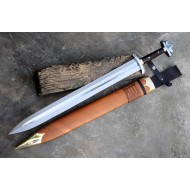
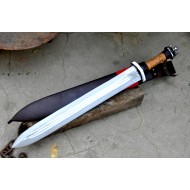
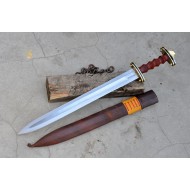
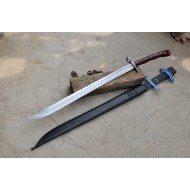
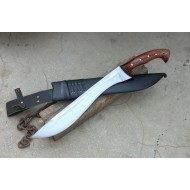
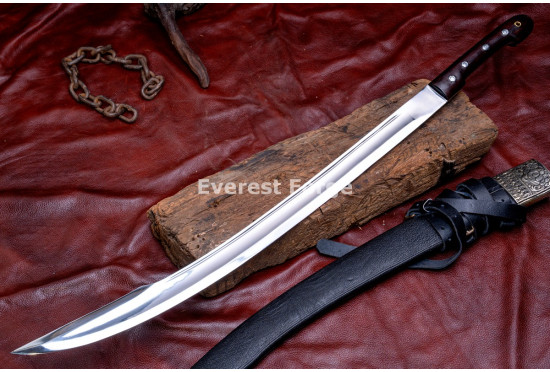
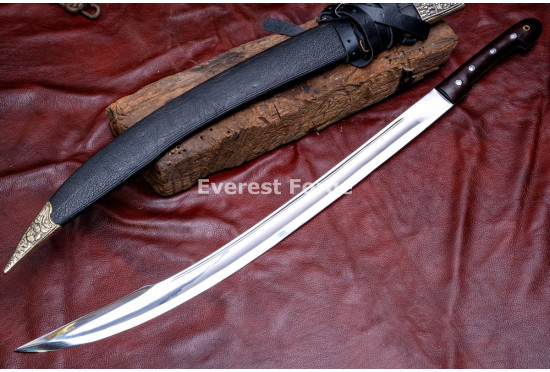
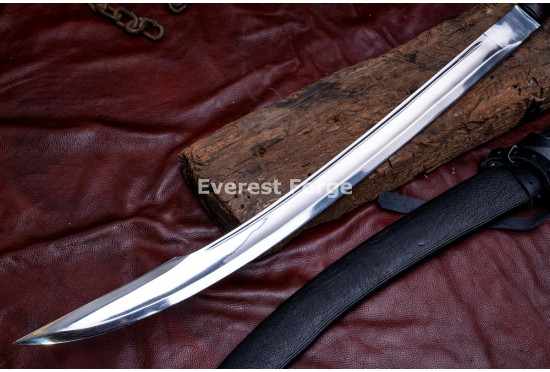
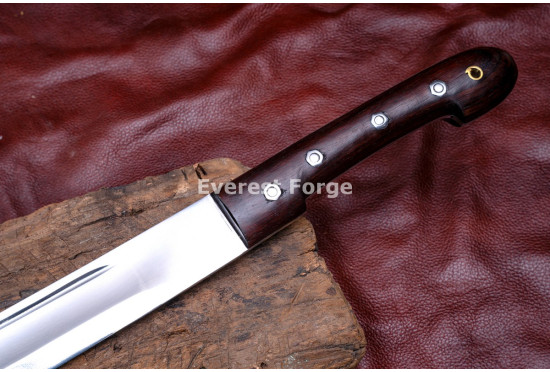
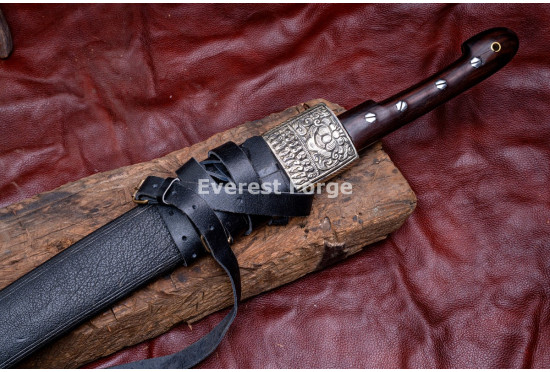
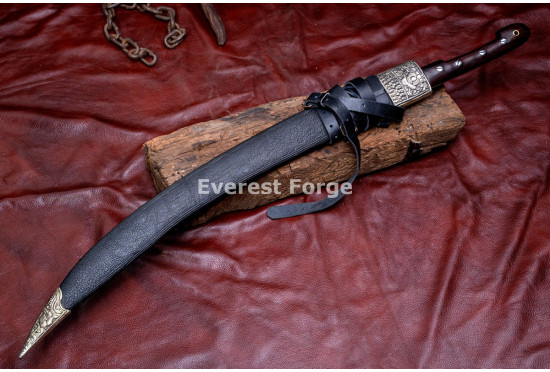
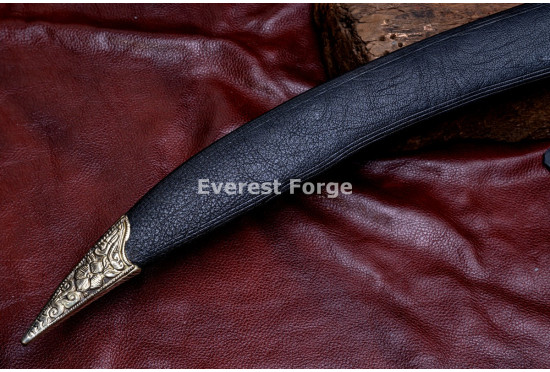
This is a hand-forged, fully functional Cossack shashka — a gently curved single-edged cavalry blade forged in Nepal from 5160 high-carbon spring steel, oil-tempered, full tang, and sharpened to a true edge. The hilt is rosewood, riveted through the tang in the traditional construction, with a fuller cut along the spine and a bright polished finish. It ships with a black leather scabbard with a decorated metal throat. Every sword is made to order in your chosen length, finish, and engraving.
The standard blade is 28 inches on an 8-inch hilt, for an overall length around 37 inches. That is a full cavalry-length blade with a shallow curve — enough to slice cleanly on the draw without losing the reach and point control that a deeply curved sabre gives up. The oil-tempered 5160 steel and full tang make it a working sword, not a cast wall-hanger.
An honest note. This is a modern hand-forged interpretation of the shashka, not a museum reproduction of a specific regulation pattern. The dimensions are ours rather than copied from a Model 1881 or a particular Caucasian example, and the blade carries a bright polished finish rather than the working finish a service weapon would have had. The construction follows the type properly, with rosewood scales riveted through the tang. If you want a strict reproduction of a particular model, tell us which and we will quote it through Custom Forge.
Bespoke Service
Forge a Shashka to Your Own Design
Want a specific regulation pattern, a different blade curve, additional fullers, a horn or bone grip, or your own engraving? Our Custom Forge service builds swords to your spec, by hand in Kathmandu.
Request a Custom Forge →What Is a Shashka?
The shashka is a guardless single-edged cavalry sword that originated among the Circassian peoples of the North Caucasus. The name comes from the Adyghe word sashkho, meaning roughly "long knife". Russian and Cossack forces encountering it during the Caucasian campaigns adopted it wholesale, and by the late 19th century it had displaced the sabre across the Russian cavalry, becoming regulation with the Model 1881. The blade is single-edged with a shallow curve, and the hilt is a plain grip riveted directly to the tang. It was carried edge-up and drawn into the cut in a single motion, which is the whole logic of the design.
Specifications
Customize Your Shashka
Every sword is forged to order. Set your options before you add to cart:
Hand-Forged, Not a Wall-Hanger
This Shashka
- Hand-forged 5160 high-carbon spring steel
- Oil-tempered, hard edge and flexible spine
- Full tang with riveted grip scales
- Rosewood scales riveted through the tang, the correct construction
- Sharpened, balanced, made to your spec
A Wall-Hanger
- Cast stainless, brittle under load
- No real heat treatment
- Rat-tail tang glued into a hollow grip
- Stamped from flat bar with no forged curve
- Blunt, display-only
How It Is Made
Who It Is For
- Collectors of Russian, Cossack and Caucasian arms who want the type built correctly
- Reenactors and living-history groups portraying Cossack or Imperial Russian cavalry
- Cutting practitioners who want a fast draw-cutting blade rather than a heavy chopper
- Collectors of curved swords who want something other than another sabre or scimitar
- Larp and costume users, who should order the display-blunt option
- Gift buyers personalizing a blade with a name, date, or engraving
What Is Included
- One hand-forged Cossack shashka, built to your chosen spec
- Black leather scabbard with decorated metal throat and leather suspension
- Rosewood grip scales riveted through the tang, with metal ferrule and pommel cap
- Any personalization or engraving you ordered
- A polished, fullered, sharpened blade
- Everest Forge manufacturer warranty
Explore More Curved Swords
Shipping, Returns & Care
Shipping
In-stock specs dispatch within 2 to 3 business days; fully custom builds take roughly 4 to 6 weeks to forge before dispatch. We ship worldwide by DHL or FedEx in 7 to 14 business days, tracked. Import and blade laws vary by country, so please check your local rules before ordering.
Returns & Warranty
Every blade is backed by the Everest Forge warranty against forging and material defects. If something is wrong with your order, we will repair, replace, or refund it. Personalized and custom-engraved blades are made to order, so please confirm your spec carefully before purchase.
Care
Wipe the blade clean and dry after handling, and apply a light coat of oil before storage to protect the high-carbon steel from moisture. A polished finish shows fingerprints and corrosion sooner than a satin one, so it needs oiling more diligently, and the fuller holds moisture more readily than a flat section. Treat the leather scabbard occasionally with a conditioner, and do not store the sword inside it for long periods.
From The Forge
Build a Shashka That Is Yours Alone
Beyond the options here, our Custom Forge service will build to a specific regulation pattern, alter the curve, add fullers, or fit a horn or bone grip — direct from the maker in Kathmandu, roughly 4 to 6 weeks from order.
Start a Custom Forge →Frequently Asked Questions
What is a shashka sword?
The shashka is a guardless single-edged cavalry sword that originated among the Circassian peoples of the North Caucasus. Its name comes from the Adyghe sashkho, meaning roughly "long knife". Russian and Cossack forces adopted it during the Caucasian campaigns of the 19th century, and it went on to replace the sabre across the Russian cavalry, becoming regulation issue with the Model 1881. The blade is single-edged with a shallow curve, and the hilt is a plain riveted grip.
Is this a historically accurate shashka?
In the ways that matter for the type, yes. It is single-edged with a shallow curve, fullered, and built with grip scales riveted directly through the tang, which is the correct construction for the type. What it is not is a reproduction of one specific regulation pattern — the dimensions are ours rather than copied from a Model 1881 or a particular Caucasian example, and the blade is brightly polished rather than finished the way a service weapon would have been. Treat it as a faithful modern interpretation of the type rather than a museum copy. If you want a specific pattern reproduced, we will quote it through Custom Forge.
What is the difference between a Cossack and a Caucasian shashka?
Broadly, the Caucasian shashka is the original, with a distinctive cleft or eared pommel, and worn in a scabbard that swallows the hilt almost to the pommel so only the top shows. The Cossack and later Russian regulation versions are the adopted forms, generally with a longer blade, a plainer capped pommel, and a scabbard that sits below the hilt in the usual way. This sword follows the Cossack line: plain capped pommel, conventional scabbard.
How does this differ from your Ottoman Kilij?
Both are historical curved cavalry swords, but they come from different traditions and handle differently. The kilij is Turkish, with a pronounced curve, a crossguard, and characteristically a yelman — a widened false edge along the back near the point that adds mass exactly where the cut lands. The shashka is Caucasian and Russian, and carries a shallower curve with the weight distributed more evenly. In use the kilij hits harder on a committed swing; the shashka is faster to draw and better suited to a slicing draw-cut. Buy the kilij for Ottoman and Middle Eastern collecting; buy this for Russian, Cossack and Caucasian.
Is this a real, functional sword?
Yes. It is hand-forged from 5160 high-carbon spring steel, full tang, oil-tempered, and sharpened to a true cutting edge before it ships. The grip scales are riveted through the tang rather than glued around a stub. It handles tatami mats, water bottles and light green targets well. Do not use it on bone, metal, seasoned hardwood, or anything you would not put a good knife through.
What steel is it, and is it oil-tempered?
The blade is forged from 5160 high-carbon spring steel, the same alloy used in heavy-duty truck leaf springs, prized for toughness and edge retention. It is oil-tempered for a hard cutting edge backed by a flexible, shock-absorbent spine. On a long curved cavalry blade that flex matters — the blade loads unevenly through a draw-cut, and the steel has to take that without setting a bend.
How is the hilt built? Is it full tang?
Full tang, with the rosewood scales riveted straight through it and a metal ferrule at the blade and a cap at the top. This is the correct construction for the type: the grip is mechanically fastened to the tang itself rather than relying on a pommel nut to hold an assembly together. There is no rat-tail and nothing glued into a hollow handle.
Why does a shashka have no guard?
Because it was built around the first cut rather than the exchange. A guard exists to protect the hand while you parry and bind against another blade — the shashka's design assumes you are not going to do that. It was carried edge-up and drawn straight into the cut in one motion, so the priority was a fast draw and an unobstructed hilt, not hand protection in a fencing exchange. Removing the guard also lets the sword sit deeper in its scabbard and clears the hand for a rolling wrist cut. It is a genuine design trade-off: you gain speed and lose protection.
How was a shashka carried and drawn?
Edge-up, suspended from the belt — the opposite of a European sabre, which hangs edge-down. Carrying it edge-up means the draw and the cut are the same movement: the hand comes up and back, the blade clears the scabbard already travelling along its cutting line, and the stroke lands without a separate windup. It is why shashka technique looks so different from sabre fencing. The scabbard supplied carries leather suspension so you can rig it to a belt in the traditional way.
Does it arrive sharpened?
Yes, sharpened as standard along the full edge, finished by hand. If you need it blunt for reenactment, larp, stage use, display, or to satisfy import rules where you live, choose the display-blunt option or tell us in your order notes. There is no extra charge either way.
Can I order a different length, curve, or grip?
Yes. Blade length, curve depth, fuller arrangement, finish and grip material are all adjustable to order — rosewood as standard, with buffalo horn, bone and walnut available. If you want a specific regulation pattern reproduced, send us the model and any measurements or photographs you have and we will tell you honestly what we can match. Use Custom Forge to start that conversation.
Do you ship worldwide, and how long does it take?
Yes. We ship worldwide from Nepal by DHL or FedEx in 7 to 14 business days with tracking. In-stock specs dispatch within 2 to 3 business days; fully custom builds take roughly 4 to 6 weeks to forge first. Import and blade laws vary by country, so please check your local rules before ordering.
| Specification | |
| Blade: | 28 inches. Hand forged from 5160 carbon steel |
| Total Length: | 37 inches |
| Handle: | 8 inches. Full tang with rosewood scales riveted through it, metal ferrule and pommel cap |
| Weight: | Approx 1670 grams total (blade approx 1080 grams) |
| Note: | As every piece is forged by hand, slight variation in weight, dimensions and finish may occur. Rosewood grain varies between pieces. A polished blade needs oiling more diligently than a satin one - keep it lightly oiled when not in use. |