Menu
Your Cart

Hand-Forged Medieval Arming Sword, Celtic Knotwork

Hand-Forged Medieval Arming Sword, Celtic Knotwork
$324.99
Ex Tax: $324.99
  • Model: Medieval Arming Sword
  • Product Code: Arming 24
  • Location: Kathmandu,Nepal

Available Options

Hand-Forged Medieval Arming Sword — Celtic Knotwork Hilt in 5160 Carbon Steel

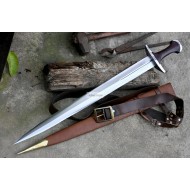
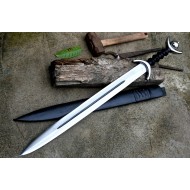
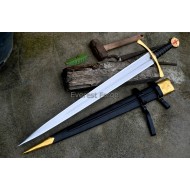
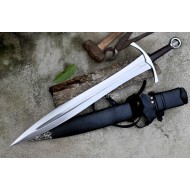
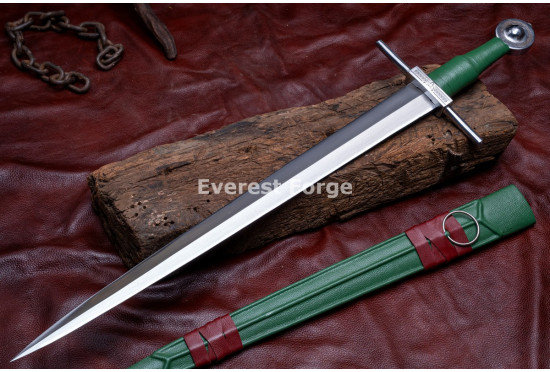
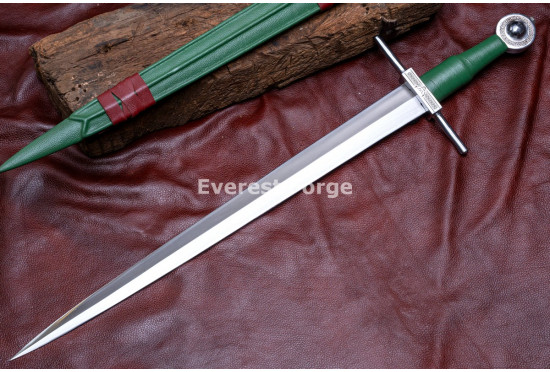
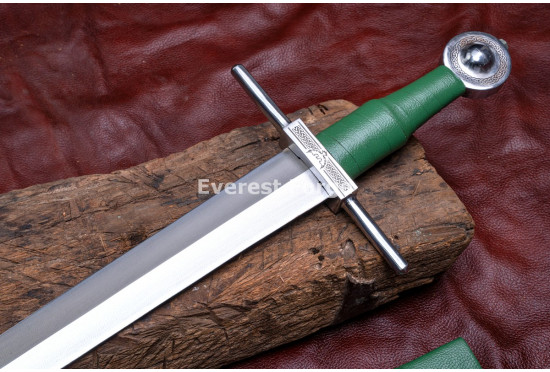
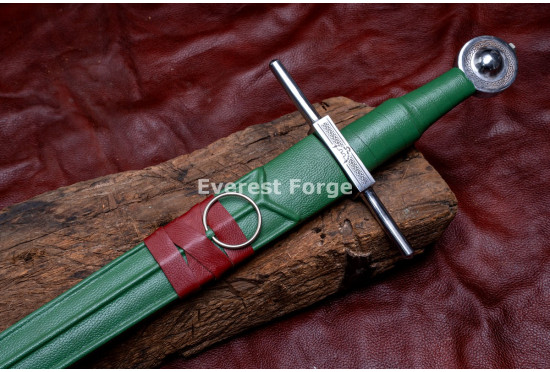
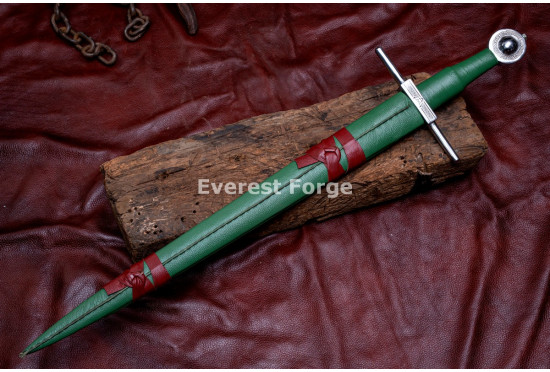
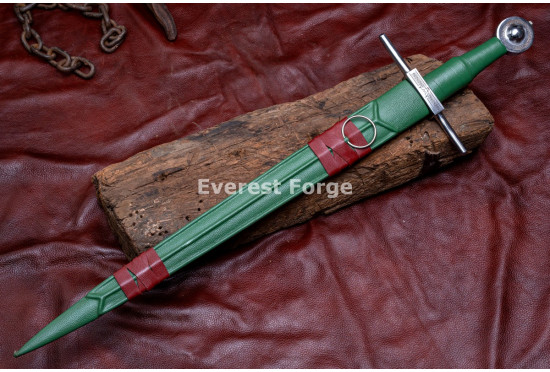
This is a hand-forged, fully functional medieval arming sword — a broad, acutely tapering double-edged blade forged in Nepal from 5160 high-carbon spring steel, oil-tempered, full tang, and sharpened to a true edge. The hilt is a straight cruciform cross with a knotwork-engraved guard block, a wood grip under a green leather wrap, and a domed brazil-nut pommel. It ships with a green leather scabbard with oxblood strapping and a steel suspension ring. Every sword is made to order in your chosen length, finish, and engraving.

The standard blade is 23.5 inches on a 7.4-inch hilt with a 4.8-inch grip, for an overall length around 31 inches at about 1.25 kg. That is a true single-hand sword — long enough to control distance and cut with authority, light enough to carry all day at the belt with a shield or buckler in the other hand. The oil-tempered 5160 steel and full tang make it a working sword, not a cast wall-hanger.

An honest note. Swords like this are often sold as "Celtic swords", and that label is misleading. Iron Age Celtic blades of the La Tene period look nothing like this — they carry bell-shaped or anthropomorphic hilts and short organic grips, with no long straight quillons. What you are looking at is a medieval European arming sword decorated with Insular knotwork. The decoration is Celtic in origin; the sword is medieval. We have named it accordingly. If you came looking for an Iron Age Celtic blade, this is not it, and we would rather tell you now than after it arrives.

Bespoke Service

Forge an Arming Sword to Your Own Design

Want a different blade length, a wheel or disc pommel, a different wrap colour, or your own knotwork pattern engraved? Our Custom Forge service builds swords to your spec, by hand in Kathmandu.

Request a Custom Forge →

What Is a Medieval Arming Sword?

The arming sword is the standard single-hand sword of medieval Europe, in use from roughly the 11th century to the 15th. It is defined by a straight double-edged blade, a cruciform cross guard, and a grip sized for one hand, with a pommel heavy enough to counterbalance the blade. It was worn at the belt as a sidearm and used alongside a shield or buckler rather than on its own. Ewart Oakeshott's typology remains the standard reference for the family, sorting swords by blade profile and pommel form rather than by nationality. This one carries a broad blade with a steady taper to an acute point, a straight cross, and a domed brazil-nut pommel of the kind Oakeshott catalogued on European swords from the 10th century onward — with knotwork engraving on the guard as a regional decorative treatment.

Real Forged BladeHand-forged 5160 spring steel, full tang, oil-tempered and sharpened.
Knotwork Engraved GuardInsular interlace worked into the guard block — the detail that sets this hilt apart.
Brazil-Nut PommelDomed steel pommel that pulls the balance back toward the hand.
5160 Spring SteelTruck leaf-spring steel — tough, shock-resistant, holds an edge.
Green Leather GripWood core under a green leather wrap for a secure single-hand hold.
Ringed ScabbardGreen leather scabbard with oxblood strapping and a steel suspension ring.

Specifications

TypeHand-forged medieval arming sword, single-hand
Blade Length23.5 inches standard (custom lengths to order)
Handle Length7.4 inches overall, 4.8-inch grip section
Overall LengthApprox 31 inches at standard blade size
WeightApprox 1250 g total, 1030 g blade
Blade Steel5160 high-carbon spring steel (truck leaf spring)
Heat TreatmentOil-tempered — hard edge, flexible spine
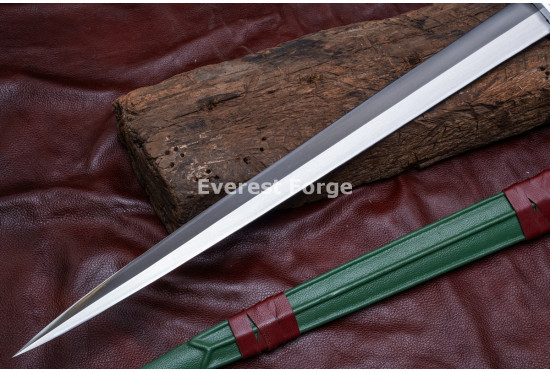
Blade StyleDouble-edged, steady taper to an acute point, satin finish, sharpened
TangFull tang, peened at the pommel
HandleWood grip under a green leather wrap
FittingsPolished steel straight cross with knotwork-engraved guard block, domed brazil-nut pommel
ScabbardGreen leather with oxblood strapping and steel suspension ring, included
OriginHand-forged in Tokha-3, Kathmandu, Nepal

Customize Your Arming Sword

Every sword is forged to order. Set your options before you add to cart:

Blade LengthStandard 23.5 inches, or order a shorter or longer blade to your spec.
Blade WidthStandard section, or a broader or narrower blade on request.
Pommel StyleBrazil-nut as standard, or a wheel, disc, or scent-stopper pommel.
EdgeSharpened to a true cutting edge, or left display-blunt on request.
Grip WrapGreen as standard, or black, brown, oxblood, or plain wood.
EngravingKnotwork as standard, or your own pattern, name, or inscription.

Hand-Forged, Not a Wall-Hanger

This Arming Sword

  • Hand-forged 5160 high-carbon spring steel
  • Oil-tempered, hard edge and flexible spine
  • Full tang, peened over the pommel
  • Solid steel cross and pommel carrying real counterweight
  • Sharpened, balanced, made to your spec

A Wall-Hanger

  • Cast stainless, brittle under load
  • No real heat treatment
  • Rat-tail tang that snaps at the guard
  • Knotwork moulded into pot metal, not cut into steel
  • Blunt, display-only

How It Is Made

You set the spec — length, width, pommel style, edge, wrap colour, and any engraving you want.
A smith forges the blade from a 5160 leaf-spring billet and draws the taper to the point.
The blade is oil-tempered, then polished to a satin finish and hand-sharpened.
We cut the knotwork, fit the cross and pommel, wrap the grip, peen the tang, cut the scabbard, and ship worldwide tracked.

Who It Is For

  • Collectors of medieval European arms who want a decorated hilt rather than a plain one
  • Reenactors and living-history groups needing a single-hand sword for use with a shield
  • Buyers drawn to Insular and Celtic decorative art who want it on a sword that is honestly described
  • Cutting practitioners who want a balanced single-hand blade for light target work
  • Larp and costume users, who should order the display-blunt option
  • Gift buyers personalizing a blade with a name, date, or their own knotwork pattern

What Is Included

  • One hand-forged medieval arming sword, built to your chosen spec
  • Green leather scabbard with oxblood strapping and steel suspension ring
  • Wood grip under a green leather wrap, with polished steel cross and brazil-nut pommel
  • Knotwork engraving on the guard block
  • A satin-finished, sharpened blade
  • Everest Forge manufacturer warranty

Explore More Hand-Forged Swords

Shipping, Returns & Care

Shipping

In-stock specs dispatch within 2 to 3 business days; fully custom builds take roughly 4 to 6 weeks to forge before dispatch. We ship worldwide by DHL or FedEx in 7 to 14 business days, tracked. Import and blade laws vary by country, so please check your local rules before ordering.

Returns & Warranty

Every blade is backed by the Everest Forge warranty against forging and material defects. If something is wrong with your order, we will repair, replace, or refund it. Personalized and custom-engraved blades are made to order, so please confirm your spec carefully before purchase.

Care

Wipe the blade clean and dry after handling, and apply a light coat of oil before storage to protect the high-carbon steel from moisture. Treat the leather wrap and scabbard occasionally with a conditioner, and keep dyed leather out of prolonged direct sun so the green does not fade. Do not store the sword inside the scabbard for long periods, as leather traps damp against steel.

From The Forge

Build a Sword That Is Yours Alone

Beyond the options here, our Custom Forge service shapes a blade to your own length, section, pommel, wrap, and engraving — including your own knotwork pattern, direct from the maker in Kathmandu, roughly 4 to 6 weeks from order.

Start a Custom Forge →

Frequently Asked Questions

What is a medieval arming sword?

The arming sword is the standard single-hand sword of medieval Europe, in use from roughly the 11th century to the 15th. It has a straight double-edged blade, a cruciform cross guard, a one-hand grip, and a pommel heavy enough to balance the blade. It was carried at the belt as a sidearm and used with a shield or buckler rather than alone. Ewart Oakeshott's typology is the standard reference and sorts these swords by blade profile and pommel form.

Is this a Celtic sword?

No, and it is worth being clear about it. Iron Age Celtic swords of the La Tene period have bell-shaped or anthropomorphic hilts, short organic grips, and no long straight quillons — they look nothing like this. What you have here is a medieval European arming sword whose guard is decorated with Insular knotwork. That decorative tradition is genuinely Celtic in origin and survived in Irish and British metalwork well into the medieval period, so knotwork on a medieval hilt is a plausible regional treatment. But decoration does not determine type. The sword is medieval; the ornament is Celtic.

How does this differ from your Crusader Arming Sword?

They are the same class of sword, so the differences are in detail rather than category. The Crusader Arming Sword is a plainer crusader-pattern blade with undecorated fittings and a shorter blade. This one is longer through the blade, carries a knotwork-engraved guard block, a domed brazil-nut pommel, a green leather wrap, and a green scabbard with oxblood strapping. In practice: buy the Crusader for a plain, austere, historically restrained sword suited to crusade-period reenactment; buy this one if you want a decorated hilt and a piece with more visual character. Handling is similar — both are single-hand swords meant for use with a shield.

Is this a real, functional sword?

Yes. It is hand-forged from 5160 high-carbon spring steel, full tang, oil-tempered, and sharpened to a true cutting edge before it ships. The fittings are solid steel and the tang is peened over the pommel rather than glued or threaded. It handles tatami mats, water bottles and light targets well. Do not use it on bone, metal, seasoned hardwood, or anything you would not put a good knife through, and check the peen after every cutting session.

What steel is it, and is it oil-tempered?

The blade is forged from 5160 high-carbon spring steel, the same alloy used in heavy-duty truck leaf springs, prized for toughness and edge retention. It is oil-tempered for a hard cutting edge backed by a flexible, shock-absorbent spine. On a long single-hand blade that flex matters — a hard, brittle sword of this length would be dangerous rather than durable.

Is it full tang?

Yes. The tang runs the full length of the hilt and is peened over at the pommel, so the cross, grip and pommel are mechanically captured on the tang itself. There is no rat-tail, no weld, and no glued-in stub to fail.

What is the knotwork on the guard, and how is it applied?

It is Insular interlace — the continuous woven line-work found in Irish and British metalwork, manuscript illumination and stone carving, best known from pieces like the Book of Kells and the Ardagh Chalice. On this sword it is worked into the guard block at the base of the hilt rather than moulded into cast fittings, which is the difference between a decorated sword and a decorated-looking one. You can specify your own pattern on a custom build.

What kind of pommel is this, and what does it do?

It is a brazil-nut pommel — a domed, slightly flattened form that Oakeshott catalogued on European swords from around the 10th century. Its job is counterweight, not decoration. Sitting behind the hand, it pulls the balance point of the sword back toward the grip so the blade recovers faster between cuts and takes less effort to hold on guard. It is also the structural anchor of the hilt: the tang is peened over it, so it holds the whole assembly tight under load.

Does it arrive sharpened?

Yes, sharpened as standard and finished by hand. If you need it blunt for reenactment, larp, stage use, display, or to satisfy import rules where you live, choose the display-blunt option or tell us in your order notes. There is no extra charge either way.

What is the scabbard like, and how is it carried?

A green leather scabbard with oxblood leather strapping and a steel suspension ring, cut by hand to fit the blade size you order. The ring lets you hang it from a belt or baldric with your own straps, which is how a medieval arming sword was worn — at the left hip for a right-handed user, high enough to draw cleanly without fouling the shield arm. A custom blade length gets a custom scabbard to match.

Can I order a different length, pommel, or colour?

Yes. Blade length, blade width, pommel style and wrap colour are all adjustable to order, and you can specify your own engraving pattern instead of the standard knotwork. Send us what you want and we will tell you honestly how it will handle before we forge it — changing blade length without changing the pommel will shift the balance, and we will say so. Use Custom Forge to start that conversation.

Do you ship worldwide, and how long does it take?

Yes. We ship worldwide from Nepal by DHL or FedEx in 7 to 14 business days with tracking. In-stock specs dispatch within 2 to 3 business days; fully custom builds take roughly 4 to 6 weeks to forge first. Import and blade laws vary by country, so please check your local rules before ordering.

Specification
Blade: 23.5 inches. Hand forged from 5160 carbon steel
Total Length: 31 inches
Handle: 7.4 inches overall with a 4.8 inch grip section. Full tang, wood under a green leather wrap, with polished steel straight cross and domed brazil-nut pommel
Weight: Approx 1250 grams total (blade approx 1030 grams)
Note: As every piece is forged by hand, slight variation in weight, dimensions and finish may occur. Leather colour and knotwork detail vary slightly between pieces. Keep the blade lightly oiled when not in use.

Write a review

Note: HTML is not translated!
Bad Good
Captcha