

- Model: KHOPESH SWORD
- Product Code: KHOPESH027
- Location: Kathmandu,Nepal
Available Options
A Hand-Forged Egyptian Khopesh With a Deep Recurve
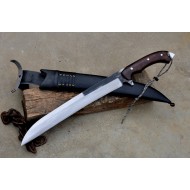
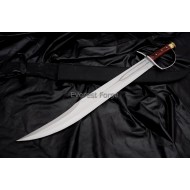
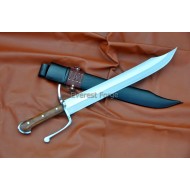
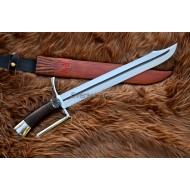
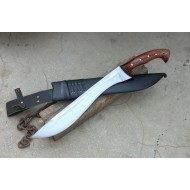
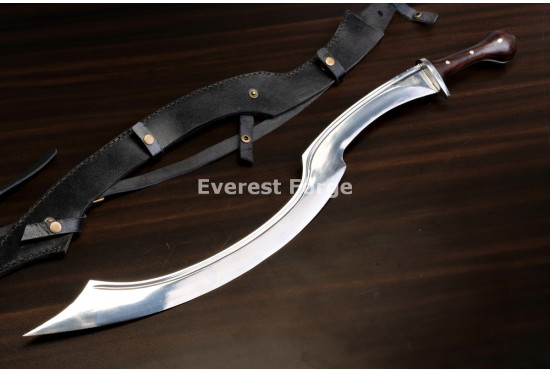
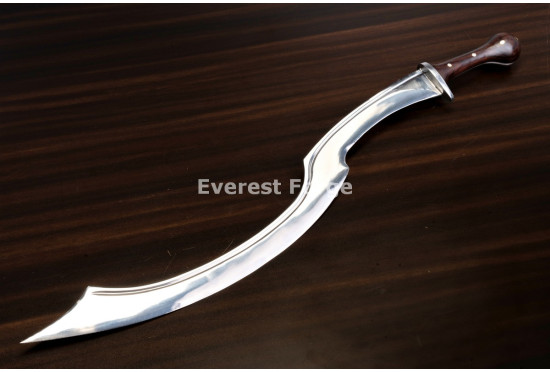
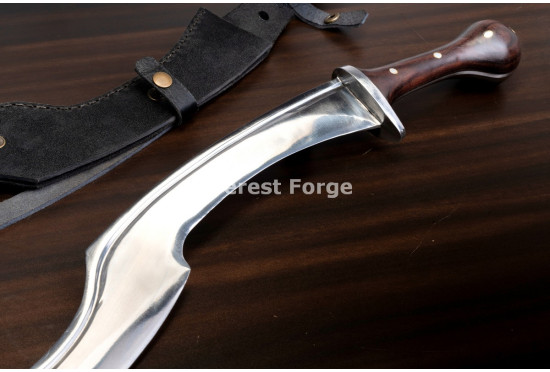
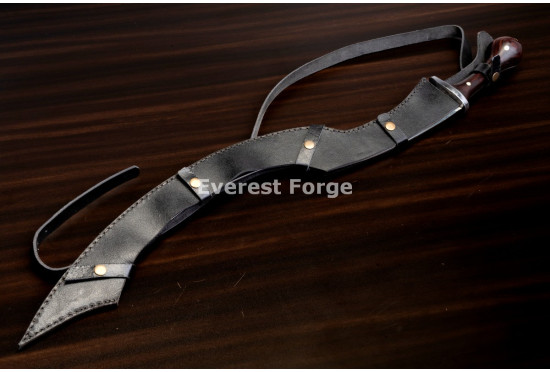
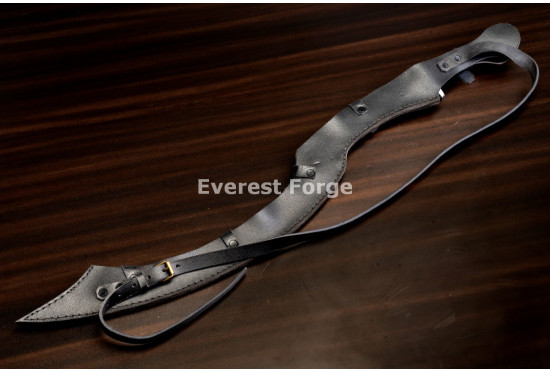
This is a hand-forged khopesh with a deep forward-curving blade, a rosewood grip on a flared steel ferrule, and a leather sheath on a harness rig, forged from 5160 high-carbon spring steel in our workshop in Tokha-3, Kathmandu. Nothing is held in stock and nothing here is a fixed size: the blade is forged after your order arrives, so the length, the edge arrangement, the grip and the guard are all yours to set at no extra cost. The dimensions in the specifications below are the standard build, and they are a starting point rather than the product.
The khopesh is the sickle-sword of ancient Egypt, and no weapon of the ancient world carried more symbolic weight. It grew out of the battle axe rather than the dagger, which is why it behaves as it does: mass carried forward into the belly of the curve, a cut that lands with the authority of a chop, and an inner curve that hooks. Pharaohs are shown holding one in temple reliefs from Abu Simbel to the Ramesseum, and several were buried with Tutankhamun.
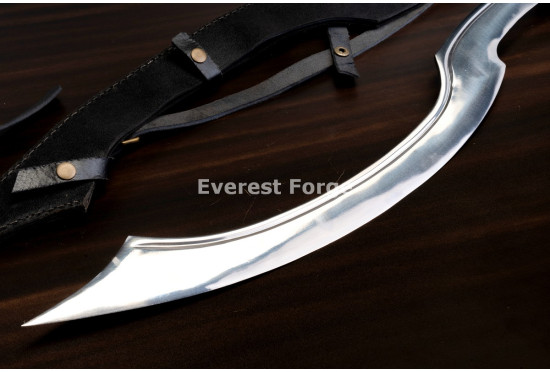
What sets this one apart from the rest of our khopesh range is the blade form. Where the machete and short-sword tiers carry a tighter, more compact hook, this blade runs out in a long continuous sweep, hollow through the forte and swelling through the belly to an upswept point. It is the most dramatic curve we forge in this shape, and it is the thing that stays constant whatever length you order it at.
An honest note. Three things worth having before you order. The standard build is not a reproduction: surviving khopesh swords run roughly 50 to 60 centimetres overall and the blade shown here is longer than that, so as built it is an extended modern interpretation of a genuine ancient shape. If period accuracy is what you want, order it at around 20 inches of blade and it sits inside the historical range, at no extra cost. Second, it is stout — about 42.6 grams per inch of blade against roughly 33 for historical swords of this family — so expect authority rather than quickness, which on a weapon descended from the axe is arguably the right trade. Third, it is big enough to need real space, both to handle and to hang. What we will not do is stamp reproduction arsenal or armoury marks on it, or sell you a modern length as an ancient one.
Why It Is Built This Way
Full Specifications
Figures are taken from the sword shown. Hand-forged work varies a little from piece to piece, so read these as close rather than exact. If a dimension matters, tell us before we start and we will build to it and measure the finished sword for you.
Build It Your Way
None of this costs extra, because none of it is made before you ask for it. Work down these six and put what you want in the order note.
Want it at a different size, or with royal fittings?
A period 55 centimetre blade built from a museum photograph, a knuckle bow, a horn grip, gold-toned fittings, or an Udjat inlaid rather than engraved. Send us the reference and we will quote against it before anything goes on the fire.
Start a Custom Forge Request →What It Does Well, and What It Does Not
What it does well
- The deepest, most dramatic sweep we forge in this shape, and the one thing about the piece that stays constant whatever size you order it at.
- Real cutting geometry: forward pitch, mass in the belly, an edge finished where the cut actually lands.
- A shape with four and a half thousand years behind it, forged by a house whose own national blade sits on the same family tree.
- Honest length. It is longer than any surviving khopesh and the page explains why steel allows that where bronze did not.
- Complete configurability at no extra cost, including a period-proportioned build and a knuckle bow.
- Honest materials. Mono-steel 5160, rosewood, real leather, no plating standing in for solid metal.
What it does not do
- The standard build is not a reproduction. Surviving khopesh swords run 50 to 60 centimetres overall and this one is longer. Order it at around 20 inches of blade if period accuracy matters to you.
- It is heavy for the family, around a quarter more steel per inch of blade than historical forward-curving swords. Authoritative rather than quick.
- At the standard size it needs space. This is not a sword to swing in a living room, and it wants a wall with room around it. Order it shorter if that is a problem.
- It has no hand protection as built. Correct for the type, but order the knuckle bow if you intend to use it actively.
- We will not stamp reproduction arsenal or armoury marks on it, whatever the reason.
- It is not stainless. 5160 rusts if left wet and wants an occasional wipe of oil.
How to Order
Who It Is For
- Collectors who already own a khopesh at machete scale and want the shape at full sweep.
- Buyers drawn to ancient Egypt — Tutankhamun, Ramses II, the temple reliefs — who want the weapon at a scale that matches the mythology.
- Khukuri collectors curious about where the forward-curving blade comes from, for whom this is a long way up the family tree.
- Stage combat and theatrical armourers, who can order this sword rebated and round-tipped at no extra cost.
- Buyers who want the khopesh silhouette at its most dramatic rather than its most compact.
- Anyone who would rather be told plainly which parts of a sword are historical than be sold a modern build as a reproduction.
What Is Included
- The khopesh, hand-forged in Tokha-3, Kathmandu, Nepal.
- A leather sheath with a leather harness rig.
- A protective coat of oil on the blade for transit, wiped off before handling.
- Care instructions, and the Everest Forge manufacturer warranty against defects in materials and workmanship.
Not sure what size you want it?
Every blade here is forged after the order, so the length is a choice rather than a fixed specification. Around 20 inches is historical, around 16 is a one-handed working blade, and 27 is the standard build. Tell us what you want the sword for and we will tell you what we would forge you.
Compare Every Khopesh Size →Related Blades and Reading
Shipping, Returns and Care
Dispatch and transit. Standard builds leave the workshop in 2 to 3 business days. Genuinely custom work — a period-length blade, a knuckle bow, a different grip material — runs 4 to 6 weeks depending on the queue. We ship by DHL or FedEx with tracking, typically 7 to 14 business days from Kathmandu, sheathed and braced with the harness packed separately so nothing bears on the blade.
Duties, import and edge law. Import duty and local taxes are the buyer's responsibility and vary by country. Swords are regulated differently in different places and a 33.5 inch blade is treated more strictly than a knife almost everywhere. Please check what applies where you live before ordering. If an unsharpened build would make the difference, we will supply one at no extra cost.
Returns and warranty. Because every sword is forged after the order, a custom build cannot be restocked, so please make sure the specification is right before you confirm. Anything damaged in transit, or showing a defect in materials or workmanship, is covered by the Everest Forge manufacturer warranty and we will repair or replace it. Photograph the packaging as well as the sword if something has gone wrong on the way.
Care. 5160 is a high-carbon steel and it is not stainless. Wipe the transit oil off before handling and put a light film back on before the sword goes away. Fingerprints are acidic and will etch a polished blade if left for weeks. Pay attention to the hollow of the curve, which is the one stretch a cloth drawn straight along the blade never properly touches. Do not store the sword in the sheath for long periods: leather holds moisture against steel. Light surface rust comes off with oil and fine steel wool; nothing abrasive on a polished finish. The rosewood grip wants a rub of furniture or boiled linseed oil once or twice a year.
Questions About the Khopesh
What size is it, and can I change it?
The standard build carries a 27 inch blade on a 6.5 inch grip, 33.5 inches overall. That is where we set it because the long sweep of this blade shows best at that scale, but it is a default rather than a fixed specification — every blade we make is forged after the order, so the length is yours.
Buyers ask for three broad things on this shape. Around 20 inches puts the blade inside the historical range. Around 16 gives you something closer to a machete you can work with one hand all day. Longer than 27 is possible but starts to want two hands and a very clear wall. None of it changes what the sword is, and the full khopesh collection shows how the shape reads at other sizes.
Is the standard build a historically accurate size?
No, and it is worth being exact rather than glossing it. Surviving khopesh swords run roughly 50 to 60 centimetres overall. The build shown here is 85. As standard it is an extended modern interpretation of a genuine ancient shape, not a reproduction of a museum piece, and we would rather you had that from us than worked it out later.
The fix is free and it is on this same page: order the blade at around 20 inches and you are inside the historical range. What you cannot order is a bronze one, and the reason the originals stopped where they did is worth knowing.
Why were the originals so short?
Bronze. The khopesh developed in the Bronze Age and the originals were cast rather than forged, and cast bronze sets a hard ceiling on how long a curved blade can usefully be. It is soft enough to take a set under load and brittle enough to fail at a stress riser, and a long curved blade is one continuous stress riser. Push the length and you get a weapon that bends in use and breaks under a hard parry.
That ceiling is why the shape stayed compact for fifteen centuries, and why blades grew as iron arrived. 5160 high-carbon spring steel lifts it much further again. A 27 inch khopesh is a length the Egyptian smiths would very likely have built if their metallurgy had allowed it. That is a more honest thing to say than pretending the size is period, and it is the real reason this piece can exist at all.
How is the edge arranged?
The standard build follows the historical arrangement: sharpened along the outer curve, with the inner curve left blunt. That is what separates a khopesh from a farm sickle. The outer face does the cutting, and the unsharpened inner curve gives you the hook the weapon is famous for — able to catch a shield rim or a weapon arm and drag it aside.
Because everything here is forged to order, the arrangement is yours to set. If you want both faces sharpened, or the inner curve given an edge for a particular purpose, say so in the order note. Our guide to the khopesh goes into how the two edges were used in Bronze Age combat.
How does the weight compare?
It is stout. The sword is 1,150 grams over a 27 inch blade, which works out at about 42.6 grams per inch. Forward-curving swords of this family generally sit nearer 33 grams per inch, so we are running about a quarter heavier for every inch of length.
On a khopesh that is less of a departure than it would be on a sabre, because the khopesh was always the heavy end of the sword world — it grew out of the battle axe rather than the dagger, and the weight-forward chop is the point of it. Expect authority rather than quickness. If you want it livelier, ask for increased distal taper and we will tell you honestly what that costs in robustness.
Is the khopesh related to the khukuri?
By descent, yes, and it is the reason this sword sits oddly well in a Nepali forge. The usual account runs khopesh to kopis to the blades that travelled east with Hellenistic armies, and from there toward the Nepali khukuri. What survives the whole length of that line is a single idea: a single-edged blade that pitches forward from the hand with its mass in the belly, so the weight arrives where the edge does.
Our article on the origin of the khukuri traces that descent properly, and our comparison of curved blades sets the khopesh beside the kopis, the khukuri, the talwar and the scimitar. For the specific difference against the Ethiopian shotel, we have written that up separately.
What is the grip made of, and is there a guard?
Rosewood, pinned through the tang, swelling to a rounded butt, with a flared steel ferrule where the grip meets the blade. Rosewood is our default across the range: dense, hard, dimensionally stable and about as handsome as timber gets.
There is no crossguard, which is correct for the type. On the originals the straight lower section of the blade served that function and the hilt ran into the blade without a separate guard. If you want hand protection we forge a D-guard or a full knuckle bow at no extra cost — two pieces already in the range carry one. Horn, bone and leather-wrapped grips are available too.
Does it arrive sharp?
Yes, sharpened and ready to use unless you tell us otherwise, with the edge finished most carefully through the belly where the cut actually lands.
Unsharpened builds are free, for display or for an awkward import. So is a stage combat build — rebated edge, rounded tip — balanced for the work. Add that exact wording to your order note.
What steel is it, and how is it heat treated?
5160 high-carbon spring steel, which we use across the whole range. The blade is forged to shape, quenched, and then tempered back by hand as a separate operation afterwards. Those two steps are distinct and the second is what matters: quenching alone leaves a blade hard and brittle, and tempering trades a little hardness for the toughness a long curved blade needs to take a hard stop without cracking.
5160 is not stainless and is not meant to be. It rusts if left damp, and in exchange it takes and keeps an edge far better than any stainless we could sensibly forge. We do not make pattern-welded or laminated blades at all, by choice.
Where does it balance?
Forward, and deliberately so. Mass biased toward the belly is not an accident of this shape, it is the design logic of the khopesh: it descends from the axe and it is meant to arrive like one.
We do not publish a single point-of-balance figure, because hand-forged blades vary and a number two inches out is worse than none. Ask before dispatch and we will measure the actual sword we are sending you, from the ferrule, and send you the number.
Will you engrave it?
Yes, and engraving is free across the range, text or photo. On a khopesh the two that come up most are the Udjat, the Eye of Horus, and the ankh, both of which appear on royal blades and both of which suit a blade this size. Your own name, initials, a dedication or a date are equally welcome.
What we will not do is stamp reproduction arsenal, armoury or maker's marks that imply an origin the sword does not have. A marked blade outlives the person who commissioned it, and at that point a stamp ordered as decoration is indistinguishable from one meant to deceive.
How long does it take, and how is it shipped?
Nothing is held in stock. Every blade is forged after the order arrives, which is why the length, the edge arrangement, the grip and the guard are all free to change — there is no standard version already made. Standard builds dispatch in 2 to 3 business days; genuinely custom work runs 4 to 6 weeks depending on the queue.
The sword ships sheathed and braced in a rigid carton with the harness packed separately so nothing bears on the blade, by DHL or FedEx with tracking, typically 7 to 14 business days from Kathmandu. Import duty and local taxes are the buyer's responsibility and vary by country.
| Specification | |
| Blade: | 27 inches. Hand forged from 5160 carbon steel |
| Total Length: | 33.5 inches |
| Handle: | 6.5 inches. Full tang, rosewood grip with flared steel ferrule, no crossguard |
| Weight: | 1150 grams the sword, 1560 grams with the sheath |
| Note: | Handmade variation in weight, dimensions and finish may occur. Keep blade lightly oiled when not in use. |