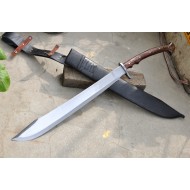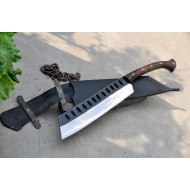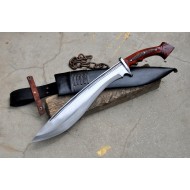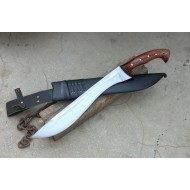


- Model: Custom Sword
- Product Code: Customforge1024
- Location: Kathmandu, Nepal
Available Options
A Hand-Forged Flamberge With a Downturned Cross
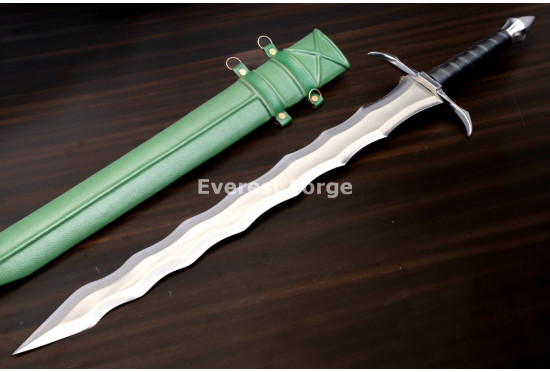
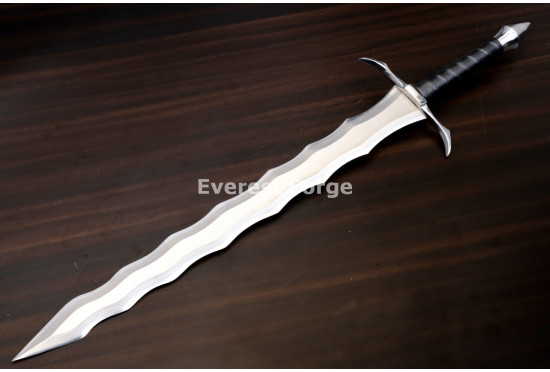
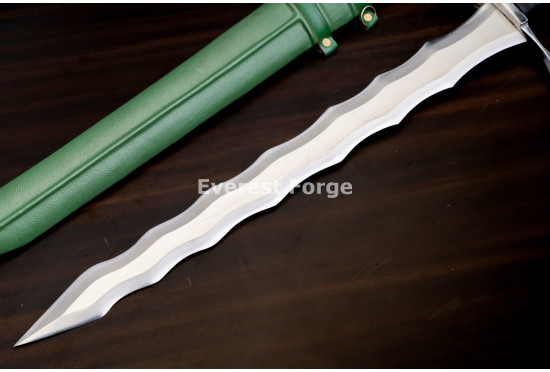
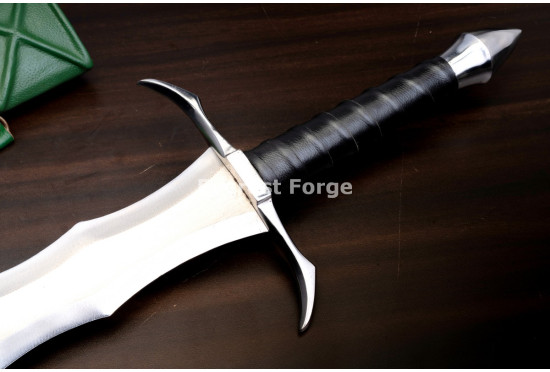
This is a hand-forged flame-bladed sword: a double-edged blade whose edges run in deep regular waves from just above the cross to an acute point, on a cruciform hilt with a black leather grip, a steel cross whose quillons sweep downward toward the blade, and a faceted steel pommel. It is forged from 5160 high-carbon spring steel in our workshop in Tokha-3, Kathmandu, and comes with a leather scabbard. Nothing is held in stock and nothing here is fixed: the sword is forged after your order arrives, so the dimensions, the wave depth, the grip material and the furniture are all yours to set at no extra cost. The figures in the specifications are the standard build.
Flame blades are real, and they are among the most striking objects the Renaissance produced. The German sources call the type a Flammenschwert, and surviving examples are mostly enormous two-handed swords carried by the doppelsoldner who fought at the front of a Landsknecht formation and were paid double for it. The waves were expensive to forge and they made a weapon that announced itself from across a field.
What we will not do is tell you the waves were a secret weapon. There is a great deal of nonsense written about flame blades — that they set up vibrations which shatter a parried sword, that they tear wounds no surgeon can close — and none of it is true. What the waves actually do is modest, real, and covered honestly in the questions below. The reason to own one is that it looks extraordinary, and that is a perfectly good reason.
An honest note. Three things worth having before you order. Strictly, flamberge and Flammenschwert describe a LARGE TWO-HANDED sword; this is a single-hand sword at roughly a third of that size, so the blade type is genuine but the word carries a two-hander's history with it. Second, the waves do not improve cutting, and anyone telling you otherwise is selling a myth — they bind slightly grabbier, they put more edge in contact, and they look magnificent. Third, a wavy edge is about three times slower to sharpen than a straight one and needs a round file or rod rather than a stone, which is the genuine ownership cost and nobody mentions it before you buy. None of that is a reason not to own one. It is a reason to own one knowing what it is.
Why It Is Built This Way
Full Specifications
Figures are taken from the sword shown and describe the standard build. Hand-forged work varies a little from piece to piece, so read these as close rather than exact. If a dimension matters, tell us before we start and we will build to it and measure the finished sword for you.
Build It Your Way
None of this costs extra, because none of it is made before you ask for it. Work down these six and put what you want in the order note.
Want the two-hander the word actually means?
A full Flammenschwert at Landsknecht proportions, with a long ricasso above the waves, parrying hooks and a two-handed grip, is a completely different sword from this one and we will forge it. Send us a museum reference or your own drawing and we will quote against it before anything goes on the fire.
Start a Custom Forge Request →What It Does Well, and What It Does Not
What it does well
- A silhouette nothing else in the range comes close to. If you want a sword people ask about, this is the one.
- Waves forged into the blade rather than ground out of a straight blank, which is where cheap flame blades give themselves away.
- An edge actually finished through the hollows, by hand, with a round tool. Most wavy swords arrive sharp on the crests and blunt in the troughs.
- Forged cross and pommel rather than castings, and a scabbard built with the clearance a waved blade genuinely needs.
- Lighter in the hand than the figure suggests, because the waves remove steel as well as adding outline.
- Everything configurable at no extra cost, including wave depth, which almost nobody offers.
What it does not do
- The waves do not make it cut better, and we will not tell you they do. They bind slightly grabbier and they look magnificent. That is the honest list.
- It is slower to sharpen. Roughly three times as long as a straight edge of the same length, and it needs a round file or rod rather than a stone.
- Strictly, flamberge describes a large two-handed sword. This is a single-hand interpretation and a collector will know the difference.
- It is around a quarter heavier than a straight single-hander of the same blade length, in line with how we build across the sword range.
- It is not a reproduction of any documented sword. The blade type is genuine; this particular sword is a modern design.
- It is not stainless. 5160 rusts if left wet and wants an occasional wipe of oil.
How to Order
Who It Is For
- Collectors who want one sword on the wall that stops every conversation, and would rather know what the waves do and do not do.
- Fantasy and film-inspired buyers after a flame blade made from proper steel by people who make weapons for a living.
- Buyers who want a matched build — grip and scabbard chosen together — rather than whatever colour the supplier had.
- Stage combat and theatrical armourers, who can order this design rebated and round-tipped at no extra cost.
- Anyone who has seen cheap wavy swords with ground-in undulations and blunt hollows and wants to know the difference.
- Anyone who would rather be told that a flamberge is properly a two-hander than have it quietly not mentioned.
What Is Included
- The sword, hand-forged in Tokha-3, Kathmandu, Nepal.
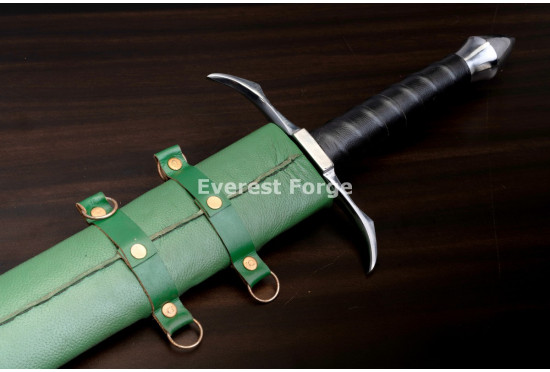
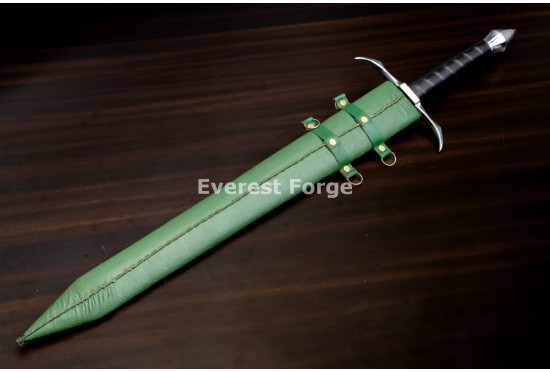
- A leather scabbard with a moulded spine and stamped throat panel, on a strap rig with brass fittings.
- A protective coat of oil on the blade for transit, wiped off before handling.
- Care instructions, and the Everest Forge manufacturer warranty against defects in materials and workmanship.
Choose your wave depth
Almost nobody offers this. Shallower undulations give you a sword with a flourish; deeper ones give you something that looks like it came out of a story. It costs nothing either way, it changes the character of the piece completely, and it is the one decision on this sword worth thinking about before you order. Tell us which way you want it.
Talk to the Forge →Related Blades and Reading
Shipping, Returns and Care
Dispatch and transit. Standard builds leave the workshop in 2 to 3 business days. Genuinely custom work — a longer blade, different wave depth, different furniture — runs 4 to 6 weeks depending on the queue. We ship by DHL or FedEx with tracking, typically 7 to 14 business days from Kathmandu, sheathed and braced with the strap rig packed separately so nothing bears on the blade.
Duties, import and edge law. Import duty and local taxes are the buyer's responsibility and vary by country. Swords are regulated differently in different places and are treated more strictly than knives almost everywhere. Please check what applies where you live before ordering. If an unsharpened build would make the difference, we will supply one at no extra cost, and on this blade an unsharpened build loses you very little.
Returns and warranty. Because every sword is forged after the order, a custom build cannot be restocked, so please make sure the specification is right before you confirm. Anything damaged in transit, or showing a defect in materials or workmanship, is covered by the Everest Forge manufacturer warranty and we will repair or replace it. Photograph the packaging as well as the sword if something has gone wrong on the way.
Care. 5160 is a high-carbon steel and it is not stainless. Wipe the transit oil off before handling and put a light film back on before the sword goes away. Fingerprints are acidic and will etch a polished blade if left for weeks. On a flame blade pay particular attention to the troughs: they are the surfaces a cloth drawn straight down the blade skips entirely, and they are where rust will start. Sharpening needs a round file or a ceramic rod worked along each wave, never a flat stone. Do not store the sword in the scabbard for long periods, since leather holds moisture against steel.
Questions About the Flamberge
What is a flamberge, and is this one?
A flame-bladed sword — one whose edges run in a regular series of waves rather than a straight line. The German sources call the type a Flammenschwert. This blade is exactly that: deep, even undulations running from just above the cross all the way to an acute point.
One honest qualification on the word. Strictly, flamberge and Flammenschwert describe a LARGE TWO-HANDED sword, the kind carried by Landsknecht doppelsoldner in the sixteenth century, and the term got attached to it by later collectors rather than by the men who used it. This is a single-hand sword at a third of that size. The blade is a genuine flame blade; the word carries a two-hander's history with it, and you should know that before a collector tells you.
Do the waves actually do anything?
A little, and far less than the internet claims. The honest answer has three parts. A waved edge puts more inches of steel in contact with whatever you are cutting than a straight edge of the same blade length, which can help a draw cut. In a bind, the undulations give an opposing blade or a spear shaft something to catch on, so the parry is grabbier than a smooth edge. And it is visually alarming, which on a Renaissance battlefield was worth something on its own.
That is the whole list. The waves do not make the sword cut deeper, they do not make it stronger, and they cost you something too: a wavy edge is slower to sharpen, the blade is narrower at the troughs than at the peaks, and the extra edge length is extra edge to maintain. Anyone selling you a flame blade on performance grounds is overselling it. Buy it because it looks extraordinary, which it does.
Is it true that a wavy blade causes wounds that will not heal, or shatters the blade it parries?
No to both, and these are the two myths that follow this sword everywhere. The first says the waves tear a ragged wound that cannot be closed. The second says the undulations set up a vibration in a parried blade that cracks or shatters it. Neither has any support in the period sources or in physics.
The vibration story is the more persistent and the more obviously wrong: a sword in a bind is in sliding contact under load, which damps vibration rather than amplifying it, and the steel in an opposing blade is not brittle enough to shatter from a scrape regardless. Wavy blades were made because they looked magnificent and bound slightly better, not because they had a secret mechanism. We would rather sell you one honestly than repeat a story you will later find out was invented.
How do you sharpen a wavy edge?
Not on a flat stone, which is the practical thing nobody mentions before you buy. A bench stone or a flat hone rides across the peaks and never reaches the troughs, so the edge goes dull in the hollows and stays sharp on the crests, which is the worst of both.
What you need is a round tool that follows the curve: a tapered round file for reprofiling, and a ceramic or diamond rod for maintenance, worked along each wave in turn rather than dragged down the blade. It takes maybe three times as long as a straight edge of the same length. That is the real ownership cost of a flame blade, it is entirely manageable, and it is worth knowing before rather than after. Our forge terminology page covers the other blade features you will meet.
What size is it, and can I change it?
The standard build carries a 24 inch blade and a 9 inch hilt with a 6 inch grip, 33 inches overall. That is a default rather than a fixed specification — every blade we make is forged after the order, so the dimensions are yours to set.
Two changes are worth thinking about on a flame blade in particular. A longer blade gives you more waves and a more dramatic silhouette, and takes the sword toward the two-handed proportions the word flamberge properly describes. A longer grip lets the off hand crowd the pommel, which matters more here than on a plain sword because the waves add weight without adding reach. Neither costs extra.
How heavy is it, and is it one-handed?
1,240 grams with a 24 inch blade, which is about 52 grams per inch of blade. A straight single-handed sword of this length would run nearer 40, so it is around a quarter heavier than the historical equivalent — robust rather than lively, and in line with how we build across the sword range.
The 6 inch grip is a single-hand grip with room to crowd the pommel with two fingers of the off hand, which we would suggest doing. If you want a genuinely two-handed sword, ask for a longer grip and a longer blade and we will build it, at no extra cost. If you want it lighter, ask for thinner stock with more distal taper and we will tell you honestly what that costs in robustness.
Does it arrive sharp?
Yes, both edges sharpened through every wave and ready to use, unless you tell us otherwise. Sharpening a flame blade properly takes longer than a straight one and it is done by hand along each undulation.
Unsharpened builds are free, for display or for an awkward import, and on a wavy blade an unsharpened build is a genuinely popular choice because the silhouette is the point. A stage combat build — rebated edge, rounded tip — is also available at the same price.
What steel is it, and how is it heat treated?
5160 high-carbon spring steel, which we use across the whole range. The blade is forged to shape, quenched, and then tempered back by hand as a separate operation afterwards. Those two steps are distinct and the second is what matters: quenching alone leaves a blade hard and brittle, and tempering trades a little hardness for toughness.
On a flame blade the heat treatment matters slightly more than usual, because the waves mean the blade is narrower at the troughs than at the peaks and the section is not constant along its length. A blade left hard and untempered would find those narrow points first. 5160 is not stainless, rusts if left damp, and holds an edge far better than any stainless we could sensibly forge. We do not make pattern-welded or laminated blades at all, by choice.
Where does it balance?
Close to the hand for a sword of this length, because the waves remove steel as well as adding outline and the hilt carries a solid cross and a faceted pommel behind it. In practice it feels quicker than 1,240 grams suggests.
We do not publish a single point-of-balance figure, because hand-forged blades vary and a number two inches out is worse than none. Ask before dispatch and we will measure the actual sword we are sending you, from the cross, and send you the number. Our sword guide explains what the measurement means and why it is worth asking any seller for.
What are the grip and furniture made of?
The standard build has a black leather-wrapped grip over the tang, a polished steel cross whose quillons sweep downward toward the blade and taper to flattened tips, and a faceted steel pommel. Everything metal is forged and finished by hand rather than cast.
Grip material and colour are both selectable. Rosewood, horn, bone, micarta and other leather colours are all available at no extra cost, and we will match the scabbard to whatever you choose. Cast fittings are cheaper to make and they are the first thing to fail on a sword that gets handled, which is why we do not use them.
What comes with it?
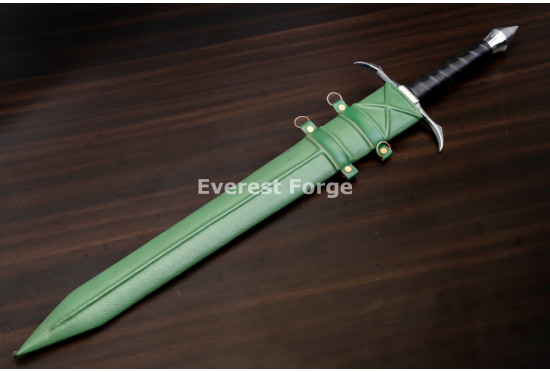
A leather scabbard with a moulded raised spine down each face and a stamped panel at the throat, carried on a strap arrangement with brass fittings. The standard build pairs it green against the black grip, and the colour is yours to change.
A flame blade needs a scabbard built with clearance rather than a close fit, because an undulating edge cannot be drawn through a throat cut to a straight profile. Ours is made to suit the blade. If you want a different colour, a belt rather than a strap rig, or a wall mount cut to this blade's outline, those are custom forge items and we will quote them.
How long does it take, and how is it shipped?
Nothing is held in stock. Every blade is forged after the order arrives, which is why the dimensions, the grip material, the finish and the edge specification are all free to change — there is no standard version already made. Standard builds dispatch in 2 to 3 business days; genuinely custom work runs 4 to 6 weeks depending on the queue.
The sword ships sheathed and braced in a rigid carton with the strap rig packed separately so nothing bears on the blade, by DHL or FedEx with tracking, typically 7 to 14 business days from Kathmandu. Import duty and local taxes are the buyer's responsibility and vary by country.
| Specification | |
| Blade: | 24 inches. Hand forged from 5160 carbon steel |
| Total Length: | 33 inches |
| Handle: | 9 inches. Full tang, 6 inch leather-wrapped grip, steel cross and faceted pommel |
| Weight: | 1240 grams the sword, 1600 grams with the scabbard |
| Note: | Handmade variation in weight, dimensions and finish may occur. Keep blade lightly oiled when not in use. |