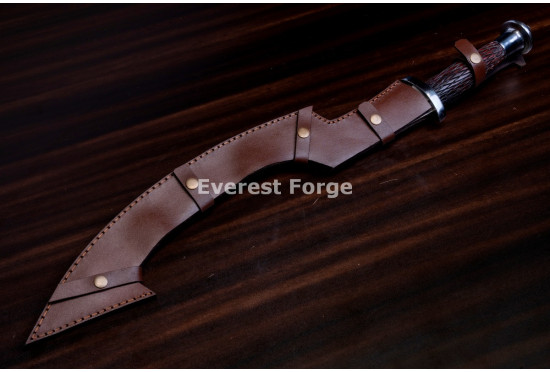
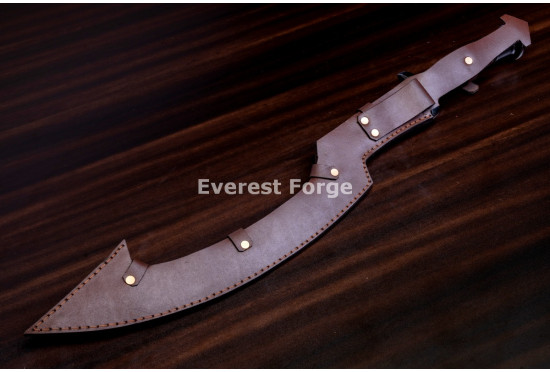
- Model: KHOPESH SWORD
- Product Code: KHOPESH021
- Location: Kathmandu,Nepal
Available Options
A Hand-Forged Khopesh Sword With a Single Fuller
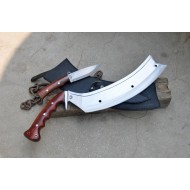
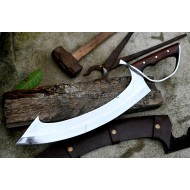
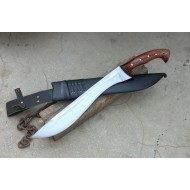
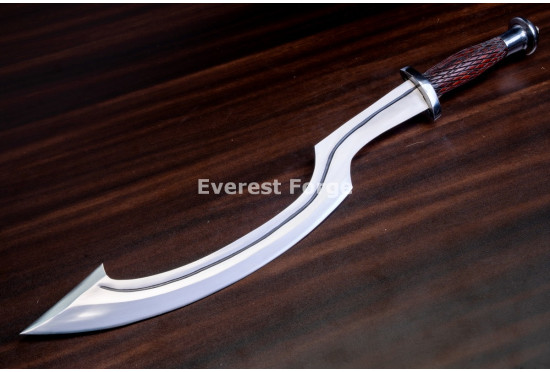
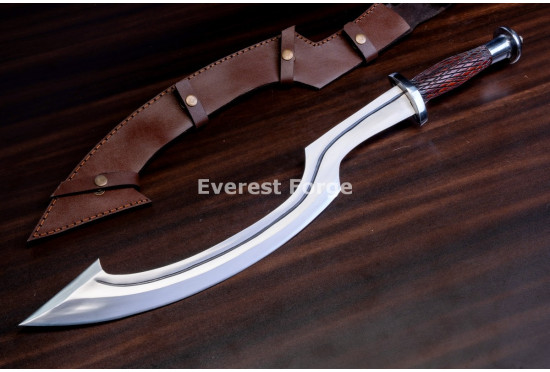
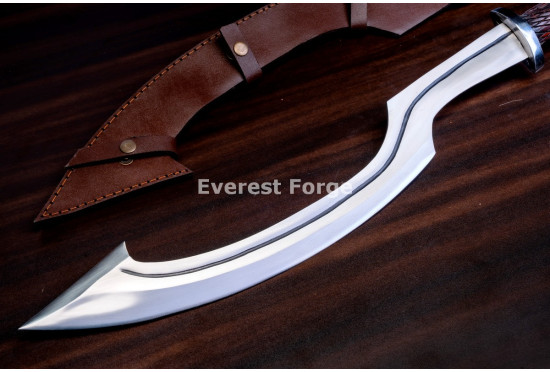
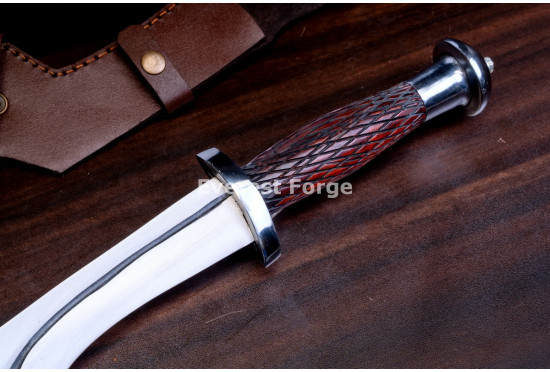
This is a large khopesh, hand-forged in Tokha-3, Kathmandu, Nepal from 5160 high-carbon steel, oil-quenched and tempered. The blade runs 21 inches, dropping through a deep sickle curve into a broad belly and rising again to an upswept point, with a single fuller worked the length of the blade just inside the spine and a stepped shoulder where the section widens. The cutting edge sits on the outer curve, which is the arrangement that defines the sickle-sword family. The hilt carries a checkered rosewood grip between a polished disc guard and a broad flared pommel, and the sword stands 28 inches overall. It ships sharpened, in a fitted brown leather scabbard.
An honest note. This is a working interpretation rather than a museum reconstruction, and the differences are worth stating. The crescent profile, the forward mass and the sharpened outer curve are all correct. What is not period: a true khopesh was a single piece of bronze, later iron, with no guard, no separate pommel and a longer straight section between the hand and the start of the hook — and it carried no fuller, because fullering a cast bronze blade is neither practical nor useful. The disc guard, the flared pommel, the checkered grip and the fuller are all modern additions. They make a better sword; they also make it an interpretation. If you want a strict period reconstruction, our smiths will forge one.
Want a Strict Period Reconstruction?
Our smiths will forge a khopesh to the historical pattern — longer straight section, no guard or pommel, an unfullered blade and a simple wrapped grip, with proportions taken from a specific find if you have one in mind. Send a reference and we will quote it.
Start a Custom Build →Why This Khopesh Is Built the Way It Is
Full Specifications
How You Can Configure It
Is This the Right Sword for You?
Buy This If You Want
- The largest khopesh in our range, at 21 inches of blade
- A fullered blade, which almost no khopesh on the market has
- A textured grip that holds under a hard swing rather than a smooth one that does not
- Real forged 5160 with a proper heat treatment, not cast decoration
- A counterweighted hilt on a blade that carries its mass forward
- A piece a smith will move toward the historical pattern if you ask
Look Elsewhere If You Want
- A strict museum reconstruction — guard, pommel and fuller are not period
- A bronze piece; this is steel, which the originals were not
- A compact sword; at 28 inches with a broad blade this is the big one
- A thrusting weapon — the geometry is built to cut
- A stainless blade that needs no oiling or care
- Identical units; every piece is forged by hand and varies slightly
How to Order
Who This Khopesh Suits
- Ancient-world collectors who want the largest and most worked piece in the khopesh range rather than the plainest.
- Test cutters after a forward-weighted sickle blade with a grip that will not turn in the hand.
- Cosplay and film prop users needing a silhouette that reads instantly on camera at full sword size.
- Display buyers after a wall piece with visible hand work in the fuller and the checkering.
- Gift buyers looking for something with three thousand years behind the outline, etched with a name or a date.
What Is Included
- One hand-forged khopesh sword, sharpened and ready to use
- Fitted brown leather scabbard with riveted straps and belt harness
- Care and oiling instructions
- Everest Forge manufacturer warranty against defects in forging and heat treatment
Other Hand-Forged Curved Swords
Shipping, Returns and Care
Shipping. Standard builds dispatch in 2 to 3 business days. Custom builds take 4 to 6 weeks. We ship worldwide by DHL or FedEx, 7 to 14 business days, fully tracked. Sword laws vary by country and by state — please check what applies where you live before ordering, as we cannot deliver into a restricted address.
Returns. Standard builds can be returned unused and in the original scabbard within 30 days. Custom builds, altered dimensions and etched pieces are made to your specification and cannot be returned unless there is a fault in forging or heat treatment.
Care. 5160 is a high-carbon steel and it will rust if you neglect it. Wipe the blade dry after handling and keep a thin film of oil on it in storage. This sword has three places a cloth skips over: the inside of the sickle curve, the length of the fuller, and the cuts of the checkering on the grip. The fuller in particular holds oil and dust, so run a corner of cloth along it every time. Do not store the sword in the scabbard for long periods, because leather traps damp against steel, and condition the leather once or twice a year.
Frequently Asked Questions
Which of your khopesh should I buy?
Work down by size, because that is what actually decides it. This one is the largest, at 21 inches of blade and 28 inches overall, and it is also the most worked — the fuller, the checkered grip, the disc guard and the flared pommel are all features the others do not carry. Our other full-size khopesh runs 18 inches of blade at 24.5 inches overall with a plainer hilt and an unfullered blade, which makes it lighter in the hand and quicker to bring round; it is the one to take if you want the shape without the mass. At the other end, our khopesh-style chopper is a short working blade of 10.5 inches, built for camp and bushcraft use rather than as a weapon. In short: this is the display and cutting piece, the 18 inch is the carry piece, and the chopper is the tool.
Why does a curved sword need a fuller at all?
Because a curved blade already has a weight problem that a straight one does not. On any forward-curved sword the mass sits ahead of the hand by design — that is where the cutting authority comes from — but past a certain size that same mass makes the sword slow to start and slow to stop. A fuller lets you remove steel from the middle of the section, where it contributes least to stiffness, without narrowing the blade or thinning the edge. On a straight sword that is mostly about overall weight. On a curved sword it is about WHERE the weight is: you are taking material out along the blade's length while leaving the belly and the edge intact, which pulls the balance back toward the hand without softening the cut. That is why a fullered khopesh handles noticeably livelier than an unfullered one of the same dimensions. It is also difficult to forge cleanly along a curve, which is why almost no khopesh on the market has one.
Why is the grip checkered rather than smooth?
Retention, and it matters more on this shape than on most swords. A forward-weighted blade pulls against the hand through the whole arc of a swing, and at the moment of impact it wants to rotate in the grip rather than stay aligned. A smooth timber grip relies entirely on how hard you are squeezing, which fails the moment your hand is wet, cold, sweaty or gloved. Cutting a diamond pattern into the wood gives the skin something to key into, so the sword stays indexed with far less grip pressure — and gripping less hard is itself worth having, because a tight fist transmits shock into the wrist and tires you within minutes. The trade-off is that checkering is harsher on a bare hand over a long session and it hides the grain, which is why we offer smooth timber, horn and wrapped grips as alternatives. If the sword is primarily going on a wall, smooth looks better; if it is going to be swung, take the checkering.
How close is this to a historical khopesh?
Right on the fundamentals, openly different on the details. The crescent profile is correct, the forward mass is correct, and the edge is on the outer curve, which is the single most important diagnostic and the one most sellers get backwards. What is not period: the original was a single piece of bronze, later iron, with no guard and no separate pommel, and it carried a longer straight section between the hand and the start of the hook. It also carried no fuller at all, because you cannot usefully fuller a cast bronze blade. The disc guard, the flared pommel, the checkered grip and the fuller on this sword are all modern. We offer a strict reconstruction through the custom forge for anyone who wants the period line rather than the improved one.
What steel is it and how is it heat treated?
5160 high-carbon spring steel, oil-quenched and then tempered back. 5160 holds a working edge and flexes under load rather than snapping, which is what a heavy forward-weighted blade needs. It is also the steel family Nepali smiths have traditionally drawn from vehicle leaf spring, so our forge reads it by colour and by sound at the anvil. It is a considerable improvement on the bronze the originals were cast in, which was softer and had to be made thicker to compensate.
Does it arrive sharp?
Yes. It ships with a working edge along the outer curve, sharpened by hand and ready out of the scabbard. It is not a blunt wall-hanger with a sword-shaped profile ground into it. If it is going into a display case, a costume or a setting where an edge is a liability, ask for it blunted in the order note before we ship and we will finish it that way at no extra cost.
Is the tang full length?
Yes. The tang runs the full length of the hilt with the disc guard, grip and pommel fitted to it, so the assembly is held by steel rather than by adhesive. On a blade shaped like this it matters more than usual: a curved sword loads the hilt sideways as well as along its length, and a short or partial tang will work loose at the guard under exactly that stress. You feel it as a rattle long before anything actually fails.
Can I have it made longer or shorter?
Yes. Blade length is selectable, and beyond the listed options our smiths will forge to a dimension you specify. The important point on this shape is that the curve is redrawn rather than stretched — a khopesh profile scaled up without redrawing puts the mass in the wrong place and the sword feels dead. The fuller is laid out afresh to suit the new length as well, since a fuller that stops in the wrong place does nothing useful. Both are included in a custom build.
Is the scabbard included?
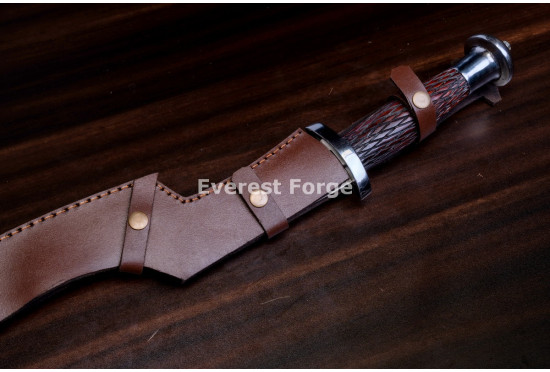
Yes. A fitted brown leather scabbard with riveted straps and a belt harness comes with the sword, cut around this specific blade profile. A deeply curved blade is genuinely awkward to sheath safely, so this is not a generic sleeve the sword happens to fit — it is made around the piece. If you change the blade length on a custom build, the scabbard is made to the new dimensions.
How do I look after it?
Treat it like any high-carbon sword, with three spots that need attention rather than the usual one. Wipe the blade dry after handling and keep a thin film of camellia, mineral or light gun oil on it in storage. The places a cloth skips are the inside of the sickle curve, the full length of the fuller, and the cuts of the checkering on the grip — the fuller especially holds oil and dust, so run a cloth corner along it every time rather than wiping across it. Do not store the sword sheathed for long periods, because leather traps damp against steel, and condition the leather once or twice a year so it does not dry and crack.
Will every sword look exactly like the photograph?
No, and that is inherent to hand forging. Every blade is drawn out under a hammer, so the depth of the curve, the width at the belly and the exact line of the fuller carry small differences from piece to piece. The checkering is cut by hand, so its spacing varies slightly, and rosewood is a natural timber so grain and colour differ on every grip. Weights and dimensions vary by a few percent either way. What is consistent is the steel, the heat treatment, the construction and the edge. If you need a piece to match the photograph closely, note it on your order and we will pick the nearest one in the rack.
Where is it made and by whom?
Hand-forged in Tokha-3, Kathmandu, Nepal, by our own smiths. Everest Forge is a working forge rather than a reseller putting a name on imported blanks — the steel is cut, drawn, quenched, tempered and ground, the fuller worked in, the grip shaped and checkered, and the scabbard stitched, all under one roof. That is why we can move a piece toward the historical pattern on a custom order: there is a smith at the anvil rather than a catalogue of finished stock.
| Specification | |
| Blade: | 21 inches. Hand forged from 5160 carbon steel |
| Total Length: | 28 inches |
| Handle: | 7 inches total with a 4.5 inch grip, full tang, checkered rosewood grip with polished disc guard and broad flared pommel |
| Weight: | 1500 grams approx, as shipped with the scabbard |
| Note: | handmade variation in weight, dimensions and finish may occur; keep blade lightly oiled when not in use |