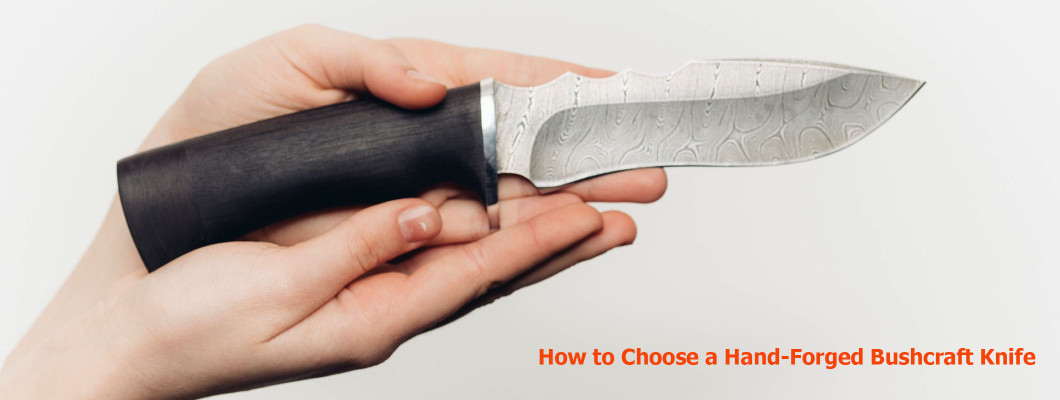
How to Choose a Hand-Forged Bushcraft Knife
A bushcraft knife is the one blade you will use more than any other in the woods, and it is the one most people buy wrong. They buy too long, they buy the wrong grind, they buy on looks, and they end up with a knife that photographs well and carves badly.
Bushcraft is woodcraft — feather sticks, notches, try-sticks, tent pegs, pot hangers, traps, spoon carving, bark stripping, fine kindling. Every one of those tasks rewards precision and punishes the wrong tool. This guide walks the four things that actually decide whether a bushcraft knife works: blade length, grind, tang and spine. Get those four right and handle and steel fall into place. Get them wrong and no amount of quality forging saves the knife.
If you are still deciding whether you want a bushcraft knife at all, or a camp knife or survival knife instead, start with camp knife vs bushcraft knife vs survival knife first, then come back here to choose the bushcraft blade itself.
Everything below applies to blades hand-forged in Tokha-3, Kathmandu, Nepal from 5160 high-carbon spring steel, full tang and oil-tempered — but the selection principles hold for any bushcraft knife you are weighing up.
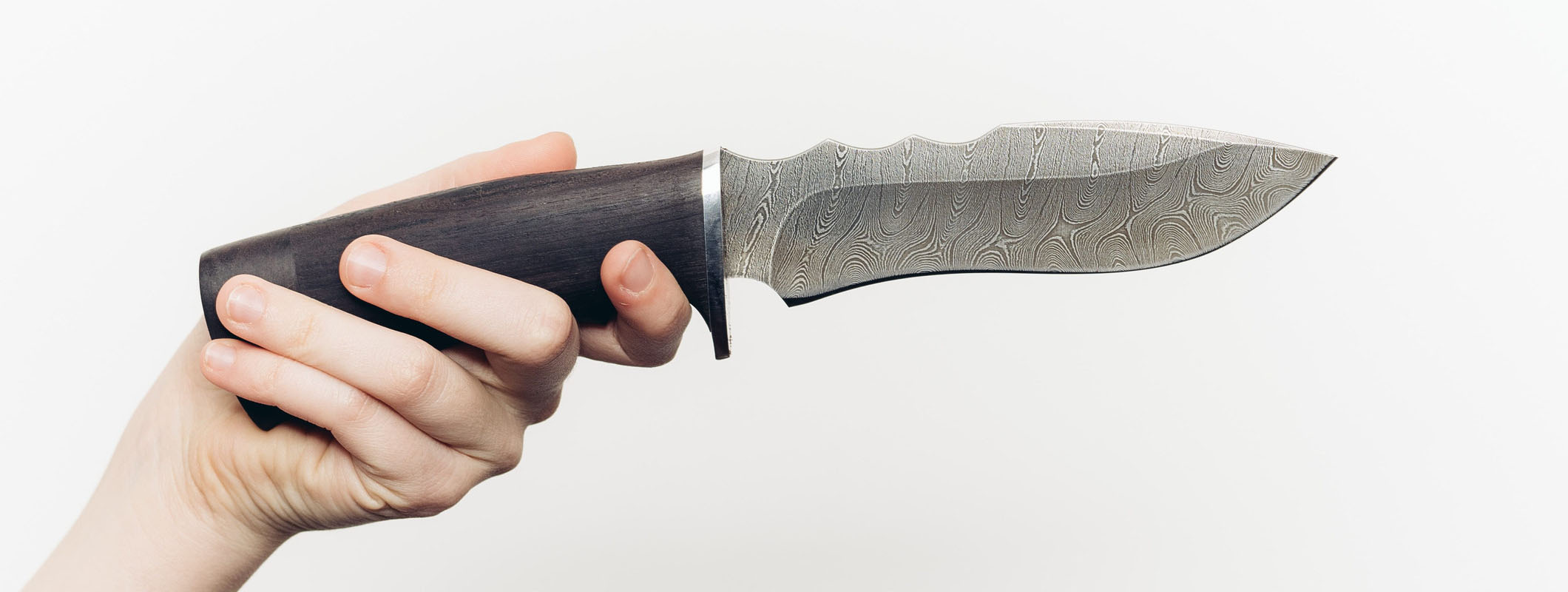
1. Blade Length — Shorter Than You Think
This is the mistake almost everyone makes. A bushcraft knife should be roughly 4 to 5 inches of blade, and most people's instinct is to buy 7 or 8. The instinct is wrong, and the reason is physics, not preference.
Control drops off with every inch the edge sits away from your hand. In carving, the work happens in the first two or three inches of blade nearest the handle, where you have leverage and feel. The rest of a long blade is dead weight that fights your wrist and gets in the way of a controlled cut. A 4.5-inch blade lets you choke right up to the work; a 9-inch blade forces your hand back and turns fine carving into a wrestling match.
How to think about length
- 4 to 4.5 inches — the carving specialist's choice. Maximum control, ideal for spoon carving, trap triggers, and detail work. Struggles with anything you need to chop.
- 4.5 to 5 inches — the all-round bushcraft sweet spot. Still controllable for carving, long enough to prepare food and handle light camp chores. If you buy one bushcraft knife, buy this length.
- 5 to 6 inches — the upper limit before "bushcraft knife" becomes "outdoor knife." Fine if you want more reach and a bit more chopping ability and accept slightly less carving finesse.
- Over 6 inches — no longer a bushcraft knife. You are now buying a camp or survival blade, and the job of chopping is better handled by a dedicated tool anyway.
The honest rule: if you find yourself wanting a longer blade so it can chop, you do not want a longer bushcraft knife — you want a bushcraft knife and a chopping tool. A small knife paired with an axe or a working kukri beats one stretched-out compromise blade at both jobs.
2. Grind — Scandi for Carving, Flat for Versatility
The grind is the shape of the bevel that forms the edge, and on a bushcraft knife it matters more than on any other blade. For bushcraft, the choice comes down to two grinds, and the verdict is short:
- Scandi grind — the carving specialist. A single wide bevel that bites into wood like a chisel and self-jigs on a stone, so you can restore a shaving edge in the field with no skill. Choose it if carving is the point — spoons, kuksa, notches, fine woodcraft. The trade-off is that it slices food and rope less cleanly.
- Flat grind — the all-rounder. Tapers evenly toward the edge, slices food and rope well, handles a wider range of tasks. Choose it if the knife has to do a bit of everything. It carves with slightly less bite and takes a little more skill to sharpen freehand.
If you are new to sharpening, the Scandi's self-jigging bevel is far more forgiving to learn on. There is no universally correct answer — anyone who gives you one is selling a preference as a fact.
That is the bushcraft verdict. For the full picture — how each grind is actually formed, and the other geometries (hollow, convex, high flat, chisel and more) with cross-section diagrams — see our complete blade grind types guide. Grind is also one of the things worth specifying on a custom build rather than settling for what a stock knife happens to come with.
3. Tang — Full Tang, No Exceptions
The tang is the part of the blade steel that extends into the handle. It is invisible once the knife is assembled, which is exactly why it is where corners get cut. For a bushcraft knife, there is only one acceptable answer: full tang.
Full tang means the steel runs as a single unbroken piece the full length and width of the handle, with the scales fixed to either side of it. A rat-tail tang narrows to a thin rod inside the handle, sometimes held by a single nut at the pommel. On a wall-hanger, a rat-tail is fine. On a working bushcraft knife, it is a failure waiting for a load.
Here is why it matters in the field. A bushcraft knife gets batoned — struck on the spine with a piece of wood to split kindling — and it gets used to pry, lever and dig whether or not the maker approves. Every one of those actions concentrates stress at the point where the tang meets the blade. A full tang spreads that load across the whole handle. A rat-tail concentrates it on a thin rod, and that rod is where the knife snaps, usually at the worst possible moment.
An honest note. "Full tang" is one of the most misused terms in knife listings — some sellers call a partial or stick tang "full" because the steel technically reaches the pommel even though it narrows to a rod on the way. Look for a tang whose profile you can see sandwiched between the scales along the whole handle. Every fixed blade in the Everest Forge collections is genuine full tang, and where a spec sheet is ambiguous we build and state full tang by default.
4. Spine — The Detail That Reveals Who Designed the Knife
The spine is the unsharpened back of the blade, and it is the single best tell for whether a knife was designed by someone who has used one. A well-made bushcraft spine does three jobs, and a badly made one does none of them.
- Ferro rod striking. A spine ground to a crisp 90-degree edge will throw a shower of sparks off a ferrocerium rod. A rounded or bevelled spine will slide off it uselessly. If firelighting matters to you, this is non-negotiable, and it costs the maker nothing but attention.
- Tinder scraping. That same square spine scrapes dry tinder, shaves fatwood, and processes bark into a fine ignitable fluff — all without dulling your cutting edge on the abrasive work.
- Thumb purchase for carving. A flat spine you can press your thumb along gives you control and pushing force in a carving cut. A rounded spine bites into your thumb instead.
Spine thickness is a separate question and a balancing act. Too thin and the knife flexes and cannot be batoned safely; too thick and it wedges in cuts and carves poorly. For a bushcraft knife, a medium spine — thick enough to baton light kindling, thin enough to carve cleanly — is the target. This is not the place for the thick stock of a survival chopper.
The 90-degree spine is another feature worth specifying on a custom build, because plenty of otherwise good stock knives leave it rounded.
The Fifth Factor — Handle
Length, grind, tang and spine decide the blade. The handle decides whether you can use it for an hour without your hand cramping. It is not one of the headline four, but it is close behind them.
A bushcraft handle wants a neutral, rounded shape with no aggressive finger grooves — grooves lock your hand into one grip, and bushcraft demands many grips: forehand, reverse, chest-lever, thumb-assisted push cuts. It wants a material with grip when wet — rosewood, horn or bone full-tang scales serve well. And it wants to be sized to your hand, which is the one thing a stock knife cannot promise and a custom build can.
A Word on Steel
Steel comes last here deliberately — because a bushcraft knife in a modest steel with the right length, grind, tang and spine beats a knife in an exotic steel with the wrong geometry every time. Geometry cuts; steel only decides how long the edge lasts and how easily you restore it.
5160 high-carbon spring steel — the steel Everest Forge forges from — suits bushcraft particularly well. It is the steel used in vehicle leaf springs, chosen for toughness: it takes the shock of batoning and prying without chipping, where a harder, more brittle stainless can crack. It takes a keen edge, and critically for the field, it sharpens back quickly on a simple stone with no special abrasives. The trade-off is that it is a carbon steel and will rust if neglected — wipe it dry, keep a light film of oil on it, and many users let a stable dark patina form that slows further oxidation.
For the full picture on forging, tempering and what "hand-forged" actually means, see how your blade is forged and the Everest Forge Battle Ready Standard.
Bushcraft Knives Worth Looking At
Matched to the priorities above — controllable length, working geometry, genuine full tang.
Want something smaller for everyday carry as well? Browse compact and EDC knives. Want the full range side by side? See all heavy-duty bushcraft knives or the complete forged knives collection.
A Quick Buyer's Checklist
| Factor | What to want | Why |
|---|---|---|
| Blade length | 4 to 5 inches | Control lives near the hand; longer fights the wrist |
| Grind | Scandi for carving, flat for versatility | Scandi bites wood and self-sharpens; flat does everything |
| Tang | Full tang, genuinely | Batoning and prying break rat-tail tangs |
| Spine | 90-degree, medium thickness | Sparks a ferro rod, scrapes tinder, gives thumb purchase |
| Handle | Neutral shape, grippy when wet | Bushcraft demands many grips; grooves lock you into one |
| Steel | Tough carbon steel, e.g. 5160 | Survives shock, sharpens easily; geometry matters more |
When No Stock Knife Ticks Every Box
Here is the reality of choosing a bushcraft knife off a shelf: you will almost always compromise on one of the six factors above. A knife with the perfect length has the wrong grind; the one with a true Scandi has a rounded spine; the right blade has a handle sized for someone else's hand. That is the nature of stock production.
A bushcraft knife is one of the best possible candidates for a custom forge, precisely because these variables are personal and few of them are visible in a photo. Blade length to the quarter-inch, a genuine Scandi grind, a square 90-degree spine, a handle sized to your grip in the material you prefer, and a sheath cut for your carry — all specifiable.
Have Your Bushcraft Knife Built to Your Hand
Specify blade length, grind, spine geometry, tang, handle material and size, guard and sheath — or send a sketch, a reference photo or a 3D model. Every custom blade is hand-forged in Nepal from 5160 spring steel, full tang, oil-tempered and sharpened. We reply to every request within 24 to 48 hours with a free quote.
Request a Custom Forge →Want a rough figure first? The custom forge price estimator gives you a ballpark from your specs. Prefer a stock pattern made yours? We offer free personalisation — a name, initials or a message engraved on the blade or handle at no extra cost.
Frequently Asked Questions
What is the best blade length for a bushcraft knife?
Between 4 and 5 inches for most people. Around 4.5 inches is the all-round sweet spot — controllable enough for carving, long enough for food prep and light camp chores. Shorter (4 inches) favours detail carving; longer than 6 inches stops being a bushcraft knife and becomes a general outdoor or camp blade.
Scandi grind or flat grind for bushcraft?
Scandi if carving is your priority — it bites into wood and is the easiest grind to sharpen in the field because the whole bevel lays flat on the stone. Flat grind if you want one knife that also slices food and rope well. Scandi is a wood specialist; flat is the versatile all-rounder. For how every grind is formed, see our blade grind types guide.
Why does a bushcraft knife need a full tang?
Because bushcraft involves batoning, prying and levering, and every one of those concentrates stress where the tang meets the blade. A full tang spreads that load across the whole handle. A rat-tail tang concentrates it on a thin rod, which is where the knife breaks under hard use.
What is a 90-degree spine and do I need one?
It is a spine ground to a crisp square edge rather than rounded off. A square spine throws sparks off a ferrocerium rod for firelighting and scrapes tinder and fatwood without dulling your cutting edge. If firecraft matters to you, insist on it — many otherwise good knives leave the spine rounded.
How thick should a bushcraft knife blade be?
Medium — thick enough to baton light kindling without flexing, thin enough to carve cleanly. A blade as thick as a survival chopper wedges in cuts and carves poorly. Bushcraft rewards a moderate spine, not maximum stock.
Can I baton firewood with a bushcraft knife?
Light kindling, yes, if the knife is full tang with a medium-to-thick spine. Strike the spine over the supported wood, never over the unsupported blade past the exit point, and avoid knots. For splitting larger rounds, an axe or a heavier chopper is the correct tool — do not ask a fine carving knife to do a chopper's job.
Is 5160 steel good for a bushcraft knife?
Very. 5160 spring steel is tough, which is exactly what a batoned and pried bushcraft blade needs — it resists chipping where a harder stainless can crack. It also sharpens back quickly on a simple field stone. The trade-off is that it is carbon steel and will rust if left wet, so keep it dry and lightly oiled.
What handle material is best for a bushcraft knife?
One that grips when wet and suits many grips — rosewood, horn or bone full-tang scales all work. Avoid aggressive finger grooves, which lock your hand into a single grip when bushcraft demands several. Handle size matters as much as material, which is why a hand-sized custom build has an edge over stock.
How is a bushcraft knife different from a survival or camp knife?
A bushcraft knife is built around control for woodcraft — short, fine, carving-focused. A camp knife is built around fire and food, usually wider and heavier. A survival knife is built around being the only blade you have, so it is longer and thicker to chop. The full comparison is in our camp vs bushcraft vs survival knife guide.
Can you forge a custom bushcraft knife to my specification?
Yes — this is one of the builds custom forging suits best. Blade length, grind, spine geometry, tang, handle material and size, and sheath are all specifiable, and you can upload sketches or 3D models. Submit a custom forge request for a free quote within 24 to 48 hours.
Shop Hand-Forged Bushcraft Knives
Full Tang, Field-Ready, Hand-Forged in Nepal
Bushcraft and outdoor fixed blades forged from 5160 spring steel by our smiths in Tokha-3, Kathmandu — oil-tempered and sharpened before they ship. Browse the range, or have one built exactly to the specification this guide describes.
Browse Bushcraft Knives →