The Wings Are the Whole Point: A Boar Spear Is Built to Stop a Charging Animal Before It Reaches the Hunter
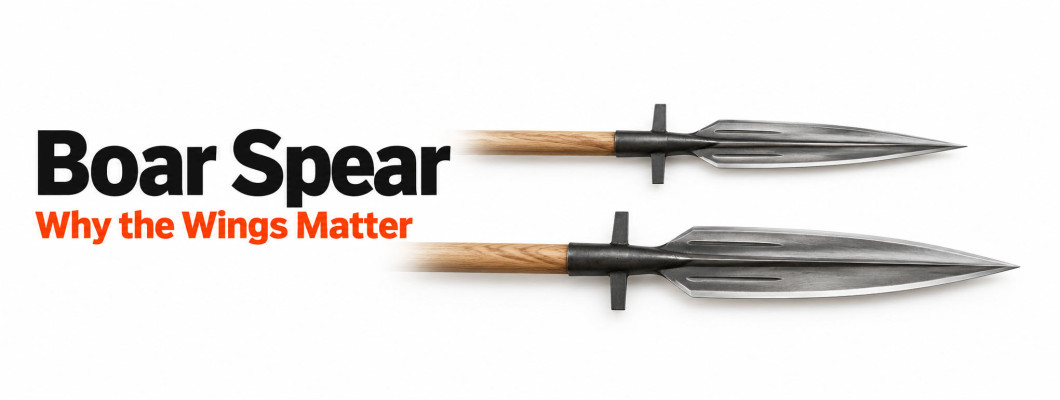
A boar spear is a heavy hunting spear with a broad, leaf-shaped head and two lugs, or wings, just below the blade. Medieval and Renaissance hunters across Europe used it to receive the charge of a wild boar on foot. The broad head makes a wide, deep wound. The lugs stop the head going in too far, so the animal cannot force its way up the shaft to the hunter, which a wounded boar will try to do. The shaft is long and stout, usually ash, often wrapped in leather or studded with nails for grip, and the butt is braced against the ground. This guide explains why the wings matter, how the spear was used, how its head changed from the Carolingian winged spear to the crossbar spear and the bear spear, and how the boar spear differs from an ordinary hunting spear.
The boar spear is one branch of the spear family. For the rest of that family, from the dory to the pike and the assegai, start with our guide to types of spears. This post gives the boar spear the depth that guide could not.
What Makes a Spear a Boar Spear?
German hunters called it the Saufeder, the "sow feather", after the feather-like head. Whatever the name, a boar spear has four features:
- A broad leaf-shaped head, usually 20 to 30 cm long, double-edged, with a strong midrib. It is wider than a war spear's head, to open a wound large enough to bring down a heavy animal quickly.
- Lugs or wings forged on the socket just below the blade, or, from the sixteenth century, a separate crossbar (toggle) lashed to the shaft.
- A long socket fitted over the shaft and nailed through, so the head cannot come off under load.
- A long, stout shaft, usually around 1.8 to 2.2 m, of ash. It was often wrapped with leather thongs or set with nails along the grip so wet hands would not slip.
Why the Wings Matter
A wild boar is heavy, low, fast and extremely tough. A wounded boar does not retreat; it keeps pushing forward. With a plain spear, a boar that took the head in its chest could drive itself further onto the shaft until it reached the hunter's hands and legs with its tusks. Hunting manuals and chronicles describe exactly that happening.
The lugs solve the problem. They act as a stop, letting the head go in to its full depth and no further, so the shaft holds the animal at a fixed distance. They also give the hunter leverage to turn the boar aside or pin it while hounds or other hunters close in. On later spears the crossbar did the same job and could be replaced if it broke.
How the Boar Spear Was Used
Boar hunting was a noble pastime in medieval and Renaissance Europe and one of the most dangerous. Gaston Phoebus's Livre de chasse of the late fourteenth century describes and illustrates it in detail. Hounds found the boar and brought it to bay, and the hunter, on foot, waited for it to charge. He set the butt of the spear against the ground or his rear foot, held the shaft low with both hands and angled it to meet the boar's chest. The animal impaled itself on the head, and the lugs held it there.
Mounted hunters sometimes used lighter spears or swords, but the classic boar spear was a foot weapon. It needed nerve more than strength. The hunter had to stand still and keep the point on target while a large animal came straight at him. For the general principles of thrusting spears, see our guide to thrusting spears vs throwing spears.
From the Carolingian Winged Spear to the Bear Spear
The Carolingian winged spear, of the eighth to tenth centuries, already had small wings on its socket. It was a war spear as well as a hunting one, and the wings kept it from sinking too far into an enemy or a shield, so it could be pulled free. The Viking spears that sat alongside it are covered in our Viking spear history.
The lugged boar spear of the fourteenth to sixteenth centuries is the classic form. It has a broad leaf head and long lugs forged as part of the socket.
The crossbar boar spear of the sixteenth and seventeenth centuries replaced the forged lugs with a separate bar of wood, antler or iron lashed to the shaft below the head. It was easier to make and to repair.
The bear spear (Bärenspiess) is the heavy relative of the boar spear, with a wider head and stronger lugs for a still larger animal. Many of the finest surviving examples are princely hunting weapons, with etched or gilded heads.
The winged war spear's descendants on the battlefield, the partisan and the spetum, are covered in polearms explained.
Boar Spear vs Hunting Spear
| Boar spear | General hunting spear | |
|---|---|---|
| Head | Broad leaf, 20 to 30 cm | Leaf or narrower, varies widely |
| Lugs or crossbar | Always | Usually none |
| Shaft | Long and stout, about 1.8 to 2.2 m, braced | Shorter or lighter; may be thrown |
| Use | Receiving a charge on foot | Thrusting or throwing at game |
| Thrown? | Never | Often |
Every boar spear is a hunting spear, but most hunting spears are not boar spears. The lugs and the braced, unthrown use are what define it.
Is Spear Hunting Legal Today?
In most countries, hunting with a spear is illegal or tightly restricted, and in many it is banned outright on animal-welfare grounds. In a few places, notably some US states, feral hogs may be hunted by methods that include a spear under general hunting rules, and spear hunting of hogs survives as a niche pursuit. The rules differ from state to state and change. Check your local game laws before you treat any spear as a hunting tool. Our spear laws guide covers ownership, carry and import.
Choosing a Hunting Spear From Everest Forge
Our spears are in the hand-forged spears collection, forged on demand in our Kathmandu workshop from mono-steel 5160 spring steel. Nothing is held in stock; every blade is forged after the order is placed.
- The Boar Spear: our compact short hunting spear with a broad blade and a leather-wrapped haft.
- The Survival Spear: a larger leaf-bladed spear with a long fuller and a ring pommel.
- The Sentinel Spear: a heavy short spear with a striking pommel.
- The Scout Spear: a light short spear that can be thrown.
An honest note on these spears. All of our catalogue hunting spears, including the one we call the Boar Spear, are short one-piece spears with a full tang running into the handle. None has lugs or a full-length shaft. They are excellent short spears for collectors, camp and display, but they are not historical boar spears. If you want a true boar spear, with a broad socketed head, forged lugs or a crossbar and a full ash shaft, ask for it through the custom forge. Our guide to how a spear is hafted explains the socket and shaft. For choosing between our spears, see how to choose a hand-forged spear.
To set the blade length, finish and handle yourself, start from Build Your Blade. Any spear can be ordered blunt with a rounded tip for display or stage use by asking in the order note. Catalogue builds dispatch in 2 to 3 business days; custom builds take 4 to 6 weeks at the forge; shipping is DHL or FedEx, tracked, 7 to 14 business days worldwide.
An honest note on the steel. Everest Forge forges mono-steel 5160 only. We do not make Damascus, pattern-welded, folded or laminated steel. Some Carolingian winged spearheads were pattern-welded, and later boar spears were plain iron and steel. Ours are 5160 spring steel throughout.
Related Guides
Commission a True Boar Spear
A broad socketed leaf head with forged lugs, a sixteenth-century crossbar spear, a heavy bear spear, or a copy of a museum original, ready for your own ash shaft or fitted to one. Send photos or measurements; the forge quotes it, builds it in 4 to 6 weeks, and ships it tracked worldwide.
Start a Custom Forge RequestFrequently Asked Questions
Why does a boar spear have wings?
The wings, or lugs, stop the head going in too far. A wounded boar keeps pushing forward, and without the lugs it could drive itself up the shaft and reach the hunter with its tusks.
What is a boar spear called in German?
Saufeder, the "sow feather", after its feather-like head. The heavier bear spear is the Bärenspiess.
How long is a boar spear?
Historically about 1.8 to 2.2 m overall, with a head of about 20 to 30 cm. The long shaft kept the animal at a distance and could be braced against the ground.
Was the boar spear thrown?
No. It was held with both hands and braced to receive the boar's charge. Throwing it would have left the hunter unarmed in front of a wounded animal.
What is the crossbar on some boar spears?
From the sixteenth century, many boar spears had a separate bar of wood, antler or iron lashed to the shaft below the head in place of forged lugs. It did the same job and was easier to replace.
What is the difference between a boar spear and a hunting spear?
A boar spear always has lugs or a crossbar and a long, stout shaft for receiving a charge, and it is never thrown. Hunting spear is a broader term that includes lighter and throwing spears without lugs.
What is a Carolingian winged spear?
A spear of the eighth to tenth centuries with small wings on the socket, used in war and hunting. It is the ancestor of the later boar spear.
Is it legal to hunt with a spear?
In most countries, no, or only under tight restrictions. A few places, including some US states for feral hogs, permit it under general hunting rules. Always check your local game laws first.
Does Everest Forge make a boar spear with lugs?
Not as a catalogue item. Our Boar Spear is a compact short hunting spear without lugs. A true lugged or crossbar boar spear can be made through the custom forge.
How long does a hand-forged spear take to arrive?
Catalogue builds dispatch in 2 to 3 business days and ship by DHL or FedEx, tracked, in 7 to 14 business days. Custom builds take 4 to 6 weeks at the forge before shipping.