A Pike Is a Spear Grown Too Long for One Man: Both Are Polearms, but They Fight Very Differently
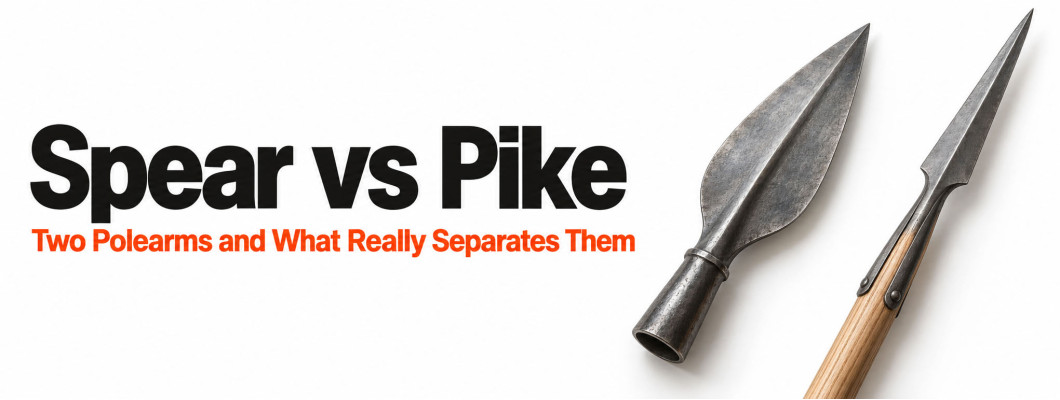
A spear and a pike are both polearms: weapons with a point or blade mounted on a long wooden shaft. The difference is length, and everything that follows from it. A spear is usually 1.5 to 3 m long and can be used by one person, often in one hand with a shield, for thrusting or throwing. A pike is 4 to 6 m or more, needs both hands, carries a small head protected by iron langets, and only works in a dense formation of other pikemen. The hoplite's dory is a spear. The Macedonian sarissa and the Swiss pike are pikes. This guide explains what makes a weapon a polearm, how spear and pike differ in length, head, grip and tactics, how the pike rose and fell, and where glaives and halberds fit.
Commission a Spear or Pike Head to Your Specification
A broad leaf spearhead, a hoplite dory head with its butt spike, a narrow pike head with long langets, or a boar spear with lugs, socketed and ready for your own shaft. Send a drawing or measurements; the forge quotes it, builds it in 4 to 6 weeks, and ships it tracked worldwide.
Start a Custom Forge RequestFor the whole family of pole weapons, from the halberd to the naginata, start with our guide to types of polearms. For every kind of spear, see types of spears. This post compares the two pole weapons people most often confuse.
What Makes a Weapon a Polearm?
A polearm is any weapon whose striking part, a point, a blade, an axe head or a hook, is mounted on a shaft much longer than the user's arm and is usually held with both hands. By that broad definition, which most modern writers use, every spear and every pike is a polearm, along with the glaive, the halberd, the bill, the guandao and the naginata.
Some older and more specialised writers use "polearm" more narrowly, for hafted blades and axes such as the halberd and glaive, and treat spears as a separate family. That is why you will see "spears and polearms" listed side by side. Either way, the pike is a spear in form, and a spear is a polearm in the broad sense. The useful question is not which word applies but how long the weapon is and how it is used.
Spear vs Pike at a Glance
| Spear | Pike | |
|---|---|---|
| Typical length | About 1.5 to 3 m | About 4 to 6 m, sometimes longer |
| Grip | One or two hands, often one with a shield | Always two hands, held well apart |
| Head | Broad leaf or lugged head, 15 to 30 cm | Small, narrow head, often with long iron langets |
| Weight | Light, often 1 to 2 kg | Heavy, often 3 to 6 kg |
| Used alone? | Yes, on foot or horseback, or thrown | No, only in a formation |
| Main role | Thrusting, throwing, hunting | Holding off cavalry and pushing enemy infantry |
| Famous examples | Hoplite dory, boar spear, assegai, yari | Macedonian sarissa, Swiss and landsknecht pike, Scottish schiltron spear |
Length Changes Everything
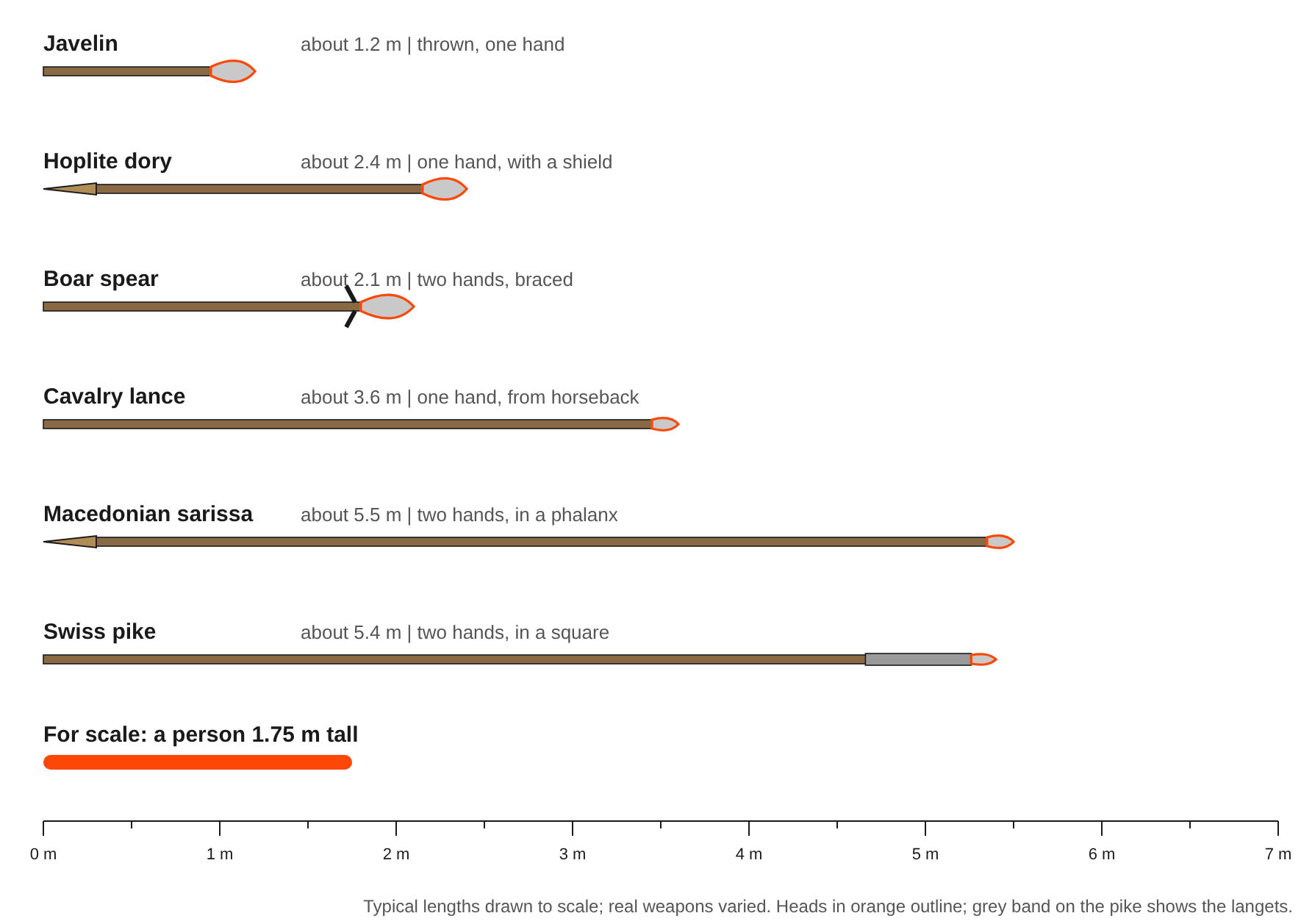
A spear short enough to use in one hand leaves the other hand free for a shield. That is the hoplite's system: a dory of about 2.4 m in the right hand and the large aspis on the left arm. A spear that length can be thrust overhand or underhand, recovered quickly and, if needed, thrown.
Make the shaft twice as long and the weapon changes character. A 5 m pike cannot be swung or thrown, and one person cannot defend himself with it once an enemy gets inside the point. But a block of pikemen, with the points of the first four or five ranks projecting in front of the front rank, presents a wall of steel that cavalry will not charge and infantry cannot easily reach.
The Head: Broad for a Spear, Small for a Pike
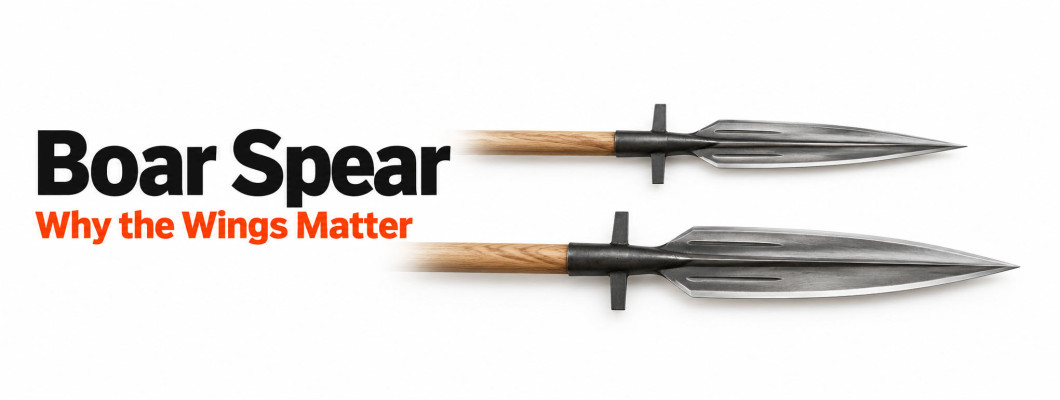
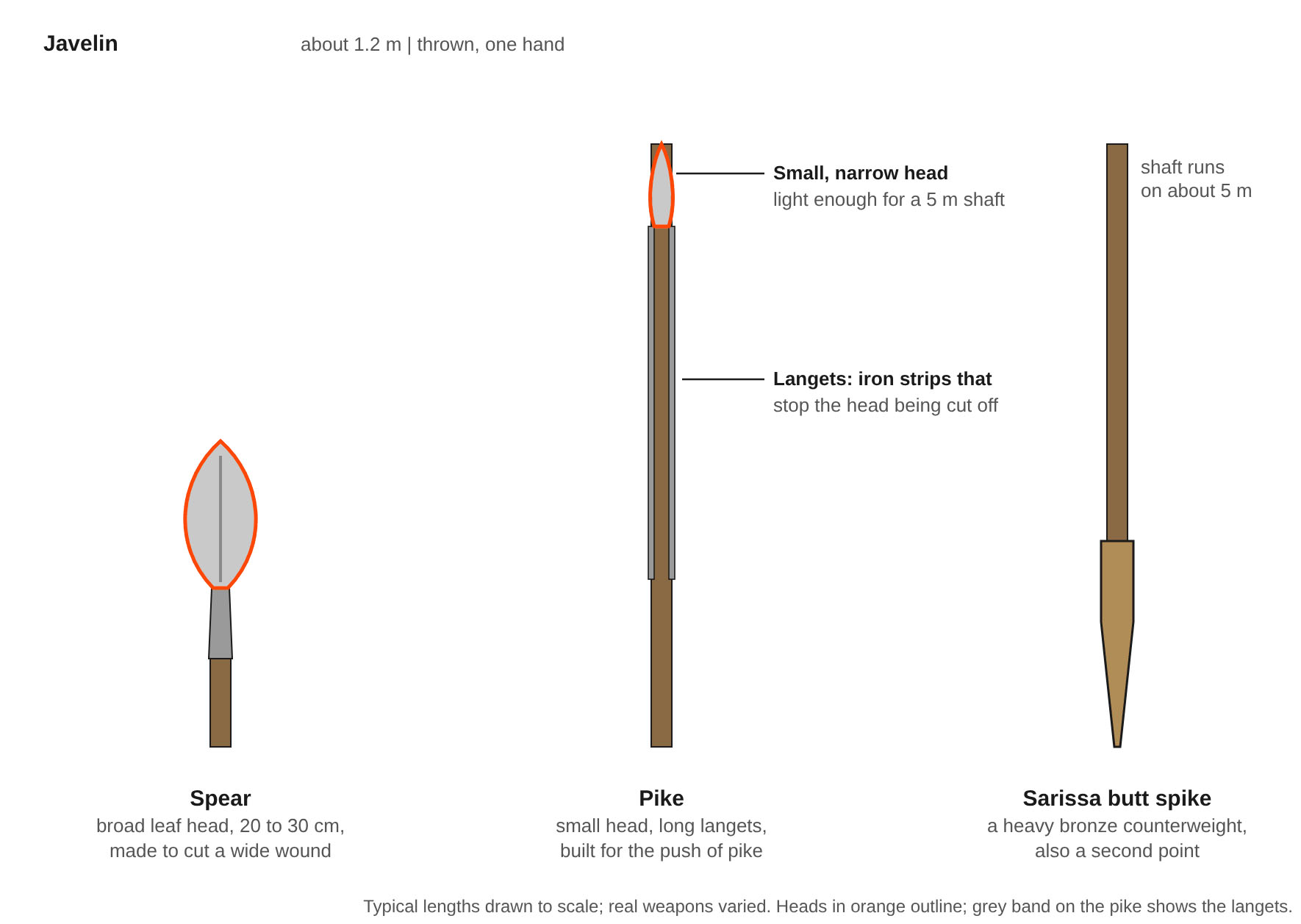
A spear's head is built to wound. A leaf-shaped head of 15 to 30 cm, with a strong midrib, opens a wide cut, and a hunting spear may add lugs to stop an animal running up the shaft. Our boar spear guide explains why those lugs matter.
A pike's head is built for the shaft. Every gram at the end of a 5 m shaft is multiplied at the hands, so pike heads are small and narrow. They are usually fixed with long iron strips called langets, running down the shaft for half a metre or more, so that an enemy cannot simply cut the head off. The Macedonian sarissa added a heavy bronze butt spike, which balanced the shaft, let the pike stand upright and gave a second point if the front broke.
For how a head is fitted to a shaft, see how a spear is hafted.
The Spear Family: Dory, Boar Spear, Lance and Yari
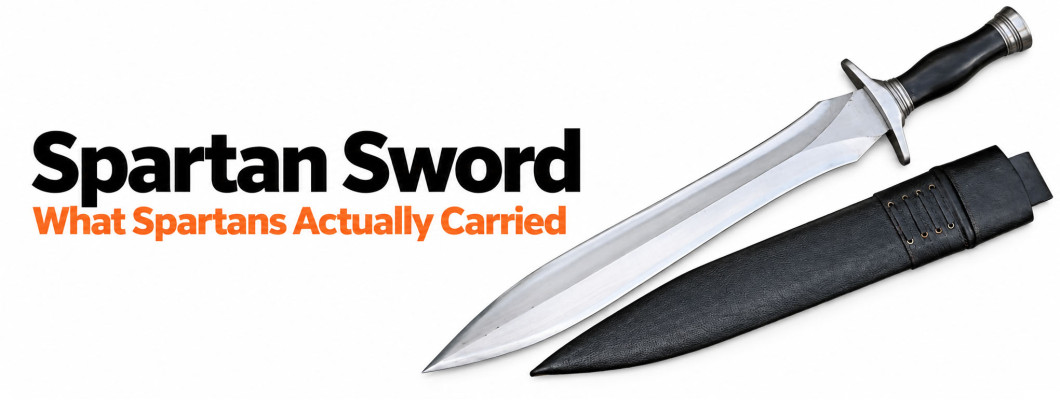
- The hoplite dory, about 2.4 m with a leaf head and a bronze butt spike, used one-handed with a shield in the Greek phalanx. Our post on what Spartans actually carried shows the dory to scale against the hoplite's sword.
- The boar spear, about 2 m, with a broad head and lugs, held in two hands and braced to receive a charge.
- The cavalry lance, about 3 to 4 m, a horseman's spear couched under the arm.
- The yari of Japan, from short to very long, with straight or cross-bladed heads.
- The javelin and assegai, short spears made to be thrown or stabbed at close range.
For why the spear outlasted the sword on most battlefields, read why the spear beat the sword.
The Pike: From Macedonia to the Swiss Square
The Macedonian sarissa. Philip II of Macedon armed his phalanx in the fourth century BC with the sarissa, a pike of about 4.5 to 6 m in cornel wood, held in both hands with a small shield slung from the shoulder. Alexander the Great conquered the Persian Empire with it, using the phalanx to pin the enemy while his cavalry struck.
The Scottish schiltron. In the wars of independence, Scottish infantry formed dense rings and blocks of long spears, called schiltrons, to stop English cavalry, most famously at Bannockburn in 1314.
The Swiss and the landsknechts. In the fifteenth century the Swiss confederates made the pike the master of European battlefields. Their pikes of about 5 to 5.5 m, used in deep, fast-moving squares, beat the Burgundian knights in the 1470s. The German landsknechts copied and rivalled them.
Pike and shot. Through the sixteenth and seventeenth centuries, pikemen protected musketeers from cavalry in mixed "pike and shot" formations. The socket bayonet, which turned every musket into a short spear, made the pike obsolete around 1700.
Where Glaives, Halberds and the Guandao Fit
Spears and pikes are thrusting polearms. The other great branch of the family puts a cutting blade or axe head on the shaft: the European glaive and bill, the halberd with its axe, spike and hook, the Chinese guandao with its broad curved blade, and the Japanese naginata. These weapons cut and hook as well as thrust, and they were usually shorter than pikes, about 1.8 to 2.5 m. Our types of polearms guide covers each of them.
Spears and Polearms From Everest Forge
Every spear and polearm below is forged on demand in our Kathmandu workshop from mono-steel 5160 spring steel. Nothing is held in stock; every blade is forged after the order is placed.
- Our hand-forged spears collection: leaf, winged, Viking, Greek and hunting spears.
- The Greek Spartan spear and the Achilles Greek spear: leaf-headed spears in the dory tradition.
- The guandao: the Chinese bladed polearm.
- The custom spear request: any spearhead or pike head, built to your drawing.
An honest note on pikes. We do not currently list pikes as catalogue products, and a 5 m shaft is impractical to ship across the world. The practical way to own one is to have us forge the head, with its socket and langets, and the butt spike if you want one, and fit them to a locally sourced shaft. The custom forge and the custom spear request page both take these orders.
Any spear can be ordered blunt with a rounded point for display or stage use by asking in the order note. Catalogue builds dispatch in 2 to 3 business days; custom builds take 4 to 6 weeks at the forge; shipping is DHL or FedEx, tracked, 7 to 14 business days worldwide.
An honest note on the steel. Everest Forge forges mono-steel 5160 only. We do not make Damascus, pattern-welded, folded or laminated steel. Historic spear and pike heads were forged from iron and steel, and ours are 5160 spring steel throughout.
Related Guides
Build a Spear or Pike the Way It Was Carried
A dory head and sauroter for a hoplite kit, a sarissa head and butt spike, a Swiss-style pike head with long langets, or a winged war spear. Tell us the length of shaft you will fit; the forge quotes it, builds it in 4 to 6 weeks, and ships it tracked worldwide.
Start a Custom Forge RequestFrequently Asked Questions
Is a spear a polearm?
Yes, in the broad sense most writers use: a polearm is any weapon with a point or blade on a long shaft. Some older sources reserve "polearm" for hafted blades such as halberds and treat spears as a separate family.
Is a pike a polearm?
Yes. A pike is a very long spear, and both are polearms. It is the longest common polearm, usually 4 to 6 m.
What is the difference between a spear and a pike?
Length and use. A spear is about 1.5 to 3 m and can be used by one person, often with a shield. A pike is 4 to 6 m or more, needs both hands and only works in a dense formation.
How long was a pike?
Usually about 4 to 6 m. The Macedonian sarissa was about 4.5 to 6 m, and Swiss and landsknecht pikes about 5 to 5.5 m, with some longer.
Why did pike heads have langets?
Langets are long iron strips running from the head down the shaft. They stopped an enemy cutting the head off and strengthened the most exposed part of the shaft.
Was the hoplite dory a pike?
No. The dory, about 2.4 m, was a spear used in one hand with a shield. The Macedonian sarissa that replaced it in Macedon's phalanx was a true pike.
Why did the pike disappear?
The socket bayonet, introduced in the late seventeenth century, let every musketeer act as his own pikeman, so separate pike units were no longer needed. The pike was largely gone by about 1700.
What is the difference between a pike and a halberd?
A pike is a very long thrusting spear. A halberd is shorter, about 1.8 to 2.4 m, and carries an axe blade, a spike and a hook, so it cuts and hooks as well as thrusts.
Does Everest Forge sell pikes?
We forge pike heads, with langets and an optional butt spike, through the custom forge and the custom spear request page. The long shaft is best sourced locally, as it cannot be shipped economically.
How long does a hand-forged spear take to arrive?
Catalogue builds dispatch in 2 to 3 business days and ship by DHL or FedEx, tracked, in 7 to 14 business days. Custom builds take 4 to 6 weeks at the forge before shipping.