The Kindjal Is the Dagger of the Caucasus: Straight, Guardless and Worn by Every Mountain Warrior
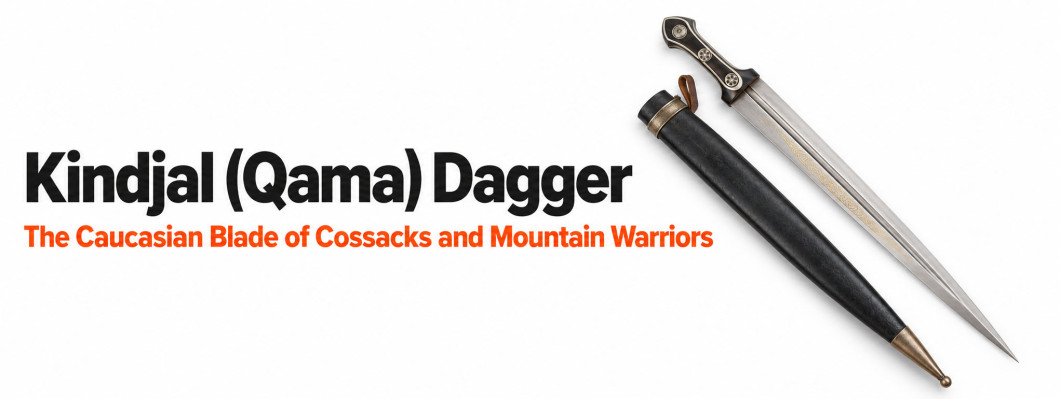
The kindjal (Russian kinzhal), also called the qama or kama in the Turkic and Caucasian languages and the khanjali in Georgian, is the long, straight dagger of the Caucasus, usually double-edged but also made single-edged. It was carried for centuries by Georgians, Circassians, Chechens, Dagestanis and the other peoples of the mountains, and was adopted in the nineteenth century by the Terek and Kuban Cossacks and the Russian army. A kindjal has a straight blade, usually sharpened on both edges, that runs parallel or tapers evenly to a sharp point, usually with fullers offset so that one face is grooved near one edge and the other face near the opposite edge. It has no crossguard, a grip of horn, bone or wood held by two or three large rivets, and a flared or capped pommel. This guide explains the names, the form, why the fullers are offset, how the Cossacks took it up, and how the kindjal differs from a dirk and a gladius.
The kindjal is one of the great dagger types of the world. For the others, start with our guide to 30 types of daggers around the world. For the kindjal alongside the shashka and the other blades of the Russian Empire, read Russian sword types.
Kindjal, Qama, Kama, Khanjali: One Dagger, Many Names
The many names come from the many languages of the Caucasus and from Russian.
- Kindjal, kinjal, kinzhal are spellings of the Russian kinzhal, which simply means "dagger". In English the type is best known by this name.
- Qama, kama are the Turkic and North Caucasian names, used in Azerbaijani, Kumyk, Circassian and Dagestani languages.
- Khanjali is the Georgian name, related to the khanjar of Persia and Arabia.
All of them refer to the same straight Caucasian dagger. Collectors usually say kindjal or qama, and both are worth knowing when you search.
The Form of a Kindjal
- A straight blade, usually double-edged, 30 to 50 cm long and sometimes more, either with parallel edges for most of its length before it narrows to a long, acute point, or tapering evenly from hilt to point.
- Fullers, often one per face and offset to opposite edges. Some kindjals have two or three narrow fullers per face, still staggered.
- No crossguard. The grip meets the blade at a small metal collar or bolster.
- A slab grip of horn, bone, ivory or wood, riveted through the tang with two or three large rivet heads, often silver rosettes, and flaring at the pommel into a cap or hood.
- A matching scabbard, often covered in leather with a metal throat and chape. On fine pieces it is silver-mounted, with niello or gold decoration in the style of the Kubachi workshops of Dagestan.
Overall a kindjal is usually about 45 to 70 cm long. The longest examples sit on the border between a dagger and a short sword.
Is a Kindjal Double-Edged or Single-Edged?
Most kindjals are double-edged, and that is the form most people mean by the name: a straight blade sharpened on both sides, right to the point. But single-edged kindjals exist too, and they are a genuine part of the tradition, not a mistake.
- Double-edged is the classic form, found across Georgia, Dagestan, Chechnya and Circassia and in the Cossack and Russian army patterns. It is built for the thrust, with both edges able to cut. The curved bebut is double-edged as well.
- Single-edged kindjals have one sharp edge and a thicker, flat back, keeping the kindjal's straight blade, guardless hilt and riveted grip. They appear among regional forms and later pieces, and some old blades are sharpened on one side for most of their length with a short back edge near the point. A single-edged blade is a little stronger along the spine and easier to keep for everyday cutting work.
What makes a blade a kindjal is the whole form: the straight blade, the long point, the absence of a guard, the riveted slab grip and the Caucasian hilt. The number of edges is a variation within that form. If you are buying, check the listing or the photos so you know which you are getting. We forge the double-edged form as standard and a single-edged kindjal on request.
Why Are the Fullers Offset?
The offset fuller is the kindjal's signature. On one face the groove runs near one edge; turn the blade over and the groove on the other face runs near the opposite edge.
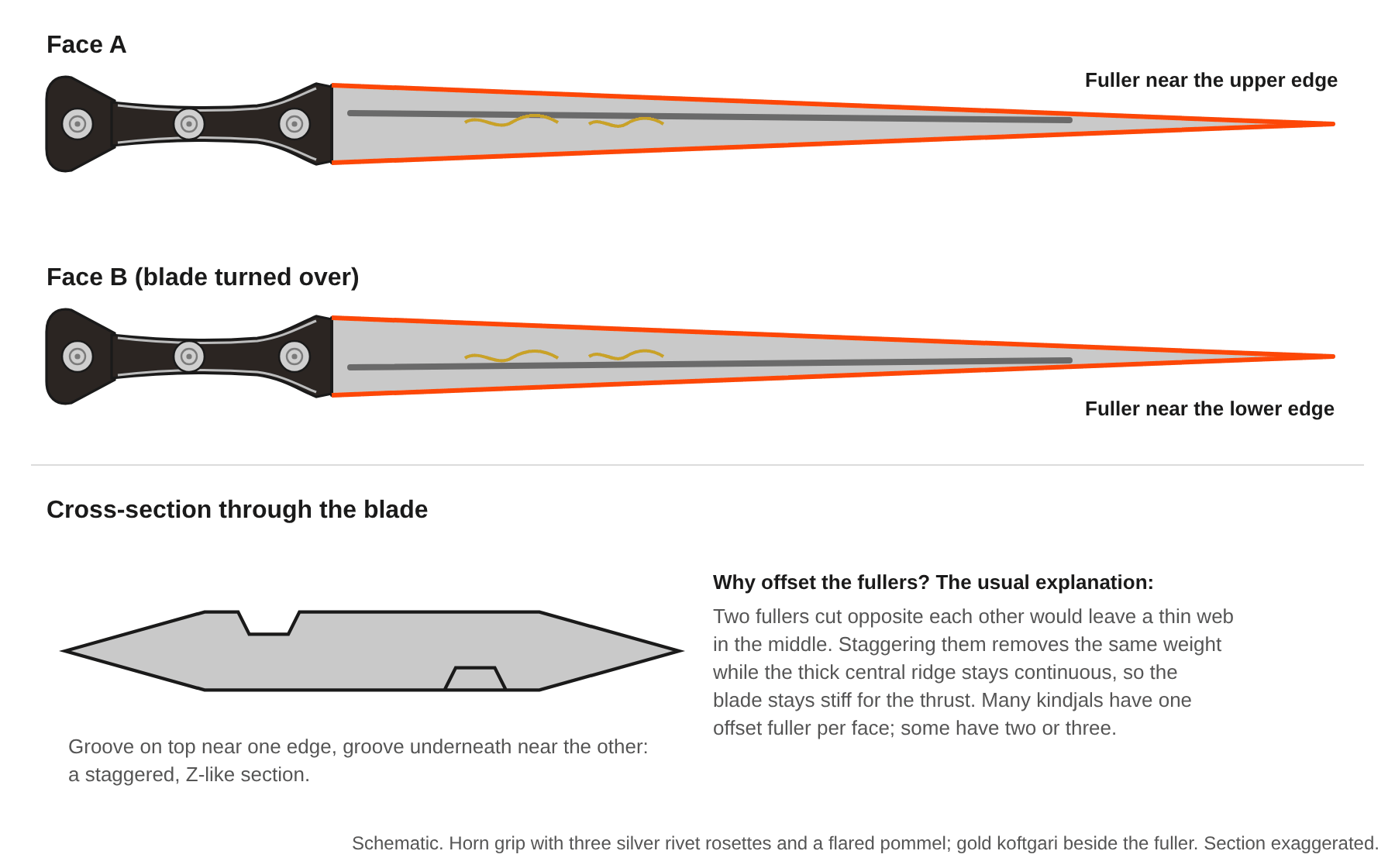
The usual explanation is structural. Two fullers cut directly opposite each other would leave a thin web of steel in the middle of the blade. Staggering them removes the same weight but keeps a thick, continuous ridge running the length of the blade, so a long, narrow blade stays stiff for the thrust. Whether every smith thought of it in those terms or simply followed tradition, the result is a light, rigid blade that is easy to recognise.
The Kindjal in the Caucasus
In the mountains of the Caucasus, a man's kindjal was part of his dress and his honour. It was worn at the front of the belt, often with a pistol and later with the shashka. It was used in war, in feuds and in defence, and it was handed down through families. Georgia, Dagestan, Chechnya and Circassia each had their own styles of hilt and decoration. The silversmiths of Kubachi in Dagestan became famous across the Russian Empire for their nielloed and engraved mounts.
The kindjal is often compared with ancient straight daggers, such as the Scythian akinakes and the Roman gladius. The resemblance is real, but a direct line of descent cannot be traced with confidence. It is better to see the kindjal as the Caucasian answer to the same need: a long, strong thrusting and cutting dagger that could be carried every day.
How the Cossacks and the Russian Army Took It Up
When the Russian Empire pushed into the Caucasus in the eighteenth and nineteenth centuries, the Terek and Kuban Cossacks who settled on the frontier adopted much of the dress and weaponry of their mountain neighbours. That included the cherkeska coat with its cartridge pockets, the papakha hat, the shashka sabre and the kindjal. A Cossack in full Caucasian dress wore the kindjal at the front of his belt and the shashka on a shoulder belt.
The Russian army followed. Caucasian units and Cossack regiments carried the kindjal as part of their equipment and dress, and in the early twentieth century the army issued a curved version, the bebut, to artillery crews and machine-gunners. The kindjal remains part of Cossack and Caucasian ceremonial dress today. The shashka, its partner, will get its own post. Until then, see Russian sword types.
Kindjal vs Dirk vs Gladius
The kindjal is most often confused with two other blades: the Scottish dirk, another long guardless dagger, and the Roman gladius, another straight double-edged blade of similar length.
| Kindjal (qama) | Scottish dirk | Roman gladius | |
|---|---|---|---|
| Region | Caucasus | Scottish Highlands | Rome |
| Edges | Usually two; single-edged versions exist | One, often with a false edge near the tip | Two |
| Blade | Narrow, straight, offset fullers | Tapering, triangular in section | Broad, with a short, strong point |
| Guard | None | None | Broad handguard |
| Grip | Horn or bone slabs, two or three large rivets | Carved wood, often knotwork | Grip between guard and round pommel |
| Typical length | About 45 to 70 cm | About 40 to 50 cm | About 60 to 75 cm |
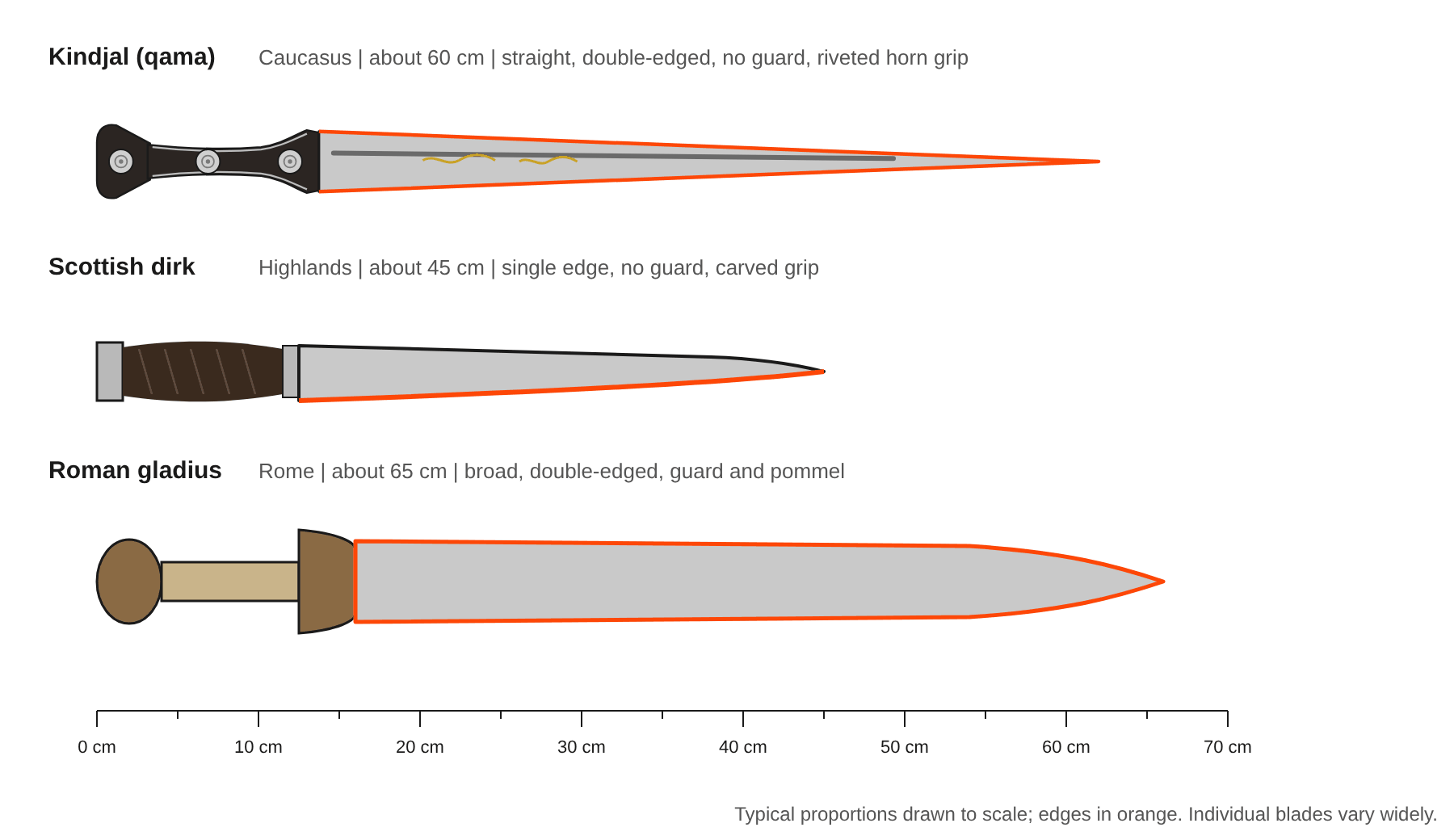
For the dirk, read the evolution of the Scottish dirk. For the gladius, see our Roman gladius history. For where a long dagger ends and a short sword begins, see dagger vs short sword vs long sword.
What a Hand-Forged Kindjal Needs
A good kindjal is a long, narrow blade that has to stay stiff and keep its point. When you choose one, look for:
- A full tang running the length of the grip, riveted through the scales. That is how the originals were built, and it is what keeps a long blade secure.
- A spring steel that takes a hard edge and flexes rather than snaps. Our kindjals are forged from 5160.
- Fullers, ideally offset, to lighten the blade without weakening it.
- A balance close to the hand, so the point moves quickly for the thrust.
Our Hand-Forged Kindjals
Every kindjal below is forged on demand in our Kathmandu workshop from mono-steel 5160 spring steel, with a full tang, a rosewood grip and a leather scabbard. Nothing is held in stock; every blade is forged after the order is placed.
- The Kindjal sword: the classic Caucasian kindjal, a long double-edged dagger.
- The Kindajal dagger: a double-edged kindjal with a full-tang rosewood grip.
- The Kindajal short sword: the kindjal in its longer, short-sword form.
- The Custom kindjal dagger: the largest of our kindjals, with a wooden-core scabbard.
An honest note on the hilts. Our catalogue kindjals use rosewood grips rather than horn or bone slabs with large decorated rivets, and their product pages do not specify offset fullers. If you want a single-edged kindjal, or the full traditional form, ask for it through the custom forge: offset fullers, a horn or bone slab grip with two or three silver rivet rosettes, and a flared pommel.
To set the blade length, finish and handle yourself, start from Build Your Blade. Any kindjal can be ordered left-handed by writing "Left Handed" in the order note, or blunt with a rounded tip for display and stage use the same way. Catalogue builds dispatch in 2 to 3 business days; custom builds take 4 to 6 weeks at the forge; shipping is DHL or FedEx, tracked, 7 to 14 business days worldwide.
An honest note on the steel. Everest Forge forges mono-steel 5160 only. We do not make Damascus, pattern-welded, folded or laminated steel. Some of the finest Caucasian blades were forged from crucible or pattern-welded steel, and a few famous makers' marks were widely copied. Ours are plain, hardened spring steel.
Related Guides
Commission a Kindjal in the Traditional Form
A kindjal with offset fullers, a horn grip with silver rivet rosettes and a flared pommel, a Georgian khanjali, a Cossack-pattern kindjal to go with a shashka, a single-edged kindjal, or a curved bebut. Send photos or measurements; the forge quotes it, builds it in 4 to 6 weeks, and ships it tracked worldwide.
Start a Custom Forge RequestFrequently Asked Questions
What is a kindjal?
A long, straight dagger, usually double-edged, of the Caucasus, with no crossguard, a slab grip held by two or three large rivets, and usually offset fullers. It was carried by the mountain peoples and adopted by the Cossacks and the Russian army.
What is the difference between a kindjal and a qama?
None. Kindjal comes from the Russian kinzhal, meaning dagger, and qama or kama is the Turkic and North Caucasian name for the same weapon. In Georgian it is the khanjali.
Is a kindjal single-edged or double-edged?
Both. Most kindjals are double-edged, sharpened on both sides to the point, but single-edged kindjals with one sharp edge and a thicker back were also made. The straight blade, guardless hilt and riveted grip are what make it a kindjal; the number of edges varies.
Why does a kindjal have offset fullers?
Staggering the fullers on opposite faces lightens the blade while keeping a thick, continuous central ridge, so a long, narrow blade stays stiff for the thrust. It is also the kindjal's most recognisable feature.
Did Cossacks carry the kindjal?
Yes. The Terek and Kuban Cossacks adopted the kindjal along with Caucasian dress and the shashka in the nineteenth century, wearing it at the front of the belt. It is still part of Cossack ceremonial dress.
What is a bebut?
A curved version of the kindjal issued by the Russian army in the early twentieth century, mainly to artillery crews and machine-gunners.
Is a kindjal a dagger or a short sword?
A dagger, though long examples of 60 cm or more sit on the border with a short sword. Most are 45 to 70 cm overall.
What is the difference between a kindjal and a dirk?
Both are long daggers without a guard, but the kindjal is usually double-edged with a narrow, straight blade, while the Scottish dirk is single-edged with a tapering blade and a carved wooden grip.
What is the difference between a kindjal and a gladius?
Both are straight and double-edged, but the gladius has a broad blade with a handguard and a round pommel, while the kindjal is narrower, guardless and has a riveted slab grip.
Where was the kindjal made?
Across the Caucasus: Georgia, Dagestan, Chechnya and Circassia, among others. The silversmiths of Kubachi in Dagestan were especially famous for decorated hilts and scabbards.
Can I order a kindjal left-handed or blunt?
Yes. Write "Left Handed" in the order note for a left-hand build, or ask for a blunt edge and rounded tip for display, reenactment or stage use.