Every Curved Dagger Is Built Around One Movement: The Draw Cut, the Downward Stab or the Hook
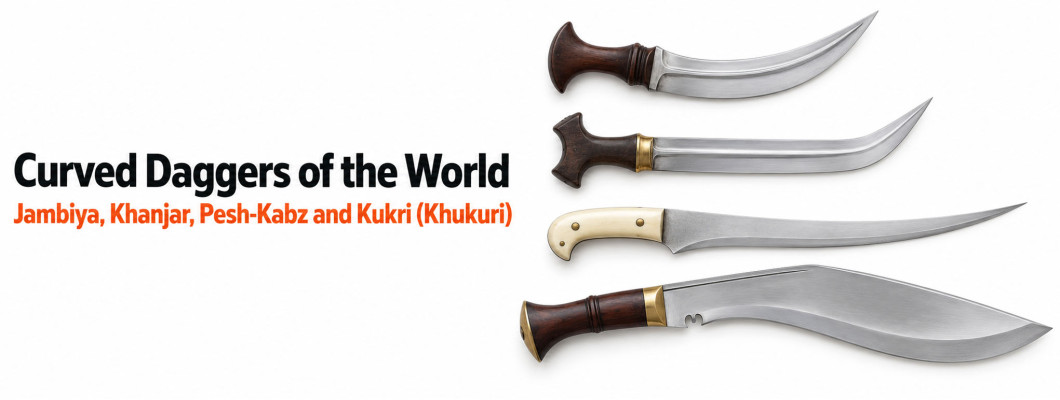
A curved dagger is a short blade whose edge or spine bends away from a straight line, and the major types each come from a different part of the world. The jambiya belongs to Yemen and Arabia, the khanjar to Oman, Persia, the Ottoman world and Mughal India, and the pesh-kabz to Persia, Afghanistan and northern India. India also has the bichuwa, chilanum and khanjarli, and Indonesia and Malaysia have the karambit. The kukri (khukuri) of Nepal is a curved knife rather than a true dagger, but it is often counted with them. The curve is never decoration alone. Depending on the type, it lengthens the draw cut, lines the point up with the forearm for a downward stab, stiffens a thrusting point, or turns the blade into a hook. This guide names each type, shows how each curve works and how each dagger is worn, and helps you tell them apart.
For daggers of every shape, straight and curved, start with our guide to 30 types of daggers around the world. For the place of the dagger in Islamic dress, honour and art, read the cultural soul of the Islamic dagger. This post goes into the curved family only: the shapes, the mechanics and the names.
Curved Dagger Names at a Glance
If you are trying to put a name to a curved knife, start here. The kard is included as the straight Persian knife the others are often confused with.
| Name | Region | Curve | Edge | How it is worn |
|---|---|---|---|---|
| Jambiya | Yemen, Arabian Peninsula | Steady upward curve from a broad base | Double, with a midrib | Upright at the front of a wide belt, in a J-shaped sheath |
| Omani khanjar | Oman | Nearly straight, then a sharp J-curve near the tip | Double | Front of the belt, in a sheath bent at a right angle |
| Khanjar (Persian, Ottoman hançer, Mughal) | Persia, Turkey, Mughal India | Gentle curve or S-curve | Double, often ribbed | Tucked into a sash |
| Pesh-kabz | Persia, Afghanistan, northern India | Recurved edge to a needle point | Single, T-section spine | Slanted through a sash |
| Kard | Persia, Central Asia | Straight | Single | Sash or belt |
| Khanjarli | Odisha and central India | Double curve | Double | Sash; recognised by its crescent-shaped pommel |
| Bichuwa | Central and southern India | Recurved, "scorpion" sting | Double | Concealed; loop hilt |
| Chilanum | Southern India | Double curve | Double | Sash or belt |
| Karambit | Indonesia, Malaysia | Tight claw | Single, on the inside of the curve | Waist, often edge-in |
| Kukri (khukuri) | Nepal | Forward-angled, weight toward the tip | Single, on the inside of the bend | Curved scabbard at the side or back |
Why Do Daggers Curve?
Every curved dagger keeps the dagger's job of reaching a short distance with a sharp point. What the curve adds depends on which way it bends and where.
- A longer draw cut. A curved edge meets its target at an angle and slides as it cuts, so more of the edge passes through for the same movement. This is the same principle that makes a sabre cut better than a straight sword of the same length.
- The point in line with the forearm. Held in a fist with the point up, a jambiya or khanjar curves so that the point lines up with a downward or hooking stab. A straight blade would sit at an awkward angle in the same grip.
- A stiff point behind a cutting belly. The pesh-kabz curves at the belly and then straightens into a thick, narrow point. The belly cuts, and the point, backed by a T-section spine, is stiff enough to drive through mail.
- A hook. The karambit's tight claw, with the edge on the inside, catches and pulls rather than stabs.
- Standing and display. In Yemen and Oman today the jambiya and khanjar are worn far more as dress and a sign of manhood and standing than as weapons. The curve and the sheath are part of a recognisable silhouette.
For the same question asked of swords, see curved vs straight swords.
Arabia: The Jambiya and the Omani Khanjar
The jambiya is the curved dagger most people picture. It has a broad blade that curves steadily upward from the hilt, is sharpened on both edges, and is stiffened by a raised midrib. In Yemen it is worn upright at the centre front of a wide embroidered belt, in a sheath called the asib that curls up into a J. How a man wears it, the sheath style and the quality of the hilt have long signalled family, tribe and standing. The finest old hilts were rhinoceros horn, now banned in international trade; modern hilts are wood, horn, bone or resin. Our Yemeni jambiya history covers its craft in depth.
The Omani khanjar looks related but is built differently. Its blade runs almost straight for most of its length and turns sharply upward only in the last third. The sheath copies that shape with a right-angle bend, and on fine pieces it is covered in silver wire and fitted with silver rings. The hilt ends in a flat, crown-like top. The khanjar is Oman's national emblem, set over two crossed swords on the national flag and on the country's coat of arms, and it is still worn at weddings, at Eid and on formal occasions.
Persia, Turkey and Mughal India: The Khanjar Family
Outside Oman, khanjar is a broad name for a double-edged curved dagger. The Persian khanjar has a slender, often ribbed blade with a gentle curve or a slight S-bend, and a hilt of ivory, walrus tusk, bone or steel. The Ottoman hançer is the Turkish form of the same word and the same kind of blade, often with a walrus-ivory or jade hilt. At the Mughal court in India the khanjar became a jewelled object, with a recurved blade under a carved jade hilt, sometimes shaped as a horse's or ram's head.
A note on the Elif. Elif is the Turkish name for alif, the first letter of the Arabic alphabet. Our Elif curved dagger is a modern design in the Persian manner, a long, sweeping curved blade, and the name is ours rather than a historical type. Its blade is long enough to sit on the line between dagger and short sword.
Persia, Afghanistan and India: The Pesh-Kabz
The pesh-kabz was carried from Safavid Persia through Afghanistan into Mughal and later Indian armies, and it was in use from roughly the sixteenth century to the nineteenth. Its name is usually explained as "fore-grip". Its blade is single-edged, wide and very thick at the hilt, with a T-section spine, and the edge curves gently before straightening into a needle point. The hilt is a straight grip with no guard, usually with slabs of ivory, bone, horn or stone. It was made to push through mail and padded armour, and the curve exists to give a cutting belly without weakening the point.
The pesh-kabz will get its own full history post soon. Until then, the types of daggers guide is the place for its neighbours. Our pesh-kabz dagger is forged to the traditional thick-spined profile.
India: Khanjarli, Bichuwa and Chilanum
India developed some of the most elaborate curved daggers anywhere.
- Khanjarli. A double-curved, double-edged dagger from Odisha and central India, recognised by the crescent-shaped (lunette) pommel at the top of its grip, often in ivory.
- Bichuwa. Named for the scorpion (bichchhu), whose sting its recurved tip resembles. It has a small double-curved blade and a loop hilt that protects the knuckles, and it was easy to hide in a sleeve or sash.
- Chilanum. A double-edged dagger of southern India with two curves and a hilt with a flared pommel and guard, associated with the Vijayanagara period.
The haladie, a double-bladed dagger with two curved blades on one grip, comes from the same Indian world. It will get its own post. Until then, see the types of daggers guide.
Southeast Asia: The Karambit and the Kris
The karambit comes from Sumatra, with the Minangkabau people usually named as its origin, and spread through Indonesia and Malaysia. It is often said to imitate a tiger's claw. The blade hooks tightly, the edge is on the inside of the curve, and a ring at the end of the grip lets the hand keep hold of it. Our karambit dagger keeps the claw and the ring.
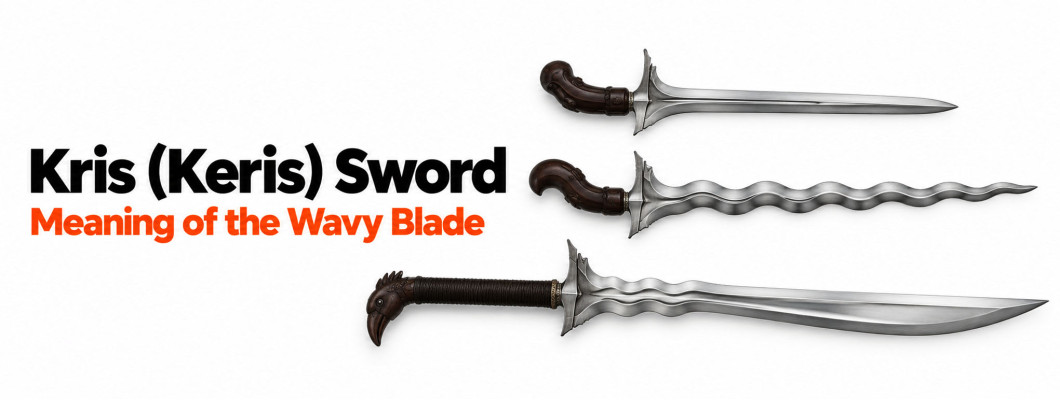
The kris (keris) is often added to lists of curved daggers, but its blade usually waves rather than curves, and some kris are straight. We explain the waves in the kris (keris) and the meaning of the wavy blade.
Nepal: Is the Kukri (Khukuri) a Curved Dagger?
Not strictly. The kukri (khukuri) has a single edge on the inside of a forward bend, a heavy spine and its weight toward the tip, and it is built for chopping more than stabbing. That makes it a curved knife, or a short chopper, rather than a dagger. It is grouped with curved daggers so often that the question needs answering here. Its scabbard also carries two small blades of its own, the karda and the chakmak. See our authentic kukri (khukuri) collection for the regional forms.
How Curved Daggers Are Worn
The sheath tells you as much about a curved dagger as the blade does, because it is shaped to the blade and to the way the dagger is carried.
The front-of-the-belt position of the jambiya and khanjar puts the hilt in plain view, which is the point when the dagger is dress. The pesh-kabz and the Persian khanjar were tucked into a waist sash at an angle, where the hand could reach them across the body. The karambit is often worn edge-in at the waist so that it comes out ready to use.
Curved Dagger or Curved Sword?
There is no fixed length where a dagger becomes a sword. A useful rule is to ask whether the blade was meant mainly for close work and the off-hand, or for full arm cuts at reach. Most curved daggers have blades of 15 to 35 cm (6 to 14 in). Anything much past 40 cm (16 in) begins to behave like a short sword, which is where the long Persian-style blades such as our Elif sit. The curved swords of the same regions, the shamshir, kilij, talwar and the Arabian saif, will be covered in our upcoming Middle Eastern swords guide. Until it is live, the types of daggers guide links onward to them.
Hand-Forged Curved Daggers From Everest Forge
All of these are in our traditional and historical daggers collection, forged on demand in our Kathmandu workshop from mono-steel 5160 spring steel. Nothing is held in stock; every blade is forged after the order is placed.
- The Yemeni jambiya dagger: the broad, upward-curving Arabian form.
- The Persian Fighter jambiya: a double-edged, forward-curved fighting dagger.
- The pesh-kabz dagger: the thick-spined, mail-piercing profile.
- The Elif curved dagger: our long, sweeping Persian-style design.
- The karambit dagger: the claw with the ring.
An honest note on the kilij dagger. Our Turkish kilij dagger is named for the Ottoman kilij and has a pistol-grip hilt, but its blade is straight and double-edged. If you want a curved Ottoman hançer, ask for one through the custom forge.
To set the blade length, finish and handle yourself, start from Build Your Blade. Any dagger can be ordered left-handed by writing "Left Handed" in the order note, or blunt with a rounded tip for display and stage use the same way. Catalogue builds dispatch in 2 to 3 business days; custom builds take 4 to 6 weeks at the forge; shipping is DHL or FedEx, tracked, 7 to 14 business days worldwide.
An honest note on the steel. Everest Forge forges mono-steel 5160 only. We do not make Damascus, pattern-welded, folded or laminated steel. Many of the finest historic Persian and Mughal khanjars and pesh-kabz were forged from crucible (wootz) steel, which shows a watered pattern, and some later pieces were pattern-welded. Our blades are plain, hardened spring steel.
Related Guides
Commission a Curved Dagger to Your Own Pattern
An Omani khanjar with a right-angle sheath, a curved Ottoman hançer, a bichuwa, a khanjarli with a crescent pommel, or a copy of a dagger you own. Send a drawing or photos; the forge quotes it, builds it in 4 to 6 weeks, and ships it tracked worldwide.
Start a Custom Forge RequestFrequently Asked Questions
What is a curved dagger called?
It depends on the region. In Yemen and Arabia it is a jambiya, in Oman a khanjar, in Persia and Turkey a khanjar or hançer, and in Persia, Afghanistan and northern India the recurved type is a pesh-kabz. India also has the bichuwa, chilanum and khanjarli, and Indonesia and Malaysia have the claw-shaped karambit.
What is the difference between a jambiya and a khanjar?
The jambiya has a broad blade that curves steadily from the hilt and is worn in a J-shaped sheath. The Omani khanjar runs almost straight and turns up sharply near the tip, has a flat-topped hilt, and sits in a sheath bent at a right angle. Outside Oman, khanjar is a broader name for many double-edged curved daggers.
Why are some daggers curved?
A curve can lengthen the draw cut, line the point up with the forearm for a downward stab, put a cutting belly behind a stiff thrusting point, or turn the blade into a hook. In Yemen and Oman the curve is also part of a dagger worn as dress and a mark of standing.
What is a pesh-kabz?
A single-edged dagger from Persia, Afghanistan and northern India with a thick T-section spine and an edge that curves before straightening into a needle point. It was designed to pierce mail and padded armour.
Is the khanjar on the flag of Oman?
Yes. The khanjar over two crossed swords is Oman's national emblem and appears on the national flag and coat of arms.
Is a kukri (khukuri) a curved dagger?
Not strictly. The kukri (khukuri) is a forward-curved knife with a single edge and its weight toward the tip, built mainly for chopping. It is often listed with curved daggers, but it works more like a short chopper.
What is the claw-shaped curved knife called?
The karambit, from Sumatra, Indonesia and Malaysia. It has a tight hooked blade with the edge on the inside and a ring at the end of the grip.
Is a kris a curved dagger?
Usually it is a wavy dagger rather than a curved one. Many kris have a blade with an odd number of waves, called luk, and some are straight.
Can I order a curved dagger left-handed?
Yes. Write "Left Handed" in the order note and the forge sets up the edge and hilt for the left hand. A blunt edge and rounded tip for display or stage use can be ordered the same way.
How long does a hand-forged curved dagger take to arrive?
Catalogue builds dispatch in 2 to 3 business days and ship by DHL or FedEx, tracked, in 7 to 14 business days. Custom builds take 4 to 6 weeks at the forge before shipping.