The Kris Is a Wavy-Bladed Weapon of Island Southeast Asia, Part Dagger, Part Sword, and Still a Living Tradition
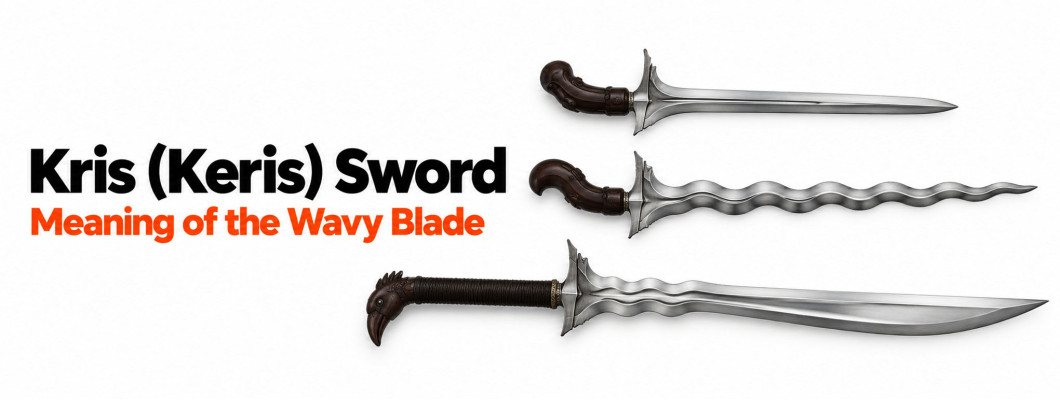
The kris (keris in Indonesian and Malay, kalis in the Philippines) is the asymmetrical, often wavy-bladed weapon of Java, Bali, the Malay world and the southern Philippines. Its waves are called luk, and are traditionally made in odd numbers; its surface pattern, pamor, comes from forge-welding layers of iron and a nickel-bearing metal; and in Java and Bali it is as much a spiritual heirloom as a weapon, which is why UNESCO lists the Indonesian kris as intangible cultural heritage. Two very different objects share the name: the Javanese keris, a dagger of 30 to 40 cm worn at the back of the sash, and the Moro kris of Mindanao and Sulu, a fighting sword of 50 to 70 cm. This guide explains both, what the luk and the pamor mean, and how a hand-forged kris is made honestly today.
Our guide to Filipino swords and machetes introduces the Moro kris among the blades of the archipelago; this post gives the kris the full treatment that guide could only touch on.
Keris, Kris, Kalis: One Name, Two Weapons
| Feature | Javanese / Balinese / Malay keris | Moro kris (kalis) |
|---|---|---|
| Region | Java, Bali, Madura, Sumatra, the Malay Peninsula | Mindanao and the Sulu archipelago, southern Philippines |
| Type | Dagger | Sword |
| Blade length | Typically 30 to 40 cm | Typically 50 to 70 cm |
| Blade shape | Straight (lurus) or wavy along most of its length; strongly asymmetric at the base | Usually wavy near the hilt and straight toward the point, or fully straight; broad and heavy |
| Luk | Odd numbers, from 3 up to 13 and beyond; straight blades common | Varies; often several waves near the base only |
| Hilt (hulu) | Carved wood, ivory or bone, often stylised figures; set at an angle | Long hilt, often with a kakatua (cockatoo) pommel, wrapped in fibre or metal |
| Scabbard | Warangka (boat-shaped top) and gandar (sheath), often with a metal pendok cover | Wooden scabbard, often bound with rattan |
| Carried | Tucked in the sash, often at the back | At the side as a sword |
| Main role | Status, heirloom (pusaka), spiritual object, last-resort weapon | Primary fighting sword, also heirloom and status |
Parts of a Keris
The keris has its own vocabulary, and the parts matter because collectors and makers read a blade by them.
- Wilah: the blade.
- Ganja: the separate crosspiece at the base of the blade, a defining feature of the kris. In good blades the ganja is shaped to continue the blade's line so the join almost disappears.
- Gandik and greneng: the asymmetric shoulder and decorative notches at the base of the blade.
- Pesi: the tang, a round rod that fits into the hilt.
- Luk: the waves.
- Pamor: the surface pattern of the blade.
- Hulu: the hilt; warangka and gandar: the scabbard top and body; pendok: the metal sheath cover.
What the Luk Mean
The waves of the kris are its most famous feature, and they are almost always odd in number: three, five, seven, nine, eleven, thirteen and, on rare court pieces, many more. A straight keris, keris lurus, is just as respected and very common. Odd numbers are considered auspicious in the Javanese tradition, and the count of luk was read alongside the pamor and the shape of the base to give a blade its character.
The meanings people attach to particular counts vary a great deal by region, by school and by the maker, and many published lists contradict each other, so we would rather say that than give you a neat table that is not true everywhere. The broad idea is consistent: the waves are often compared to the movement of a naga, the serpent-dragon, and a wavy blade is associated with a body in motion, a straight one with stillness and meditation. Practically, the waves also make a longer cutting edge in the same length of blade, though for the Javanese keris, a thrusting dagger, the symbolism has always mattered more than the mechanics.
The wave is not unique to the kris; wavy and flame-shaped blades appear elsewhere, from European flamberge swords to Middle Eastern daggers. Our guide to leaf-blade swords and unique blade shapes looks at some of them.
Pamor: The Pattern in the Steel
The silvery, flowing patterns on a fine keris blade are called pamor. They are made by forge-welding together layers of iron and a metal that contains nickel, folding and twisting the billet so the layers form a pattern, and then etching the finished blade so the nickel-rich layers stay bright while the iron darkens. Historically the nickel came from meteoritic iron, and some Javanese court workshops are known to have used iron from a meteorite that fell near Prambanan in the eighteenth century; later, nickel-bearing ores and then commercial nickel were used. Each pattern has a name, from beras wutah (scattered rice) to udan mas (golden rain), and the pattern was thought to carry its own luck.
The master smith who makes a keris is an empu, and the work was traditionally accompanied by fasting and ritual. Blades are classified by tangguh, the style and era they belong to, which experts read from the shape and the pamor.
A Living Tradition: Pusaka, Jamasan and UNESCO
In Java and Bali a keris is often a pusaka, an heirloom handed down in a family and believed to carry a spiritual power, tuah, of its own. Heirloom keris are cleaned and honoured in the ritual of jamasan pusaka, held by many families and by the royal courts of Yogyakarta and Surakarta in the Javanese month of Suro. Keris are still worn with formal Javanese dress, at weddings and at court, and still made by working empu. In recognition, UNESCO proclaimed the Indonesian kris a Masterpiece of the Oral and Intangible Heritage of Humanity in 2005 and inscribed it on the Representative List of the Intangible Cultural Heritage of Humanity in 2008.
The Moro kris has its own living tradition in Mindanao and Sulu, where it was the primary weapon of the Tausug, Maranao and Maguindanao and remains a symbol of identity and an heirloom. Our guide to holy daggers in world religions places the keris among the world's sacred blades.
The custom kris has a selectable blade length, finish and handle. Set the combination you want and the forge builds it to order.
Build Your BladeHow Everest Forge Makes a Kris, Honestly
An honest note, and an important one. Everest Forge does not pattern-weld. We do not make pamor, Damascus, folded or laminated steel, and we will not etch a fake pattern onto a blade and call it pamor. Every kris we make is mono-steel 5160 spring steel. What we do make is the shape: the luk are forged into the hot blade with the hammer, not ground in afterwards, so the waves run through the full thickness of the steel as they do on a traditional blade, and the asymmetric base, the ganja line and the hilt angle follow the form. A 5160 kris will not show pamor and will not carry the spiritual standing of a blade made by an empu, but it is a strong, well-made blade in the true shape, and for a fighting-style Moro kris it is tougher than most originals.
Our kris range is forged on demand, nothing held in stock:
- The custom kris sword, our Moro-style kris sword, with selectable blade length, finish and handle.
- The kris fang dagger, a wavy-bladed dagger in the keris tradition.
- The kris-style Filipino dagger, a shorter Philippine form.
- The punyal kris dagger, which draws on the Moro punyal; our punyal dagger guide covers the type.
Any of these can be ordered left-handed, with the asymmetry mirrored, by writing "Left Handed" in the order note, or blunt with a rounded tip for display and practice the same way. Catalogue builds dispatch in 2 to 3 business days; custom builds take 4 to 6 weeks at the forge; shipping is DHL or FedEx, tracked, 7 to 14 business days worldwide. If you want a specific luk count, ask for it in a custom request: we forge odd counts by default, as tradition does.
Related Guides
Commission a Kris in the Form You Want
A Moro kris sword with waves at the base, a straight keris lurus, or a dagger with a specific number of luk: send a reference, and the forge quotes it, builds it in 4 to 6 weeks from 5160 spring steel, and ships it tracked worldwide. Shape forged honestly, no imitation pamor.
Start a Custom Forge RequestFrequently Asked Questions
What is a kris sword?
A kris (keris, kalis) is the asymmetrical, often wavy-bladed weapon of Indonesia, Malaysia, Brunei and the southern Philippines. The Javanese keris is a dagger of about 30 to 40 cm; the Moro kris of Mindanao and Sulu is a sword of about 50 to 70 cm.
Why is the kris blade wavy?
The waves, called luk, are mainly symbolic, often compared to the movement of a naga, the serpent-dragon. They also give a longer cutting edge in the same blade length. Straight blades, keris lurus, are equally traditional.
Why do kris have an odd number of waves?
Odd numbers are considered auspicious in the Javanese tradition, so luk are made in counts such as 3, 5, 7, 9, 11 and 13. The specific meaning of each count varies by region and maker.
What is pamor?
The flowing surface pattern on a kris blade, made by forge-welding iron with a nickel-bearing metal, historically including meteoritic iron, and then etching the blade so the layers show.
What is the ganja on a kris?
The separate crosspiece at the base of the blade, a defining feature of the kris. On a well-made blade it continues the line of the blade so the join is almost invisible.
Is the kris a sword or a dagger?
Both, depending on the tradition. The Javanese, Balinese and Malay keris is a dagger. The Moro kris of the southern Philippines is a full fighting sword.
Is the kris recognised by UNESCO?
Yes. UNESCO proclaimed the Indonesian kris a Masterpiece of the Oral and Intangible Heritage of Humanity in 2005 and inscribed it on the Representative List of the Intangible Cultural Heritage of Humanity in 2008.
Does Everest Forge make pamor or Damascus kris?
No. Every Everest Forge kris is mono-steel 5160 spring steel. The luk are forged into the hot blade, but we do not pattern-weld or imitate pamor.
Can I choose the number of waves?
Yes, in a custom forge request. We forge odd luk counts by default, as tradition does, and a straight keris lurus is also available.
Can a kris be made left-handed?
Yes. Write "Left Handed" in the order note and the forge mirrors the asymmetric base and the hilt angle. Blunt display builds are ordered the same way.