How to Tell the British Military Kukri (Khukuri) Patterns Apart
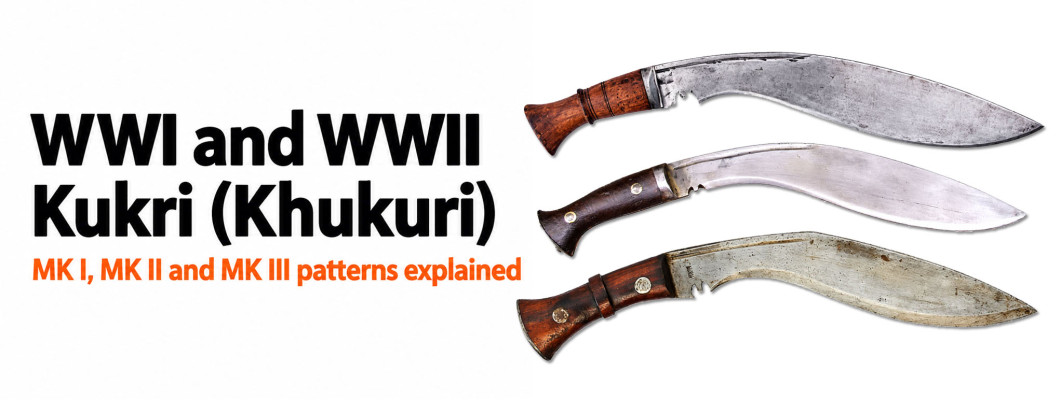
The kukri (khukuri) Gurkha soldiers carried in the First and Second World Wars came in a small number of official military patterns, which collectors call the MK I, MK II and MK III. The MK I (about 1903 to 1915) has a long blade and a rat-tail tang running through a walnut grip to a nut at the butt. The MK II (from about 1915, still made in 1944) has a full tang in a wooden grip held by two rivets, with a steel bolster and butt cap. The MK III (from about 1943) drops the separate bolster, has larger rivets and a more angular, knife-like blade. This guide shows how to tell them apart, where to find the maker's and date stamps, and which makers produced them.
For the battles, regiments and the wider story of the Gurkha kukri (khukuri) in service, read our hub post The Kukri in Service: A Gurkha Military History. This post is the identification guide that sits beside it.
| Pattern | MK I | MK II | MK III |
|---|---|---|---|
| In use | About 1903 to 1915 | From about 1915; made in large numbers in both world wars, up to at least 1944 | From about 1943; stayed in Indian Army use after the war |
| Typical blade | About 13.25 to 14 in (34 to 36 cm) | About 13 in (33 cm) | About 12 to 12.25 in (30.5 to 31 cm) |
| Typical weight | About 24 to 33 oz (680 to 935 g) | About 21 to 28 oz (595 to 795 g); WWII pieces usually heavier than WWI | Lighter than the MK II; hollow-ground blade |
| Tang | Rat-tail tang through the full grip, held by a nut recessed in the butt | Full-length, full-width tang | Full-length, full-width tang |
| Grip | Walnut, one piece | Wooden grip held by two rivets | Wooden grip, two larger rivets |
| Bolster and butt | No separate bolster; nut at the butt | Steel bolster and steel butt cap on issue pieces | No separate bolster; sturdier butt cap |
| Blade shape | Long, classic curved profile | Rounded, traditional profile | More angular, closer to a large knife |
| Typical markings | Often unmarked; "CO." (Cossipore) on some 1915 pieces; FW, QA, RP inspection marks | Maker and year on the blade, e.g. "CO. 1917", "PIONEER CALCUTTA 1943" | Maker and year, e.g. "CMW 1944", "HW 1944", "K-45" |
Sizes and weights are typical recorded examples, not official specifications. Issue pieces vary by maker, contract and year.
Why the Kukri (Khukuri) Got Official Patterns
For most of the 19th century, Gurkha soldiers in the British Indian Army carried kukris (khukuris) made in the traditional way by Nepali smiths, with a hidden partial tang and no standard size. As the Gurkha regiments grew, the army wanted a kukri it could order in quantity, inspect and replace like any other item of kit.
The answer was the "official standard pattern" kukri: a set design, made in Indian arsenals and by contracted workshops, and checked by army inspectors. Collectors number these patterns MK I, MK II and so on, after the British "Mark" system. In the 20th century there were around five numbered official patterns in all, including post-war designs. The three below are the ones carried in the two world wars.
One honest note on names: the "MK" labels are collectors' shorthand, and not every name appears on the blades. The MK III label in particular is debated. Some researchers point out that a "Mk.3" on Wilkinson Sword drawings was an internal drawing number, not an army pattern, while dealers and collectors use MK III for the angular WWII design described here. If you buy an original, go by the construction and the stamps, not the label in a listing.
The MK I Kukri (Khukuri): About 1903 to 1915
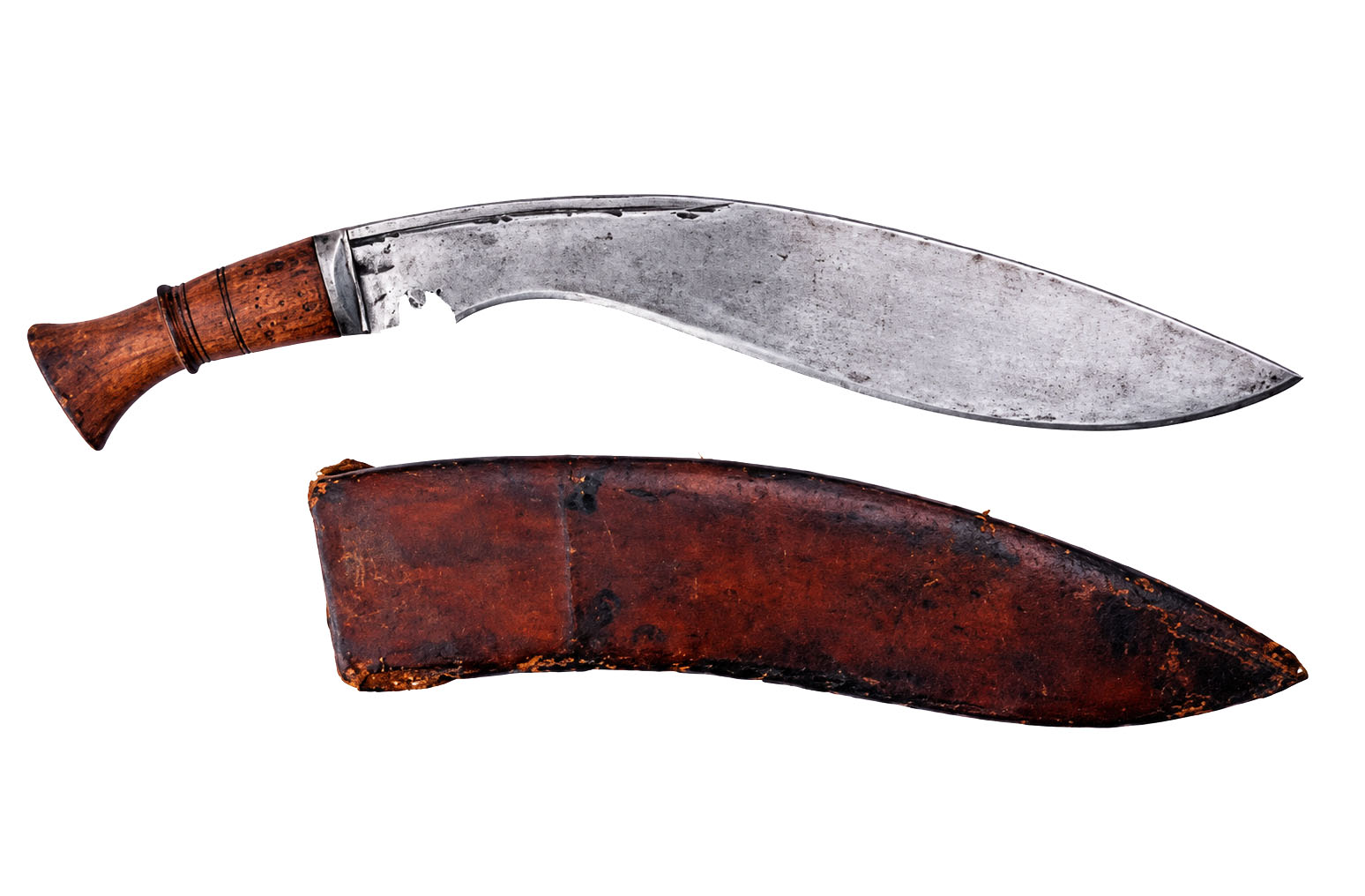
The MK I is the first official military kukri. It was in production by 1903 and carried into the opening battles of the First World War, at Neuve Chapelle and Loos in 1915, before the MK II replaced it.
- The tang is the giveaway. Instead of a hidden partial tang, a rat-tail tang runs the whole length of the walnut grip and is held by a nut recessed into the butt, much like the fitting on a rifle stock.
- A long blade. Typically 13.25 to 14 inches, and heavy for its size, at around 24 to 33 ounces on examined pieces. Some of the 1915 pieces are noticeably heavy and blade-forward in the hand.
- A rarer variant. A few lighter, longer-handled MK I kukris exist, usually unmarked. They may be private or regimental purchases rather than standard issue.
- Markings. Many MK Is carry no maker's mark at all. Some 1915 pieces are stamped "CO." for the Cossipore arsenal, and inspection marks such as FW (Fort William), QA (Quetta) and RP (Rawalpindi) appear on the spine. Civilian workshops were also subcontracted, among them E. Boota Singh & Sons of Rawalpindi.
The MK II Kukri (Khukuri): From About 1915, Through Both World Wars
The MK II was the kukri of the trenches, Gallipoli and Mesopotamia, and it was still being made in large numbers for the Second World War. It is the pattern most WWI and WWII originals belong to.
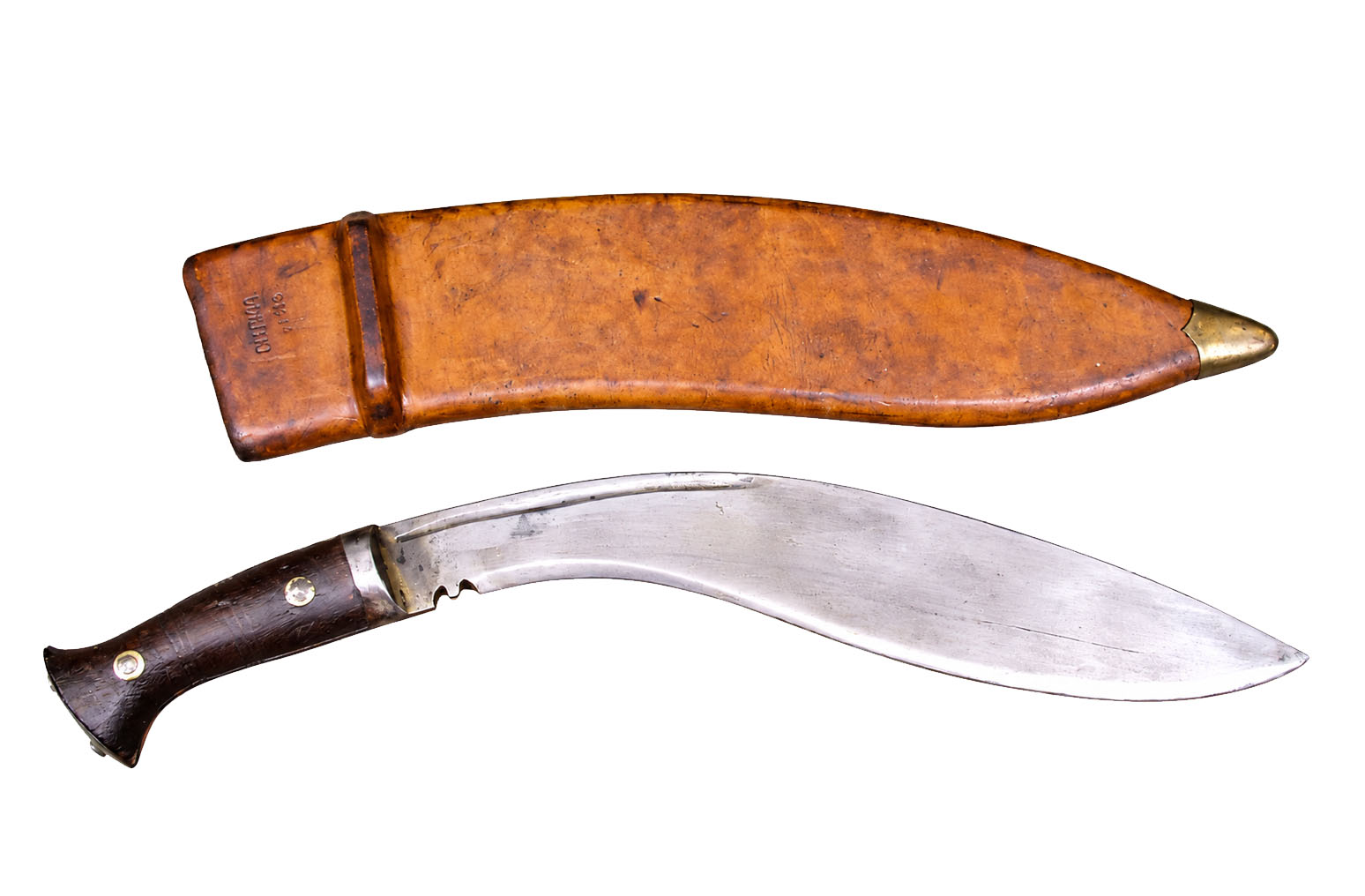
- A full-width tang. The tang runs the full length of the handle inside a wooden grip held by two rivets. This was stronger and quicker to make than the MK I's through-tang.
- Steel fittings. Issue MK IIs have a steel bolster where the blade meets the handle and a steel butt cap. Brass fittings usually point to a private purchase or a better-quality piece, not standard issue.
- Weight. Around 21 to 28 ounces on examined pieces. WWII-made MK IIs are usually heavier than WWI ones.
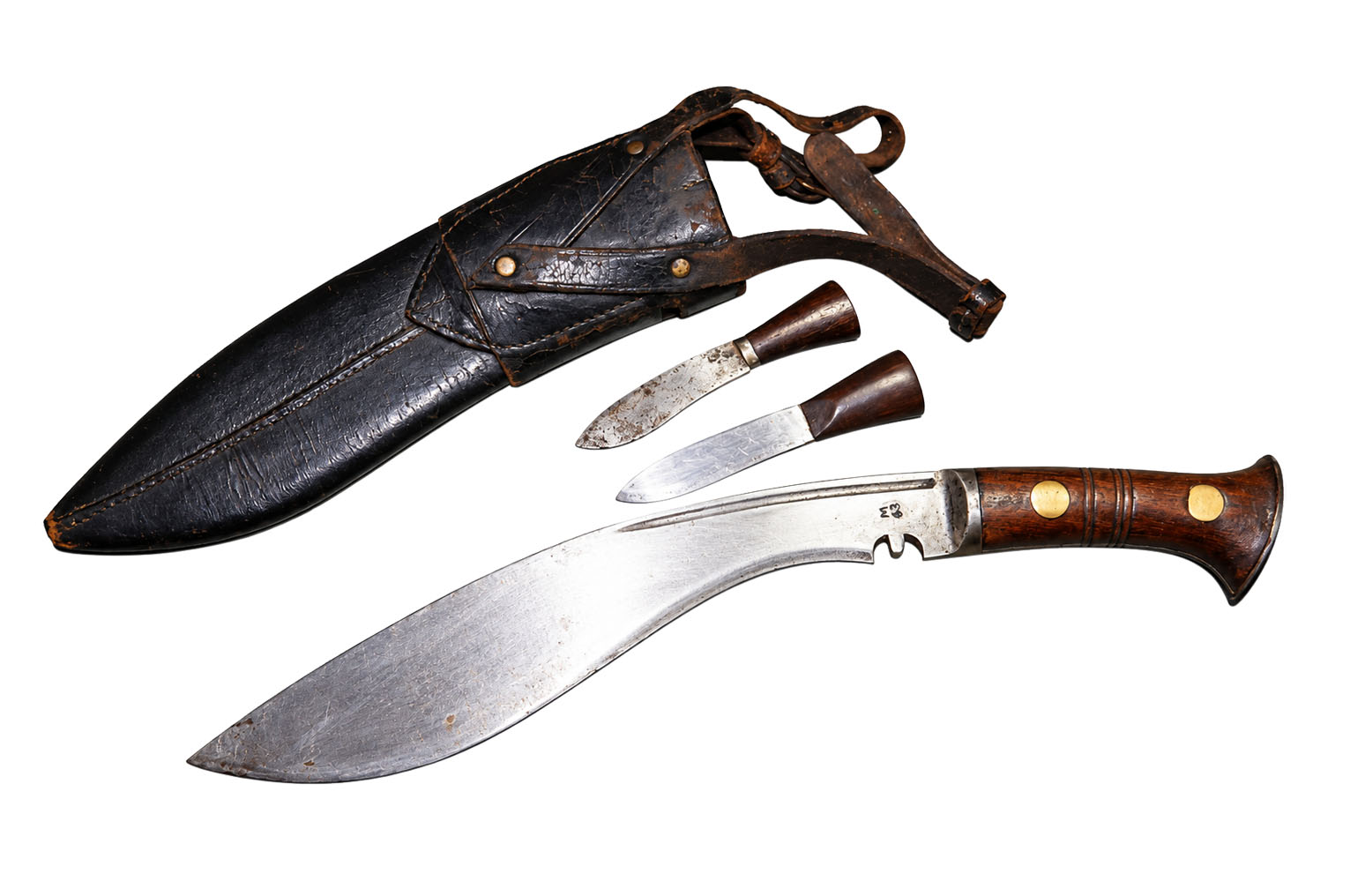
- The M43. Kukris stamped M43 are best seen as one maker's version of the MK II, with sunken rivets and a bolster welded to the tang, rather than a separate pattern. Our M43 kukri post covers it in full.
Recorded MK II makers
| War | Maker stamps recorded on MK II kukris (khukuris), with years seen |
|---|---|
| WWI | CO. (Cossipore, 1915 to 1919, the most common); DHW (1918, 1919); GDB & Co. (1917, 1918); E. Boota Singh & Sons (1917); AS & Sons Ltd (1916, rare); RFI, Rifle Factory Ishapore (a small batch in 1927) |
| WWII | ATD (1942 to 1944); M or MIL (1941, 1942); Pioneer, Calcutta (1942 to 1944); Queera Bros (1942 to 1944); JNB (1941 to 1944) |
The MK III Kukri (Khukuri): From About 1943
By 1943 the Indian Army needed huge numbers of kukris for the campaigns in Burma, Italy and North Africa, and the MK III was designed to be made faster with more modern methods.
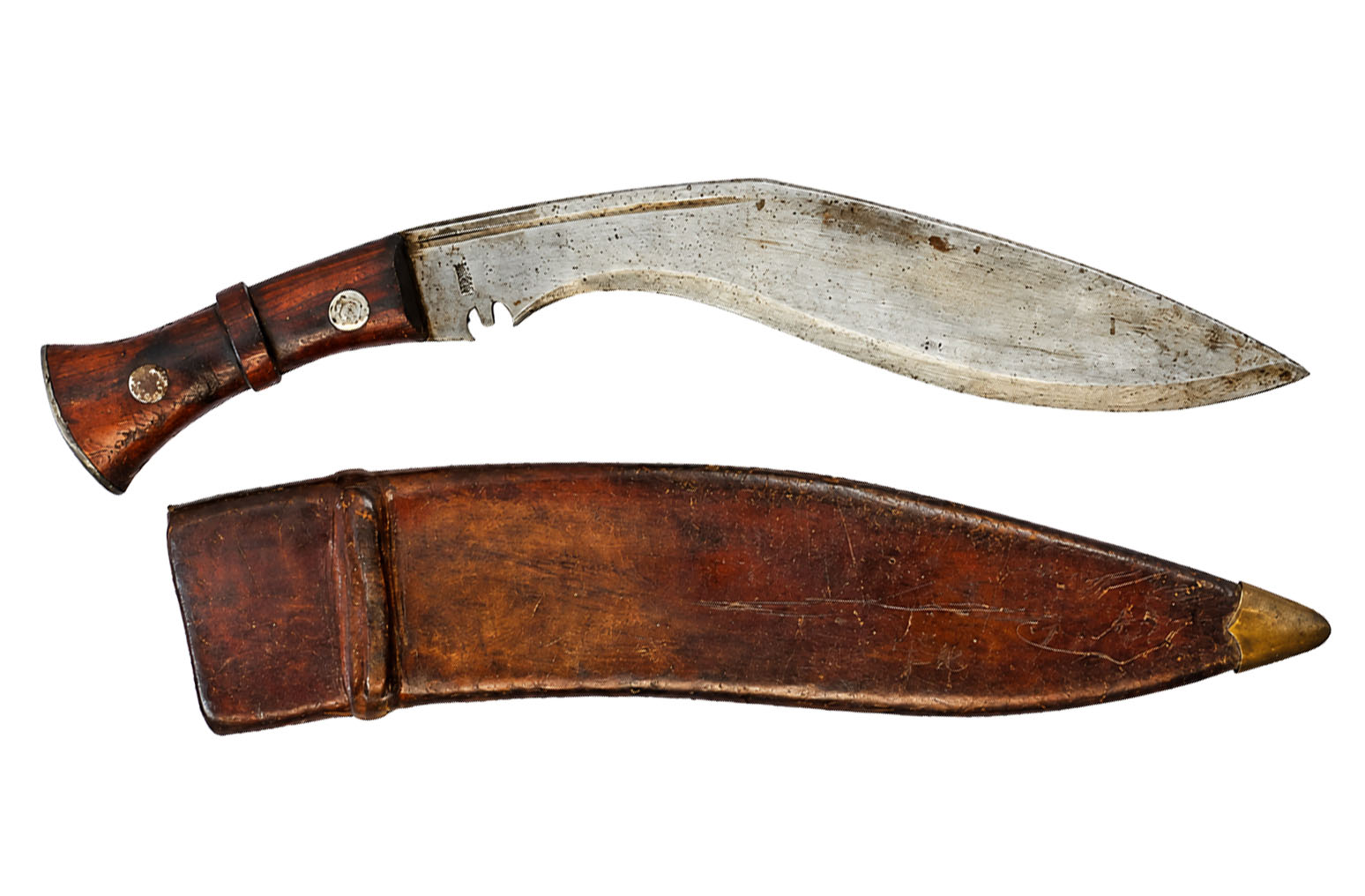
- No separate bolster. The MK II's steel bolster is gone, which saved a part and a fitting step.
- Bigger rivets and a sturdier butt cap hold the wooden grip to the full tang.
- A different blade. The blade is more angular and slightly hollow-ground, which stiffens it and saves weight. The overall look is closer to a large knife than the rounded MK II. Blades of around 12 to 12.25 inches are typical.
- Markings. Recorded MK III makers include CMW, HW and Pioneer of Calcutta, plus D.K.W. (Doon Kukri Works). Year stamps such as 1944 and 1945 appear. "K-45" is a year stamp for 1945, not a model number. Early MK III stamps are often faint and hard to read.
- A long service life. The MK III design stayed in use in parts of the Indian Army after the war, so many WWII pieces also carry later Indian Army inspection marks.
How to Read the Markings on a Military Kukri (Khukuri)
On an original, the stamps matter more than anything else. A dated, broad-arrow-marked kukri with its own scabbard and both small knives is worth far more than a plain blade. Look in three places:
- The blade, near the bolster. The maker's name or initials and the year, such as "CO. 1915" or "PIONEER CALCUTTA 1943".
- The spine and the handle. Inspection marks such as FW, QA and RP on early pieces, plus inspector numbers and later Indian Army marks on many WWII kukris.
- The scabbard and frog. The broad arrow (the British War Department mark), a contractor's mark and a year. Scabbard dates often differ from the blade date by a year or so; scabbards and blades were made and issued separately.
Regimental marks, such as a battalion of a Gurkha Rifles regiment, do turn up, but they are not part of the official pattern, and they are the marks most often faked.
Warning signs on a "wartime" kukri
- Crisp, shallow stamps on a blade that is otherwise worn and pitted.
- A regimental mark added to a plain kukri, or a genuine old kukri with new marks.
- Brass grip rings on a kukri stamped "CO. 1917"; these are a known fake.
- A fresh, unworn scabbard on a supposedly field-carried blade.
Check every stamp under 10x magnification. Real stamps are struck into the steel and wear with it; added ones often sit on top of the wear.
The Scabbard and the Two Small Knives
Issue scabbards were hard leather over a wooden core, with a metal chape at the tip and a leather frog to carry it on the belt. Many held the two small knives that go with every kukri (khukuri): the karda, a small utility knife, and the chakmak, a blunt steel for sharpening and striking fire. Our post on the karda and chakmak explains what they are for, and our scabbard (dap) guide covers how a kukri scabbard is built.
Want a WWI or WWII pattern kukri (khukuri) built your way, with your blade length, handle and finish?
Build your bladeWhere the WWI and WWII Patterns Served
In the First World War, Gurkha battalions carried the MK I and then the MK II on the Western Front in 1915, at Gallipoli and in Mesopotamia. In the Second World War, the MK II and MK III went with Gurkha units to North Africa, Italy, including Monte Cassino, and above all Burma, where the jungle fighting made the kukri (khukuri) as much a tool as a weapon. The full story, from the Anglo-Nepalese War to the Falklands, is in our Kukri in Service post. For the modern patterns that replaced these, see The Official Issue Kukri.
Our WWI and WWII Pattern Reproductions: What Is and Isn't Period-Correct
Everest Forge makes reproductions, not originals, and we think you should know exactly what you are buying:
- The blade profile follows the pattern. Our historical kukris (khukuris) are forged to the shape and size of the pattern they are named after.
- Some construction details differ. Several of our reproductions use horn or rosewood handles and traditional Nepali tang construction, where an issue MK I had a walnut grip on a threaded through-tang, and an issue MK II had a riveted wooden grip with steel fittings. If you want a closer match, ask for it through our custom forge.
- Steel. We forge in 5160 spring steel, a modern steel that is tougher than the wartime carbon steels. We do not make Damascus or pattern-welded blades. Our kukri tang types guide explains the tang options.
- Markings. An honest reproduction should never carry a period maker's stamp, a war date or a broad arrow. If you want text on the blade, ask for your own engraving instead.
These are the closest patterns we forge:
See the full range in our Historical Gurkha Kukri Replicas post.
A period pattern, forged to your specification
Walnut grip and through-tang for an MK I, or a riveted grip with a steel bolster for an MK II. Tell us the pattern and the details you want, and we will forge it in 5160 spring steel.
Request a custom forgeRelated Reading
Frequently Asked Questions
What is the difference between the MK I and MK II kukri (khukuri)?
The MK I has a rat-tail tang running through a walnut grip to a nut at the butt, and a longer blade. The MK II has a full tang in a wooden grip held by two rivets, with a steel bolster and butt cap.
How do I recognise a MK III kukri?
Look for no separate bolster, two large rivets, a sturdier butt cap and a more angular, knife-like blade of about 12 inches. Recorded MK III makers include CMW, HW, Pioneer and D.K.W.
Which kukri did Gurkhas carry in WWI?
The MK I at the very start of the war, then the MK II from about 1915. Most surviving WWI military kukris are MK IIs, many stamped "CO." for the Cossipore arsenal.
Which kukri did Gurkhas carry in WWII?
Mostly the MK II, made by contractors such as Pioneer of Calcutta, ATD and Queera Bros, and from about 1943 the MK III. The M43 is one maker's version of the MK II.
Where are the markings on a military kukri (khukuri)?
The maker and year are usually on the blade near the bolster, inspection marks on the spine or handle, and the broad arrow, contractor and year on the scabbard or frog.
What does "K-45" mean on a kukri?
It is a year stamp for 1945, not a model number. Year stamps on WWII kukris are often faint, especially on early MK IIIs.
Is "MK III" an official army name?
It is debated. Collectors and dealers use MK III for the angular WWII design, but some researchers note a "Mk.3" on Wilkinson Sword drawings was only a drawing reference. Go by construction and stamps.
How can I spot a fake WWII kukri?
Watch for crisp, shallow stamps on a worn blade, added regimental marks, brass grip rings on a "CO. 1917", and a fresh scabbard on a "field-carried" blade. Check stamps under 10x magnification.
Are Everest Forge WWI and WWII kukris originals?
No. They are hand-forged reproductions in 5160 spring steel. The blade profile follows the pattern, but some handles and tangs differ from issue pieces.
Can you forge a period-correct MK I or MK II?
Yes, through our custom forge. Ask for the details you want, such as a walnut grip and through-tang for a MK I, or a riveted grip with a steel bolster for a MK II.