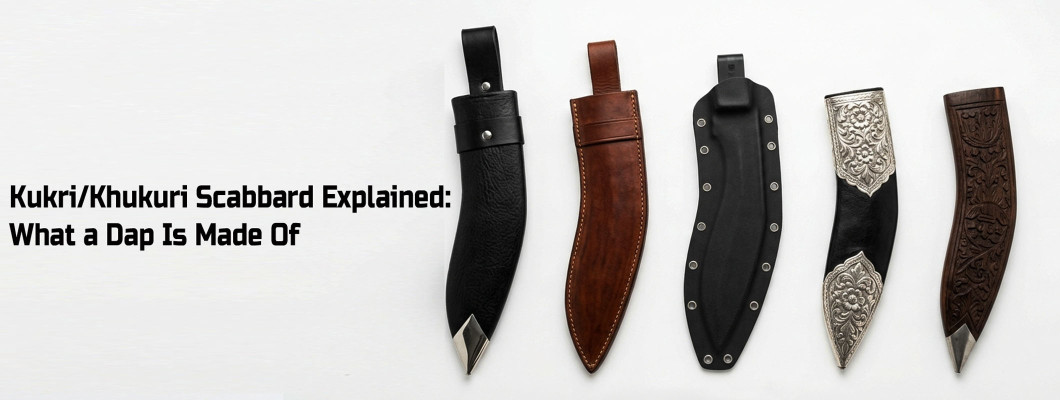
The Kukri/Khukuri Scabbard (Dap) Explained: Wood Core, Laha and the Sarki
The scabbard is not a leather bag. Inside it are two halves of carved wood, hollowed to the curve of one specific blade, held together by nothing but the leather stretched over them. It is made by a different craftsman from the one who forged the blade, it is fitted to that blade and no other, and it is the single commonest cause of rust on a kukri. Almost nobody explains any of this.
Every kukri and khukuri photograph shows the scabbard. Almost no listing tells you what is inside it, who built it, why it grips the way it does, or why a blade left in one pits within days. This guide covers all of it — the wood, the resin, the leather, the fittings, the fit, the failures and the care — from a forge where they are made.
It Is Not Made by the Blacksmith
This is the first thing to understand, and it reframes everything else.
The blade is forged by a kami, the smith. The scabbard is built by a sarki, a leatherworker, who is a different person in a different trade. On older and finer pieces a third hand was involved again: the carved wooden scabbards of the Kathmandu Valley were largely the work of Newar woodcarvers rather than either of the first two.
So a traditional kukri is not one craftsman's object. It is an assembly of at least two trades that have to agree, and the point at which they agree is the fit. The sarki works from the finished blade in his hand, not from a drawing or a standard size, which is why a dap built for one kukri will not properly take another of nominally the same length.
That is also why scabbards vary more in quality than blades do. A workshop can forge well and sheath badly, and the second is easier to hide in a photograph. When you are judging a kukri, the dap is where the corners get cut.
The Parts, and What Each One Is Called
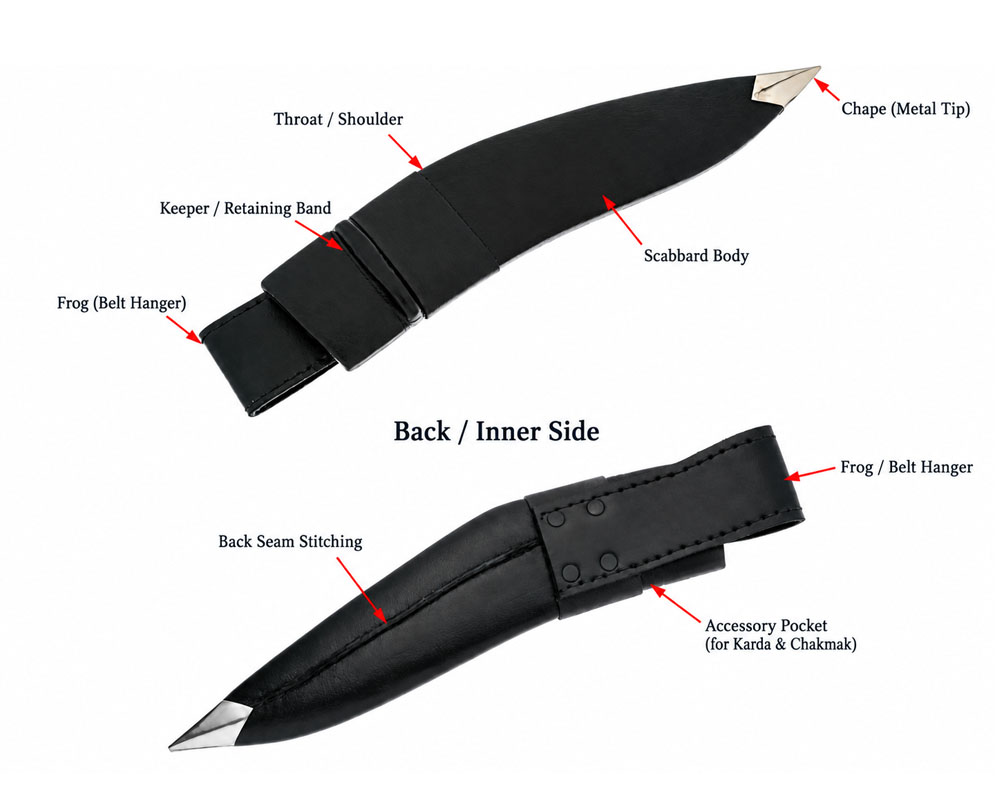
| Nepali | English | Why it matters |
|---|---|---|
| Modi | Throat, the mouth | Takes the wear every time the blade is drawn |
| Sharir | Body | Leather over the two-piece wood core. The structure |
| Juro bhag | Peak area | The broad swell where the belly of the blade sits |
| Kothi | Chape, the tip cap | Stops the point wearing through the end |
| Loti | Loop | The band the belt passes through |
| Addi | Stopper | Sits above the loti so it cannot slide down the taper |
| Farus | Frog, the belt hanger | Single or double. The karda and chakmak pocket sits behind it |
| Tuna | Lace | Threaded through the row of slits. Lets the carry be adjusted |
| Karda | Small utility knife | Part of the traditional set, not an accessory |
| Chakmak | Burnishing steel | Trues the edge between full sharpenings |
| Khisa | Tinder pouch | On older scabbards. Largely gone from modern production |
| Metal liner | Strip in the channel, plate at the throat | Needed on double-edged blades. Takes the cut instead of the wood |
The full kukri and khukuri terminology guide covers the blade and handle names alongside these.
Single Frog or Double Frog
The carry is the part of the dap you interact with most, and there are two arrangements. Both are built onto the farus, the belt hanger at the throat end, and you will see them sold as single and double loop as well as single and double frog.
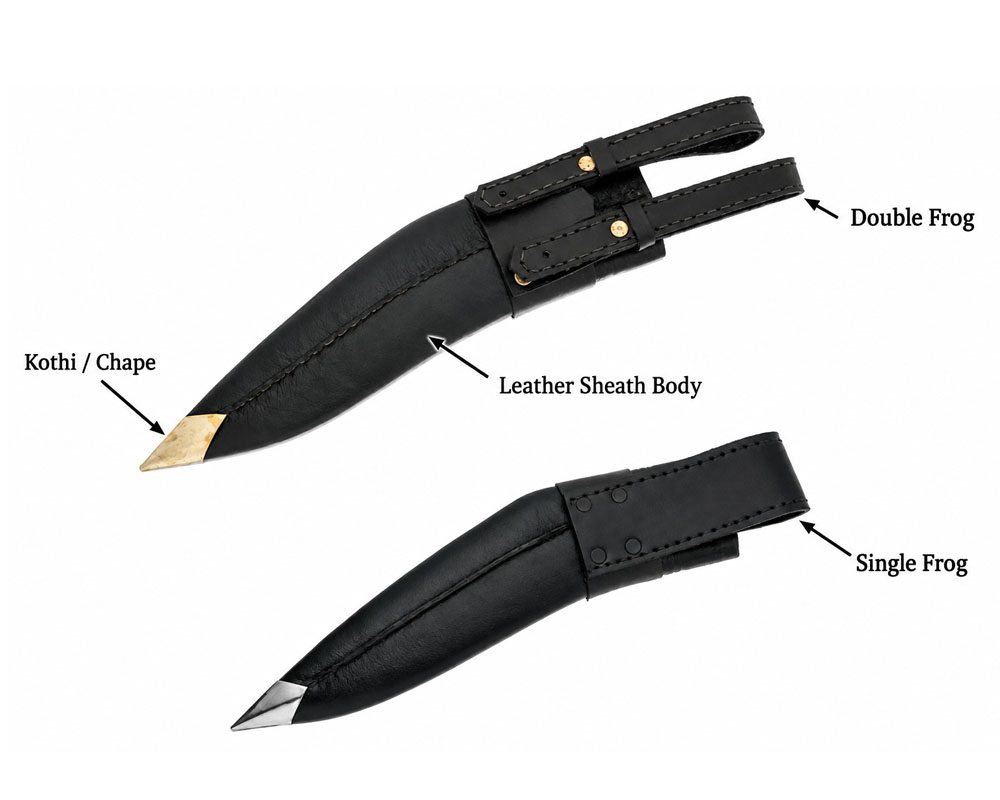
Single frog. One leather strap at the throat end, riveted through the panel the karda and chakmak pocket sits behind. Simple, quick to make, and the scabbard is free to swing on the belt, which some people prefer and some do not.
Double frog. The hanger splits into two straps. The weight is carried at two points instead of one, so the scabbard sits steadier against the body and the load is not concentrated on a single band of stitching. That matters on a heavy khukuri, where one strap carrying two pounds of blade at the end of a long lever is the part that eventually tears.
The addi holds it all in place. A dap tapers, so anything wrapped around it wants to slide toward the tip, taking the carry position with it. The addi, or ghari, is the raised stopper the loti butts against. Without one, a loop that fits today sits an inch lower next month, and a scabbard that hangs progressively lower is not a cosmetic problem — it changes where the blade sits when you reach for it.
Which to ask for. Single frog for a lighter blade, or where the scabbard is mostly stored and occasionally worn. Double frog for a heavy working khukuri, for anything carried for hours, and for anyone who dislikes a blade swinging as they walk.
The Wood Core
The part nobody sees and the part that does all the work.
Two halves, not a hollow tube. The sarki selects a piece of softwood — commonly Himalayan pine, sometimes rhododendron or another local timber — splits it, and hollows each half to the profile of the blade that will live in it. The two halves then close around the blade like a mould around a casting.
The seam is usually not glued. On most traditional scabbards the two halves are held closed by the leather alone, which is an elegant solution and also a weakness: a blade pushed in at the wrong angle can cut straight through the seam from the inside. This is the most common way a good dap is destroyed, and it is always the owner rather than the maker who does it.
Softwood is a deliberate choice, not a cheap one. A hardwood core would be stronger and would also blunt the edge every time the blade moved against it. Pine is soft enough to be kind to the steel and light enough to carry, and it accepts carving quickly, which matters when every scabbard is a one-off.
Laha: The Glue That Is Not Glue
Laha is a natural resin, gathered from tree bark and gum, melted and used hot. It appears twice in a traditional kukri: sealing the tang inside the handle, and bonding the leather to the wood core of the dap.
Its useful property is that it is reversible. Heat softens it again, which means a handle can be re-seated and a scabbard re-covered without destroying the parts. Modern epoxy is stronger and permanent, which sounds better until something needs repairing.
Its limitation is heat and damp. Laha does not enjoy a hot car dashboard or a monsoon. If a leather covering lifts at the throat, that is usually laha releasing rather than the leather failing, and it is repairable.
The Leather
Water buffalo hide, usually dyed black or dark brown, stretched over the wood while workable and pulled tight so it shrinks onto the core as it dries.
It is structural. On a traditional dap the leather is not decoration over a finished box; it is the tension holding two loose pieces of wood together. That is why a scabbard whose leather has dried, cracked and lifted starts to rattle — the core has not broken, the clamp has let go.
And it is the source of the problem. Vegetable-tanned leather holds moisture against steel and carries tanning residues that accelerate corrosion. The covering that makes the scabbard work is the same covering that makes it dangerous to store a blade in.
Why the Fit Is Harder Than It Looks
A straight knife goes into a straight sheath. A kukri does not, and the geometry is genuinely awkward.
The curve is not a circular arc. The blade sweeps forward and the belly is wider than the section behind it, so the blade has to rotate as it leaves the scabbard rather than sliding straight out. That means the throat must be cut wider than the blade to let the widest part turn through it, while the body below stays tight.
Which is why the drawing motion matters. A kukri is drawn along the curve, not yanked upward, and pushed home the same way. Force it straight and the edge meets the inside of the wood. Keep your fingers off the edge side of the scabbard while you do it — that is where the blade will come through if the seam gives.
Some scabbards are built to avoid the problem. Quick-draw versions leave the top seam open for most of its length so the blade enters from the side rather than being threaded down the curve. They are less traditional and considerably more practical for anyone drawing a blade often.
The more circular styles are easier. Older rounded profiles such as the hanshee and salyani forms have less of this problem than modern broken-back shapes, simply because their curve is closer to a true arc.
Metal Reinforcement, and Why a Double-Edged Blade Needs It
A standard dap works because only one side of the blade cuts. Change that and the whole construction has to change with it.
The problem. A kukri is drawn along its curve, which means the blade is pressed sideways into the channel as it rotates out. On a single-edged blade that pressure lands on the spine, which is blunt, thick and does no harm. On a double-edged kukri — or any blade with a sharpened back edge or false edge — that same pressure lands on a cutting surface, and the wood gives way. Given enough draws it cuts through the seam.
Why that is a safety matter rather than a durability one. The seam runs down the side of the scabbard, and the supporting hand wraps around exactly there. A blade that breaks through the wood and leather does not come out at the mouth where you are expecting it. This is the one failure mode on a scabbard that injures somebody.
The fix is a metal part. A metal liner set into the channel takes the cut instead of the wood, and a metal throat plate at the mouth takes the wear where the rotation is sharpest and the blade is moving fastest. Fitted properly, the blade rides on metal at the two points where it would otherwise be carving into softwood, and it comes out at the mouth every time.
It is not free. Metal against a finished blade will mark it if the fit is even slightly wrong, and grit caught between the liner and the steel does far more damage than grit against wood. A metal-lined dap needs the inside kept clean, and it cannot be eased with a soaked wedge the way a plain wooden scabbard can — the fit has to be right when it is built.
When to ask for it. Any double-edged kukri or khukuri. Any blade with a sharpened back edge or a working false edge. Heavy blades that will be drawn often, where throat wear is the limiting factor. And any commission where the scabbard will be handled by people who have not been shown how to draw a kukri — which, at a presentation or on a wall at home, is most of them.
The Part Nobody Tells You: The Dap Is Why Kukris Rust
This is the honest section, and it contradicts what the object appears to be for.
A wooden core wrapped in leather, closed at one end, with a blade filling the cavity, has no airflow at all. Anything wet that goes in stays wet. Sheath a kukri damp — after rain, after use, after a humid day in a pack — and you have built a sealed chamber around carbon steel with moisture in it. Pitting can start within days, and pitting is permanent.
The blade near the bolster and the notch at the base of the edge are the first places it shows, because debris and water collect there and a quick wipe misses both.
So the rule is simple and it is not optional. Dry the blade before it goes in. Never store a kukri sheathed for long periods — keep the blade in a cloth sleeve or wrapped in oiled paper and store the dap separately. Our 5160 blade care guide covers the routine, and the rust prevention guide covers why carbon steel behaves this way.
Common Problems and What Actually Fixes Them
| Problem | Cause | Fix |
|---|---|---|
| Too tight to draw | Wood swollen with damp, or a new scabbard not worn in | Whittle a wooden wedge, soak it, press it firmly into the throat and leave it. An old Gurkha field fix and still the right one |
| Blade rattles | Leather dried and lost its tension, or the core has worn | Condition the leather. If it has cracked and lifted, it needs re-covering rather than tightening |
| Blade has cut the seam | Pushed in straight instead of along the curve | Repairable by a leatherworker. Change how you sheathe it or the new one goes the same way |
| Leather lifting at the throat | Laha releasing, usually after heat | Re-bonded, not replaced. This is a repair, not a write-off |
| Leather cracked and hard | Dried out, or dried with heat after a soaking | Conditioner sparingly, dried at room temperature. Heat is what caused it |
| Kothi lost | Point wearing through, or the fitting knocked off | Replace it before the tip comes through the end |
| Loti torn | Weight of the blade on a thin loop | Restitched. Check it before carrying a heavy khukuri on a belt |
| Smells, or marks the blade | Damp trapped inside, tanning residue on steel | Dry both separately and stop storing the blade in it |
Almost everything on that list is repairable. A dap is a serviceable object, which is a large part of why the traditional construction survived — laha reheats, leather restitches, cores can be recarved.
Kothimora and Decorated Scabbards
The ceremonial version, and a different object in practice.
A kothimora dap carries worked silver or white metal mounts over the leather, often covering most of the surface, and is presented at retirements, promotions and formal occasions rather than carried. Older museum pieces run further still — silver repousse mounts, quillwork, carved hardwood cores made to imitate tooled leather.
Treat a kothimora as display, not as storage. The same moisture problem applies underneath the decoration, and it is harder to inspect. Keep the blade out of it between occasions.
The Modern Alternatives: Leather, Kydex and Nylon
The traditional dap is not the only option, and pretending otherwise does nobody any favours. Here is the honest comparison, including where the dap loses.
| Traditional dap | Modern leather | Kydex | |
|---|---|---|---|
| Moisture | Worst. Wood and leather both hold it | Poor. Leather still holds damp against steel | Best. Holds none, drains through the eyelets |
| Retention | Friction, plus a strap. Loosens as it wears | Friction and a strap. Predictable | Positive click. Holds upside down |
| Grit | Wood absorbs it | Leather absorbs it | Traps it against the blade. Rinse it out |
| Carry options | Belt only, through the loop band | Belt, mostly vertical | Belt, MOLLE, drop-leg, horizontal, inverted |
| Weight | Heaviest | Middle | Lightest |
| Noise | Silent | Silent | Audible click on draw and return |
| Heat | Laha softens in extreme heat | Hardens and shrinks if dried with heat | Deforms if left in a hot car |
| Repair | Fully serviceable. Reheat, restitch, recarve | Restitchable | Not repairable. Cheap to replace |
| Character | An heirloom made by hand | Craft object, no tradition attached | Equipment. Nobody inherits one |
Modern leather
A stitched leather sheath with no wood core, usually vegetable-tanned, and the quality question is whether it has a welt.
The welt is the whole thing. It is a strip of leather sandwiched between the two faces along the edge side, and it holds the blade's edge away from the stitching. Without one, the edge rests directly on the thread and cuts it, which is why unwelted sheaths fail along the seam within a season. Ask whether a leather kukri sheath is welted before anything else.
It is quieter and lighter than a dap and easier to draw from, since there is no rigid channel forcing the blade through a fixed arc. It still holds moisture, so the storage rule does not change: dry the blade, do not leave it sheathed for months.
Kydex
Thermoformed plastic, moulded around the specific blade and riveted. The best protection against rust of anything on this page and the worst behaviour with grit.
Why it is harder to do well on a kukri than on a straight knife. A kukri has to rotate as it leaves the sheath, and the belly is wider than the section behind it, so a fully enclosed Kydex shell cannot be drawn at all. Working kukri Kydex is therefore usually an open-faced or pancake design that grips the flats near the spine and leaves the belly and edge exposed in the cavity. That is not a shortcut — it is the only geometry that works — but it means more of the blade is open to the weather than the pictures suggest.
The grit problem is real. Kydex does not absorb anything, so sand, ash and dust stay in the shell and get dragged along the blade on every draw. Rinse and dry the inside periodically. Owners who never do this end up with a satin blade turned to a scratched one and blame the plastic.
And it has a heat limit. Kydex softens well below the temperature a closed car reaches in summer. A deformed sheath loses its retention and will not come back.
Nylon and cordura
The cheapest option and usually the one bundled with imported kukris. Soft-sided, with a plastic or card insert that is often too flimsy for a heavy blade.
Treat it as packaging rather than a sheath. A heavy khukuri in an unlined nylon pouch will work its way through the fabric, and the belt loop is the first thing to fail. If a kukri arrives in one, that tells you something about where the rest of the money went.
So which one
Dap for a traditional, ceremonial or display piece, and for anyone who wants the object as it is made in Nepal. Welted leather for everyday belt carry where quiet and comfort matter. Kydex for hard use, wet climates, salt air, and anyone who wants the blade to come out fast and stay put upside down.
Plenty of owners keep both: the dap it was born with, and a Kydex rig for the work. There is no rule saying a kukri wears one sheath for life.
What to Ask Before You Buy One
Four questions that separate a built scabbard from a sewn bag.
1. Is there a wood core? Some cheap kukris ship with a stiffened leather sheath and no core at all. It will not hold the blade off the leather and it will not last.
2. Was it fitted to this blade? It should have been carved around the specific kukri it came with. A scabbard made to a generic size will be loose in some places and tight in others.
3. Does the throat let the belly turn? Draw it. If it binds halfway rather than sweeping out, the throat was cut too narrow and it will chew the wood.
4. Are the karda and chakmak pockets real? On some production pieces they are decorative stitching with nothing behind them.
If you are choosing a kukri or khukuri in the first place, the complete kukri and khukuri guide covers blade styles, and the maintenance guide covers sharpening and scabbard care together.
Blade and Dap, Built for Each Other
Every kukri and khukuri we make is forged in 5160 spring steel and sheathed in a traditional dap — carved wood core, laha, water buffalo leather, karda and chakmak — fitted to that blade by hand. Tell us how you will carry it and we will build the scabbard to suit, including quick-draw and reinforced versions.
Frequently Asked Questions
What is a kukri scabbard called?
A dap, from the Nepali dap, also written daap or dhap. It is not simply a leather sheath: inside it are two halves of carved wood hollowed to fit one specific blade, wrapped in water buffalo leather that holds the assembly together. The front carries the belt loop and, beneath the same leather panel, pockets for the karda utility knife and the chakmak burnishing steel.
What is inside a khukuri scabbard?
A two-piece wood core, usually Himalayan pine or another local softwood, carved to the curve of the blade it was built for. The two halves close around the blade and are held shut by the leather stretched over them, which on most traditional scabbards is the only thing holding the seam together — there is often no glue along it at all.
Who makes the kukri scabbard?
A sarki, a leatherworker, and not the kami who forged the blade. They are separate trades, and the sarki works from the finished blade in hand rather than from a drawing, carving the core around that specific kukri. On older carved wooden scabbards from the Kathmandu Valley a third craft was involved again, Newar woodcarvers.
What is laha and what is it used for?
Laha is a natural tree resin, melted and used hot, which appears twice in a traditional kukri: sealing the tang inside the handle and bonding the leather to the wood core of the scabbard. Its advantage over epoxy is that it is reversible — heat softens it again, so a handle can be re-seated or a scabbard re-covered rather than destroyed during repair.
Can I store my kukri in its scabbard?
Not for long periods. A wooden core wrapped in leather has no airflow, so anything damp that goes in stays in, and vegetable-tanned leather holds moisture and tanning residues against carbon steel. A kukri sheathed wet can pit within days, and pitting is permanent. Store the blade in a cloth sleeve or oiled paper and keep the dap separately.
My khukuri scabbard is too tight. How do I loosen it?
Whittle a wooden wedge roughly the shape of the blade, soak it in water, then press it firmly into the scabbard as far as it will go and leave it. It is an old field fix from soldiers whose scabbards tightened and loosened with the season, and it still works. Do not force the blade in as a shortcut — that is how the seam gets cut.
Why did my kukri cut through its own scabbard?
Because it was pushed in straight rather than along the curve. A kukri blade is not a circular arc and the belly is wider than the section behind it, so the blade has to rotate as it enters and leaves. Forced straight down, the edge meets the unglued seam between the two wood halves and goes through it. Keep your fingers clear of the edge side while sheathing.
What are the two small knives on a kukri scabbard?
The karda, a small utility knife for fine work, and the chakmak, a blunt burnishing steel used to true the edge between full sharpenings and traditionally to strike a spark from flint. Each has its own pocket beneath the leather panel at the throat end of the front face. Older scabbards carry a third pocket, the khisa or tinder pouch, which has largely disappeared from modern production.
What wood is a khukuri scabbard made from?
Commonly Himalayan pine, sometimes rhododendron or another local timber. Softwood is a deliberate choice rather than a cheap one: it is kind to the edge when the blade moves against it, light enough to carry, and quick to carve, which matters when every scabbard is cut to one blade rather than to a standard size.
How do I look after a kukri scabbard?
Condition the leather occasionally and sparingly, never soak it, and if it gets wet dry it at room temperature away from any heat source. Heat hardens and shrinks leather, and a shrunken scabbard grips the blade badly and scrapes it every time it is drawn. Dry the scabbard separately from the blade, and check the belt loop stitching before carrying a heavy khukuri on a belt.
Can a damaged kukri scabbard be repaired?
Usually, yes. Laha reheats, so lifted leather at the throat is re-bonded rather than replaced. Cut seams and torn loops are restitched, kothis are replaced, and a worn core can be recarved. The traditional construction survived partly because it is serviceable — very little about a dap is a write-off except a core that has split along its length.
Is a kothimora scabbard different?
Yes, in purpose more than construction. A kothimora carries worked silver or white metal mounts over the leather and is presented at retirements, promotions and formal occasions rather than carried. The same moisture problem exists underneath the decoration and is harder to inspect, so treat it as display: keep the blade out of it between occasions.
Is a Kydex sheath better than a traditional kukri scabbard?
For hard use in wet conditions, yes. Kydex holds no moisture at all, drains through its eyelets and gives positive retention that holds the blade upside down, which a friction-fit dap does not. Its weaknesses are grit, which stays in the shell and scratches the blade on every draw, and heat, since Kydex softens below the temperature a closed car reaches in summer. For a traditional, ceremonial or display kukri the dap is still the right object.
Why do Kydex kukri sheaths leave part of the blade exposed?
Because of the geometry. A kukri has to rotate as it leaves the sheath and its belly is wider than the section behind it, so a fully enclosed Kydex shell cannot be drawn at all. Working kukri Kydex is usually an open-faced or pancake design that grips the flats near the spine and leaves the belly and edge open in the cavity. That is the only arrangement that draws properly, not a corner being cut.
What is a welt on a leather sheath and why does it matter?
A welt is a strip of leather sandwiched between the two faces along the edge side, holding the blade's edge away from the stitching. Without one, the edge rests directly on the thread and cuts through it, which is why unwelted leather sheaths fail along the seam within a season. It is the first thing to ask about on any modern leather kukri sheath.
Are the nylon sheaths that come with cheap kukris any good?
Treat them as packaging. Soft-sided nylon or cordura usually relies on a thin plastic or card insert that is too flimsy for a heavy khukuri, so the blade works its way through the fabric and the belt loop is the first thing to tear. If a kukri arrives in one, that tells you something about where the rest of the money went.
Does a double-edged kukri need a different scabbard?
Yes. A kukri is drawn along its curve, so the blade is pressed sideways into the channel as it rotates out. On a single-edged blade that pressure lands on the blunt spine and does no harm; on a double-edged or back-sharpened blade it lands on a second cutting surface and works through the wood. The answer is a metal liner in the channel and a metal throat plate at the mouth, so the blade rides on metal instead of carving into softwood.
Why is a blade cutting through its scabbard a safety problem?
Because of where it comes out. The seam runs down the side of the scabbard and the supporting hand wraps around exactly there, so a blade that breaks through the wood and leather does not emerge at the mouth where you are expecting it. It is the one scabbard failure that injures somebody rather than just ruining an object, and it is why double-edged blades are reinforced with metal rather than trusted to wood.
What is the difference between a single frog and a double frog kukri scabbard?
How many points carry the weight. A single frog is one leather strap at the throat end, riveted through the panel the karda and chakmak pocket sits behind, and the scabbard swings freely from it. A double frog splits the hanger into two straps, so the belt carries the scabbard at two points, it sits steadier against the body and the load is not concentrated on one band of stitching. The same thing is sold as single and double loop. Ask for a double frog on a heavy working khukuri or anything carried for hours.
What is the addi or ghari on a kukri scabbard?
The addi, also called the ghari, is the raised leather stopper above the loop, and its job is to keep the loti from sliding. A scabbard tapers toward the tip, so anything wrapped around it works its way down as it is worn. The addi gives the loti something to butt against, which holds the carry position fixed and keeps the blade where you expect it when you reach for it.