The Talwar Is Defined by Its Hilt: A Disc Pommel That Locks the Hand and Turns Every Cut Into a Draw
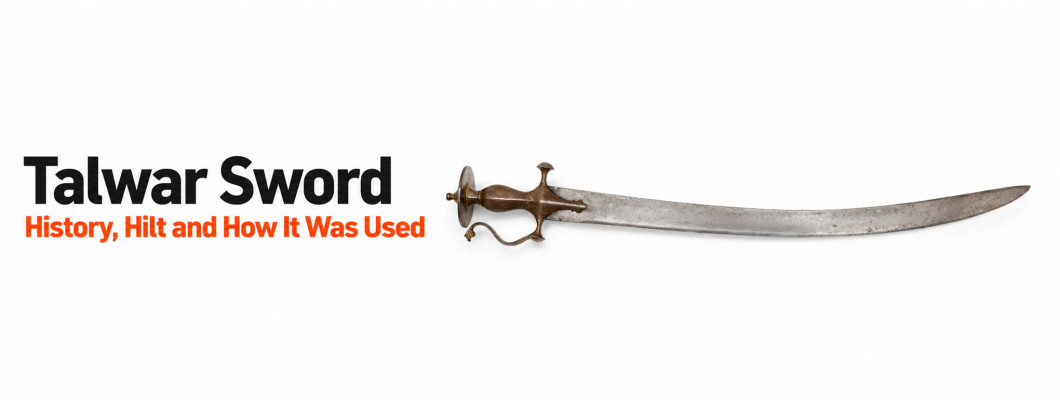
The talwar (also written tulwar or talvar) is the curved sabre of the Indian subcontinent, carried by Mughal, Rajput, Sikh and Maratha warriors and by the courts of Nepal from the medieval period to the nineteenth century. Its blade is a moderately curved, single-edged sabre, usually 70 to 85 cm long, with the edge on the outside of the curve. What makes it a talwar rather than any other sabre is the hilt. A short, all-metal grip swells at the centre and is closed at the top by a broad disc pommel. Short quillons have langets that grip the blade, and many talwars add a knuckle-bow. The hand is held tight between the disc and the guard, which turns the talwar into a sword for drawing cuts, especially from horseback. This guide explains the hilt part by part, how it was used, where the talwar came from, how its regional forms differ, and how to choose a hand-forged one.
The talwar is the best-known of India's swords, but it is one of many. For the khanda, urumi, pata, firangi and the rest, start with our guide to types of Indian swords, from talwar to urumi. This post gives the talwar the depth that guide could not.
What Is a Talwar?
The word talwar simply means "sword" in Hindi, Urdu and Punjabi, and it came into English as tulwar in the British period. As a sword type, it has five features:
- A moderately curved, single-edged blade, typically 70 to 85 cm (28 to 33 in), less deeply curved than the Persian shamshir. Many widen slightly toward the point, and some have a sharpened back edge near the tip.
- A short ricasso, an unsharpened section just below the guard, on many blades.
- An all-metal hilt of iron, steel or brass, often decorated with gold or silver koftgari (damascening).
- A disc pommel, usually topped by a small dome and a button finial over the end of the tang.
- Short quillons with central langets, and often a knuckle-bow running from the quillon to the pommel.
A typical talwar weighs about 0.9 to 1.3 kg. Light, well-balanced blades were prized, and the overall feel is quicker than its curve suggests.
The Indo-Muslim Hilt, Part by Part
Collectors call the talwar's hilt the "Indo-Muslim" or disc hilt. The same hilt appears on other Indian blades, but it is most closely identified with the talwar.
- Disc pommel. A broad, flat disc that sits against the heel of the hand. It usually carries a small dome and a button finial over the end of the tang, sometimes with a ring for a wrist cord.
- Grip. Short and swelling at the centre, so the hand closes around the widest point and cannot slide.
- Quillons. Short cross-pieces, usually ending in knobs or buds, with a small ecusson where they meet the blade.
- Langets. Two tongues of metal that run down from the centre of the guard onto both faces of the blade, binding the hilt to the blade and covering the shoulder.
- Knuckle-bow. On many talwars, a curved bar runs from one quillon up to the pommel to protect the fingers. Others have none.
How the Hilt Shapes the Cut
The talwar's grip is often called "too small" by people used to European swords. It was designed to be held exactly that tightly. With the hand locked between disc and guard, the wrist cannot flick the blade. The cut has to come from the elbow and shoulder, with the blade drawn through the target along its curve. The talwar is built for that drawing cut, which makes the most of the curve and of the speed of a horse.
On horseback, the talwar was used for slashing cuts from the saddle. On foot, it was paired with the round dhal shield, and it remains central to traditional Indian martial arts such as Sikh gatka. Its point is effective as well, especially on blades that widen and sharpen near the tip, but the talwar is first a cutting sword.
Where the Talwar Came From
The talwar descends from the curved Turco-Persian sabres brought into north India by Turkic and Afghan armies from the thirteenth century, during the Delhi Sultanate. Over the following centuries Indian smiths developed the distinctive disc hilt, and by the sixteenth century the talwar was the standard sword of the subcontinent's cavalry. It was carried in the Mughal empire, in the Rajput kingdoms, in the Deccan sultanates, by the Marathas and Sikhs, and in Nepal, each with its own preferences in blade and hilt.
Mughal, Rajput, Sikh and Maratha Talwars
Mughal. At the Mughal court the talwar became a jewelled object as well as a weapon, with hilts of gold-damascened steel, jade or enamel and blades of watered steel, some of them Persian imports. Mughal paintings show it carried at the hip on a baldric, hanging edge-down.
Rajput. The Rajput kingdoms of Rajasthan valued the talwar as a mark of honour and lineage. Swords associated with Rajput rulers are still kept in the palace museums of Udaipur and Jaipur. Rajput talwars often have a heavier blade and a pronounced widening toward the point.
Sikh. For the Sikhs the sword is sacred. Guru Hargobind wore two swords standing for spiritual and temporal authority, and the Khalsa founded by Guru Gobind Singh made bearing arms a duty. The Sikh armies used the talwar together with the broader, heavier tegha. Our guide to the sword and the kirpan in Sikh tradition covers its meaning.
Maratha. The Maratha cavalry of the Deccan carried the talwar alongside the straight firangi and the gauntlet-hilted pata. Maratha talwars are often plainer and lighter, built for fast mounted warfare.
The sword's sacred side, from the khadga of the gods to the swords offered in temples, is covered in our guide to Hindu swords and the khadga.
The Talwar in Nepal
The talwar was the sword of the Gorkhali nobility and officers during the unification of Nepal in the eighteenth century and through the nineteenth, when it appears in court portraits and in the regalia of the Shah and Rana periods. Nepali talwars follow the Indian disc-hilt pattern, often with brass hilts, and are called Indo-Nepalese by collectors. They sat alongside Nepal's own blades, the kukri (khukuri) and the kora. For those, see our guide to the kora sword and Nepalese heritage. The talwar is the reason we, as a Nepali forge, make it: it belongs to our own history too.
Talwar vs Shamshir vs Kilij, in Brief
The talwar is often grouped with the Persian shamshir and the Ottoman kilij under the Western umbrella word "scimitar". The quickest way to tell them apart is the hilt. A disc pommel means a talwar. A pistol-grip hilt with a slender, deeply curved blade means a shamshir. A pistol-grip hilt with a broad blade that flares into a yelman near the tip means a kilij. Our scimitar swords collection sets out all three side by side, and the scimitar history guide covers the family.
Choosing a Hand-Forged Talwar
Our talwars are in the Nepalese swords and talwars collection, forged on demand in our Kathmandu workshop from mono-steel 5160 spring steel. Nothing is held in stock; every blade is forged after the order is placed.
- The brass hilt talwar: a cast brass disc hilt in the Indo-Nepalese manner, the closest of our catalogue talwars to the traditional hilt.
- The Indo-Nepalese talwar sabre: a full-length talwar blade on a rosewood grip.
- The lightweight Indo-Nepalese talwar: a lighter, shorter blade for quick handling.
- The talwar scimitar: a talwar-style blade with a D-guard.
An honest note on the hilts. Only our brass hilt talwar has the traditional disc pommel. The others use rosewood grips, which many buyers find more comfortable for cutting. If you want the full Indo-Muslim hilt in steel, with langets, a knuckle-bow and a finial, ask for it through the custom forge.
To set the blade length, finish and handle yourself, start from Build Your Blade. Any talwar can be ordered left-handed by writing "Left Handed" in the order note. For gatka or stage use, ask the same way for a blunt edge and rounded tip. Catalogue builds dispatch in 2 to 3 business days; custom builds take 4 to 6 weeks at the forge; shipping is DHL or FedEx, tracked, 7 to 14 business days worldwide.
An honest note on the steel. Everest Forge forges mono-steel 5160 only. We do not make Damascus, pattern-welded, folded or laminated steel. Many of the finest historic talwars had blades of wootz, the Indian crucible steel that shows a watered pattern. Ours are plain, hardened spring steel, and we do not imitate that pattern.
Related Guides
Commission a Talwar With a Full Indo-Muslim Hilt
A talwar with a steel disc hilt, langets, a knuckle-bow and a finial, a Rajput blade that widens toward the point, a Sikh tegha, or a copy of a talwar from a museum or your family. Send photos or measurements; the forge quotes it, builds it in 4 to 6 weeks, and ships it tracked worldwide.
Start a Custom Forge RequestFrequently Asked Questions
What is a talwar sword?
The curved sabre of the Indian subcontinent, with a moderately curved single-edged blade and an all-metal hilt with a disc pommel, short quillons, langets and often a knuckle-bow. It was carried by Mughal, Rajput, Sikh and Maratha warriors and in Nepal.
Why does a talwar have a disc pommel?
The disc sits against the heel of the hand and, together with the guard, locks the hand on the short grip. That stops the wrist flicking the blade and turns each cut into a drawing cut from the elbow and shoulder.
Why is the talwar grip so small?
It was made to be held tightly, with the hand closed around the swelling at the centre and trapped between pommel and guard. It feels small to people used to European grips, but it was sized deliberately.
Is a talwar the same as a tulwar?
Yes. Tulwar is the older English spelling of talwar, which means sword in Hindi, Urdu and Punjabi. Talvar is another spelling.
What is the difference between a talwar and a shamshir?
The shamshir is Persian, with a slender, deeply curved blade and a pistol-grip hilt. The talwar is Indian, usually less deeply curved, often broader toward the point, and has the disc-pommel hilt.
What is the difference between a talwar and a kilij?
The kilij is Ottoman Turkish, with a broad blade that flares into a sharpened yelman near the tip and a pistol-grip hilt. The talwar has the disc-pommel hilt and usually no yelman.
Did the Sikhs use the talwar?
Yes. The talwar was a principal Sikh sword, used alongside the heavier tegha, and the sword holds a sacred place in Sikh tradition.
Was the talwar used in Nepal?
Yes. It was the sword of the Gorkhali nobility and officers in the eighteenth and nineteenth centuries, alongside the kukri (khukuri) and the kora. Collectors call Nepali examples Indo-Nepalese talwars.
How long is a talwar?
Usually about 80 to 100 cm overall, with a blade of about 70 to 85 cm, and a weight of about 0.9 to 1.3 kg.
Can I order a talwar left-handed or blunt for gatka?
Yes. Write "Left Handed" in the order note for a left-hand build, or ask for a blunt edge and rounded tip for gatka, training or stage use.