

- Model: Large Knife
- Product Code: Largeknife014
- Location: Kathmandu,Nepal
Available Options
What Is a Fullered Bowie Knife?
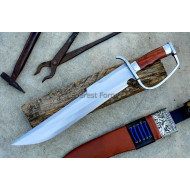
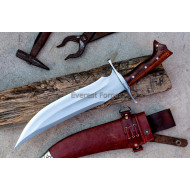
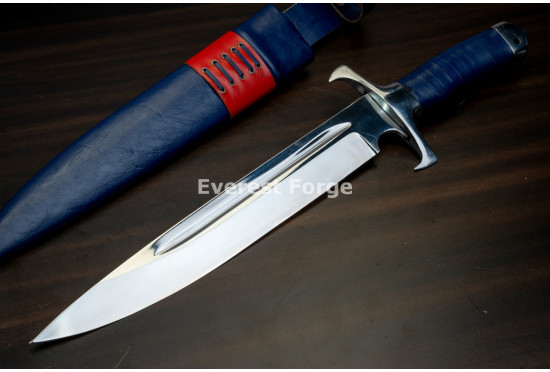
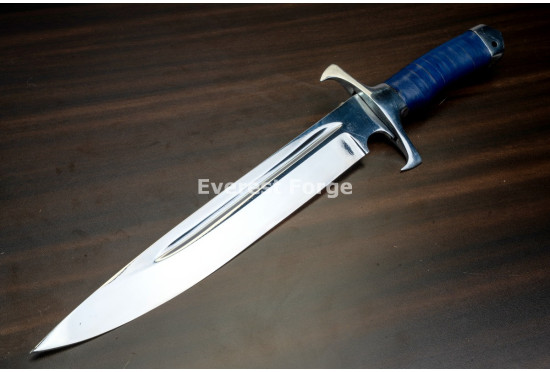
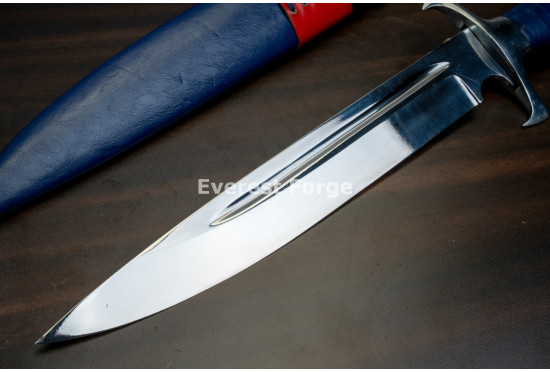
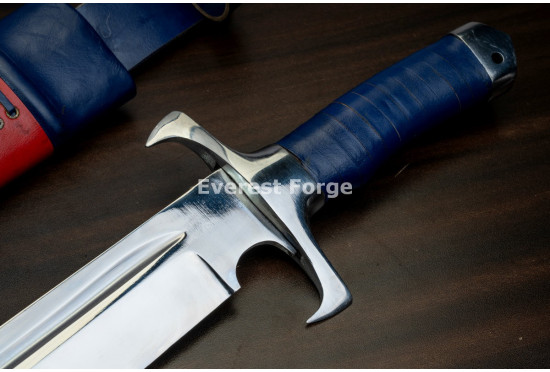
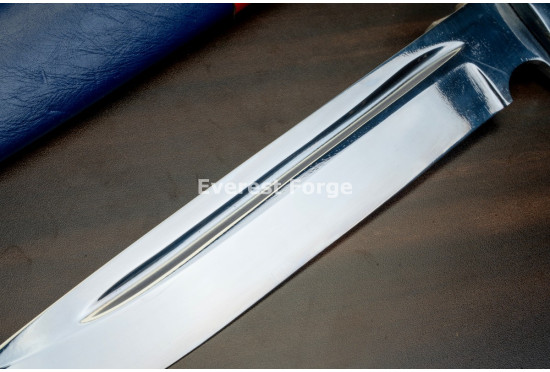
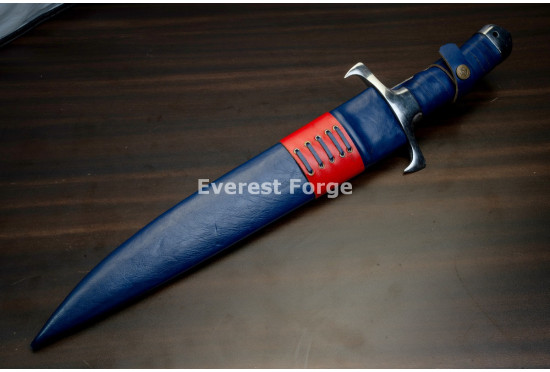
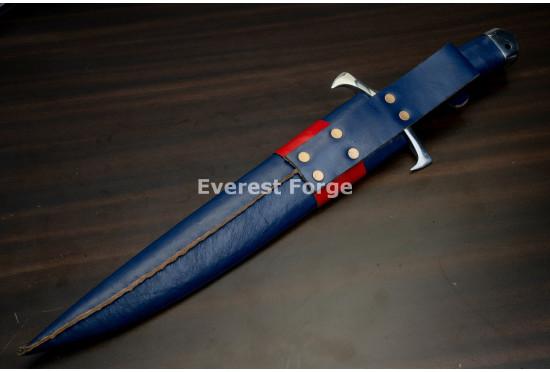
A fuller is the long narrow groove ground or forged into a blade, and on this bowie it runs high near the spine down most of the blade's length. The knife is large by any measure: a 14 inch clip point blade with a deep sweeping belly, a heavily sculpted steel guard with an upswept forward hook and a downswept lower flange, a blue leather handle, and a steel pommel cap with a lanyard hole. It runs to 20.5 inches overall and weighs 940 grams, and it is hand-forged in Nepal from 5160 high-carbon spring steel, in a matching blue leather sheath with a red laced throat panel.
It is a fantasy piece and we say so on the first screen. No historical bowie carries a guard shaped like this one, and the colour scheme is a modern choice rather than a period one. What it is instead is a genuinely large forged blade with real presence, made properly, and the page below is honest about what that means when you pick it up.
An honest note about the size. Fourteen inches of blade at 940 grams is a serious object and it does not behave like a knife. The mass sits forward of your hand, which makes it a competent chopper and a poor utility tool: it will tire your forearm inside ten minutes of continuous work, it is clumsy for anything requiring precision, and it will not do the jobs our 8.5 inch hunting bowie does well. Most people who buy a bowie this size buy it to look at, and that is a perfectly good reason. If you want one to actually carry and use, take the shorter build; it costs less and it will serve you better.
Please check your local law before ordering. At 14 inches this blade is above the everyday carry allowance in nearly every jurisdiction, and in a number of places a knife of this size is classified as a sword or a bladed weapon rather than as a knife, which brings a different set of rules with it. Some legislation also names bowie knives specifically. Import rules frequently differ from possession and carry rules, so check all three for your own address. We ship worldwide but we cannot advise on your jurisdiction. If length is the obstacle, a 9 or 10 inch build costs no more.
Want It in Your Own Colours?
The leather is dyed to order. Tell us the colour for the handle, the sheath body and the throat panel, and our smiths will match them. Send a reference image if you have one.
Specify Your Colours →Why This Knife Is Built the Way It Is
Full Specifications
Blade length, blade finish, handle material and leather colour are selectable on this listing. The figures above describe the standard build as photographed; what you receive will match the options you choose at checkout. Small variations in weight, dimension and finish are normal in hand-forged work.
Build It Your Way
What This Knife Does Well, and What It Does Not
What It Is Good At
- Display. Fourteen inches of mirror-polished blade with a fuller and a sculpted guard holds a wall on its own
- Chopping. The forward mass that makes it clumsy for fine work makes it effective on anything you swing at
- Costume, prop and photography work, where the silhouette reads as a bowie from across a room
- Colour matching. Dyed leather means it can be built to a scheme rather than to whatever leather is in stock
- Showing off a fuller, which is genuinely uncommon on a knife this shape
What It Is Not Good At
- Being used for long. At 940 grams with the mass forward, it will tire your forearm quickly
- Precision work. Skinning, caping, food prep and detail cutting all want a much smaller knife
- Historical accuracy. No period bowie carries a guard like this one
- Carry. At 14 inches it is above the allowance nearly everywhere and may count as a sword
- Low maintenance. Mirror-polished carbon steel plus dyed leather is a demanding combination
How to Order a Custom Knife
Want a Bowie You Can Actually Carry?
Our hunting bowie is 8.5 inches with a stacked leather handle and an oval guard. It is the one to buy if the knife is going into a pack rather than onto a wall, and it costs considerably less.
See the Hunting Bowie →Who This Knife Is For
- Display and collection buyers who want scale and want the fuller, which almost nobody puts on a bowie
- Costume, prop and cosplay buyers needing a large recognisable blade with colour options
- Buyers building to a colour scheme, since the leather is dyed to order rather than picked from stock
- People who want one big chopper and know that is what they are getting
- Anyone commissioning a one-off, since this is a modern design with no pattern to be faithful to
It is not for you if you want a working knife, in which case the 8.5 inch hunting bowie is the honest recommendation, or if you want historical accuracy, in which case a bowie with this guard is not the place to start.
What Is Included
- The hand-forged bowie knife, sharpened and ready to use
- A dyed leather sheath with a laced throat panel, brass stud and belt loop
- A certificate of authenticity from the workshop
- Care instructions for high-carbon steel and dyed leather
- Everest Forge manufacturer warranty against forging and material defects
Other Blades From the Everest Forge Workshop
Shipping, Returns and Care
Dispatch. Stock pieces leave the workshop within 2-3 business days. Custom builds take 4-6 weeks depending on the queue, and colour-matched leather sits at the longer end because the dyeing and drying happen after the blade is finished.
Shipping. Tracked worldwide by DHL or FedEx, typically 7-14 business days in transit from Kathmandu. Customs paperwork is completed accurately and in full. At 14 inches this knife attracts more import scrutiny than most; please check your own country's rules before ordering.
Returns and warranty. Covered by the Everest Forge manufacturer warranty against defects in forging and materials. Custom builds made to your own specification cannot be returned for a change of mind, which is why we confirm everything in writing first.
Care. Two things want attention and one of them is unusual. The steel is mirror-polished high-carbon, so wipe it after every handling and keep a light film of oil on it; our wheel pommel dagger page explains why a mirror finish is the least forgiving we sell. Pay particular attention to the inside of the fuller, which is a channel a cloth drawn along the flat never reaches properly and exactly where moisture will sit. The unusual part is the dyed leather, covered in its own question below: keep it out of prolonged sunlight, condition it rather than soaking it, and expect the colour to soften over years rather than stay as photographed.
Questions Answered
What is the fuller for, and how do I tell a forged one from a ground one?
A fuller removes material from the middle of a blade's thickness where it contributes least, so the blade loses weight without losing much stiffness. Our deep-fullered kukri page sets out that structural argument properly, and it is worth reading if you want the engineering rather than the appearance. What that page does not cover, and what is worth knowing when you are looking at any fullered blade, is how it was made. A forged fuller is hammered in with a fullering tool or a swage while the steel is hot, which displaces material rather than removing it, so the blade visibly widens slightly alongside the groove and the walls carry faint irregularities from the hammer. A ground fuller is cut in afterwards with a wheel, which removes material, leaves walls of perfectly even depth and section, and does not change the blade's width at all. Neither is dishonest and both are used by good makers, but they are different amounts of work and a seller who calls a ground fuller a forged one is telling you something about themselves. On ours you can see the fuller runs to a clean point at each end, which is where the difference is easiest to read.
Why is the guard shaped like that?
Partly tradition and partly ours. Historical bowies frequently carried an S-shaped guard with one quillon swept forward toward the blade and the other swept back, and the story attached to it is that the forward hook was there to catch and trap an opponent's blade in a fight. That claim is repeated constantly and the evidence for it is thin: it appears in nineteenth century advertising and in a great deal of twentieth century writing, but there is very little to suggest anyone actually used it that way. What the shape does do reliably is stop the hand travelling forward onto a very large blade, and give the guard enough presence to balance fourteen inches of steel visually. Ours is a heavier, more sculpted interpretation than any period example, which is one of the reasons this is a fantasy build rather than a reproduction. It is well made and it is comfortable. We would rather tell you the trapping story is doubtful than repeat it as fact.
Is the handle stacked leather or wrapped leather?
Wrapped, on this build. The difference is worth understanding because it changes how you look after it. A wrapped handle is a continuous strip or sheet of leather taken around the grip and closed, so the surface is one piece and the visible lines are where the turns or the seam sit. A stacked handle is built from separate leather washers driven onto the tang under compression and then turned to shape, which is a different construction entirely and is what our hunting bowie uses. A wrap can lift at an edge over many years and is straightforward to re-bond; a stack can lose compression and needs tightening at the butt. If you want the stacked construction on this blade instead, say so at checkout and we will build it that way.
Will the blue leather fade or run?
Fade, slowly. Run, only if you soak it when new. The leather here is dyed rather than pigment-coated, which means the colour penetrates the fibre instead of sitting on top as a film. That is the better method: the grain stays visible, it does not crack or peel the way a coated finish eventually does, and scuffs do not show a different colour underneath. The trade is that dyed leather is not permanently colourfast. Strong sunlight will lighten it over years, blues and reds more noticeably than browns, so keep it off a sunny windowsill if the colour matters to you. A brand new piece can also transfer a little dye onto a light cloth or a pale shirt the first few times it is handled, which stops after the surface dye has worn off. Condition it with a leather cream rather than soaking it, and do not use solvent-based cleaners, which will lift colour immediately.
What is the lanyard hole for?
Insurance, mostly. On a knife of this weight a lanyard through the pommel and around the wrist means that if your grip fails mid-swing the knife stops at the end of the cord rather than travelling across the room, which matters more the heavier the blade gets and more again if your hands are cold or wet. It also lets you let go momentarily, to use the hand for something else, without putting the knife down. There is a second use worth knowing: a long lanyard held at its end effectively extends your reach by a few inches for a chopping stroke, which is a technique used with heavy camp knives, though it takes practice and is not something to try casually. On a display piece the hole is decorative, and that is fine too.
What is a 14 inch bowie actually like to use?
Heavier than almost anyone expects, and that shapes everything. At 940 grams with the mass sitting well forward of your hand, this knife swings well and does everything else badly. It will chop through green wood and light limbs quite happily and it makes short work of anything you can hit. But it is genuinely tiring to hold out, it is clumsy at any task requiring the point to go somewhere specific, and it is a poor tool for skinning, food preparation or the ordinary cutting jobs a knife spends most of its life doing. There is nothing wrong with owning it for that reason. Just know that a large bowie is closer in use to a light machete than to a hunting knife, and if what you want is a knife, our 8.5 inch build is the right purchase and costs less.
How does it compare with your other bowies?
Three builds, and they are genuinely different tools rather than sizes of the same thing. Our Hunting Bowie is 8.5 inches with a stacked leather handle and a small oval guard: an actual working knife for field dressing and camp use, and the one we recommend if you intend to use it. Our crossguard bowie is the middle build, closer to the classic American form with a straight guard. This is the largest of the three at 14 inches, with a fuller nothing else in the range carries, a sculpted guard, and colour-dyed leather throughout. It is the display and costume piece. Pick by what you want it to do, not by which looks best in a photograph, because on a photograph the biggest one always wins.
Is this a real bowie, or a fantasy one?
Both, in the sense that the word has never had a strict definition. There has never been an agreed specification for a bowie knife; the knives associated with Jim Bowie and his imitators varied enormously, and what most people mean today is a large single-edged knife with a clip point, a deep belly and a guard. This is all of those things, made properly and forged from spring steel rather than stamped from bar. What it is not is a reproduction. The guard is a modern sculptural interpretation with no period parallel, the fuller is uncommon on this blade shape, and the colours are a contemporary choice. We call it a fantasy build for those reasons, and we would rather do that than dress it up as something historical.
Is a knife this size legal where I live?
We cannot answer that for you, and this piece needs more care than most. At 14 inches it is above the everyday carry allowance in nearly every jurisdiction, and in a number of places a blade of this length stops being regulated as a knife at all and is treated as a sword or a bladed weapon, which brings different rules and different penalties. Some legislation also names bowie knives specifically by type. Import rules are frequently different again from possession and carry rules. Check all three for your own address before ordering. If length is the obstacle, a 9 or 10 inch build costs no more and is inside far more allowances.
Is the clip sharpened?
Not as standard, and that is deliberate. A sharpened clip is a false edge, and in a number of jurisdictions any knife with a sharpened edge along the back of the point counts as double-edged, which moves it into a considerably more restricted category regardless of how the rest of the blade is ground. Since almost nobody needs it sharpened, we leave it blunt by default and let buyers who want it ask. If you do want it, say so at checkout and please check what it means where you live first.
What steel is it, and how is it heat treated?
5160 high-carbon spring steel, the same stock our smiths use for kukris and swords, forged down from leaf spring in the Nepali tradition. It is oil-quenched and then tempered back, producing a blade that holds an edge but stays tough rather than brittle. On a blade this large toughness matters more than edge retention, because a big knife gets swung at things and a hard, brittle steel chips where a properly tempered one rolls and can be steeled back. It is not stainless and it will take a patina with use.
Will my knife look exactly like the photographs?
Close, but not identical, and on this build the colour is the part most likely to differ. The blade profile is drawn out by eye against a pattern, the fuller is cut individually so its ends land slightly differently, and the guard is forged and filed one at a time. Dyed leather varies more than most people expect: hide takes dye unevenly depending on its density, so two handles from the same dye bath will not be an exact match, and the blue on yours may sit a shade lighter or deeper than the one shown. What does not vary is the specification: length, steel, construction, heat treatment and sharpness are held to the same standard on every piece. Our kukri machete page explains in more detail what can and cannot differ between two blades from the same bench.
| Specification | |
| Blade: | 14 inches. Hand forged from 5160 carbon steel |
| Total Length: | 20.5 inches |
| Handle: | 6.5 inches, sculpted steel guard with an upswept forward hook and a downswept lower flange, blue dyed leather over the tang, polished steel pommel cap with a lanyard hole |
| Weight: | 940 grams the knife, 1130 grams with the sheath |
| Note: | Some variation in weight, dimensions and finish may occur as each piece is hand forged. Keep the blade lightly oiled when not in use |