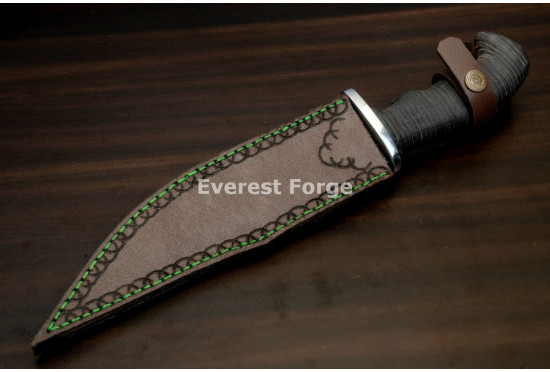


- Model: Bowie knives
- Product Code: HuntingBowie08
- Location: Kathmandu,Nepal
Available Options
What Is a Hunting Bowie?
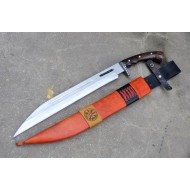
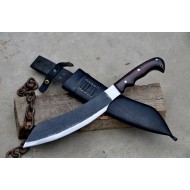
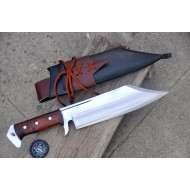
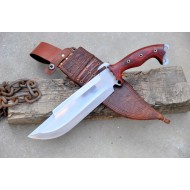
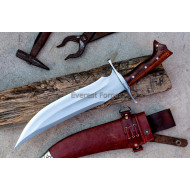
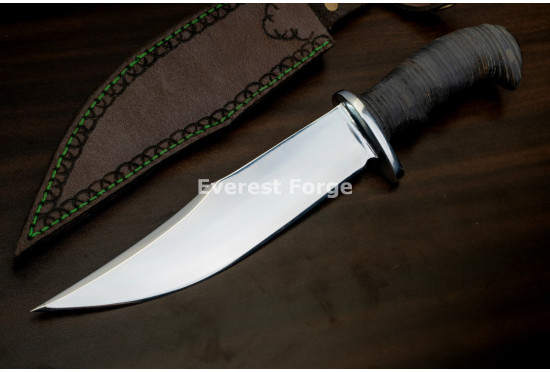
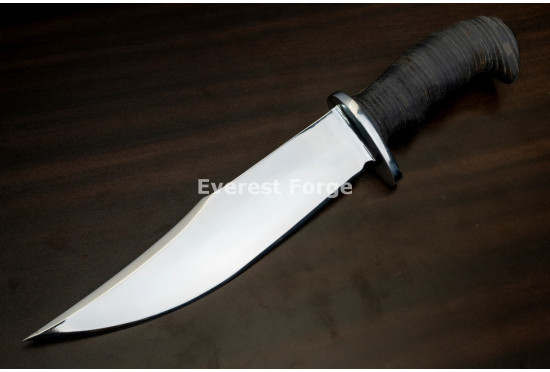
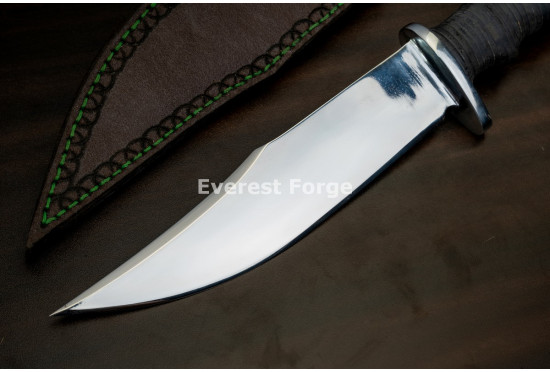
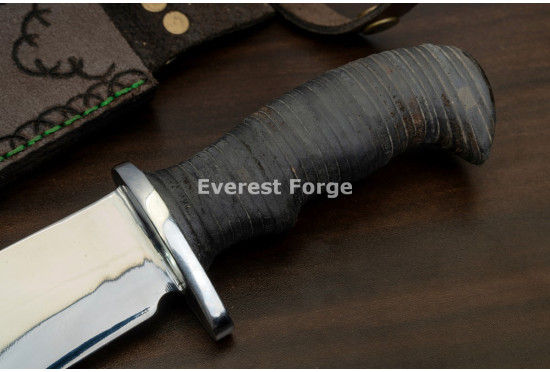
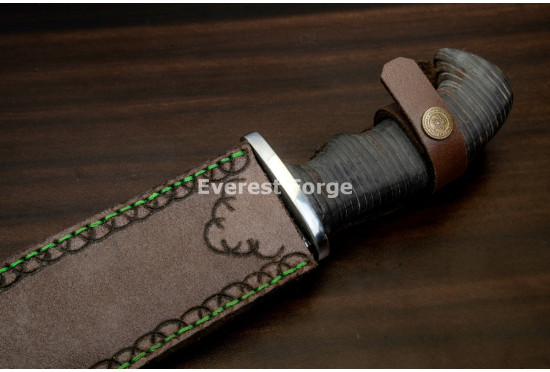
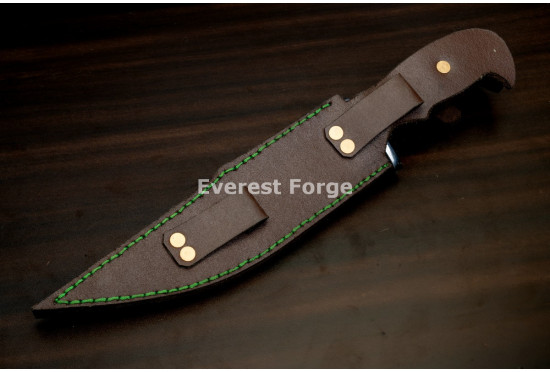
A hunting bowie is a large single-edged knife built around the work of field dressing an animal: a long sweeping belly for skinning, a clip point you can control for opening without puncturing, a guard that stops the hand travelling forward on a wet pull, and a handle you can hold securely with cold or bloodied fingers. This one has an 8.5 inch mirror-polished blade, an oval steel guard, a stacked leather handle turned from compressed washers, and 13.5 inches overall. Hand-forged in Nepal from 5160 high-carbon spring steel, in a tooled leather sheath with contrast stitching and a belt loop.
The pattern is the mid-twentieth century American hunting knife rather than the antebellum Bowie proper, which is why the guard is a small oval rather than a long crossguard. It is the shape that Marble's, Western, Ka-Bar and Randall all converged on, because it is what a century of people who actually skinned things settled into. The stacked leather handle is part of that inheritance and it is the most interesting thing on the knife.
An honest note. This is a working knife and the finish is not a working finish. A mirror polish on high-carbon steel marks if you look at it, and field use will put a patina and scratches on it within a season. That is not damage and it is what the knife is for, but if you would rather it stayed looking as photographed, order the satin or forge finish at the same price and you will be far happier. Similarly, the stacked leather handle is superb in the hand and is the one component that needs your attention over the years, for reasons set out below. Neither is a reason not to buy it. Both are reasons to choose your options with the actual use in mind.
Please check your local law before ordering. At 8.5 inches this blade is above the everyday carry allowance in many jurisdictions even though it is single-edged, and rules for carrying a hunting knife in the field are frequently different from rules for carrying one in town. Some places also treat a sharpened clip, the short false edge along the top of the point, as making a knife double-edged. Ours ships with the clip unsharpened as standard for exactly that reason. Rules vary by country and, within countries, by state and province, and import rules differ again. Check yours before ordering.
Building It to Actually Use?
Tell us so. We will put a satin or forge finish on it, adjust the blade length to what you hunt, and cut the sheath for the way you carry. It costs no more and you will end up with a better knife for the job.
Specify a Working Build →Why This Knife Is Built the Way It Is
Full Specifications
Blade length, blade finish and handle material are selectable on this listing. The figures above describe the standard build as photographed; what you receive will match the options you choose at checkout. Small variations in weight, dimension and finish are normal in hand-forged work.
Build It Your Way
What This Knife Does Well, and What It Does Not
What It Is Good At
- Skinning and field dressing, which is the work the belly and the clip point were both shaped around
- Camp knife duty: food prep, cutting cord, opening feed sacks, general knife jobs
- Being held in cold and wet hands, which is what the stacked leather and the swelled butt are for
- Field sharpening. Carbon steel takes an edge back on a pocket stone in a way stainless does not
- Lasting. A stacked leather handle can be re-turned and refinished decades later
What It Is Not Good At
- Staying pretty. A mirror polish on carbon steel will patina and scratch in a season of real use
- Neglect. Carbon steel and leather both punish being put away wet; see the care note below
- Chopping and batoning. It is a knife rather than a chopper, and 8.5 inches of clip point is not a splitting tool
- Everyday town carry. At 8.5 inches it is above the ordinary allowance in many places
- Fine detail work. The blade is long for caping; a smaller knife is the better companion for that
How to Order a Custom Knife
Want a Matching Smaller Knife?
Most people who field dress seriously carry two: a larger knife for the heavy work and a short one for caping and detail. We forge pairs on the same handle pattern so they look like a set.
Commission a Pair →Who This Knife Is For
- Hunters who want a forged carbon steel blade rather than a stamped stainless one, and will maintain it
- Anyone who likes stacked leather, which almost nobody makes any more and which nothing else feels like
- Campers and outdoors buyers wanting one large knife that will do most jobs competently
- Collectors of the American hunting pattern, which is a genuine twentieth century tradition rather than a marketing category
- Buyers commissioning a pair, since this handle pattern scales down onto a caping knife cleanly
It is not for you if you want something you never have to think about, in which case a stainless production knife is the honest answer, or if you want a chopper, in which case our kukris will do that far better.
What Is Included
- The hand-forged hunting bowie, sharpened and ready to use
- A tooled leather sheath with contrast stitching, brass studs and a belt loop
- A certificate of authenticity from the workshop
- Care instructions for high-carbon steel and stacked leather
- Everest Forge manufacturer warranty against forging and material defects
Other Blades From the Everest Forge Workshop
Shipping, Returns and Care
Dispatch. Stock pieces leave the workshop within 2-3 business days. Custom builds take 4-6 weeks depending on the queue, and we will give you the honest date rather than an optimistic one.
Shipping. Tracked worldwide by DHL or FedEx, typically 7-14 business days in transit from Kathmandu. Customs paperwork is completed accurately and in full. Please check your own country's import rules before ordering, because a parcel seized at your border cannot be recovered.
Returns and warranty. Covered by the Everest Forge manufacturer warranty against defects in forging and materials. Custom builds made to your own specification cannot be returned for a change of mind, which is why we confirm everything in writing first.
Care. Two materials, and the same enemy: moisture left on them. Wipe the blade dry after every use and keep a light film of oil on it; high-carbon steel will spot within a day of being put away damp. The handle wants a wax or a leather dressing once or twice a year, worked in and buffed off, which keeps the washers sealed against water getting between them. Never soak the knife, never put it in a dishwasher, and do not dry it near a fire or a radiator, because rapid drying is what shrinks leather washers and loosens a stack. Store it out of the sheath. Leather holds damp against steel, and on this knife the sheath will attack the blade and the handle both.
Questions Answered
Is this actually suitable for hunting?
Yes, and we say so here because we refuse the description on some of our other knives. A knife for field dressing has to be held several different ways: a full grip for the long pulls, a pinch on the blade for fine work around the head, choked up for joints, reversed for opening skin without going into the gut. That is why we tell buyers our ringed knives are not hunting knives, whatever their shape suggests, and why we point hunters at this instead. There is nothing on this knife that locks your hand into one position. The guard stops you sliding forward and otherwise stays out of the way, the handle is round enough to rotate in the palm and shaped enough to index, and the belly does the actual work. It is the pattern a century of people who skin things converged on, and that is a stronger recommendation than anything we could write.
What is a stacked leather handle, and how is it made?
It is not leather wrapped around something. The handle is built from a stack of leather washers, each punched with a hole in the middle, driven onto the tang one after another under real compression, and then locked at the butt so the whole column is squeezed solid. Once it is tight, the stack is turned and shaped exactly as though it were a single piece of timber, which is why the finished handle has a continuous shape with the layer lines running across it. The reason it was used on knives from Marble's onward, and on most military knives of the last century, is that it does three things at once. It grips better wet than dry, because leather swells slightly and the exposed end grain of every washer bites. It does not go cold in the hand at low temperatures the way steel or dense timber does. And it absorbs shock, so a hard cut does not ring through into your palm. Almost nobody makes it now because it is slow, and that is the only reason.
Will the leather handle wear out or come loose?
Not if you look after it, and it is repairable if it does, which is more than most handles can claim. What loosens a stack is water getting between the washers and then drying out fast: the leather swells, then shrinks past where it started, and the column is no longer under compression. So the rules are simple. Do not soak it, do not leave it wet, and above all do not dry it quickly near a fire or a radiator. Wax or dress it once or twice a year and it will outlast you. If a stack ever does slacken, it can be tightened at the butt and, if it is far gone, the handle can be turned down and refinished or the washers replaced entirely without touching the blade. Genuine 1940s stacked leather knives are still in service with their original handles, which tells you most of what you need to know.
What does the clip point do?
The clip is the section where material has been taken off the spine as it approaches the tip, leaving a concave or straight sweep instead of a full-thickness back. Two things follow from it. The point drops toward the centreline of the blade, which puts it much closer to the axis your wrist rotates around and makes it far easier to steer accurately, and that matters enormously when you are opening a hide and trying not to go through what is underneath. And it removes mass from the front of the blade, which quickens the knife in the hand without shortening it. The trade is that a clipped tip is thinner than an unclipped one and therefore easier to break if you pry with it. On a hunting knife that is the right trade; on a digging tool it would not be.
Is the clip sharpened?
Not as standard, and that is a deliberate decision rather than an oversight. A sharpened clip is a false edge, and in a number of jurisdictions any knife with a sharpened edge on the back of the point counts as double-edged, which puts it into a much more restricted legal category regardless of how the rest of the blade is ground. Since almost nobody hunting needs a sharpened clip, we leave it blunt by default and let buyers who want it ask. If you do want it sharpened, say so at checkout, and please check what it means where you live first. We would rather have that conversation than have a parcel stopped at your border.
Why does the blade have so much belly?
Because belly is what skins. The curved section of an edge is the part that can follow a contour, and an animal is nothing but contours, so a knife with a long straight edge and a small curve at the front spends most of a skinning job with only an inch of steel in contact. A deep sweeping belly puts a continuously changing part of the edge into the work as you draw it, which cuts more cleanly, keeps the point away from the hide, and lets you work with the flat of the blade following the shape rather than fighting it. It is the single feature that most reliably separates a knife designed for hunting from one designed for fighting, and if you are ever choosing between two knives for field work, compare their bellies before anything else.
How do I clean it after field use?
Promptly, and this is the part most people get wrong on a carbon steel knife with a leather handle. Blood is salty and mildly acidic, and left on high-carbon steel overnight it will etch a permanent grey shadow into a polished blade. So wipe the blade down in the field with whatever you have, and properly clean and oil it the same day. For the handle, wipe rather than wash: a damp cloth and then a dry one, working across the layer lines rather than along them. Do not run the knife under a tap, do not soak it, and never leave it to dry near heat, because that is what shrinks the washers. Once a season, oil the blade properly and put a wax or leather dressing through the handle. This is the honest cost of carbon steel and leather, and it takes about two minutes a day of use.
Is it a bowie?
Reasonably, though the word covers a great deal of ground. There has never been an agreed definition, and the knives associated with Jim Bowie and his imitators varied enormously in size, guard and blade shape. What most people mean by a bowie today is a large single-edged knife with a clip point and a guard, and this is that. What it is more precisely is the twentieth century American hunting pattern that grew out of the bowie tradition: the same clip point and belly, scaled to something you can actually carry and use, with a small oval guard rather than the long crossguard an antebellum bowie usually carries. If a crossguard is what you picture when you hear the word, our crossguard bowie is closer to it.
Is a knife this size legal where I live?
We cannot answer that for you. At 8.5 inches this blade is above the everyday carry allowance in a good many places even though it is single-edged, and rules for carrying a hunting knife in the field while lawfully hunting are frequently quite different from rules for carrying one in a town. If you order the sharpened clip, some jurisdictions will treat the knife as double-edged and restrict it much more heavily, which is why we leave it blunt as standard. Import rules differ again from carry rules. Check all of it for your own address, and if length is the obstacle, a 6 or 7 inch build costs no more and is a more practical size for most game anyway.
What steel is it, and how is it heat treated?
5160 high-carbon spring steel, the same stock our smiths use for kukris and swords, forged down from leaf spring in the Nepali tradition. It is oil-quenched and then tempered back, giving a blade that holds a working edge but stays tough rather than brittle. For a hunting knife the practical advantage over stainless is sharpening: carbon steel takes a keen edge quickly and brings it back on a pocket stone at the end of a long day, where many stainless alloys need more equipment and more patience. The trade is that it is not stainless, it will take a patina, and it will rust if you leave it wet.
Should I get the mirror polish or a working finish?
If the knife is going to be used, take the satin or the dark forge finish. Both cost the same. A mirror polish is bare steel taken through progressively finer abrasives until it stops scattering light, so there is nothing between the steel and the air, and on carbon steel every fingerprint, every wipe and the first contact with blood leaves a mark. After one season of real hunting the polished blade will look like a used knife, which is honest but is not what the photographs promised. A satin finish hides handling almost entirely and a forge finish hides it completely, and neither affects cutting in any way. The polish is the right choice for a display piece or a gift, and the wrong one for a pack.
Will my knife look exactly like the photographs?
Close, but not identical. The blade profile is drawn out by eye against a pattern and the clip and belly are ground by hand, so the exact sweep varies a little. The handle varies more: leather washers differ in colour and density from hide to hide, so the banding through a stacked handle is genuinely individual, and the shape is turned by hand. What does not vary is the specification: length, steel, construction, heat treatment and sharpness are held to the same standard on every piece. Our kukri machete page explains in more detail what can and cannot differ between two blades from the same bench.
| Specification | |
| Blade: | 8.5 inches. Hand forged from 5160 carbon steel |
| Total Length: | 13.5 inches |
| Handle: | 5 inches, stacked leather washers compressed on the tang and turned to shape with a swelled butt, oval steel guard |
| Weight: | 400 grams the knife, 570 grams with the sheath |
| Note: | As each piece is forged, ground and fitted by hand, slight variation in weight, dimensions and finish may occur. Wipe after handling, not just after use - fingerprints etch a polished surface over time. |