Menu
Your Cart

Hand-Forged Bollock Dagger, Twin Fullers

Hand-Forged Bollock Dagger, Twin Fullers
$174.99
Ex Tax: $174.99
  • Model: Bollock Dagger
  • Product Code: Bollock16
  • Location: Kathmandu,Nepal

Available Options

What Is a Twin Fuller Bollock Dagger?

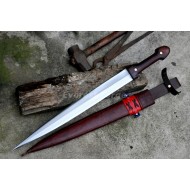
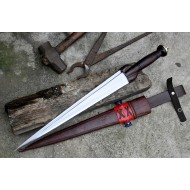
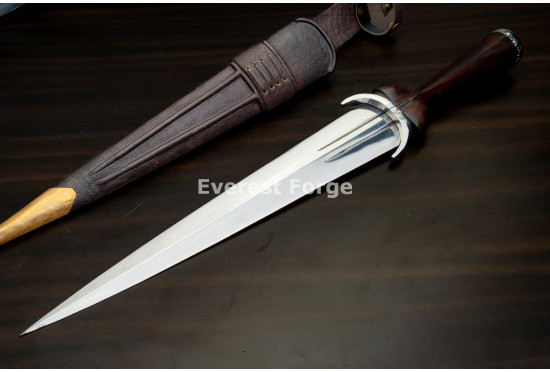
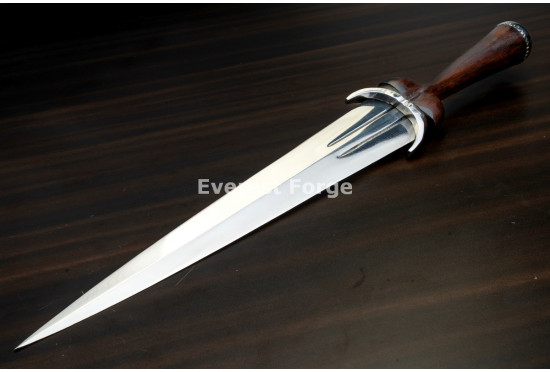
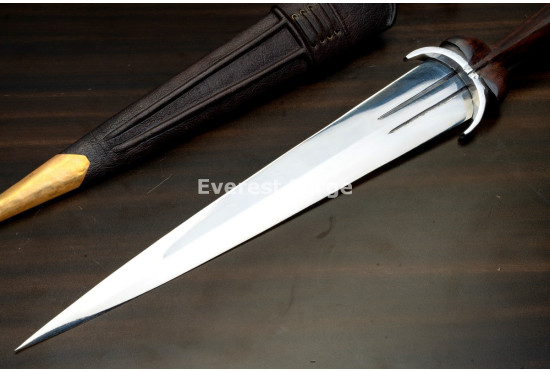
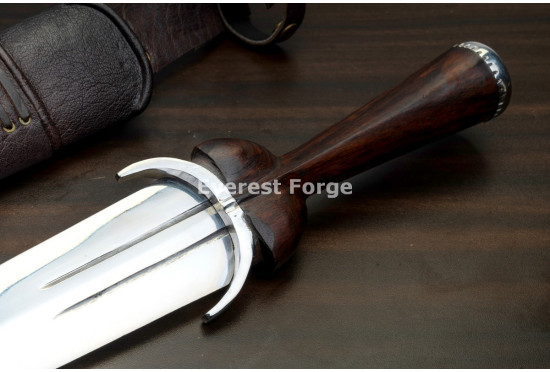
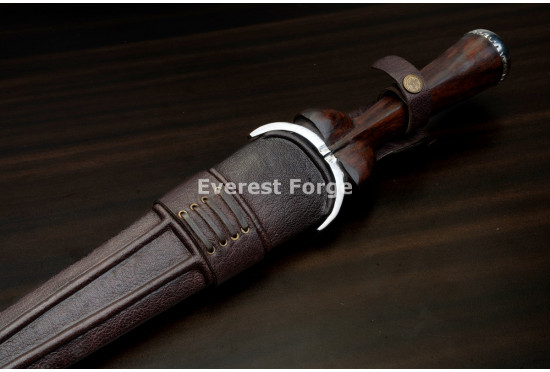
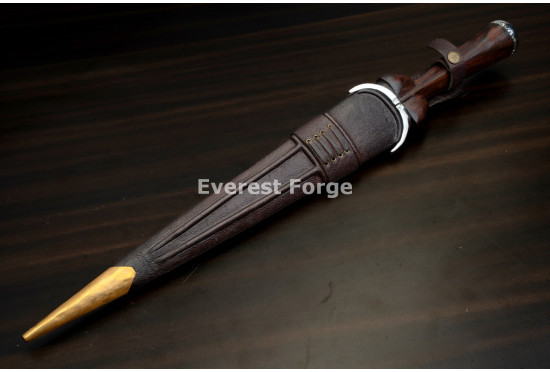
A bollock dagger is guarded by a pair of rounded lobes at the base of the grip rather than by a crossguard, a form carried across Northern Europe from roughly 1300 to 1600. This one takes that hilt and puts it on a long broad blade: 16 inches, double-edged, with a pair of short fullers cut into the forte and a fine even taper to the point. The grip is straight-tapered timber with the lobes carved from the same block, closed at the butt with a fitted metal cap, and a polished steel crescent sits at the blade shoulder. It runs to 23 inches overall, hand-forged in Kathmandu from 5160 high-carbon spring steel, in a wet-moulded leather scabbard with a long brass chape.

It is the largest of the three bollock daggers we build, and the one that sits furthest from a working sidearm. That is stated plainly rather than left for you to work out, and there is a routing question below telling you which of the three you actually want.

An honest note. Two things. The steel crescent at the blade shoulder is our smiths' addition and not a period feature; a genuine bollock dagger has no guard at all beyond the two lobes, and that absence is the definition of the type. We will build it without at no extra cost, and for a reenactor that is the version to order. The 16 inch blade is also well beyond the surviving range, which ran mostly between six and twelve inches. Neither makes it a worse object, but both make it an interpretation rather than a reproduction, and our period bollock dagger is the accurate build.

Please check your local law before ordering. This is a double-edged fixed blade of 16 inches, and both facts carry legal weight. Many jurisdictions treat double-edged daggers as a restricted category in their own right regardless of size, and length thresholds apply on top; at 16 inches this will be regulated as a sword or a bladed weapon rather than a knife in a great many places. Import rules differ again from carry rules. If the second edge is the obstacle we will sharpen one side and leave the other blunt at no extra cost.

Custom Forge

Want the Period Build Instead?

No crescent, a plain butt, a shorter blade and lobes carved as the originals were. It costs nothing extra and it is what we would recommend for reenactment or serious collecting.

Specify a Period Build →

Why This Dagger Is Built the Way It Is

Twin Forte FullersTwo short grooves cut into the base of the blade rather than running its length. Placed where the steel is thickest and contributes least, and stopped before the taper begins.
Carved LobesThe two swellings are cut from the same block as the grip, which is how the originals were made. They are the guard, and they work in both directions; see the first question below.
Distal TaperThe blade thins in thickness as well as width from the forte to the point. On a 16 inch blade this is what stops it feeling like a bar of steel.
Capped ButtA fitted metal cap closes the end of the grip, protecting the end grain and adding a little weight behind the hand.
5160 Spring SteelOil-quenched and tempered back. Toughness matters on a long thrusting blade, because a thrust that lands off-line loads it sideways.
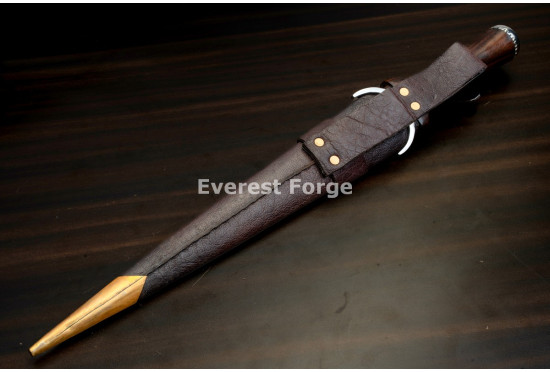
Wet-Moulded ScabbardLeather formed damp around the blade so it dries to shape and grips by fit, with a long brass chape at the point.

Full Specifications

TypeBollock dagger, twin forte fullers, interpretive build
Blade Length16 inches
Handle Length7 inches
Overall Length23 inches
Blade Steel5160 high-carbon spring steel, oil-quenched and tempered
Blade ProfileBroad at the forte, double-edged, long even taper to a fine point
FullersTwo short grooves at the forte, stopped before the taper
GuardTwo carved lobes, with a fitted steel crescent at the blade shoulder
GripStraight-tapered timber with the lobes carved from the same block
ButtFitted metal cap with a decorated rim
Blade Weight830 g
ScabbardWet-moulded leather with a laced throat panel and a long brass chape
SharpnessShips working sharp on both edges, hand-finished on stones
OriginHand-forged in Tokha-3, Kathmandu, Nepal

Blade length, blade finish and grip material are selectable on this listing. The figures above describe the standard build as photographed; what you receive will match the options you choose at checkout. Small variations in weight, dimension and finish are normal in hand-forged work.

Build It Your Way

No CrescentThe steel guard omitted, which is what a surviving bollock dagger actually looks like. No extra cost and the right call for reenactment.
Blade LengthShorter at 10 or 12 inches, which is inside the historical range and inside far more legal allowances. The taper is redrawn rather than scaled.
Single-Edged BladeOne edge sharpened and the other left blunt. Requested most often for legal reasons and it changes nothing about the look.
Grip MaterialWalnut and boxwood are closer to what a medieval maker would have used. Water buffalo horn is available and raises no CITES question.
Plain ButtThe metal cap omitted and the timber left shaped, which is the period arrangement on most surviving examples.
Blade FinishPolished as photographed, satin, or an antiqued finish that reads closer to an excavated piece.

What This Dagger Does Well, and What It Does Not

What It Is Good At

  • Display. At 23 inches with a mirror polish it is the most imposing dagger we build
  • Thrusting, which is what the fine taper and the stiff forte are arranged around
  • Handling better than its length suggests, thanks to a genuine distal taper
  • Costume and film work, where a medieval silhouette needs to read at distance
  • Showing grinding. Twin fullers on a tapered blade are difficult to cut evenly

What It Is Not Good At

  • Historical accuracy. Sixteen inches is well beyond the surviving range and the crescent is ours
  • Utility work. A double-edged blade cannot be gripped by the spine or used against a board
  • Carry. At 16 inches and double-edged it is outside ordinary knife allowances almost everywhere
  • Prying or levering. The point is fine by design and will bend
  • Low maintenance. Mirror-polished carbon steel marks if you look at it

How to Order a Custom Dagger

Decide first between this and the period build. They are different objects and the routing question below sets out which is which.
Pick your remaining options on this page, or use the custom forge form for anything outside them.
Tell us your jurisdiction if the length or the double edge is a concern, and we will build accordingly at no extra cost.
We confirm the specification in writing and quote before any steel is cut. Nothing is charged until you agree it.
Our smiths forge and grind the blade, cut the fullers, carve the hilt to the tang, then wet-mould the scabbard to the finished piece.
It ships tracked by DHL or FedEx from Kathmandu, with the customs paperwork made out correctly for your country.
The Three

Period, Fantasy or This One?

We build the bollock hilt three ways: an accurate 13 inch period piece, a 17 inch fantasy build with steel lobes, and this 16 inch interpretation with carved lobes and twin fullers.

See the Period Build →

Who This Dagger Is For

  • Display and collection buyers who want the bollock form at maximum scale
  • Buyers who look at grinding, since twin fullers on a tapering blade are the hardest cut here
  • Costume and film buyers needing a medieval silhouette that reads from across a room
  • Collectors of the form completing a set alongside the period and fantasy builds
  • Anyone commissioning a period piece, since every modern feature here can be specified out

It is not for you if you want historical accuracy, in which case take the period build, or something to carry and use, in which case any of our single-edged knives will serve you better and be legal in more places.

What Is Included

  • The hand-forged bollock dagger, sharpened and ready for display or use
  • A wet-moulded leather scabbard with a laced throat and a long brass chape
  • A certificate of authenticity from the workshop
  • Care instructions for high-carbon steel and polished finishes
  • Everest Forge manufacturer warranty against forging and material defects

Other Blades From the Everest Forge Workshop

Bollock Dagger, Fluted PommelThe accurate period build, 13 inches →
Bollock Dagger, Steel Lobed HiltFantasy build, 17 inches, steel lobes →
Quillon Dagger, Barrel PommelThe plain knightly sidearm →
Parrying Dagger, Side RingRenaissance companion to a rapier →

Shipping, Returns and Care

Dispatch. Stock pieces leave the workshop within 2-3 business days. Custom builds take 4-6 weeks depending on the queue, and we will give you the honest date rather than an optimistic one.

Shipping. Tracked worldwide by DHL or FedEx, typically 7-14 business days in transit from Kathmandu. Customs paperwork is completed accurately and in full. At 16 inches and double-edged, this piece attracts more import scrutiny than an ordinary knife; please check your own country's rules before ordering.

Returns and warranty. Covered by the Everest Forge manufacturer warranty against defects in forging and materials. Custom builds made to your own specification cannot be returned for a change of mind, which is why we confirm everything in writing first.

Care. Mirror-polished high-carbon steel is the least forgiving finish we sell, and our wheel pommel dagger page explains why in detail. Wipe the blade after every handling and keep a light film of oil on it, paying attention to the inside of both fullers, which are channels a cloth drawn along the flat never properly reaches. Oil the timber once or twice a year and feed the scabbard leather at the same interval, keeping conditioner off the steel and off the brass chape. Do not store the dagger sheathed for long periods; leather holds damp against steel.

Questions Answered

What do the lobes actually do?

More than people assume, and they work in two directions rather than one. The obvious job is the same as a crossguard's: they stop the hand travelling forward onto the blade when a thrust lands and stops dead. But because they sit as a pair on either side of the grip rather than as a bar across it, they also do something a crossguard cannot. They tell your hand which way the blade is facing. A bollock hilt is asymmetric front to back, with the lobes swelling toward the blade and the grip tapering away behind them, so your fingers register the orientation of the edges instantly and in the dark. On a double-edged blade with no spine to lay a thumb along, that matters more than it sounds. The third job is the least glamorous and the most used: they stop the dagger sliding through a belt or a scabbard throat when it is worn, which is why the form survived for three hundred years on civilian belts rather than only in armouries.

Which of your three bollock daggers should I buy?

Answer this by what you want it to be rather than by which looks best in a photograph, because the largest one always wins on a screen. Take our Bollock Dagger, Fluted Pommel if accuracy matters: 13 inches, lobes and butt carved from one block of timber, and the build we would put in front of a reenactor or a collector. Take our Bollock Dagger, Steel Lobed Hilt if you want the fantasy version: 17 inches with the lobes forged in polished steel and drawn to points, which no medieval smith made and which looks superb on a wall. Take this one if you want something between the two: carved timber lobes as the originals had, at a size the originals never reached, with twin fullers and a capped butt that neither sibling carries. It is the most decorated of the three in the grinding rather than in the fittings.

Why are the fullers short and only at the base?

Because that is the only part of this blade where a fuller does any good. A fuller removes steel from the middle of the blade's thickness, where it contributes least to stiffness, and the more thickness there is to work with the more you can safely take. On a blade that tapers as steadily as this one, the thickness runs out quickly: by the middle the steel is already thin enough that a groove would start eating into stiffness rather than surplus, and near the point it would be actively weakening the part most likely to be loaded sideways. So the fullers are cut into the forte, the broad heavy section just ahead of the hilt, and stopped before the taper properly begins. Two short grooves rather than one wider one is partly aesthetic and partly structural, since it leaves a rib of full-thickness steel down the centre between them. It is also considerably harder to cut, because both grooves have to start and stop at the same points on both faces or the blade looks crooked.

What is distal taper, and how do I check it?

It is the thing that separates a long blade you can hold from a long blade that feels like a crowbar, and hardly anybody selling knives mentions it. Every blade tapers in width toward the point, which you can see. A good one also tapers in thickness, getting progressively thinner from the forte to the tip, and that you have to look for. The effect is out of all proportion to the amount of steel involved: mass removed near the point has far more influence on how a blade swings than the same mass removed near the hilt, so a properly tapered 16 inch blade handles like a shorter one while a blade of even thickness feels dead and nose-heavy no matter how light it is overall. The test takes two seconds. Sight along the spine from the hilt end, or lay the blade flat and look at it edge-on: the thickness should visibly reduce as your eye travels toward the point, smoothly, without steps. Do this on any long blade you are considering, from any maker. A blade with no distal taper has been cut from bar stock rather than forged and ground, and it will never feel right.

Is the steel crescent a period feature?

No, and it is our addition rather than a historical one. Bollock daggers have no guard beyond the two lobes, and that absence is what defines the type, so no surviving example carries a langet like this. It is well made and it does the blade no structural harm, but if you are buying for accuracy you should order the build without it, which costs nothing extra. Our period bollock dagger page sets the point out in full and is the correct build for reenactment.

Is it sharpened on both edges?

Both edges as standard. The blade is broad and stiff at the forte, where the fullers are cut, and tapers evenly from there in both width and thickness to a fine point. It is ground for thrusting first and cutting second, which is what the type was for. If a double edge is a problem where you live, we will sharpen one side and leave the other as a blunt false edge at no extra cost, and the piece looks identical.

Can I actually use it, or is it a display piece?

It is forged, hardened, tempered and sharpened, so it is a functional weapon rather than a wall-hanger. But be realistic about what a 16 inch double-edged dagger is for. It has no crossguard worth the name, so it is not a fencing piece; it is too long and too finely pointed for any utility job; and the double edge means you cannot put a thumb on the spine or choke up on the blade. What it does well is thrust, and what it does best is hang on a wall and look considerably more serious than most things hanging near it. Most buyers display it, which is a perfectly good reason to own it. If you want something to work with, buy one of our single-edged knives.

Is a blade this long legal where I live?

We cannot answer that for you and you should be wary of any seller who claims they can. Two provisions tend to apply. Many jurisdictions treat double-edged daggers as their own restricted category regardless of size, and blade length thresholds then apply independently on top. At 16 inches this sits well above the ordinary knife allowance, which in a good many places means it is regulated as a sword or a bladed weapon rather than as a knife, with different rules and different penalties. Import rules are frequently different again from possession and carry rules. Check all three for your own address before ordering. If length is the obstacle, a 10 or 12 inch build costs no more and is inside the historical range anyway.

Why is it called a bollock dagger?

Because of the obvious resemblance of the two lobes, and the name is not a modern joke; it appears in period inventories as a plain description. The Victorians, who catalogued most surviving collections, substituted "kidney dagger", which is why both terms are still in circulation. Modern museum practice has largely gone back to the original. Our period bollock dagger page covers the naming history and the form's three centuries of use in full.

What steel is it, and how is it heat treated?

5160 high-carbon spring steel, the same stock our smiths use for kukris and swords, forged down from leaf spring in the Nepali tradition. It is oil-quenched and then tempered back, giving a blade that holds an edge but stays tough rather than brittle. Toughness matters particularly on a blade this long and this finely tapered: a thrust that lands off-line loads it sideways, and that is exactly where a hard, brittle steel snaps and a properly tempered one flexes and returns. It is not stainless and it will take a patina with use.

Is the mirror polish hard to look after?

Yes, and on this piece there is a great deal of it. A mirror polish is bare steel taken through progressively finer abrasives until the surface stops scattering light, so nothing sits between the steel and the air and a fingerprint left on carbon steel will etch in within days. The fullers make it slightly worse, because a groove holds moisture that a cloth drawn along the flat skips over. Satin costs the same, hides handling almost entirely, and on a piece this size is arguably the more sensible choice. Our wheel pommel dagger page explains the finish in detail.

Will my dagger look exactly like the photographs?

Close, but not identical. The profile is drawn out by eye against a pattern, the taper is ground by hand in both width and thickness, and the fullers are cut individually so their exact length and where they stop varies a little from piece to piece. The hilt is carved to its own tang and timber differs board to board in colour and figure. What does not vary is the specification: length, steel, construction, heat treatment and sharpness are held to the same standard on every piece. Our kukri machete page explains in more detail what can and cannot differ between two blades from the same bench.

Specification
Blade: 16 inches. Hand forged from 5160 carbon steel
Total Length: 23 inches
Handle: 7 inches. Straight-tapered timber with carved lobes and a fitted cap
Weight: 830 grams the dagger
Note: handmade variation in weight, dimensions and finish may occur; keep blade lightly oiled when not in use

Write a review

Note: HTML is not translated!
Bad Good
Captcha