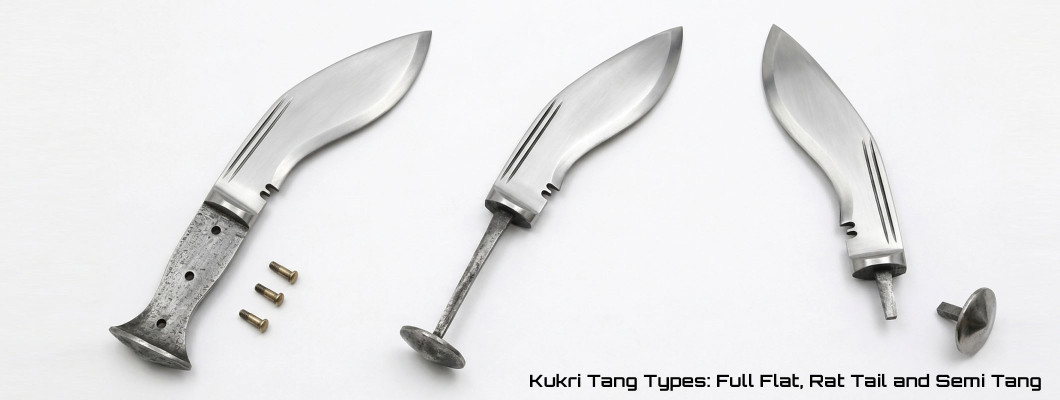
Kukri Tang Types: Full Flat, Full Rat Tail and Semi Tang Explained
The tang is the part of the blade you cannot see, and it decides whether a khukuri survives a decade of chopping or comes apart in a season. Take the handle away and the three common constructions look nothing alike. Put it back on and two of them become impossible to tell apart, and the difference between those two is the one that matters most.
This guide shows what sits under the handle of each tang type, how the butt of each is fixed, what laha is and why it matters, how screw rivets and threaded fittings compare to traditional peening, and how to work out what you actually have in your hand.
What Is Under the Handle: Three Kukris With the Handles Taken Away
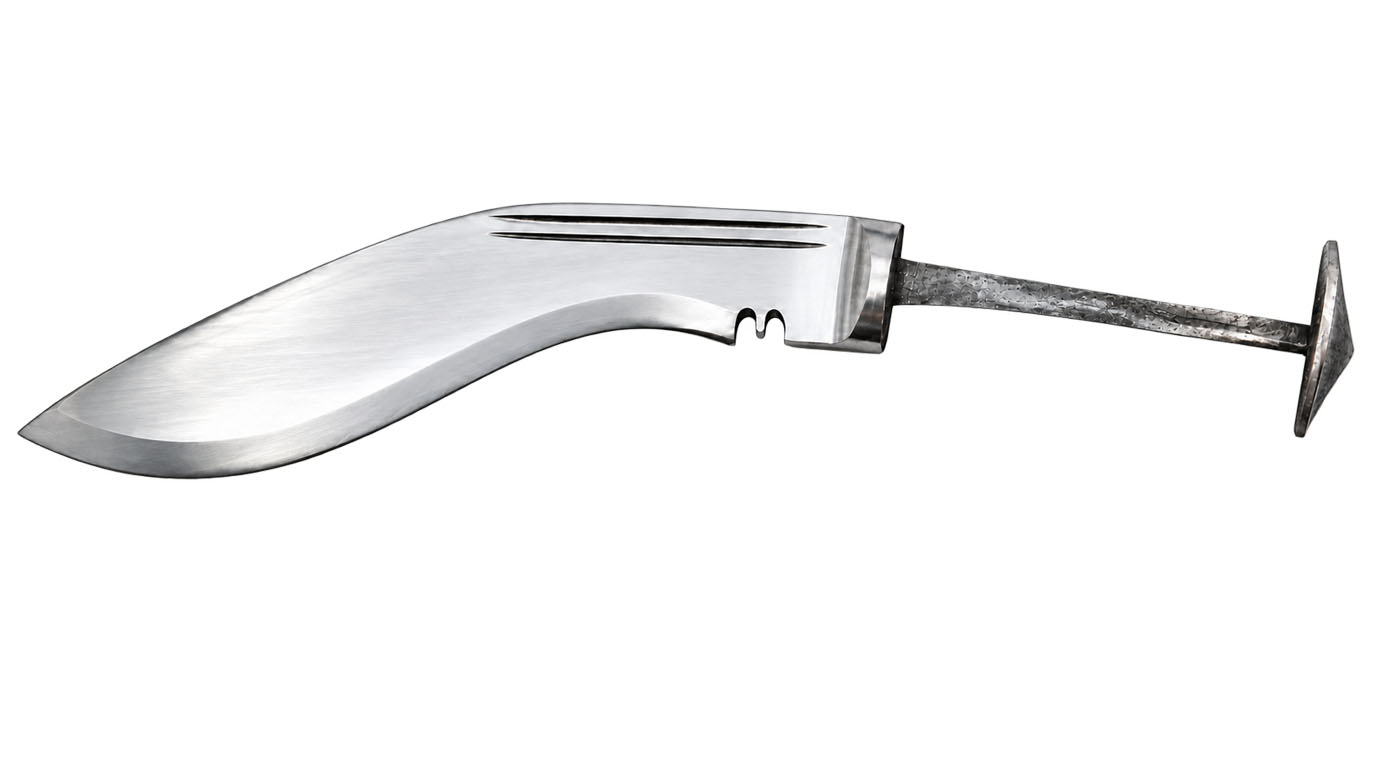
The image at the top of this page is the whole argument in one picture. Each khukuri below is shown without its handle, so you can see the steel that a finished grip hides. Look at where the steel goes, where it stops, and what the butt is attached to. Those three things decide how the knife behaves when it hits wood.
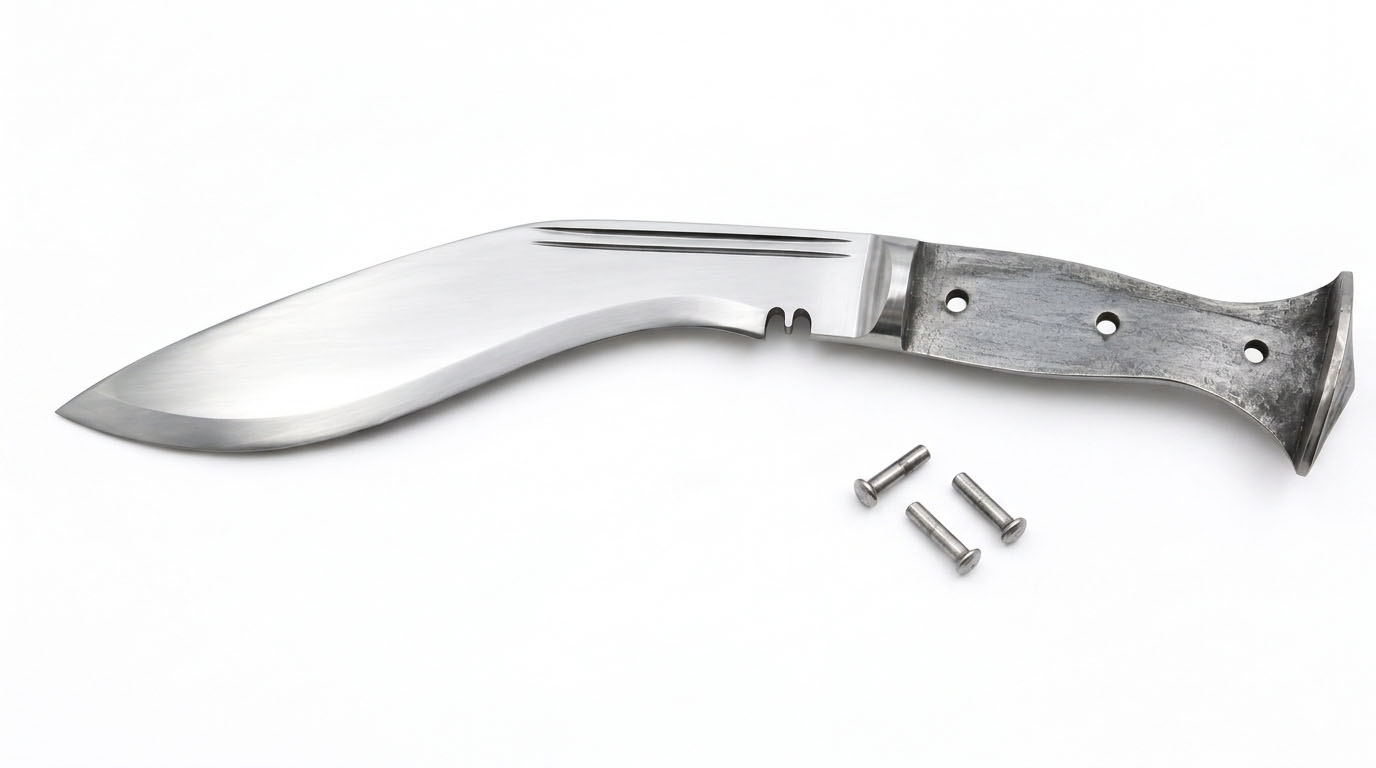
Full Flat Tang (Panawal)
The steel is the handle. The tang is as wide as the grip and runs its full length, so the shape you hold is already there in steel before any wood or horn goes on. The scales are only a covering.
The butt is part of the blade. At the end of the tang the steel flares out into the butt, forged from the same bar rather than fitted afterwards. There is no joint at the back of the handle, so there is nothing there to work loose.
Rivets clamp the scales. The three holes along the tang take the rivets that pass through one scale, through the steel and out through the other. Every rivet ties the handle to the blade along the whole grip, not just at one end.
What that means in use. The shock of a chop travels straight down the steel into your hand, with nothing to loosen and nothing to snap. It is the heaviest of the three, and the one you can check by looking: steel along both edges of the grip and rivet heads on the sides.
Full Rat Tail Tang (Paro)
A narrow bar all the way through. Behind the bolster the steel narrows into a bar that runs the entire length of the handle. The handle is a solid piece of wood or horn, drilled through and slid over it.
The tang reaches the chapri. At the far end the bar passes through the butt cap and is peened, hammered over so it spreads into a rivet head against the cap. Blade, tang and chapri become one continuous line of steel.
The handle is squeezed, not just glued. With the bolster pressing at the front and the peened chapri pressing at the back, the handle is clamped between two pieces of steel that are both part of the blade. Adhesive fills the gaps and stops the handle turning, but the peen is what holds it together.
What that means in use. Less steel in the grip makes the knife lighter and moves the balance forward, which is what makes a kukri chop the way it should. It is the traditional Nepali construction and the one used on Gurkha service patterns.
Semi Rat Tail Tang
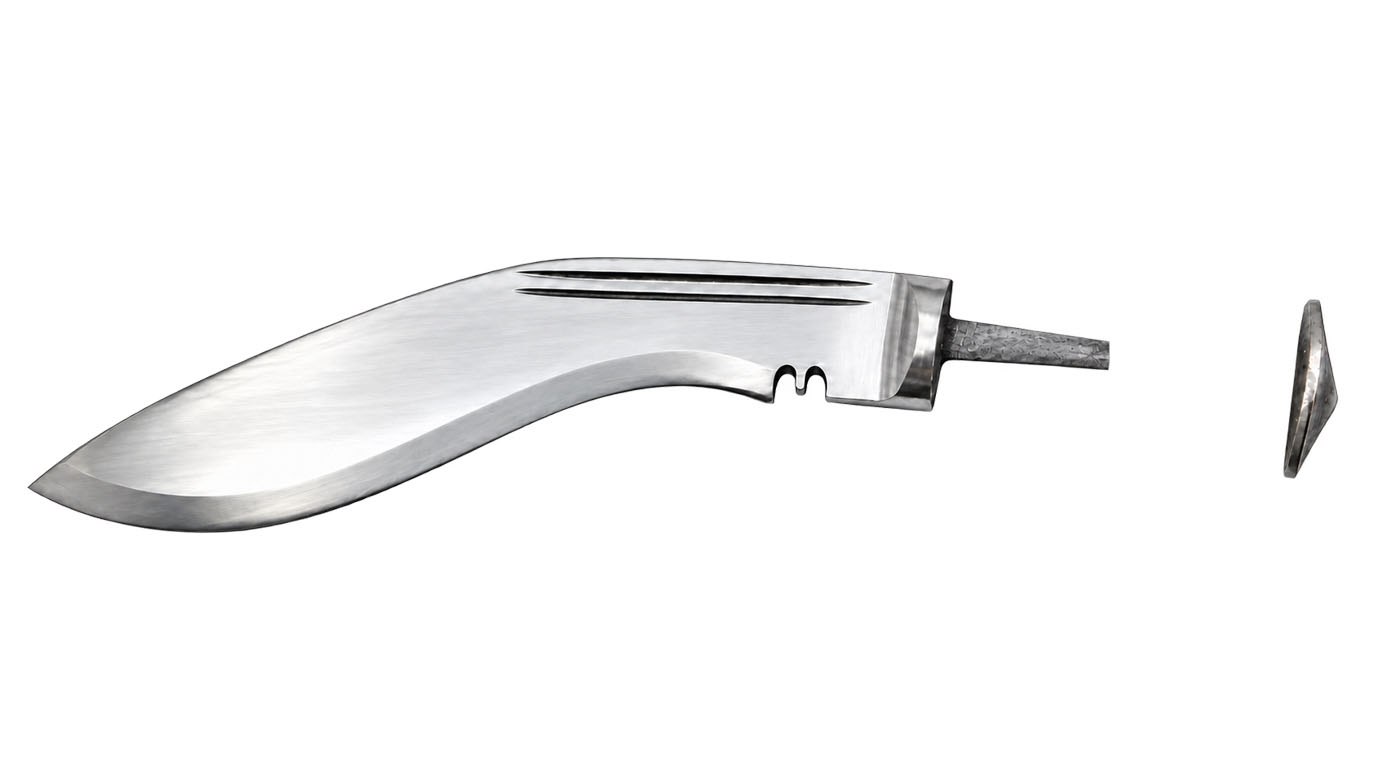
A short stub, then nothing. The steel leaves the bolster and stops after a short distance, well inside the handle. Most of the grip has no steel in it at all.
The butt cap stands alone. Look at the gap between the end of the tang and the chapri. The cap is a separate part, fixed into the back of the handle, and the blade never reaches it. Nothing can be peened, because there is no steel at the butt to peen.
Adhesive does all the work. The blade is held in the handle only by the glue around that short stub. Every chop tries to lever the stub out, and the only thing resisting it is the bond in one short hole.
What that means in use. It is the lightest of the three and fine for display. Under sustained chopping the stub works loose, often while the butt cap still looks perfectly tight.
Once the handles go on, the full rat tail and the semi rat tail look the same. Same bolster, same solid grip, same metal butt cap. One has steel running all the way to the back; the other has a gap you cannot see. Everything else in this guide follows from that.
The Three Constructions
Full flat tang, known in Nepal as panawal and the construction behind product names like Panawal Angkhola and Panawal Sirupate. The steel runs the full width and the full length of the handle, and the butt is forged into the end of the tang itself, flared so the hand cannot slide off. Handle scales sit on either side and are clamped through the tang with rivets. You can see the steel along the top and bottom edges of the grip, and you can see the rivet heads. This is the strongest of the three and the heaviest.
Full rat tail tang, the paro. A narrow tang, usually square or round in section, running the entire length of the handle and emerging at the butt, where it passes through the chapri and is hammered flat over it. The handle is a solid piece drilled through rather than two scales. Lighter than a panawal, traditional, and considerably stronger than most people assume.
Semi rat tail tang. A short tang that goes only partway into the handle and stops. The butt cap is a separate part with a short stub of its own, set into the other end of the handle. The two pieces of steel never meet, and nothing mechanical joins the blade to the butt. What holds the knife together is the adhesive in two separate holes and the handle material between them. Lighter again, and the weakest by a wide margin.
The full rat tail and the semi rat tail are the pair that matters. Both have a solid handle with no visible steel, no rivets and a metal butt cap. From the outside, in a photograph, they are indistinguishable. One is a traditional construction that has served Gurkha soldiers for two centuries. The other will fail under sustained chopping.
The Chapri: What Holds Each Kukri Together at the Butt
This is the part almost no guide explains, and it is where the whole argument lives. The butt of a khukuri is fixed in three completely different ways.
Full rat tail: the chapri is structural. The tang passes through the handle and out through the chapri — the butt cap, usually brass or steel — and the protruding end is peened: hammered so that it spreads and flattens into a rivet head against the cap. That puts the whole handle under compression. The bolster presses against the blade shoulders at one end, the chapri presses back at the other, and the handle material is clamped tight between them. The handle is not glued on. It is squeezed on, by the steel of the blade itself.
That is a genuinely strong arrangement, and it is why a well-made rat tail kukri is not the weak compromise that Western knife forums often assume. It is also why kukris are traditionally measured from the centre of the butt cap where the tang is peened over, straight to the point — the peen is treated as part of the blade rather than an attachment.
Full flat tang: there is no joint at the butt at all. On a panawal khukuri the flared butt is the end of the tang, forged from the same steel as the blade. Nothing is fitted there, so nothing can work loose there. The rivets through the scales do the job along the whole length of the grip.
Semi rat tail: the chapri is anchored to the handle, not to the blade. The butt cap has its own short spike, glued into the back of the handle while the blade stub is glued into the front. Between the two there is a length of wood or horn and nothing else. Every chop loads that gap. A semi tang kukri can keep a perfectly tight butt cap on a handle that has already come loose from the blade — and from the outside it looks exactly like a peened paro.
A better adhesive does not change that. Epoxy makes a semi tang last longer than laha does. It does not turn two separate stubs into one piece of steel.
What Sets the Tang in the Handle: Laha, and What Replaced It
The peen holds a rat tail mechanically. Something else has to fill the cavity around the tang and stop it rotating inside the grip, and this is where traditional and modern practice diverge.
Laha is the traditional answer. A resin-based adhesive made from natural materials, warmed until workable, packed into the handle cavity around the tang and left to set hard. It has been used in Nepal for generations and it works — kukris a century old are still tight on laha.
It has one real weakness: laha softens with heat. A kukri set with laha and left on a car dashboard, near a fire or in prolonged direct sun can work loose at the handle. It is usually re-settable by a smith, but it is a genuine limitation and one that matters more now than it did when these blades stayed in the hills. On a semi rat tail, where laha is the only thing holding the knife together, it matters most of all.
We use a two-part epoxy resin instead — Araldite standard, the same material used for structural bonding of metal, wood and masonry. It is mixed in two parts, sets in roughly eight hours and reaches full strength at about twenty-four, and the cured bond is tough, heat resistant and water resistant in a way laha is not.
Why it matters to you as an owner. A kukri set with epoxy will not loosen because it spent a summer in a shed or a day in a hot vehicle, and moisture cannot creep into the handle cavity and corrode the tang where you cannot see it. For a blade that will be carried, used outdoors and stored in whatever conditions a modern owner has, that is a real improvement rather than a cosmetic one.
It also explains part of a lead time. A handle is not finished when it is fitted. The epoxy needs a full day to reach strength before the blade can be worked on further, and that day is not negotiable on any blade we make.
Being clear about the trade: laha is the historically authentic material and there is a reasonable argument for it on a museum-accurate reproduction. Epoxy is the better material for a blade that will be used. We chose the second, and if you specifically want the first on a commissioned piece, that is a conversation worth having rather than an assumption either way.
Rivets, Screws and Threads: How the Fixings Compare
Not every kukri is peened, and not every flat tang is riveted the same way. The alternatives have real advantages and real costs.
Screw rivets on a full flat tang. A screw rivet is a threaded pin that tightens into a matching sleeve from the other side, clamping both scales hard against the tang. They hold as firmly as solid rivets, and the great advantage is that they can be undone — a cracked scale can be replaced without drilling anything out. Worth checking now and then on a blade that sees heavy use.
Solid peened rivets on a full flat tang. A plain pin hammered over at both ends. Permanent and very strong, but replacing a scale means drilling the rivets out.
Threaded tang with a nut. On a rat tail, the tang is threaded at the end and a nut is tightened down over the chapri, sometimes concealed beneath a decorative cap. The handle is under the same compression as a peened assembly, and the whole handle can be dismantled and replaced. The cost is that a nut can loosen with vibration in a way a peen cannot, so it wants checking.
Screwed pommel. A butt cap threaded onto the tang rather than peened over it. Convenient, but on a chopping blade a screw thread is a stress concentration in exactly the wrong place.
Peened tang. Permanent. Cannot loosen and cannot be serviced without cutting the handle off. For a working blade that will be used hard and rarely re-handled, this is still the right answer, which is why the Gurkha ceremonial and service patterns use it.
The honest summary: peened is stronger and permanent; threaded and screwed fixings are nearly as strong and repairable. Which is better depends entirely on whether you expect to re-handle the knife in twenty years.
The Three Compared
| Full flat (panawal) | Full rat tail (paro) | Semi rat tail | |
|---|---|---|---|
| Tang reaches the butt | Yes, full width | Yes, narrow | No. Stops partway |
| The butt | Forged into the end of the tang | Chapri fitted over the tang and peened | Separate chapri with its own stub, glued in |
| Held by | Rivets or screw rivets through the scales | The peen, plus epoxy or laha | Adhesive only |
| Blade joined to butt by steel | Yes | Yes | No |
| Visible from outside | Yes — steel edges and rivets | No | No |
| Strength | Highest | High | Lowest |
| Weight | Heaviest | Lighter | Lightest |
| Balance | Closer to the hand | More forward, favouring the chop | Most forward |
| Repairable | Yes with screw rivets. Rivets drilled out if solid | Not without cutting the handle | Re-glue, which rarely lasts |
| Traditional | Used in Nepal, and the Western standard | The historic Nepali construction | Not a traditional method |
| Suits | Hard use, batoning, survival, heavy field work | Traditional patterns, ceremonial, general work | Display and light use only |
Read the last row rather than the strength row. A full rat tail is not a cheap version of a panawal — it is the construction the Gurkha service and ceremonial patterns use, and it is lighter and better balanced for cutting. A panawal is not automatically better; it is stronger and heavier, and whether that trade suits you depends on the work.
The semi rat tail is the one to avoid in anything you intend to use, and it is the one you are most likely to be sold without knowing.
How to Tell What You Have
Five checks, in order of how much they tell you.
Look at the handle edges. If you can see a line of steel running along the top and bottom of the grip with rivet heads through it, and the butt is the same steel flaring out, it is a full flat tang. That is settled and you can stop.
Look at the centre of the butt cap. On a full rat tail you will usually see the peened end of the tang there — a small irregular flattened area, often slightly proud, sometimes filed smooth but still visible as a different metal from the cap around it. A semi tang chapri has its spike pointing inward, so its outer face is perfectly uniform. A butt cap with no mark in the centre is worth questioning.
Hold the blade and try to twist the handle. There should be no movement and no click. Any rotation at all means the tang is not held, whatever the construction is claimed to be.
Ask for a photograph of the butt. A workshop that made the blade can photograph the peen in two minutes. If the answer is vague, or arrives as a stock image, treat that as the answer.
Ask for a photograph of the bare blade before the handle is fitted. The definitive test, because it shows exactly what the image at the top of this page shows. A forge working to order has that blade in front of it before the handle goes on. A reseller never sees it.
Our guide to buying a kukri online covers the other specifications worth confirming before you order.
Which Should You Choose?
Choose a full flat tang, panawal, if you intend to baton wood, use the kukri as a survival or field tool, want maximum durability without regard to weight, or simply want to be able to see the construction rather than take it on trust.
Choose a full rat tail, paro, if you want a traditional Nepali kukri, prefer a lighter blade with the forward balance that makes a kukri chop the way it is supposed to, or are buying a ceremonial or service pattern where that construction is the correct one.
Choose a semi rat tail if the blade is for display and will never be used. There is a legitimate market for decorative pieces, and nothing wrong with one, provided you know that is what you are buying.
On our own blades the tang construction is stated on the product page rather than left to inference, and where you want a pattern in a construction it is not normally offered in, that is a custom forge request rather than an impossibility.
Looking After the Handle Junction
Whatever the construction, the handle junction is where a khukuri fails, and it is worth the small amount of attention it needs.
Check for movement before each heavy session. Hold the blade, twist the grip. No movement, no click. Stop using it the moment there is either.
Check the rivets on a panawal. Screw rivets can be nipped up with a screwdriver if they ever feel less than tight. Do not overtighten into wooden scales.
Keep water out of the junction. Moisture wicking in around the tang corrodes the steel where you cannot see it and degrades laha. Dry the area specifically after use and let a little oil sit there.
Heat matters on traditional laha-set handles. If your kukri was set with laha rather than epoxy — likely on an older or village-made blade — keep it away from dashboards, fires and prolonged direct sun, because laha softens. Epoxy-set handles are not affected.
A loose peened handle can usually be reset by a competent smith, and a threaded one can often be tightened at home. A semi rat tail that has come loose is rarely worth repairing, because there was never a steel connection between blade and butt to restore.
Our blade care guide covers the rest of the routine, including why the handle junction is one of the places corrosion starts.
Kukris and Khukuris in Panawal and Traditional Paro Construction
Every khukuri on our site states its tang construction, and the customisation options — blade length, handle material, finish — are on the product page itself. If you want a specific pattern in a specific construction, send it through custom forge and we will tell you honestly whether it makes sense for the work you have in mind.
Frequently Asked Questions
What is the difference between a full rat tail and a semi rat tail tang?
A full rat tail runs the entire length of the handle and passes through the chapri, where it is peened over to put the whole handle under compression. A semi rat tail is a short stub that stops partway inside, and its butt cap is a separate part with its own stub glued into the other end. The two pieces of steel never meet. From the outside the two constructions are indistinguishable, but one is used on Gurkha service patterns and the other will fail under sustained chopping.
What is under the handle of a semi tang kukri?
Two short pieces of steel pointing at each other. The blade has a stub that goes into the front of the handle, and the butt cap has its own stub that goes into the back. Between them is handle material and adhesive, with no steel connecting blade to butt. That is why a semi tang khukuri can keep a tight butt cap while the blade itself works loose, and why it suits display rather than use.
What is a panawal kukri or khukuri?
Panawal is the Nepali term for full flat tang construction. The steel runs the full width and length of the handle and ends in a flared butt forged from the same bar, with scales riveted to either side. You can see the steel along the top and bottom edges of the grip and you can see the rivets. It is the strongest of the three common constructions and the heaviest, and it is the one you can verify by looking rather than by asking.
What is the chapri on a kukri or khukuri?
The chapri is the butt cap at the rear of the handle, usually brass or steel. On a full rat tail khukuri it is structural: the tang passes through it and is peened flat against it, clamping the handle between bolster and cap. On a full flat tang there is usually no separate chapri, because the butt is forged into the tang. On a semi rat tail the chapri has its own short stub glued into the handle and is not connected to the blade at all.
Is a rat tail tang weak on a kukri or khukuri?
A full rat tail is not. It runs the whole length of the handle and is peened over the butt cap, clamping the handle under compression between bolster and chapri, and it is the construction used on Gurkha service and ceremonial patterns. The reputation comes from semi rat tails, which stop partway inside the handle and are held by adhesive alone. The two get called the same thing and they are not remotely comparable.
What is laha, and do you still use it?
Laha is the traditional Nepali resin adhesive, warmed and packed into the handle cavity around the tang to stop it rotating. It has been used for generations and works, but it softens with heat, so a laha-set kukri left on a dashboard or near a fire can loosen. We use a two-part epoxy resin instead — it sets in about eight hours, reaches full strength in twenty-four, and the cured bond is heat and water resistant in a way laha is not.
Can a kukri handle come loose in hot weather?
If it was set with traditional laha, yes — laha softens with heat, and a dashboard in summer is enough to work a handle loose over time. It is usually re-settable by a competent smith. Handles set with two-part epoxy are not affected: the cured bond is heat and water resistant, which is why we use it. If you own an older or village-made kukri, assume laha and store it somewhere that does not get hot.
How can I tell what tang my khukuri has?
Look at the handle edges first — visible steel with rivets and a steel butt means a full flat tang and settles it. Then look at the centre of the butt cap: a full rat tail usually shows the peened end of the tang as a small flattened area, while a semi tang cap is perfectly uniform because its spike points inward. Twist the handle against the blade: any movement means the tang is not held. For certainty, ask the seller for a photograph of the bare blade before the handle was fitted.
Are screw rivets as good as solid rivets on a full tang kukri?
For holding the scales, yes. A screw rivet is a threaded pin that tightens into a sleeve from the other side and clamps both scales hard against the tang. Its advantage is that it can be undone, so a cracked scale can be replaced without drilling anything out. It is worth checking now and then on a khukuri that sees heavy use, and it should not be overtightened into wooden scales.
Is a threaded tang as good as a peened one?
Nearly, and it has one real advantage. A threaded tang with a nut puts the handle under the same compression as a peen, and it can be dismantled, so a cracked handle can be replaced without destroying anything. The trade-off is that a nut can loosen with vibration where a peen cannot. Peened is stronger and permanent; threaded is nearly as strong and repairable. Which is better depends on whether you expect to re-handle the knife in twenty years.
Which tang should I choose for a working khukuri?
Panawal full flat tang if you intend to baton wood, use it as a survival or field tool, or want maximum durability regardless of weight. Full rat tail if you want a traditional Nepali kukri, prefer a lighter blade with the forward balance that makes a kukri chop properly, or are buying a ceremonial or service pattern where that construction is correct. Avoid semi rat tail for anything you intend to use.
My khukuri handle has come loose. Can it be fixed?
Usually, depending on the construction. A peened handle can be reset by a competent smith, a threaded one can often simply be tightened, and screw rivets on a panawal can be nipped up at home. A semi rat tail that has worked loose is rarely worth repairing, because there was never a steel connection between blade and butt to restore. Stop using any khukuri the moment the handle moves or clicks against the blade.