Full Tang vs Rat-Tail Tang — The Failure Nobody Warns You About
The question that matters is not whether a tang is full or hidden. It is whether the tang runs the full length of the handle and is mechanically secured at the end. Most advice online gets this wrong. It treats every narrow tang as dangerous, which would condemn the Japanese sword, and it treats the word "full tang" as a guarantee, which it is not. This guide sets out what each construction actually is, which ones fail and why, and how to tell what you are buying before you spend money.
What a Tang Is and Why It Decides Everything
The tang is the part of the blade that continues past the guard and into the handle. It is not a separate component — on a properly made blade it is the same piece of steel as the blade itself, forged as one.
Every force a blade experiences ends up at the tang. When you swing, the mass of the blade pulls against it. When you strike something, the shock travels back down into it. When you lever or twist, the tang takes the bending load. The blade can be perfect steel, perfectly treated, and none of it helps if the part inside the handle gives way.
This is also the one component you cannot inspect. The blade you can see, the edge you can feel, the fittings you can examine. The tang is buried in the handle, which is exactly why it is where corners get cut.
The Constructions, One by One
Full tang, slab construction
The steel runs the full length and the full width of the handle, and two scales of wood, horn or micarta are riveted to either side of it. You can see the steel as a strip running around the edge of the grip.
This is the standard for fixed-blade knives, and for good reason — it is the strongest construction available and there is nothing hidden about it. It is heavier than the alternatives, which is why it is less common on long blades where the weight would sit in exactly the wrong place.
Verdict: excellent. The correct answer for knives, kukris and machetes.
Through-tang, peened
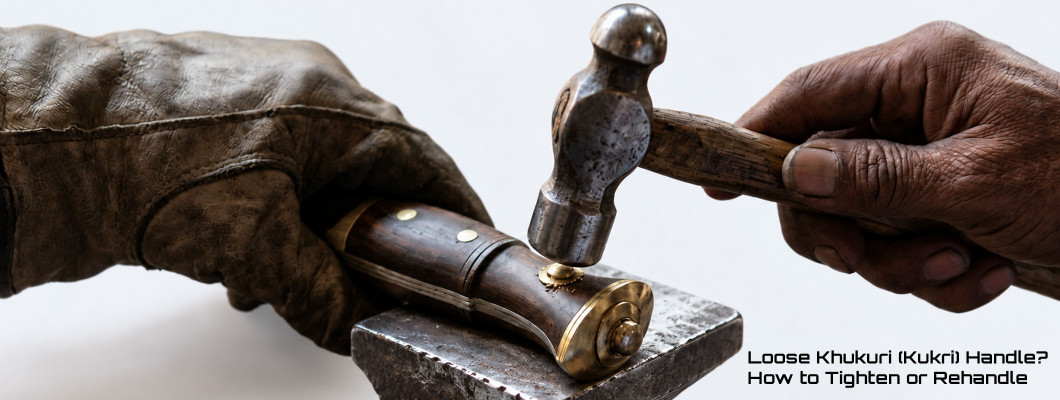
The tang runs the full length of the grip but narrows as it goes, passing through the guard, the grip and the pommel. Where it emerges at the top it is hammered over cold — peened — spreading into a rivet head that locks the whole assembly together under compression.
This is how European swords were made for a thousand years, and it is still the right answer. The narrowing is deliberate: it moves weight out of the handle and into the blade, which is what gives a sword its handling. The peen is what makes it safe, because there is no fastener to work loose.
Verdict: excellent. The correct answer for swords.
Hidden tang, mechanically pegged
The tang runs the full length of the grip but is not peened over at the pommel — instead it is held by transverse pegs or pins through the handle. The Japanese nakago is the best-known example, secured by bamboo mekugi pegs through the tsuka.
A great deal of internet advice condemns this construction because it is not "full tang". That advice is wrong. A properly made nakago is a broad, full-length tang, and the peg system has held up under real use for centuries. It also has a genuine advantage: it is designed to be disassembled for maintenance.
Verdict: sound, when properly executed. The failure is in bad copies, not in the design.
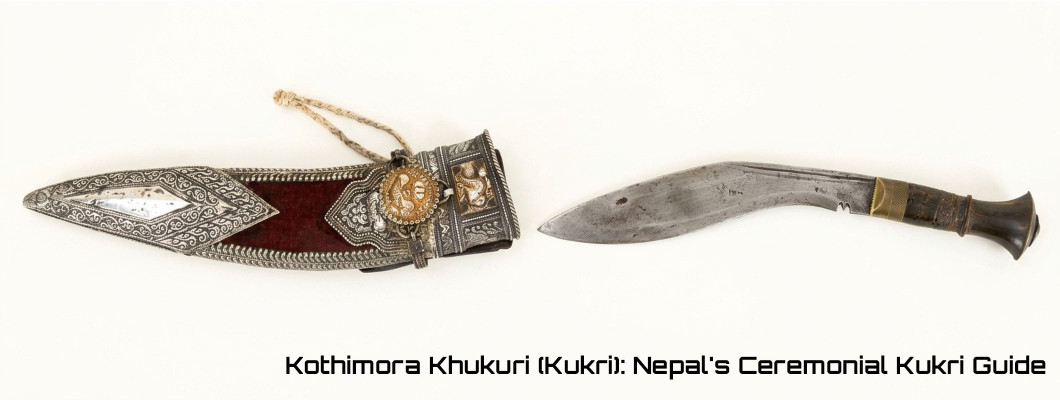
Panawal — the kukri construction
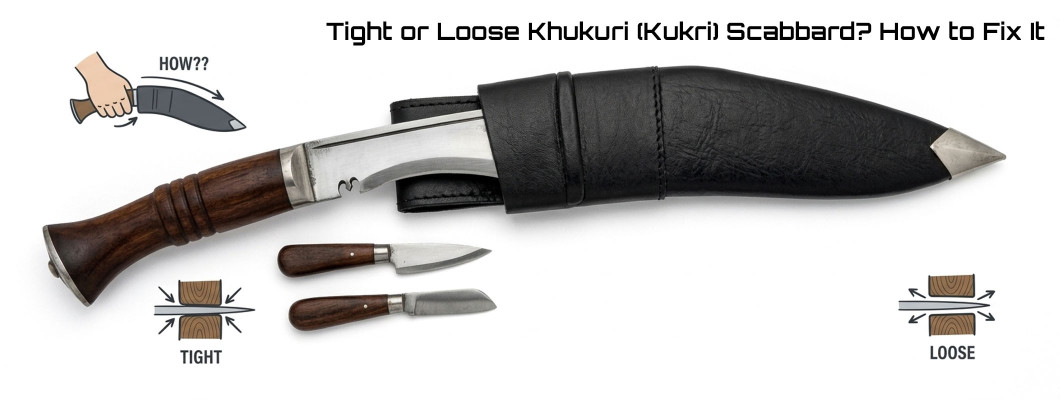
The Nepali term for a full-width tang with the handle scales riveted through it, usually with a steel bolster and butt cap. It is the kukri equivalent of slab construction and it is what separates a working khukuri from a decorative one.
The alternative in cheap kukris is a stick tang glued into a solid handle with laha, a traditional resin. On a village blade made and repaired by the same smith that is a serviceable system. On an export blade that will never see that smith again, it is the exact point where cheap kukris fail.
Verdict: excellent, and worth insisting on for any kukri you intend to use.
Rat-tail tang
Here is the problem construction. A thin rod — often round, often much narrower than the blade — is welded to the base of the blade and buried in a hollow handle. Sometimes it is threaded at the end for a screw-on pommel.
The rod is not the same piece of steel as the blade. There is a join, and the join sits at the shoulder, which is the point of maximum leverage on the whole assembly. Every force the blade generates is concentrated at a weld made by someone whose priority was speed.
Verdict: avoid. This is the construction the warnings are actually about.
Glued stick tang
A narrow tang, not welded, but held in the handle by adhesive alone with no peen, no rivet and no peg. Epoxy is doing structural work it was not designed for.
The failure here is slower and sneakier than a weld breaking. Adhesive creeps under sustained load and softens with heat, and warm environments — a car boot in summer, a stage under lighting — accelerate it. The handle loosens gradually until one day it does not hold.
Verdict: avoid on anything you intend to use.
Why Rat-Tails Fail
Three things stack up, and they compound.
The weld is a discontinuity. Forged steel has a grain structure that runs through the piece. A weld interrupts it, and the heat-affected zone around the weld has different properties from the steel on either side. You have created a boundary at the exact spot that experiences the most bending force.
The cross-section is too small. Resistance to bending rises sharply with thickness — a rod half the thickness of a proper tang is far weaker than half as strong. A thin round rod is close to the worst shape you could choose for the job.
Fatigue accumulates invisibly. Steel that flexes repeatedly under load develops microscopic cracking long before anything visible happens, and each cycle makes the next one worse. This is why rat-tail failures feel sudden and are not. The blade was failing for months.
The consequence is that a rat-tail sword can pass a light test cut, and a second, and a fiftieth, and then release the blade from the handle on the fifty-first with the full momentum of the swing behind it.
Peened or Threaded — the Other Half of the Question
A full-length tang can still be assembled badly. The question is what happens at the pommel end.
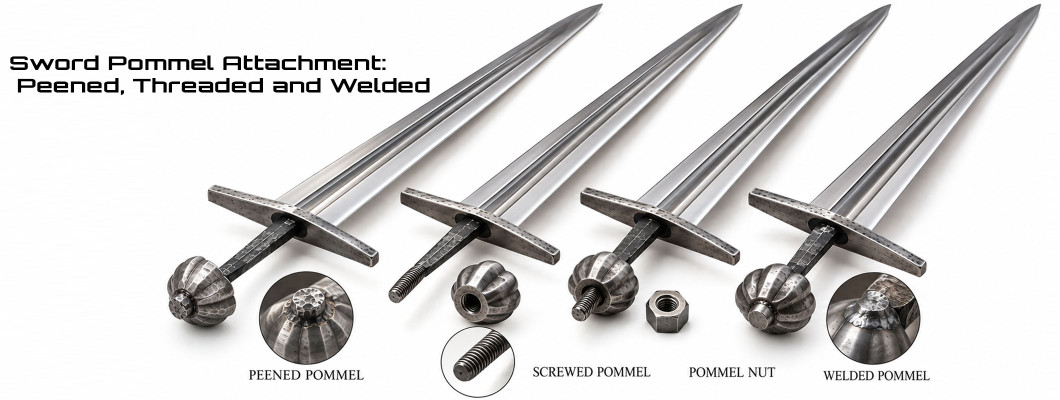
A peened pommel has the tang hammered over into a rivet head. It cannot unscrew, because there is nothing to unscrew. Taking it apart means drilling it out.
A threaded pommel screws onto a threaded tang end. It is quick, it allows flat-pack assembly, and it works loose. Every impact is a small rotational shock, and repeated rotational shock backs a threaded fastener out in exactly the way a bolt walks out of a vibrating machine. On a blade that takes contact it is a countdown, which is why it is the most common serious failure in stage combat swords.
The great majority of blades we forge are peened rather than threaded. If it matters for how you intend to use a blade, ask us to confirm it for the specific piece — we would rather answer than have you assume.
The Constructions Compared
| Construction | What it is | Suitable for |
|---|---|---|
| Full tang, slab | Full width and length, scales riveted on | Knives, kukris, machetes — strongest option |
| Through-tang, peened | Full length, narrowing, hammered over at the pommel | Swords — the historical standard |
| Hidden tang, pegged | Full length, held by transverse pegs | Japanese swords — sound when properly made |
| Panawal | Full width, riveted through, steel bolster | Working kukris |
| Rat-tail | Thin rod welded to the blade base | Nothing that will be swung |
| Glued stick tang | Narrow tang held by adhesive alone | Nothing that will be swung |
How to Identify a Rat-Tail Before You Buy
You cannot see the tang, so you work from indirect evidence. Four things.
Ask directly, and listen to the shape of the answer. "Is the tang full length, and is the pommel peened or threaded?" A maker who does it properly answers in one sentence without pausing. Anything vague — the blade is "securely constructed", the handle is "solidly fitted", the sword is "battle ready" — is an answer about marketing rather than construction.
Look at the pommel end in photographs. A peened tang shows a small irregular dome of hammered steel where it was spread. A threaded assembly shows a smooth cap, a visible nut, or a decorative finial that is obviously a separate part.
Feel the balance. A sword with very little steel in the handle feels blade-heavy and slightly hollow, and the point of balance sits further forward than it should. It is not conclusive on its own, but combined with a vague answer it is telling.
Check the price against the claim. Peening a pommel is skilled hand work that adds real time per blade. A sword sold at a price that leaves no room for that work has probably not had it.
What to Ask Before You Buy
- Does the tang run the full length of the handle? This is the question, not "is it full tang".
- Is the tang forged from the same piece as the blade, or welded on? Welded means rat-tail.
- Is the pommel peened, threaded or pegged? Peened for a sword that takes contact.
- Is there adhesive doing structural work in the handle? There should not be.
- On a kukri: is it panawal, or a stick tang in a solid handle? Panawal for anything you will actually use.
- What steel, and what heat treatment? The other half of the picture, covered in our sword steel guide.
Construction is one of the four things that separate a functional blade from a decorative one. The other three are set out on our battle ready standard.
Full-Length Tangs, Peened by Hand
Every Everest Forge blade is forged as one piece of 5160 spring steel with the tang running the full length of the handle — riveted slab construction on knives, kukris and machetes, peened through-tangs on swords. No welded rods, no glued stick tangs, anywhere in the catalogue.
Browse Hand-Forged Swords →Frequently Asked Questions
What is a rat-tail tang?
A thin rod, usually much narrower than the blade, welded to the base of the blade and buried in a hollow handle, often with a threaded pommel screwed onto the end. It is not the same piece of steel as the blade. The weld sits at the shoulder, which is the point of maximum bending force on the whole assembly, and it is where the failure happens.
Is a full tang always better than a hidden tang?
No, and this is the most common misunderstanding on the subject. What matters is whether the tang runs the full length of the handle and is mechanically secured at the end. A Japanese nakago held by bamboo pegs is a hidden tang and it is entirely sound. A European through-tang narrows as it goes and is peened over at the pommel, and that has been the standard for a thousand years. The real problem is a welded rod, not a narrowing tang.
How can I tell if a sword has a rat-tail tang?
Ask the seller whether the tang runs full length and whether the pommel is peened or threaded. A maker who builds properly answers immediately; vague answers about being securely constructed mean rat-tail. Look at photographs of the pommel end, where a peened tang shows a small hammered dome of steel rather than a smooth cap or nut. A blade-heavy, hollow-feeling balance is a supporting clue.
Why do rat-tail tangs break?
Three reasons compound. The weld interrupts the grain structure of the steel at the point of maximum leverage. The rod's cross-section is too small, and resistance to bending falls away sharply as thickness decreases. And fatigue accumulates invisibly, with microscopic cracking developing long before anything shows. That is why the failure feels sudden when it has actually been building for months.
What does peened mean on a sword pommel?
The tang passes through the pommel and the protruding end is hammered over cold, spreading it into a rivet head that locks the assembly under compression. It cannot unscrew, because there is nothing to unscrew, and taking it apart means drilling it out. A threaded pommel screws on instead, which is faster to make and works loose under repeated impact.
What is a panawal kukri?
Panawal is the Nepali term for a kukri built with a full-width tang and handle scales riveted through it, usually with a steel bolster and butt cap. It is the kukri equivalent of slab full-tang construction. The alternative is a stick tang glued into a solid handle with laha resin, which is serviceable on a village blade the maker can repair but is the standard failure point in cheap export kukris.
Does full tang mean the same thing on knives and swords?
No, and sellers exploit the gap. On a fixed-blade knife it usually means a full-width slab of steel with scales riveted to either side, visible around the edge of the grip. On a sword it usually means the tang runs the full length of the grip even though it narrows toward the pommel. Both are correct in context, so a listing that says only full tang has told you very little.
Can a rat-tail tang be repaired?
Not usefully. Re-welding puts a second heat-affected zone at the same weak point, and there is no way to add cross-section to a rod already buried in a handle. A blade with a failed rat-tail can be rehandled by a smith willing to cut it down and rebuild it, but the cost of that work is generally more than the blade is worth. It is better treated as a lesson than a repair job.