Menu
Your Cart

Hand-Forged Medieval Falchion Sword, Fluted Pommel

Hand-Forged Medieval Falchion Sword, Fluted Pommel
$234.99
Ex Tax: $234.99
  • Model: SINGLE EDGED SWORD
  • Product Code: FALICON0024
  • Location: Kathmandu, Nepal

Available Options

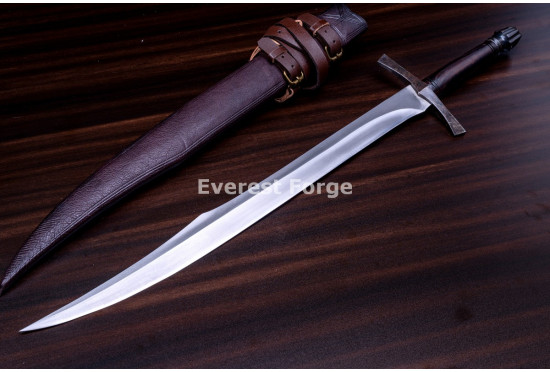
Hand-Forged Medieval Falchion Sword — Fluted Pommel and Dark Forged Fittings

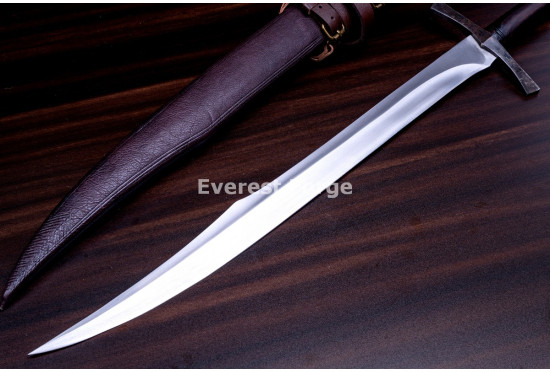
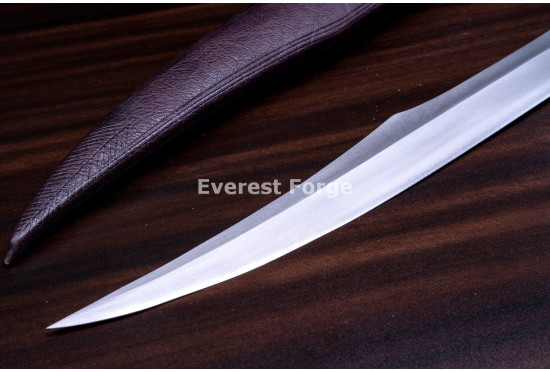
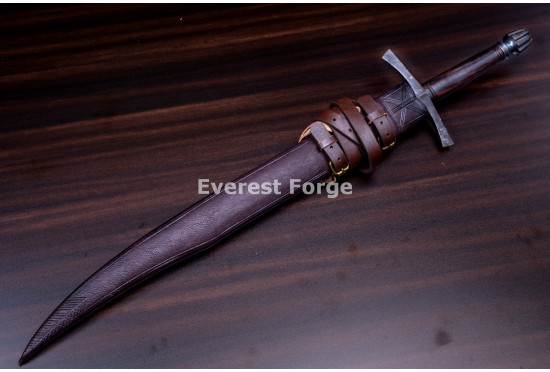
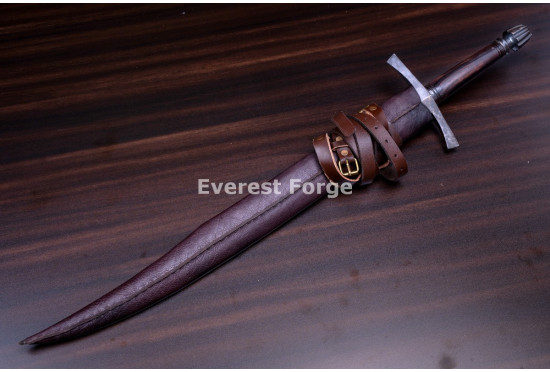
This is a hand-forged, fully functional medieval falchion — a broad single-edged blade with a straight back running into a long clipped point, forged in Nepal from 5160 high-carbon spring steel, oil-tempered, full tang, and sharpened to a true edge. The hilt is dark forged steel against a bright satin blade: a straight cross with squared flared terminals, a bare rosewood grip, and a fluted pommel. It ships with a brown leather scabbard with tooled detail, buckled straps and a decorated throat. Every sword is made to order in your chosen length, finish, and engraving.

The standard blade is 24 inches on an 8-inch hilt with a 5-inch grip, for an overall length around 32 inches at about 1.55 kg. That is a true single-hand sword, sized to be worn at the belt and used with a shield or buckler in the other hand. The mass sits forward where a single-edged blade wants it, so it cuts hard for its size, and the oil-tempered 5160 steel and full tang make it a working sword rather than a cast wall-hanger.

An honest note. This is a modern hand-forged falchion, not a reproduction of a specific surviving example. The blade geometry and the single-hand proportions follow the historical type honestly, but the dark forged fittings and the fluted pommel are our own styling rather than a copy of documented medieval furniture — period falchions carried plainer crosses and simpler pommels. We think it looks better and we would rather tell you that than imply the whole sword came out of a museum case. If you want a strictly period-styled falchion with plain fittings, we build one, and we will also make you a custom piece to a specific reference.

Bespoke Service

Forge a Falchion to Your Own Design

Want a longer blade, plainer period fittings, a wrapped grip, a different pommel form, or your own engraving? Our Custom Forge service builds swords to your spec, by hand in Kathmandu.

Request a Custom Forge →

What Is a Medieval Falchion?

The falchion is the single-edged cutting sword of medieval Europe, in use from roughly the 13th century into the 16th. It was an infantry and common-soldier's weapon as much as a knightly one, and it shows up constantly in medieval manuscript illumination — the Maciejowski Bible alone is full of them — carried alongside a shield by men who were not nobility. Part of its appeal was economic: a single-edged blade takes less steel and less finishing work than a double-edged one, which mattered a great deal when good steel was expensive. It survived alongside the arming sword for three centuries because it did one thing extremely well, which was cut. What separates a falchion from a Messer is hilt construction rather than blade shape: a falchion uses conventional sword construction, with the tang running through to a pommel, which is exactly what this sword has.

Real Forged BladeHand-forged 5160 spring steel, full tang, oil-tempered and sharpened.
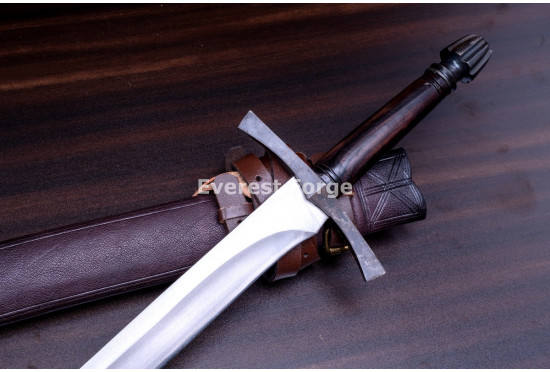
Fluted PommelDeeply fluted steel pommel that peens over the tang and anchors the hilt.
Dark Forged CrossStraight cross with squared flared terminals, left dark against the bright blade.
5160 Spring SteelTruck leaf-spring steel — tough, shock-resistant, holds an edge.
Bare Rosewood GripShaped rosewood, unwrapped — no leather to stretch, wear or come loose.
Buckled ScabbardBrown leather scabbard with tooled detail, buckled straps and a decorated throat.

Specifications

TypeHand-forged medieval falchion, single-hand
Blade Length24 inches standard (custom lengths to order)
Handle Length8 inches overall, 5-inch grip section
Overall LengthApprox 32 inches at standard blade size
WeightApprox 1550 g total, 1110 g blade
Blade Steel5160 high-carbon spring steel (truck leaf spring)
Heat TreatmentOil-tempered — hard edge, flexible spine
Blade StyleSingle-edged, straight back, long clipped point, satin finish, sharpened
TangFull tang, peened at the pommel
HandleBare shaped rosewood, unwrapped
FittingsDark forged steel cross with squared flared terminals, fluted pommel
ScabbardBrown leather with tooled detail, buckled straps and decorated throat, included
OriginHand-forged in Tokha-3, Kathmandu, Nepal

Customize Your Falchion

Every sword is forged to order. Set your options before you add to cart:

Blade LengthStandard 24 inches, or order a shorter or longer blade to your spec.
Blade WidthStandard broad section, or a narrower, faster blade on request.
Fittings FinishDark forged as standard, or polished bright, or antiqued.
Pommel StyleFluted as standard, or a plain period form, wheel, or disc pommel.
GripBare rosewood as standard, or leather-wrapped, or buffalo horn or walnut.
EngravingAdd a name, date, or your own pattern to the blade or scabbard.

Hand-Forged, Not a Wall-Hanger

This Falchion

  • Hand-forged 5160 high-carbon spring steel
  • Oil-tempered, hard edge and flexible spine
  • Full tang, peened over the fluted pommel
  • Fittings forged and finished, not cast to shape
  • Sharpened, balanced, made to your spec

A Wall-Hanger

  • Cast stainless, brittle under load
  • No real heat treatment
  • Rat-tail tang that snaps at the guard
  • Decorative pommel cast in pot metal and glued on
  • Blunt, display-only

How It Is Made

You set the spec — length, width, fittings finish, pommel style, grip, and any engraving.
A smith forges the single-edged blade from a 5160 leaf-spring billet and shapes the clipped point.
The blade is oil-tempered, then polished to a satin finish and hand-sharpened along the edge and clip.
We forge and fit the cross and fluted pommel, shape the rosewood grip, peen the tang, build the scabbard, and ship worldwide tracked.

Who It Is For

  • Collectors of medieval European arms who want a single-edged sword with character in the fittings
  • Reenactors and living-history groups portraying 13th to 15th century infantry kit
  • Cutting practitioners who want a short, forward-weighted blade that cuts above its size
  • Buyers who want a one-handed sword to pair with a shield or buckler
  • Larp and costume users, who should order the display-blunt option
  • Gift buyers personalizing a blade with a name, date, or engraving

What Is Included

  • One hand-forged medieval falchion, built to your chosen spec
  • Brown leather scabbard with tooled detail, buckled straps and decorated throat
  • Bare rosewood grip with dark forged steel cross and fluted pommel
  • Any personalization or engraving you ordered
  • A satin-finished, sharpened blade
  • Everest Forge manufacturer warranty

Explore More Hand-Forged Swords

Shipping, Returns & Care

Shipping

In-stock specs dispatch within 2 to 3 business days; fully custom builds take roughly 4 to 6 weeks to forge before dispatch. We ship worldwide by DHL or FedEx in 7 to 14 business days, tracked. Import and blade laws vary by country, so please check your local rules before ordering.

Returns & Warranty

Every blade is backed by the Everest Forge warranty against forging and material defects. If something is wrong with your order, we will repair, replace, or refund it. Personalized and custom-engraved blades are made to order, so please confirm your spec carefully before purchase.

Care

Wipe the blade clean and dry after handling, and apply a light coat of oil before storage to protect the high-carbon steel from moisture. Give the fluting on the pommel an occasional wipe as well, since the grooves hold moisture and dust more readily than a smooth surface. Treat the leather scabbard occasionally with a conditioner, and do not store the sword inside it for long periods.

From The Forge

Build a Falchion That Is Yours Alone

Beyond the options here, our Custom Forge service will build to plain period fittings, a longer blade, a wrapped grip, or a specific reference you send us — direct from the maker in Kathmandu, roughly 4 to 6 weeks from order.

Start a Custom Forge →

Frequently Asked Questions

What is a medieval falchion?

The falchion is the single-edged cutting sword of medieval Europe, in use from roughly the 13th century into the 16th. It was carried by infantry and common soldiers as much as by knights, and it appears constantly in medieval manuscript illumination — the Maciejowski Bible is full of them, usually paired with a shield. It survived alongside the arming sword for three centuries because it did one thing exceptionally well, which was cut. What separates a falchion from a Messer is hilt construction rather than blade shape: a falchion has a conventional sword hilt with the tang running through to a pommel.

Why is a falchion single-edged? What is the advantage?

Three things, and the first is the one people forget. Economics: a single-edged blade uses less steel and takes far less finishing work than a double-edged one, which mattered enormously when good steel was expensive and every bevel was ground by hand. That is a large part of why the falchion was a common soldier's weapon. Structurally, leaving the back thick means all the mass sits behind the one edge doing the cutting rather than being split between two, so the blade cuts harder than a double-edged sword of the same weight, and the thick spine resists bending. The trade-off is that you cannot cut on the backstroke, and a thick single-edged blade is a poorer thruster than a tapered double-edged one — which is exactly why the falchion lived alongside the arming sword rather than replacing it.

How does this differ from your other Medieval Falchion?

They are the same class of sword — single-hand medieval falchions — so the difference is in the hilt and the styling rather than the category. This one carries dark forged fittings against a bright satin blade: a cross with squared flared terminals, a deeply fluted pommel, and a bare rosewood grip left unwrapped, with a brown leather scabbard with buckled straps. Our other falchion is the plainer, more restrained pattern. Buy that one if you want period simplicity; buy this one if you want visible forge work in the fittings and a sword with more presence on a wall or at the belt. Handling is comparable — both are single-hand cutters.

Is it one-handed or two-handed?

One-handed. The 5-inch grip is sized for a single hand and nothing more, which is correct for the type — a falchion was carried as a sidearm with a shield or buckler in the other hand. If you want a two-handed single-edged sword, look at our larger patterns instead, or ask through Custom Forge for a longer grip on this blade.

Is this a real, functional sword?

Yes. It is hand-forged from 5160 high-carbon spring steel, full tang, oil-tempered, and sharpened to a true cutting edge before it ships. The cross and fluted pommel are forged steel and the tang is peened over the pommel rather than glued or threaded. It handles tatami mats, water bottles and light green targets well. Do not use it on bone, metal, seasoned hardwood, or anything you would not put a good knife through.

What steel is it, and is it oil-tempered?

The blade is forged from 5160 high-carbon spring steel, the same alloy used in heavy-duty truck leaf springs, prized for toughness and edge retention. It is oil-tempered for a hard cutting edge backed by a flexible, shock-absorbent spine. On a heavy single-edged cutter that toughness is the point — the blade delivers a lot of energy into whatever it meets and the steel has to absorb what comes back without chipping or setting a bend.

Is it full tang?

Yes. The tang runs the full length of the hilt and is peened over at the fluted pommel, so the cross and rosewood grip are mechanically captured on the tang itself. There is no rat-tail, no weld, and no glued-in stub to fail. On a forward-weighted cutting sword that construction matters — the leverage a blade like this exerts on the hilt under a hard cut is exactly what breaks stub tangs.

What is a fluted pommel, and what do the fittings do?

Fluting is the pattern of grooves cut around the pommel, and here it is both decorative and practical: it breaks up the surface so the pommel does not read as a plain lump of steel, and it gives your palm something to register against when your hand slides back under a heavy cut. Functionally the pommel is a counterweight and the structural anchor of the hilt — the tang is peened over it, so it holds the whole assembly tight. The cross is forged steel with squared, flared terminals, left dark against the bright blade rather than polished to match. Both are solid steel, not cast alloy or plated pot metal.

How is the scabbard made?

It is a leather scabbard built the traditional way, around a fitted core rather than as a flat leather sleeve — that is what keeps the sword from cutting its way out and lets it hold the blade securely without a retaining strap doing all the work. The leather is tooled, stitched and dyed brown, with a decorated throat at the mouth and buckled straps for belt suspension. Each one is cut by hand to the blade it is made for, which is why a custom blade length always means a custom scabbard and adds to the lead time. Keep the sword out of it for long-term storage: leather is tanned with acids and holds damp, and both are bad for carbon steel over months.

Does it arrive sharpened?

Yes, sharpened as standard along the edge and the clip, finished by hand. If you need it blunt for reenactment, larp, stage use, display, or to satisfy import rules where you live, choose the display-blunt option or tell us in your order notes. There is no extra charge either way.

Can I order plain period fittings or a different length?

Yes. Blade length, blade width, fittings finish, pommel style and grip material are all adjustable to order. If you want this blade with plain medieval furniture rather than the dark forged cross and fluted pommel, we will build it that way — say so and we will quote it. Send us a manuscript reference or a photograph of a surviving falchion and we will tell you honestly what we can match before starting.

Do you ship worldwide, and how long does it take?

Yes. We ship worldwide from Nepal by DHL or FedEx in 7 to 14 business days with tracking. In-stock specs dispatch within 2 to 3 business days; fully custom builds take roughly 4 to 6 weeks to forge first. Import and blade laws vary by country, so please check your local rules before ordering.

Specification
Blade: 24 inches. Hand forged from 5160 carbon steel
Total Length: 34 inches long in total
Handle: 8 inches overall with a 5 inch grip section. Full tang, bare shaped rosewood, with dark forged steel cross and fluted pommel
Weight: Approx 1550 grams total (blade approx 1110 grams)
Note: As every piece is forged by hand, slight variation in weight, dimensions and finish may occur. Rosewood grain and leather colour vary between pieces. Keep the blade lightly oiled when not in use.

Write a review

Note: HTML is not translated!
Bad Good
Captcha