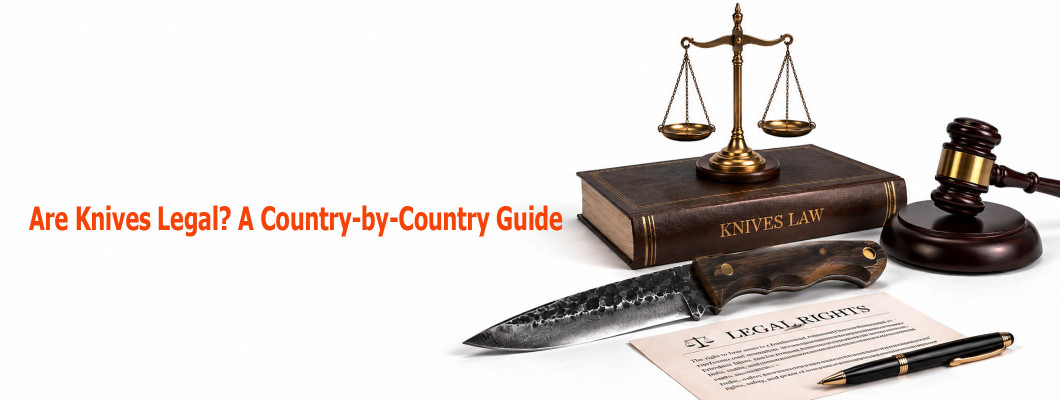
Are Knives Legal? A Country-by-Country Guide for Buyers
Important: This is general information, not legal advice, and Everest Forge is not a law firm. Knife laws are complex, differ by country, state, province and even city, and they change — several of the countries below tightened their laws in 2025 and 2026. Nothing here is a guarantee that a given blade is legal for you to buy, own, carry or import. You are responsible for checking the current law in your own jurisdiction before you order, and for any customs duties or import rules that apply. When in doubt, contact your local police or a qualified solicitor in your area.
The single most useful thing to understand about knife law is that it asks three separate questions, and people constantly confuse them:
- Can you own it? In most of the world, the answer for an ordinary fixed-blade knife is yes — kept at home, on private property, or used for a lawful outdoor purpose.
- Can you carry it in public? This is where almost all the restrictions live. Many countries let you own a knife freely but require a "good reason" or "lawful excuse" to have it on you in a public place.
- Can you import it? A handful of countries block specific knife types at the border regardless of whether you could own them domestically. This is the question that matters most when you are buying from an overseas maker like us.
A knife can be perfectly legal to own, illegal to carry without justification, and separately either fine or blocked at customs — all at the same time, in the same country. Read for your country below with those three questions in mind.
The Types That Cause Trouble Almost Everywhere
Before the country breakdown, one pattern holds across nearly every jurisdiction in this guide. Certain knife types are restricted or banned in most Western countries regardless of local nuance:
- Automatic knives / switchblades — blades that open by a button or spring.
- Gravity and "centrifugal" knives — blades that open by a flick of the wrist.
- Butterfly knives / balisongs.
- Push daggers and disguised knives (belt-buckle, comb, lipstick knives).
- Double-edged blades and daggers — a blade sharpened or ground on both edges is treated far more strictly than a single-edged knife in the UK, Australia, Germany and elsewhere, and is a common import trigger.
Everest Forge does not build switchblades, gravity knives, butterfly knives or push daggers. The one category above that touches our range is the double-edged blade — some daggers and certain fantasy pieces are ground on both edges. If you are ordering into a country with strict import or carry rules, a single-edged knife is almost always the safer choice, and this is worth raising with us before you order.
United Kingdom
The UK has some of the strictest knife laws in the world, and it is the country buyers most often get wrong. The key is the own-versus-carry split.
Owning. Most knives, including fixed-blade knives and locking folding knives, are legal to own in the UK — you can keep them at home, use them on private property, or take them to the countryside for a lawful purpose. Bushcraft, camping, fishing and outdoor use are all recognised legitimate contexts.
Carrying. Carrying any knife in public — including a fixed blade or a locking knife — requires a "good reason," and self-protection is not accepted as one. The only knife you can carry without a specific reason is a non-locking folding knife with a cutting edge of 3 inches (7.62 cm) or less — and both conditions must apply at once; a small blade that locks is not a legal everyday carry. A fixed blade always needs a good reason in public, no matter how short.
Banned outright. Flick knives, butterfly knives, disguised knives, zombie knives, push daggers and certain other types are illegal to own under any circumstances. Since April 2022, knife deliveries in the UK require age verification at the point of delivery to ensure they reach adults over 18.
An honest note for UK buyers. A hand-forged bushcraft, hunting or camp knife from us is legal for you to own and use for its intended outdoor purpose. What you cannot do is carry it around in public without a good reason — transport it sheathed, stored in a bag rather than on your belt, by a direct route to where you will lawfully use it, and where possible keep evidence of that purpose. Purpose and context are everything.
United States
The US is the opposite of a single system. Knife laws are set almost entirely at the state and local level, and what is perfectly legal to carry in one state can be a criminal charge in another.
Owning. Owning ordinary fixed-blade knives — hunting, bushcraft, survival, bowie — is legal across the country. Restrictions are overwhelmingly about carry, not ownership.
Carrying. The rules vary state by state and sometimes city by city, covering open versus concealed carry, blade-length limits, and restricted types. Many states that allow concealed carry of folding knives restrict concealed carry of fixed blades, dirks or daggers, so wearing a fixed blade openly on the belt is generally the safest approach. The broad trend over the last decade has been toward looser knife laws, though city ordinances can be stricter than state law.
What to do. Because there is no federal carry standard, check your own state's law — and your city's — before carrying. States like Texas, Tennessee and Kansas are permissive; states like New York, New Jersey and Massachusetts are notably stricter. Ownership for home and lawful outdoor use is not the issue; carry is.
Australia
Australia is the country where the import question matters most, because it is enforced at the federal border and it is where overseas orders most often run into trouble.
Owning. Most standard knives — including fixed-blade hunting knives, folding knives and kitchen knives — are legal to own in every state and territory, provided they are not on the prohibited import list.
Importing. This is the critical part. Federal law restricts the import of specific types without a permit. Daggers and similar devices — including any knife with a second or false edge capable of being sharpened — cannot be imported without the necessary permit, along with flick knives and throwing blades. A single-edged fixed blade generally imports fine; a double-edged dagger can be held or seized at customs. This is exactly why the single-edged-versus-double-edged distinction matters for Australian orders.
Carrying. Carry rules are set by each state and territory, and the test is contextual — a chef walking to work with a knife roll is lawful; the same person carrying a fixed blade in the city centre on a Saturday night without a reason is not. Self-defence is never a lawful excuse to carry a knife in any Australian jurisdiction, and prohibited types include flick knives, butterfly knives, push knives and machetes with blades over 20 cm in some states. A knife that is legal in one state can be treated differently the moment you cross into another, so check the destination state's list before travelling.
An honest note for Australian buyers. Order single-edged fixed blades — hunting, bushcraft, survival, camp — and you are on the safe side of the import rules. If you are drawn to one of our daggers or a double-edged piece, talk to us first, because it may require an import permit or be blocked at the border.
Canada
Canada has no blade-length limit and permits ordinary fixed blades, but it is strict on opening mechanism and on concealment.
Owning and importing. Fixed-blade knives are generally legal, but automatic (switchblade) knives, butterfly knives, push daggers, and knives that open by centrifugal force or gravity are prohibited to own or import. There is no specific blade-length limit for legal knives, though a larger knife may be treated as a weapon if the circumstances suggest it is intended for a dangerous purpose. Note that Canada's "centrifugal" rule is broad and has caught many ordinary one-hand flipper folders at the border — but it does not affect plain fixed blades, which have no opening mechanism.
Carrying. Canada focuses on the intent behind carrying rather than blade length: carrying a fixed blade for camping, hunting, fishing or work is within your rights, but carrying it for protection or as a weapon is not. Concealed carry is generally illegal — a knife carried for a legitimate purpose should not be concealed.
Germany and the European Union
There is no single EU knife law. The European Union does not regulate personal knife carry — criminal and public-order rules are left to each member state, so 27 EU countries plus non-EU nations each maintain their own framework. If you are travelling across borders, the strictest law on your route is the one that governs you.
Germany reformed its Weapons Act (Waffengesetz) in 2026 and is a useful reference point. Knives remain legal, but the reforms narrowed what can be carried in public, raised the minimum purchase age, and stiffened penalties; kitchen, hunting and fixed-blade knives with a blade of 12 cm or less remain permitted provided they are not marketed as weapons. Carrying a fixed blade over the limit is permitted only with a justified reason such as hunting or professional use, self-defence is not a valid reason, and many cities operate local "weapons ban zones" (Waffenverbotszonen) where carry is restricted regardless. Automatic knives, butterfly knives and push daggers are prohibited.
Elsewhere in Europe, the rules diverge sharply. Italy's 2026 security decree made carrying a blade over 8 cm without justification a crime punishable by up to three years, and applies the same to locking or one-hand-opening folders of 5 cm or more. In France it is a criminal offence to carry a knife at a train station. A small non-locking folder is the closest thing to universally tolerated across Europe, but even that is not guaranteed everywhere. Always check the specific country.
Everywhere Else — General Principles
For countries not listed above, these principles hold in most of the world and are a sensible default until you confirm local law:
- Owning a single-edged fixed blade at home is usually legal. Most restrictions target carry and specific mechanisms, not ownership.
- Automatic, gravity, butterfly and disguised knives are widely banned. If a knife opens by itself or hides what it is, assume it is restricted.
- Double-edged daggers face the strictest treatment and the most import scrutiny. Single-edged is the safer choice for cross-border orders.
- Self-defence is almost never an accepted reason to carry. Lawful reasons are work, hunting, fishing, camping, sport, food preparation and similar.
- You must be an adult to buy — typically 18, and higher in some places.
- Import duties and customs are separate from legality. A legal knife can still attract import tax; that is your responsibility as the buyer.
How This Affects Ordering From Everest Forge
We ship worldwide — to Australia, the USA, the UK, Canada, Europe and beyond — and the practical guidance is simple. Our core range is single-edged, functional fixed blades: hunting knives, bushcraft knives, camp cleavers, survival knives, kukris, machetes and bowies. For the large majority of buyers in the large majority of countries, these are legal to own and to import for lawful outdoor use.
The two things to watch are: double-edged pieces (some daggers and fantasy blades), which face the strictest import and carry rules — especially in Australia and the UK — and your own country's carry laws, which are your responsibility once the knife arrives. If you are unsure whether a specific blade will clear customs in your country, contact us before ordering and we will help you choose a piece that fits, or advise where a single-edged alternative makes more sense.
Buyers are responsible for checking their local import laws — this is stated in our shipping and returns policy — and for any duties that apply.
Not Sure What Is Legal Where You Are? Build It Right
If your country restricts double-edged blades, long blades, or specific types, a custom forge lets you commission a single-edged, compliant fixed blade built to a length and profile that suits both your use and your local law. Tell us where you are and what you need — we reply to every request within 24 to 48 hours with a free quote.
Request a Custom Forge →Official Sources — Check These Before You Order
The links below go to the actual government bodies that set and enforce these rules. They are the authoritative word; this article is only a plain-English summary of them. If anything here conflicts with an official source, the official source is right.
United Kingdom
- GOV.UK — Selling, buying and carrying knives and weapons — the government's own guidance, including the full table of banned knives, the "good reason" examples and current penalties.
- Your local police force — GOV.UK itself advises contacting local police to check whether a specific knife is legal, and for advice on what counts as a good reason.
Australia
- Australian Border Force — Prohibited goods: weapons — the import rules, permit tests and application process. This is the page that matters for any overseas knife order.
- Customs (Prohibited Imports) Regulations 1956 — Schedule 13 lists the restricted edged weapons by name, including daggers and double-edged blades.
- Your state or territory police weapons registry — carry law and prohibited-weapon lists are set at state level, not federally, and they differ.
Canada
- CBSA Memorandum D19-13-2 — Importing and exporting firearms, weapons and devices — the working import policy, including the definition of centrifugal force.
- CBSA Customs Notice 18-01 — Centrifugal opening knives — the notice that set the current, broad interpretation of prohibited opening mechanisms.
Germany
- Waffengesetz (WaffG) § 42a — the section on the official federal law portal governing what may not be carried in public, including one-hand knives and fixed blades over the length threshold.
- Your local Ordnungsamt or police — for city weapons ban zones (Waffenverbotszonen), which are set locally.
United States
- There is no single federal knife-law source, because carry law is set by state and often by city. Check your own state legislature's statutes and your city ordinances. Where a knife matters to you legally, a licensed attorney in your state is the reliable answer.
Everywhere else
- Your national customs or border agency for import rules, and your national or local police for carry rules. Most publish plain-language guidance.
Sources consulted for this article were current as of July 2026. Knife law is changing quickly — the UK, Australia, Germany and Italy all amended their rules during 2025 and 2026 — so always verify against the official links above rather than relying on any retailer's summary, including ours.
Frequently Asked Questions
Is it legal to buy a hand-forged fixed blade knife?
In most countries, yes — owning a single-edged fixed-blade knife for lawful use is legal. The restrictions almost always apply to carrying it in public, and in a few countries to importing specific types. Check your own country's law, and note that carrying and owning are two different questions.
Can I carry a fixed blade knife in public?
Usually only with a lawful reason. In the UK, Australia, Canada, Germany and many other places, you can own a fixed blade but need a "good reason" or "lawful excuse" — work, hunting, fishing, camping, sport — to carry it in public. Self-defence is almost never accepted as a reason. The exact rules vary widely, so check your jurisdiction.
Why do double-edged knives and daggers face stricter rules?
A blade sharpened or ground on both edges is legally treated as a weapon rather than a tool in many countries. The UK, Australia and Germany all single out double-edged blades and daggers for stricter treatment, and Australia restricts their import without a permit. A single-edged knife is almost always the safer choice for cross-border orders.
Will my knife clear customs?
For single-edged fixed blades, in most countries, yes. The main exception is countries that restrict specific imports — Australia, for example, requires a permit for daggers and double-edged blades. If you are unsure, contact us before ordering and we will help you choose a piece that fits your country's rules. Import duties are separate from legality and are the buyer's responsibility.
What is the legal blade length for a knife?
It depends entirely on the country, and length is often less important than type and context. The UK sets a 3-inch limit only for carrying a non-locking folder without a reason — it does not make longer knives illegal to own. Germany uses a 12 cm carry threshold. Australia, Canada and most of the US set no general ownership length limit. Always check locally.
How old do I have to be to buy a knife?
You must be an adult — 18 in most countries, and higher in some (Germany raised its purchase age in its 2026 reforms). Retailers, including us, apply age checks. We do not sell to minors.
Is self-defence a valid reason to carry a knife?
In almost every jurisdiction in this guide — the UK, Australia, Canada, Germany and others — no. Carrying a knife specifically for self-protection is explicitly not accepted as a lawful reason and can itself be an offence. Lawful reasons are work, outdoor recreation, sport and similar practical purposes.
Does Everest Forge guarantee a knife is legal in my country?
No, and no honest seller can. Laws vary by country, state and city and change over time. We can advise on import considerations and steer you toward compliant single-edged options, but the responsibility for checking your local law before ordering rests with you. This guide is general information, not legal advice.
Shop Hand-Forged, Single-Edged Fixed Blades
Functional Working Knives, Forged in Nepal, Shipped Worldwide
Our core range is single-edged fixed blades built for lawful outdoor use — hunting, bushcraft, camp and survival knives forged from 5160 spring steel. For most buyers in most countries, these are the straightforward, compliant choice.
Browse Forged Knives →