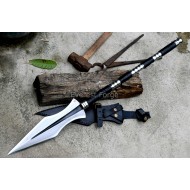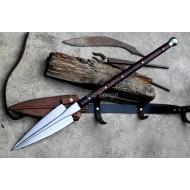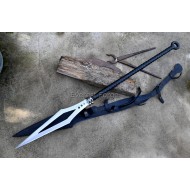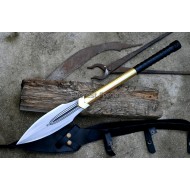
- Model: SPEAR
- Product Code: SPEAR0017
- Location: Kathmandu, Nepal
Available Options
A Hand-Forged Leaf-Blade Sword With a Two-Hand Grip
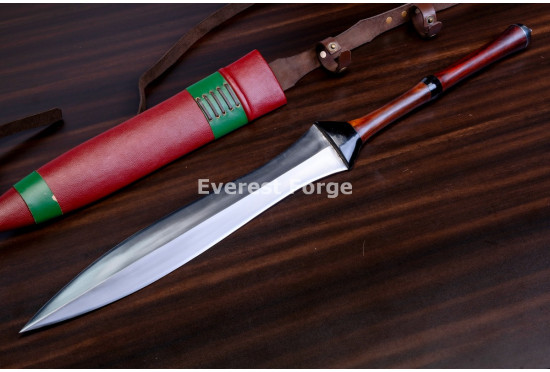
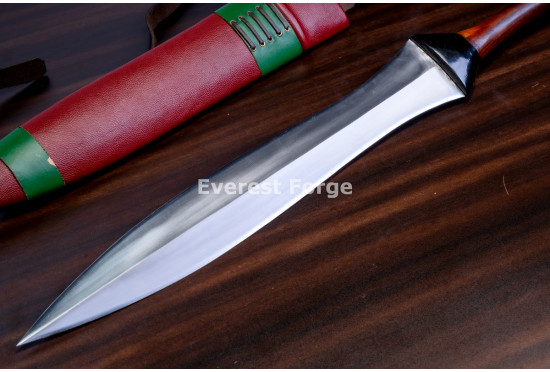
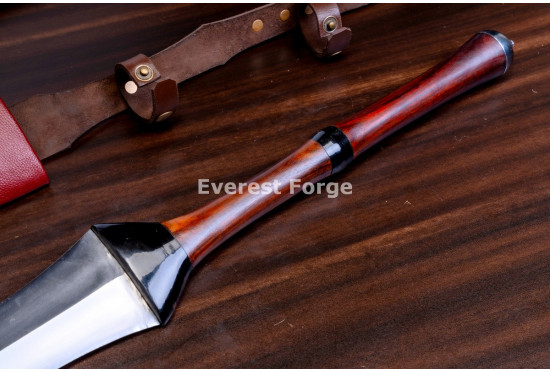
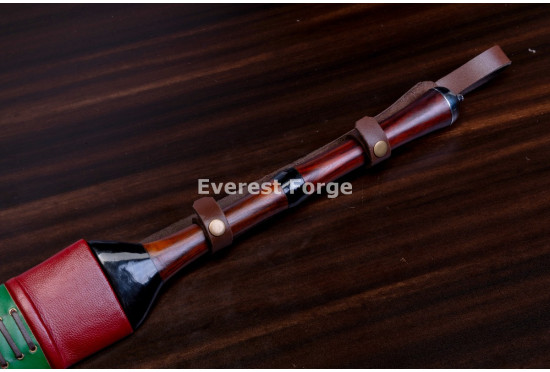
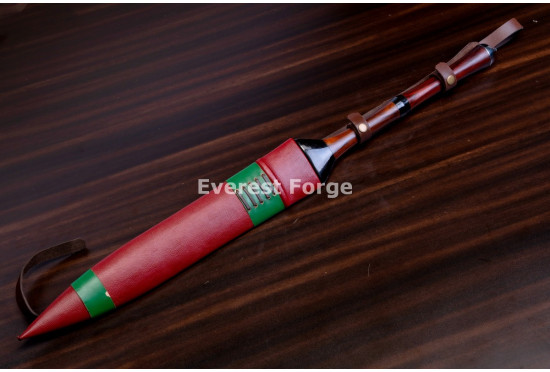
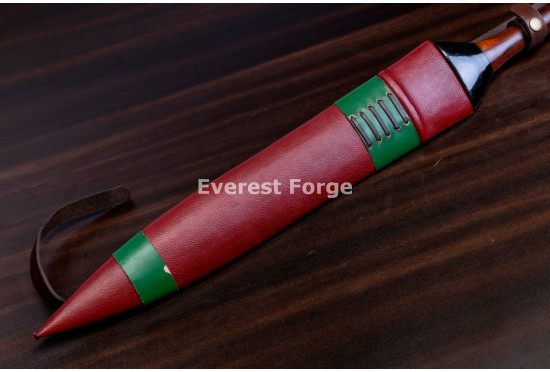
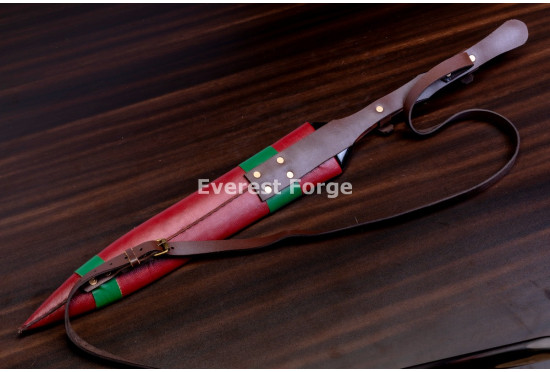
This is a broad leaf-bladed sword, hand-forged in Tokha-3, Kathmandu, Nepal from 5160 high-carbon steel, oil-quenched and tempered. The blade runs 18 inches, swelling through its width before drawing into a fine symmetrical point, with a satin polish across the flats. Behind it sits a fitted dark collar and a shaped rosewood grip of 15 inches finished with a polished pommel cap — a grip nearly as long as the blade, which makes this a two-handed sword on a short blade rather than a one-handed sword with a long handle. Overall it stands 33 inches. It ships sharpened, in a red leather scabbard with green accent bands and a shoulder baldric.
An honest note. This piece is sometimes listed as a spear, and the construction says otherwise. A spear head is socketed or tanged onto a shaft, and a spear is carried in the hand or on the back with the head sheathed. What you see here is sword construction throughout: a fitted collar at the blade root, a waisted grip shaped to the hand, a pommel cap closing the assembly, and a scabbard on a shoulder baldric. Those are the fittings of a sword, not a polearm. The blade profile is genuinely a broad leaf, which is the shape most ancient spear heads used as well, and that is where the confusion comes from — but a leaf blade on a sword hilt is a sword. If you want this head socketed onto a real shaft, our smiths will build it that way.
Want This Blade on a Real Spear Shaft?
Our smiths will forge the same broad leaf head with a socket and mount it on a full-length hardwood shaft, or build the sword to different proportions — a shorter single-hand grip, a longer blade, or a period-style hilt. Send a sketch or a reference and we will quote it.
Start a Custom Build →Why This Sword Is Built the Way It Is
Full Specifications
How You Can Configure It
Is This the Right Sword for You?
Buy This If You Want
- A two-handed sword you can actually swing indoors and store on a shelf
- The oldest blade shape in the world, forged properly rather than cast
- Real 5160 with a full heat treatment behind the styling
- A double edge that cuts on the return stroke
- A scabbard with a shoulder baldric rather than a display sleeve
- A piece a smith will re-proportion to your dimensions before it ships
Look Elsewhere If You Want
- A spear — the fittings are sword fittings, whatever the listing says
- A reach weapon; at 33 inches this is a short sword with a long grip
- A strict reconstruction of a Greek, Celtic or Bronze Age pattern
- A stainless blade that needs no oiling or care
- A light sword; a broad leaf carries real mass by design
- Identical units; every piece is forged by hand and varies slightly
How to Order
Who This Sword Suits
- Test cutters who want two-handed leverage without the storage and swing space a full longsword demands.
- Ancient-world collectors filling the leaf-blade slot alongside classical and Bronze Age pieces.
- Cosplay and stage users who need a striking silhouette with a real forged blade and a blunted option.
- Reenactors and living-history groups after a bold, colourful scabbard rig rather than plain brown leather.
- Gift buyers looking for a display piece that stands out on a wall, etched with a name or a date.
What Is Included
- One hand-forged leaf-blade sword, sharpened and ready to use
- Red leather scabbard with green accent bands and shoulder baldric
- Care and oiling instructions
- Everest Forge manufacturer warranty against defects in forging and heat treatment
Other Hand-Forged Swords and Blades
Shipping, Returns and Care
Shipping. Standard builds dispatch in 2 to 3 business days. Custom builds take 4 to 6 weeks. We ship worldwide by DHL or FedEx, 7 to 14 business days, fully tracked. Sword laws vary by country and by state — please check what applies where you live before ordering, as we cannot deliver into a restricted address. A socketed spear build on a full-length shaft ships as an oversize consignment at a higher freight cost, which we will quote before starting.
Returns. Standard builds can be returned unused and in the original scabbard within 30 days. Custom builds, altered dimensions and etched pieces are made to your specification and cannot be returned unless there is a fault in forging or heat treatment.
Care. 5160 is a high-carbon steel and it will rust if you neglect it. Wipe the blade dry after handling and keep a thin film of oil on it in storage, paying attention to the shoulders where the blade meets the collar, which a cloth skips over. Bare rosewood needs no wrap care, but a light coat of hard wax or furniture oil once or twice a year keeps the grain from drying around the pommel cap. Dyed leather is the one part that needs real attention: keep the scabbard out of direct sunlight, which fades coloured leather far faster than natural, and condition it once or twice a year. Do not store the sword sheathed for long periods.
Frequently Asked Questions
Is this a spear or a sword?
It is a sword, and the fittings settle it. A spear head is socketed or tanged onto a shaft; this blade sits behind a fitted collar on a shaped, waisted grip closed with a pommel cap, and it ships in a scabbard on a shoulder baldric. Every one of those is sword construction. The confusion is understandable, because the broad leaf profile is exactly the shape most ancient spear heads used — leaf blades dominated both spears and short swords across the Bronze Age and the classical world, and the head of a Greek dory and the blade of a Greek xiphos are recognisably relatives. But a leaf blade on a sword hilt is a sword. If you want this same head socketed onto a real hardwood shaft, our smiths will build it that way; it is one of the more common custom requests on this profile.
Why is the grip almost as long as the blade?
Because grip length buys leverage, and leverage is what a short blade lacks. Think of the sword as a lever: your leading hand is the fulcrum and your rear hand applies the force, so the further apart they sit, the more control and power you get for the same effort. On a conventional single-hand sword, a four to five inch grip means both the fulcrum and the force are in essentially the same place, and everything depends on wrist and forearm. Put fifteen inches between your hands and you can drive an eighteen inch blade with your whole body, stop it mid-swing, and reverse it quickly. That is why polearms, greatswords and Japanese two-handers all use long grips regardless of blade length. The trade-off is that you give up a hand — no shield, no off-hand dagger — and the sword is slower to bring on line from a resting position. On a piece this size, that trade generally favours the long grip, because the blade is short enough that reach was never the selling point.
What is a baldric, and is it better than belt carry?
A baldric is the shoulder strap this scabbard hangs from — it crosses the chest from one shoulder to the opposite hip, rather than hanging the sword from a waist belt. It is not merely decorative. Baldric carry takes the weight off your waist and puts it across your torso, which is far more comfortable for a heavy piece worn for hours, and it hangs the sword at a consistent angle so the draw is repeatable. It also lets you carry a blade that is too long or too awkwardly shaped to clear a belt-hung scabbard, which is exactly the case with a broad leaf blade in a fitted sheath. What belt carry gives you in return is a lower profile, a faster draw at close range and the ability to take the whole rig off quickly. We build either, and a belt frog can be added to this scabbard on request.
What steel is it and how is it heat treated?
5160 high-carbon spring steel, oil-quenched and then tempered back. 5160 holds a working edge and flexes under load rather than snapping, which matters on a broad blade that carries real mass. It is also the steel family Nepali smiths have traditionally drawn from vehicle leaf spring, so our forge reads it by colour and by sound at the anvil rather than by instrument alone.
Does it arrive sharp?
Yes. It ships with a working edge on both sides, sharpened by hand and ready out of the scabbard. It is not a blunt wall-hanger with a sword-shaped profile ground into it. If the sword is going into a display case, a costume or a stage production where an edge is a liability, ask for it blunted in the order note before we ship and we will finish it that way at no extra cost.
Is the tang full length?
Yes. The tang runs the full length of the grip with the collar, grip and pommel cap fitted to it, so the assembly is held by steel rather than by adhesive. It matters particularly on a two-handed piece, because two hands generate considerably more torque against the hilt than one does. A short or partial tang under that kind of load works loose at the collar, and you feel it as a rattle long before anything actually fails.
Can I have the blade or the grip made to different lengths?
Both are adjustable. Blade length and grip length are separately selectable, so you can move the piece toward a classical single-hand short sword, keep the two-hand proportions as photographed, or lengthen the blade so the reach matches what the grip implies. When the blade length changes, the leaf is redrawn rather than simply scaled, because a leaf profile stretched without redrawing puts the widest point in the wrong place and the sword feels dead. Tell us the dimensions and how you intend to use the sword and the smiths will proportion it accordingly.
Is the scabbard included, and can I choose different colours?
Yes, the scabbard is included — red leather with green accent bands, laced detail and a shoulder baldric, cut around this specific blade profile. The colours can be changed on any build: a plain natural or black scabbard, a different accent, or a belt frog instead of the baldric. Dyed leather does need slightly more care than natural, which is covered in the care section above. If you change the blade dimensions on a custom build, the scabbard is made to the new size automatically.
Can I use it for test cutting?
Yes, and the two-hand grip makes it well suited to it. With the standard sharpened edge it will handle soft targets — water bottles, tatami, pool noodles — and the leverage from the long grip gives you far better control of the cut than a single-hand sword of the same blade length. What we would not recommend is steel-on-steel contact work, not because of the blade but because the fittings on a display and cutting sword are not built for repeated impact against another weapon. If contact sparring is what you want, commission a purpose-built blunt from the custom forge and say so, and the smiths will build the collar and tang for it.
How do I look after the steel, the rosewood and the dyed leather?
Three materials, three routines. The blade is high-carbon steel: wipe it dry after handling, since fingerprints will etch a satin finish within days, and keep a thin film of camellia, mineral or light gun oil on it in storage, checking the shoulders where the blade meets the collar. The rosewood needs a light coat of hard wax or furniture oil once or twice a year, particularly around the pommel cap where the end grain sits. The dyed leather is the part people neglect: coloured leather fades in direct sunlight much faster than natural tan, so keep the scabbard out of a sunny window, and condition it once or twice a year so the dye does not dry and crack along the fold lines.
Will every sword look exactly like the photograph?
No, and that is inherent to hand forging. Every blade is drawn out under a hammer, so the width of the leaf and the point at which it reaches its widest carry small differences from piece to piece. Rosewood is a natural timber, so grain and colour vary on every grip. Dyed leather takes colour slightly differently on every hide, so the red and the green will not be identical between pieces. Weights and dimensions vary by a few percent. What is consistent is the steel, the heat treatment, the construction and the edge.
Where is it made and by whom?
Hand-forged in Tokha-3, Kathmandu, Nepal, by our own smiths. Everest Forge is a working forge rather than a reseller putting a name on imported blanks — the steel is cut, drawn, quenched, tempered and ground, the grip turned and fitted, and the scabbard cut, dyed and stitched, all under one roof. That is why we can change blade length, grip length and scabbard colour on a custom order, or socket the same head onto a spear shaft: there is a smith at the anvil rather than a catalogue of finished stock.
| Specification | |
| Blade: | 15 inch shaped rosewood two-hand grip, full tang, fitted collar and polished pommel cap |
| Total Length: | 33 inches |
| Handle: | 18 inches. Hand forged from 5160 carbon steel |
| Weight: | 1660 grams approx, as shipped with the scabbard |
| Note: | handmade variation in weight, dimensions and finish may occur; keep blade lightly oiled when not in use |