Menu
Your Cart

Hand-Forged Fantasy Glaive, Barbed Blade

Hand-Forged Fantasy Glaive, Barbed Blade
$324.99
Ex Tax: $324.99
  • Model: SPEAR
  • Product Code: SPEAR51
  • Location: Kathmandu, Nepal

Available Options

A Hand-Forged Fantasy Glaive With a Barbed Blade

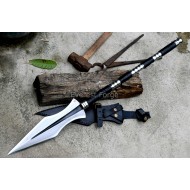
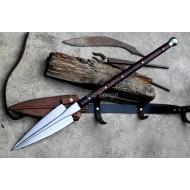
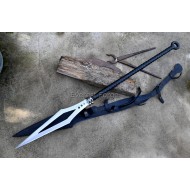
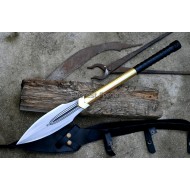
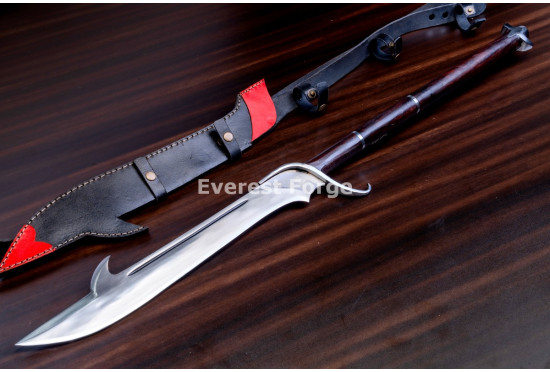
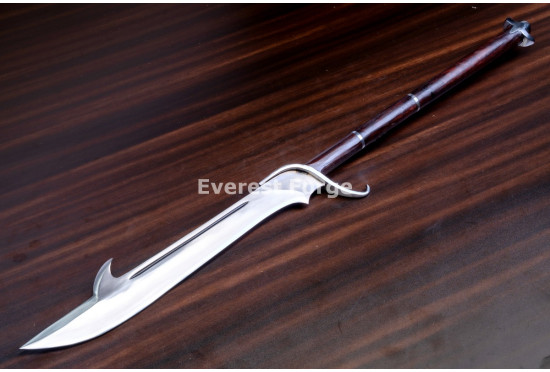
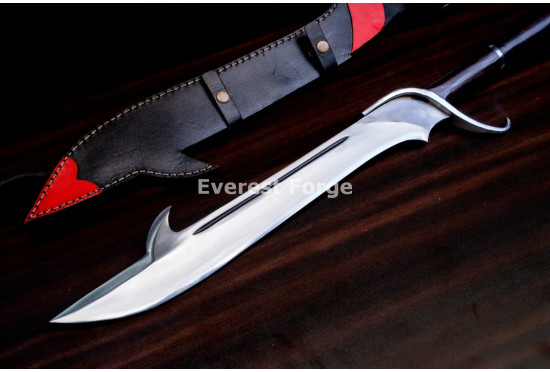
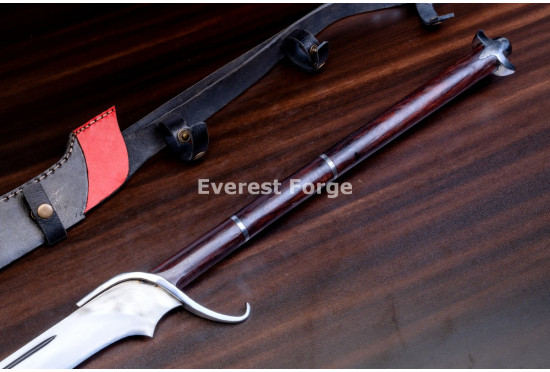
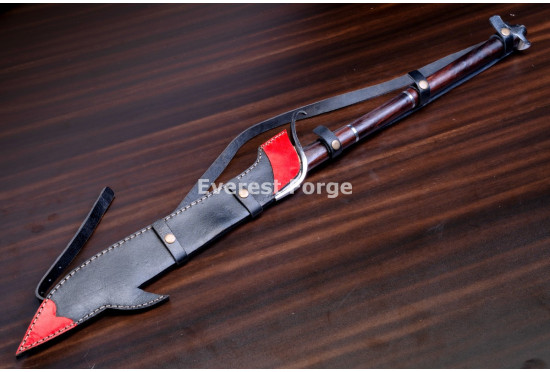
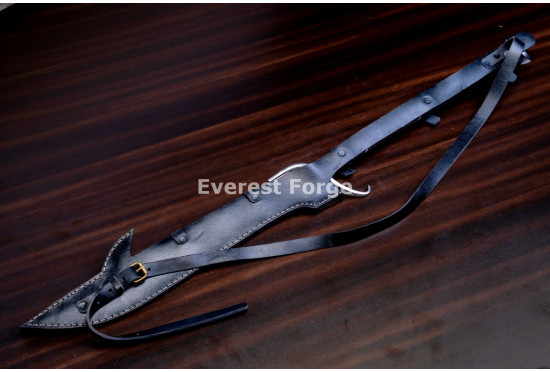
This is a short hafted blade, hand-forged in Tokha-3, Kathmandu, Nepal from 5160 high-carbon steel, oil-quenched and tempered. The head runs 18 inches, broad and swept with a long fuller worked into the flat, a barb standing proud of the edge partway down its length and a sculpted guard curling back where the blade meets the wood. Behind it sits an 18 inch rosewood haft banded with polished rings and closed with a shaped finial — a blade and a shaft of equal length, which is what makes this a hafted weapon rather than a sword. Overall it stands 36 inches. It ships sharpened, with a black leather scabbard trimmed in red on a long baldric strap.

An honest note. This is listed as a spear and it is not one, though it is closer than the name suggests. A spear has a symmetrical head built around a point, because a spear exists to thrust. This has a broad swept blade with the edge doing the work, a barb, and a sculpted guard — that is a cutting head on a shaft, which is a GLAIVE. The construction is genuine hafted construction, so unlike some pieces sold as spears this really is a polearm in miniature; it is simply the wrong kind of polearm to be called a spear. It is also short. A fighting glaive runs six to seven feet; at 36 inches this is a short-form piece for display, costume and collection. The design is original fantasy, not a reconstruction of any historical pattern.

Custom Forge

Want This Head on a Full-Length Shaft?

Our smiths will build the same barbed head onto a war-length or standing-display shaft, or forge a true spear head with a symmetrical point if that is what you were after. Send a sketch, concept art or a reference photo and we will quote it.

Start a Custom Build →

Why This Glaive Is Built the Way It Is

Broad Swept HeadThe blade widens away from the shaft before sweeping to the point, putting mass out where the cut lands. A glaive is a cutting polearm and the head is shaped for it.
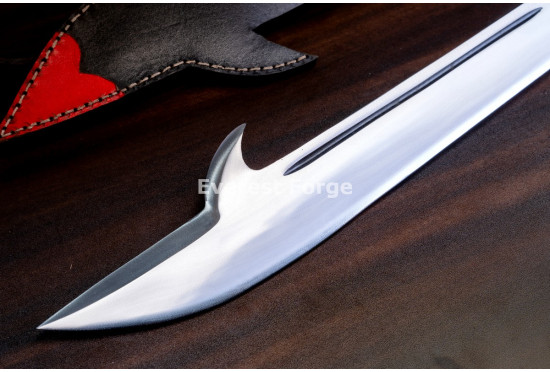
Barb on the EdgeA projection standing proud partway down the blade. On a hafted weapon this is functional furniture, not decoration — it stops, catches and holds in a way a plain edge cannot.
Long FullerWorked into the flat along most of the head, taking weight out of the section without taking stiffness out of it. It matters more on a hafted blade, where every gram sits at the end of a long lever.
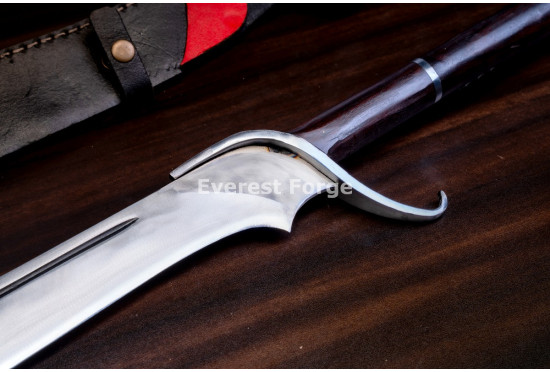
Sculpted GuardCurled back where the blade meets the wood, both to finish the transition visually and to put steel across the joint that takes the most abuse on any hafted weapon.
Banded Rosewood HaftTurned and banded with polished rings that stiffen the shaft and stop the grain splitting outward from the head, which is where a plain dowel always fails first.
5160 High-Carbon SteelSpring steel, oil-quenched and tempered. It takes an edge and flexes under load rather than shattering — the same family Nepali smiths have drawn from leaf spring for generations.

Full Specifications

Blade Length18 inches
Haft Length18 inches
Overall Length36 inches
Blade Steel5160 high-carbon spring steel, oil-quenched and tempered
Blade ProfileBroad swept glaive head with a barb standing proud of the edge
FullerLong fuller worked into the flat of the head
EdgeSharpened and ready to use
GuardSculpted steel guard curling back at the blade root
HaftTurned rosewood banded with polished rings, shaped finial
Weight1740 grams approx, as shipped with the scabbard
ScabbardBlack leather with red trim, on a long baldric strap
OriginHand-forged in Tokha-3, Kathmandu, Nepal
Standard Build18 inch head, satin finish, rosewood haft. Blade length, blade finish and haft material are selectable above — the photographed piece shows the standard build.

How You Can Configure It

Blade LengthShorter for a lighter display piece, or longer if the glaive is going onto a full shaft. The sweep is redrawn rather than stretched so the head still balances.
Haft LengthShort-form as photographed, a taller standing length, or a full war-length shaft. Tell us the height and we will proportion the guard and finial to it.
Blade FinishA bright satin that shows the fuller and the sweep, or a darker finish that gives the head a colder, heavier presence.
Haft MaterialRosewood as standard, or a plain hardwood, a stained finish, or a leather-wrapped grip section where the hands sit.
Edge GeometryA keen cutting edge, or a blunted display edge for a case, a costume or a stage production.
MarkingsA name, a date, a rune or a small motif etched on the flat or along the fuller. Send the text with your order note.

Is This the Right Piece for You?

Buy This If You Want

  • A hafted fantasy weapon you can display indoors without a seven-foot wall
  • A barbed head with real forged steel behind the styling
  • A silhouette nobody else in the room will have
  • A banded hardwood haft rather than a plain dowel
  • A scabbard on a baldric rather than a display sleeve
  • A piece a smith will re-proportion, or rehaft to full length, to order

Look Elsewhere If You Want

  • A spear — this is a cutting head, not a thrusting point
  • A full-length polearm; at 36 inches this is short-form
  • A historical reconstruction of a glaive, partisan or naginata pattern
  • A weapon for contact work; a sculpted guard is styling first
  • A stainless blade that needs no oiling or care
  • Identical units; every piece is forged and fitted by hand and varies

How to Order

Choose Your BuildSet blade length, haft length, finish and haft material from the options above, then add to cart.
Add Any NotesEtching text, a full-length shaft or a blunted display edge go in the order note.
We Forge and FitStandard builds dispatch in 2 to 3 business days. Custom builds take 4 to 6 weeks from confirmation.
Tracked DeliveryDHL or FedEx, 7 to 14 business days worldwide, tracked door to door and covered by our manufacturer warranty.

Who This Glaive Suits

  • Fantasy and gaming collectors who want a polearm in the rack and not another sword.
  • Cosplayers and prop builders needing a hafted silhouette that reads instantly on camera, with a blunted option.
  • Tabletop and video game players putting a character's glaive into actual steel.
  • Display buyers who like hafted arms but do not have the ceiling height for a real polearm.
  • Gift buyers after something unusual, etched with a name, a date or a rune.

What Is Included

  • One hand-forged fantasy glaive, sharpened and ready to display
  • Black leather scabbard with red trim, on a long baldric strap
  • Care and oiling instructions
  • Everest Forge manufacturer warranty against defects in forging and heat treatment

Other Hand-Forged Fantasy Blades

Shipping, Returns and Care

Shipping. Standard builds dispatch in 2 to 3 business days. Custom builds take 4 to 6 weeks. We ship worldwide by DHL or FedEx, 7 to 14 business days, fully tracked. Bladed and hafted arms are restricted in some countries and states — please check what applies where you live before ordering, as we cannot deliver into a restricted address. A full-length shaft ships as an oversize consignment at a higher freight cost, which we will quote before starting.

Returns. Standard builds can be returned unused and in the original scabbard within 30 days. Custom builds, altered dimensions and etched pieces are made to your specification and cannot be returned unless there is a fault in forging or heat treatment.

Care. Three materials, three routines. The head is high-carbon steel: wipe it dry after handling and keep a thin film of oil on it in storage, paying attention to the fuller and the inside curve of the barb, where a cloth skips and moisture sits. The rosewood haft wants a light coat of hard wax or furniture oil once or twice a year, particularly at the ends where the grain is exposed. The dyed leather scabbard should stay out of direct sunlight, which fades coloured leather far faster than natural, and be conditioned once or twice a year. Do not store the head sheathed for long periods.

Frequently Asked Questions

Is this a spear, a glaive, or something else?

It is a glaive, and the distinction is worth having because these words get used interchangeably by sellers and they should not be. A SPEAR has a symmetrical head built around a point and exists to thrust; everything about it, from the narrow head to the light shaft, is arranged so the point arrives first. A GLAIVE has a broad single-edged blade on a shaft and exists to cut; the mass moves out to the head and the weapon is swung rather than driven. A PARTISAN is a spear with symmetrical wings at the base of the head. A HALBERD adds an axe and a hook to a spear point. A NAGINATA is the Japanese glaive, curved rather than straight. This piece has a broad swept cutting blade, a barb and a sculpted guard on a shaft, which puts it squarely in the glaive family. It is listed as a spear in places and we would rather correct that than let you order the wrong thing.

What is the barb on the blade actually for?

On a hafted weapon a barb or a lug is a stop, and it exists to solve a problem specific to polearms. Put a long shaft behind a blade and you generate enormous thrusting force — enough to bury the head so deep that you cannot recover it, which on a battlefield leaves you holding a stick. The classic answer is the boar spear crossbar: a bar or a pair of lugs across the base of the head that stops penetration at a controlled depth so the weapon can be withdrawn and used again. Winged spears and partisans use the same principle. A barb standing proud of the edge, as here, adds a second function — it catches on what it passes, so a drawing cut bites and holds instead of sliding off. Note that this is a different job from the hook on a sickle-sword, which is there to pull a shield down rather than to limit penetration; the two look similar and do opposite things.

Why is it only 36 inches?

Because it is a display and collection piece rather than a fighting polearm. A glaive built for use runs six to seven feet, since the entire advantage of a hafted weapon is that it strikes from outside the reach of a sword. At 36 inches this one keeps the proportions — an 18 inch head on an 18 inch shaft — while staying short enough to hang on a normal wall, lie in a display case, or be carried at a convention without becoming a problem. If you want the real thing, our smiths will build the same head onto a full-length shaft; be aware that it changes the balance completely and ships as an oversize consignment.

What steel is it and how is it heat treated?

5160 high-carbon spring steel, oil-quenched and then tempered back. 5160 holds a working edge and flexes under load rather than snapping, which matters on a broad head that carries its mass at the end of a shaft. It is also the steel family Nepali smiths have traditionally drawn from vehicle leaf spring, so our forge reads it by colour and by sound at the anvil. The guard is worked from steel and finished by hand rather than cast.

Does it arrive sharp?

Yes. It ships with a working edge, sharpened by hand and ready out of the scabbard. It is not a blunt wall-hanger with a blade-shaped profile ground into it. If the piece is going into a display case, a costume or a convention where an edge is a liability — and for a hafted weapon at an event, it usually is — ask for it blunted in the order note before we ship and we will finish it that way at no extra cost.

How is the head fixed to the shaft?

The head seats into the sculpted guard and the banded collar at the top of the haft, which carries the joint. That is the arrangement used on decorative and ceremonial hafted arms, and it is what allows the guard to be shaped the way it is. If you are commissioning a full-length working shaft from us, ask for a socketed build instead and tell us what you intend to do with it — a socket wraps the wood in steel and spreads the load right around the joint, which is what you want on anything that will actually be swung with force. Either way the joint is the part of a hafted weapon that fails first, so it is worth specifying rather than leaving to chance.

Can I have a full-length shaft made?

Yes, and it is the most common custom request on a piece like this. Our smiths will build the same barbed head onto a war-length or standing-display shaft, re-proportioning the guard and the finial so the glaive does not look like a short piece that has been stretched. Two practical points: a long shaft changes the balance completely, so tell us whether the piece will be carried, mounted or stood upright, and a full-length shaft ships as an oversize consignment at a higher freight cost, which we will quote before starting.

Is the scabbard included?

Yes. A black leather scabbard trimmed in red comes with the glaive, cut around this specific head profile and hung on a long baldric strap so the piece can be worn across the back. A barbed head is genuinely awkward to sheath safely, so it is made around the piece rather than being a generic sleeve. Plain colours, a different trim or a belt frog can be specified instead, and on a custom head size the scabbard is made to the new dimensions.

Can I mount it on a wall?

Yes, and at 36 inches it is far easier to live with than a full polearm. It hangs horizontally on two brackets, or diagonally on a single hook through the baldric, and it will lie in a display case without needing a bespoke one. If you want it to stand upright in a corner or a stand, ask for a flat-based or spiked ferrule instead of the shaped finial, or for a full-length shaft with a weighted butt — the standard short-form piece will not stand on its own. We can supply a simple wall bracket on request.

How do I look after the steel, the rosewood and the leather?

The head is high-carbon steel: wipe it dry after handling, since fingerprints will etch a satin finish within days, and keep a thin film of camellia, mineral or light gun oil on it in storage. Two spots need attention rather than a general wipe — the length of the fuller, which holds oil and dust, and the inside curve of the barb, which a cloth simply skips over. The rosewood haft wants a hard wax or furniture oil once or twice a year, especially at the ends. The dyed leather should stay out of direct sunlight and be conditioned annually.

Will every piece look exactly like the photograph?

No, and that is inherent to hand forging and hand fitting. Every head is drawn out under a hammer, so the sweep of the blade, the exact projection of the barb and the line of the fuller carry small differences from piece to piece. The guard is shaped and polished by hand, so its curl differs on every one. Rosewood is a natural timber, so grain and colour vary on every haft. Weights and dimensions vary by a few percent. What is consistent is the steel, the heat treatment, the fitting and the edge.

Where is it made and by whom?

Hand-forged in Tokha-3, Kathmandu, Nepal, by our own smiths. Everest Forge is a working forge rather than a reseller putting a name on imported parts — the steel is cut, drawn, quenched, tempered and ground, the guard shaped, the haft turned and banded, and the scabbard cut and stitched, all under one roof. That is why we can change the head size, the shaft length and the finial on a custom order: there is a smith at the anvil and a fitter at the bench rather than a catalogue of finished stock.

Specification
Blade: 18 inches. Hand forged from 5160 carbon steel
Total Length: 36 inches
Handle: 18 inch turned rosewood haft banded with polished rings, sculpted steel guard at the blade root, shaped finial
Weight: 1740 grams approx, as shipped with the scabbard
Note: handmade variation in weight, dimensions and finish may occur; keep blade lightly oiled when not in use

Write a review

Note: HTML is not translated!
Bad Good
Captcha