Viking Axes: The Weapon That Actually Armed the North
Most Viking-age warriors did not own a sword. Nearly all of them owned an axe. A sword took many times the iron and a specialist smith, and it did one job — fighting. An axe was already hanging in the house, because it felled the timber, split the firewood and shaped the ship. When a raid was called, a man picked up the tool he already had, and that is the plain reason the axe became the weapon of the North. This guide covers the types, what a real Viking axe head was actually like, why the bearded shape exists, the two-handed Dane axe that broke shield walls, and why the axes given names in the sagas were given women's names.
Why the Axe and Not the Sword
It comes down to iron, and iron was expensive.
A sword blade is a long piece of steel, and in the Viking age good steel was scarce and hard-won. A sword also had no second use: it sat on a hip and waited for a fight. That made it a statement of wealth as much as a weapon, which is precisely why swords turn up in the richest graves and why they carried names and inherited histories.
An axe needed a fraction of the material. Better still, most of the head could be plain wrought iron with only a strip of harder steel forge-welded in at the edge — a technique that let a smith put good steel exactly where it did the work and nowhere else. That is why Viking axe heads are often startlingly light and thin compared to what people expect.
And the axe was already there. Every farm needed one for timber, firewood and boatbuilding, and Norse society ran on timber and boats. Arming yourself cost nothing you had not already spent.
This is the same logic that made the spear the primary battlefield weapon almost everywhere, and we have written about it at length in why the spear beat the sword. The axe sits in the same argument: cheap, dual-purpose, and in everyone's hands already.
What a Real Viking Axe Head Was Like
Modern reproductions get this wrong more often than they get it right, so it is worth being specific.
They were light. Many Viking axe heads weigh well under a kilogram. The heavy, thick-bodied "Viking axe" sold as a wall piece bears little resemblance to what came out of the ground.
The blades were thin and wide. A broad cutting edge on a slim body gives you cutting power without mass, which matters enormously when you are swinging one-handed behind a shield all day.
The eye was often small and D-shaped, wrapped and forge-welded rather than punched.
Steel was used sparingly. A hardened steel edge welded into an iron body was normal practice. The whole head was rarely good steel, because good steel was not there to spare.
Archaeologists sort the surviving heads using a typology first laid out by Jan Petersen in 1919, the same scheme used for Viking swords, running through a series of lettered types by shape and period. It is the reference framework anyone serious about Norse arms eventually meets.
The Bearded Axe
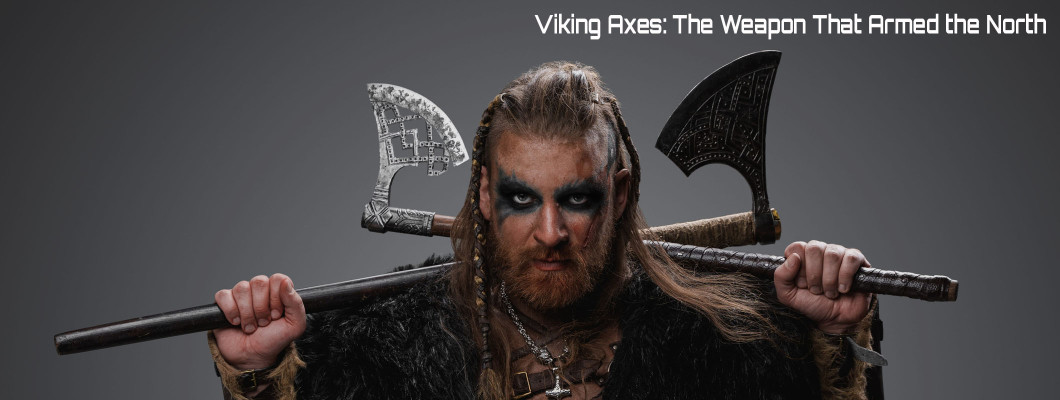
The skeggøx, or bearded axe, is the shape most people picture, and the beard is not decoration.
The lower part of the blade is drawn down and back, extending the cutting edge while leaving a gap behind it. Three things follow from that.
You get more edge for less weight. The cutout removes steel from the middle of the head while the edge stays long, so the axe cuts like a bigger tool and handles like a smaller one.
You get a hook. The beard can catch a shield rim and pull it aside, or hook a leg, or catch an opponent's weapon. Whether Norse fighters used it that way deliberately is argued over, but the shape allows it.
You can choke up behind the bit. Grip the handle right up in the gap behind the beard and the axe becomes a controllable carving tool. For a woodworking axe that doubles as a weapon, this is the feature that matters most, and it is a strong hint about what these tools mostly did.
The Dane Axe
At the other extreme sits the breiðøx, the broad axe, better known now as the Dane axe: a two-handed weapon with a wide thin blade on a haft of four to five feet.
This one is unambiguously a weapon. It cannot be used one-handed with a shield, and it is the tool of a man who has chosen reach and cutting power over defence. It is associated above all with the huscarls, the professional household troops of Scandinavian and Anglo-Danish lords, and it appears repeatedly in the Bayeux Tapestry in the hands of English fighters at Hastings — a reminder of how thoroughly Norse arms had been absorbed into England by 1066.
Blade widths of eight inches or more are known, and the heads remain surprisingly light for their size because the steel is so thin. It was made to cut men and shields, not timber.
Axes Had Names, and the Names Were Female
Here is the detail that most surprises people.
Swords in Norse tradition carry names, which is not unusual across cultures. But axes carried names too, and Norse poetic convention treated the axe as feminine — poets built their kennings for axes around troll-women and giantesses, and named axes tended to follow suit.
Tradition holds that Olaf Haraldsson, later Saint Olaf, carried an axe named Hel, after the goddess of the underworld. The axe still appears on the coat of arms of Norway.
It is a small thing that tells you a lot. A weapon does not get named unless it matters, and the naming of axes is evidence that they were not merely the poor man's substitute for a sword. They were carried with pride by men who could have afforded otherwise.
A Word About Throwing
Throwing axes are strongly associated with the Vikings in popular culture and the evidence for it is thinner than you might expect.
The famous throwing axe of the early medieval world is the francisca, the Frankish weapon that gave the Franks their name, thrown in volleys to break shields before contact. That is a well-attested practice and it is not Norse.
Norse sources do describe weapons being thrown, and a light hand axe can obviously be thrown by anyone who wants to. But there is no clear Viking equivalent of a purpose-built throwing axe as a standard piece of kit. Treat the image with some caution.
The Types at a Glance
| Type | Norse name | Character | Used for |
|---|---|---|---|
| Hand axe | øx | Light head, short haft, one hand | Everything — tool and weapon |
| Bearded axe | skeggøx | Extended lower edge, cutout behind | Woodwork and fighting |
| Broad axe | breiðøx | Wide thin blade, long two-handed haft | War only |
| Frankish throwing axe | francisca | Curved head, thrown in volleys | Frankish, not Norse |
Buying a Viking Axe Today
Most "Viking axes" on the market are too heavy, too thick through the body, and shaped for the photograph rather than the hand. If you want something closer to the real thing, look for these:
- A head that is not absurdly heavy. Historical heads are often lighter than modern buyers expect. A very heavy head is a modern fantasy, not a Norse one.
- A thin blade with a broad edge, rather than a thick chunky wedge.
- Carbon steel, properly heat treated. Not stainless, ever, on anything you intend to swing. Our stainless guide explains why.
- A sound hang. The most common failure in any axe, historical pattern or not — see our handle guide.
- Honesty about what it is. An axe inspired by Norse forms is a fine thing. An axe sold as a museum-accurate reproduction should be able to name the type it reproduces.
Ours are original Everest Forge interpretations of Norse patterns rather than reproductions of specific excavated pieces, hand-forged in Kathmandu from 5160 spring steel, and we would rather say that plainly than claim an accuracy we have not earned.
Commissioning a Norse Pattern
Historical axe patterns are one of the better reasons to commission rather than buy off the shelf, because the details that make a Norse axe read correctly — head weight, blade width, the depth of the beard, haft length — are exactly the things a catalogue fixes for you.
Worth specifying: the pattern you want (bearded, broad axe, plain hand axe), head weight, blade width, haft length matched to your height, handle wood, and runic or personal engraving on the head.
If you are building a reenactment kit to a group standard, send us the standard. Send the specification through custom forge and we confirm every dimension in writing before forging.
A Norse Axe Built to Your Spec
Bearded, broad axe or plain hand axe — head weight, blade width, haft length and engraving all to your specification. Hand-forged and hand-hung in Kathmandu from 5160 spring steel, tempered, sharpened, with a hand-stitched leather sheath.
Request a Custom Axe →Frequently Asked Questions
Did Vikings use axes more than swords?
Yes, considerably. A sword took many times the iron of an axe and required a specialist smith, making it a marker of wealth that turns up mainly in rich graves. An axe used a fraction of the material, could be built with only a strip of hardened steel welded into an iron body, and was already in every household for timber, firewood and boatbuilding. Arming yourself with one cost nothing you had not already spent.
What is a bearded axe and why is it shaped that way?
The skeggøx has its lower blade edge drawn down and back, extending the cutting edge while leaving a gap behind it. That gives more edge for less weight, creates a hook that can catch a shield rim, and — most usefully — lets you grip the handle right up behind the bit for controlled carving work. The last point is a strong hint that these were woodworking tools as much as weapons.
How heavy was a real Viking axe?
Much lighter than most people expect. Many surviving heads weigh well under a kilogram, with thin blades and broad cutting edges rather than the thick heavy wedges sold as Viking axes today. The lightness was deliberate: a broad edge on a slim body gives cutting power without mass, which matters when you are swinging one-handed behind a shield.
What is a Dane axe?
The breiðøx or broad axe, a two-handed weapon with a wide thin blade on a haft of four to five feet. Unlike the hand axe it is unambiguously a weapon, since it cannot be used alongside a shield. It is associated with huscarls, the professional household troops of Scandinavian and Anglo-Danish lords, and appears repeatedly in the Bayeux Tapestry in English hands at Hastings.
Did Viking axes have names?
Yes, and Norse poetic convention treated the axe as feminine, building kennings for axes around troll-women and giantesses, with named axes tending to follow suit. Tradition holds that Olaf Haraldsson, later Saint Olaf, carried an axe named Hel after the goddess of the underworld, and that axe still appears on the coat of arms of Norway.
Did Vikings throw their axes?
The evidence is thinner than popular culture suggests. The well-attested throwing axe of the early medieval world is the Frankish francisca, thrown in volleys to break shields before contact, which is Frankish rather than Norse. Norse sources describe weapons being thrown and a light hand axe can obviously be thrown, but there is no clear Viking equivalent of a purpose-built throwing axe as standard kit.
What were Viking axe heads made of?
Usually a body of plain wrought iron with a strip of harder steel forge-welded in at the cutting edge. Good steel was scarce and expensive in the Viking age, so a smith put it exactly where it did the work and nowhere else. This is a major reason Viking axe heads are so much lighter and thinner than modern reproductions of them.
What should I look for in a Viking axe today?
A head that is not absurdly heavy, a thin blade with a broad edge rather than a thick wedge, carbon steel properly heat treated rather than stainless, and a sound hang with no movement between head and handle. Also look for honesty: an axe inspired by Norse forms is a fine thing, but one sold as a museum-accurate reproduction should be able to name the type it reproduces.