How to Choose an Axe: Head Weight, Handle Length and What Makes a Good One
Three numbers decide what an axe can do, and three things decide whether it is any good. The numbers are head weight, handle length and bit geometry. The quality markers are the steel, the heat treatment, and how the head is hung on the handle — and only one of those three is visible in a photograph. This guide works through each in turn, gives you a sizing method that takes ten seconds, and explains what to ask before spending money on an axe you cannot inspect.
Head Weight
Head weight is momentum. A heavy head keeps moving when it meets resistance; a light one stops. That is the whole of it, and it explains why a hatchet bounces out of green wood while a felling axe buries itself.
Rough classes, in the weights the trade uses:
- Around 1 to 1.5 lb — hatchet territory. Kindling, limbing, camp work, carried all day without noticing.
- Around 2 to 2.5 lb — the boy's axe or three-quarter axe class. Enough to fell and buck small timber, still portable. The most useful single weight if you want one axe.
- Around 3 to 4 lb — a full felling axe. Serious wood volume, and serious fatigue if you are not used to it.
- 6 lb and up — splitting mauls. A different job entirely, and one where weight does most of the work.
The mistake almost everyone makes is buying heavier than they need. Head weight you cannot swing accurately for an hour is not power, it is a hazard — tired arms miss, and a miss with an axe is how handles break and legs get hurt.
Handle Length — and How to Size One to Yourself
Handle length gives leverage. Doubling it makes the head arrive considerably harder for the same effort, and it moves your hands further from the impact, which matters for safety as much as power.
It also has a cost nobody mentions: overstrike. That is when you miss the target with the bit and hit it with the handle instead, just behind the head. It is the single most common way axe handles break, and longer handles overstrike more often because there is more handle to hit with. It is also why a handle you cannot swing accurately is worse than a shorter one you can.
The ten-second sizing test
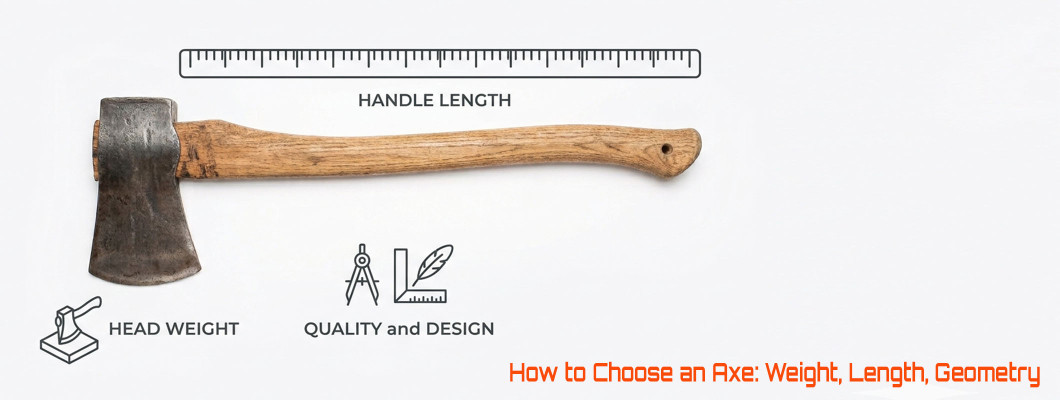
For a felling-style axe: hold the head in your hand and tuck the end of the handle into your armpit. If the handle roughly reaches, the length suits your reach. Shorter and you lose leverage; longer and you lose accuracy.
Height matters more here than with almost any other tool, and every axe sold off a shelf was sized for an average. If you are notably tall or short, a stock handle is a compromise you did not choose.
Bit Geometry — the Part Nobody Explains
The shape of the axe head behind the edge decides how it behaves in wood, and it is the difference between an axe that works and one that sticks.
Thin bit, for cutting across the grain. Felling is a slicing action, and a thin profile with a sharp edge enters cleanly. Too thin and it wedges and jams.
Thick wedge, for splitting along the grain. Here you are not cutting at all, you are forcing fibres apart. Edge sharpness barely matters; wedge angle and weight do everything.
Convex cheeks matter more than either. The curved swell on the sides of the head behind the edge is what pops the chip out and releases the axe from the cut. A head with flat cheeks bites in and binds, and you spend the day levering it free. This is the single most common failing in cheap axes and it is almost impossible to see in a product photograph — but you can ask.
Edge curve. A pronounced curve concentrates force on a small area and bites deeper. A straighter edge spreads the cut. Neither is better; carving axes tend straighter, felling axes tend curved.
The Handle
Wood. Hickory is the traditional choice because it is exceptionally tough and absorbs shock. Ash is the European equivalent and behaves similarly. Rosewood, which we use, is denser and heavier — it gives a solid, substantial feel and takes a finish beautifully.
Grain direction is more important than species. The grain should run straight along the length of the handle for its full length. What kills handles is runout — grain that exits the side partway along, which is a break waiting for a reason. Look at the handle end-on and along its length; straight lines running the full way are what you want.
Straight or curved. Curved handles suit single-bit axes used for felling, giving a slight mechanical advantage and a comfortable grip at the end. Straight handles suit splitting, hatchets and anything you might choke up on. It is largely preference below about 20 inches.
Finish. Avoid thick varnish or lacquer. It looks good in a shop, it becomes slippery when your hands are wet, and it hides the grain you were supposed to inspect. Oil is the right finish.
How the Head Is Hung
This is where axes actually fail, and it is completely invisible in photographs.
The head sits on the handle in the eye, which is tapered wider at the top. The handle is driven in from below, and a wedge is then driven into a saw kerf in the handle end, spreading the wood to fill the eye and lock the head in place. Sometimes a metal cross-wedge is added.
Signs of a bad hang: the handle end not filling the eye completely, a wedge sitting proud or already loosening, visible gaps at the top of the eye, or any movement at all when you grip head and handle and try to twist them apart.
A loose head is not a minor fault. An axe head that comes off mid-swing travels a long way at speed, and it is the reason axes should be checked before use rather than after.
Steel and Heat Treatment
An axe asks something specific of its steel: it is struck against wood, knots and occasionally hidden metal, thousands of times, and it must not chip or crack.
That means toughness matters more than maximum hardness, which is exactly why spring steels suit axes. We forge ours from 5160 reclaimed from vehicle leaf springs — the same steel we use across the range, chosen because it absorbs repeated impact and flexes rather than fracturing. The reasoning is set out in our steel guide.
Many traditional axes are also differentially treated: the edge hardened for retention, the body and poll left softer to absorb shock. A through-hardened axe head can be brittle at the poll, which matters for the next point.
What ruins axes at the factory is skipped tempering, which is invisible until the edge chips on its first knot. Our guide to heat treatment explains why that stage gets cut and what it costs.
Should You Hammer With the Poll?
Usually not, and this catches people out.
The poll is the flat back of the axe head. Unless it has been specifically hardened for striking — and most are not — hitting steel wedges or tent pegs with it will mushroom and deform it over time. On a differentially treated head the poll is deliberately soft.
Driving a wooden peg or tapping something soft is fine. Using an axe as a general hammer is a slow way to ruin the head. If you need a striking face, ask for it when you commission, because it is a build decision rather than something you can add later.
Specification by Use
| Use | Head weight | Handle | Bit |
|---|---|---|---|
| Camping and kindling | 1–1.5 lb | 12–16" | Thin, curved edge |
| Bushcraft, general | 2–2.5 lb | 19–24" | Medium, convex cheeks |
| Felling | 3–4 lb | 28–36" | Thin, pronounced curve |
| Splitting firewood | 4–8 lb | 28–36" | Thick wedge |
| Carving and hewing | 1.5–2.5 lb | Short, straight | Straight edge, bearded |
| Display and historical | Whatever suits the form | Per the pattern | Per the pattern |
What to Ask Before Buying
- What steel, by name, and what hardness? A specific number. "High carbon" alone is not an answer.
- Is the head differentially treated, or through-hardened? And is the poll hardened for striking?
- Are the cheeks convex? The question most sellers cannot answer, and the one that decides whether the axe sticks.
- What is the head weight, in pounds or grams? Not "heavy duty".
- How is the head hung — wooden wedge, metal cross-wedge, both?
- What handle wood, and is the grain straight the full length?
- Does it come sharpened and ready to use? Many axes ship with a rough grind and need work before first use.
When to Have One Made
Axes are the best commissioning candidate in our whole catalogue, and the reason is simple: the two specifications that decide how an axe performs are the two a catalogue cannot personalise. Head weight and handle length are not accessories. They are the tool.
Worth commissioning when:
- You are tall or short. A stock handle is sized for an average. If the armpit test above tells you a standard axe is wrong for your reach, that is a real performance difference over years of use, not a preference.
- You want a specific head weight — heavier for splitting, lighter for carrying, or a weight matched to what you already own and like.
- You want a historical pattern — a Dane axe, a particular bearded profile, a Nepali working form.
- You want a hardened poll for striking, which must be built in rather than added.
- You want engraving on the head, or a specific handle wood and finish.
- You are buying a gift and want it marked.
Tell us your height, what the axe is for, and any weight or length you already know suits you. Send it through custom forge and we confirm every dimension in writing before forging.
Head Weight and Handle Length, Built to You
The two specifications that decide how an axe performs are the two you cannot choose off a shelf. Hand-forged in Kathmandu from 5160 spring steel, tempered and sharpened, with a hand-stitched leather sheath. Tell us your height and the job, and we will spec it before a hammer touches steel.
Request a Custom Axe →Frequently Asked Questions
What size axe should I buy?
For one general-purpose axe, something around 2 to 2.5 pounds of head on a 19 to 24 inch handle covers most jobs — enough to fell and buck small timber while remaining portable. Camping and kindling want a lighter hatchet at 1 to 1.5 pounds on 12 to 16 inches. Felling wants 3 to 4 pounds on a long handle. Buying heavier than you can swing accurately for an hour is the most common mistake.
How do I know if an axe handle is the right length for me?
Hold the head in your hand and tuck the handle end into your armpit. If it roughly reaches, the length suits your reach. Shorter and you lose leverage; longer and you lose accuracy, which matters because missing the target and striking with the handle instead is how most handles break. Every off-the-shelf axe is sized to an average, so if you are notably tall or short a stock handle is a compromise.
Why does my axe keep sticking in the wood?
Almost always flat cheeks. The cheeks are the sides of the head behind the edge, and a convex swell there is what pops the chip out and releases the axe from the cut. A head ground flat bites in and binds, and you spend the day levering it free. It is the most common failing in cheap axes and it is nearly invisible in a product photograph, so ask the seller directly.
What is the best wood for an axe handle?
Hickory traditionally, because it is exceptionally tough and absorbs shock well; ash is the European equivalent. But grain direction matters more than species. The grain should run straight along the full length of the handle, and what kills handles is runout, where the grain exits the side partway along and creates a break point. Avoid thick varnish, which becomes slippery when wet and hides the grain.
Why do axe heads come loose?
Because the hang has failed. The head sits in a tapered eye and is locked by a wedge driven into the handle end, spreading the wood to fill the eye. If the handle does not fill the eye completely, or the wedge sits proud or works loose, the head starts to move. Check by gripping head and handle and trying to twist them apart — any movement at all means the axe comes out of service until it is rehung.
Can I use the back of an axe as a hammer?
Usually not. Unless the poll has been specifically hardened for striking, and most are not, hitting steel with it will mushroom and deform the head over time. On a differentially treated axe the poll is deliberately left soft to absorb shock. Driving a wooden peg or tapping something soft is fine; using an axe as a general hammer will slowly ruin it. A hardened poll has to be built in when the axe is made.
What steel should an axe be made from?
Something tough rather than something maximally hard, because an axe is struck against wood, knots and occasionally hidden metal thousands of times and must not chip or crack. Spring steels suit this well, which is why we forge ours from 5160 reclaimed from vehicle leaf springs. Many traditional axes are also differentially treated, with the edge hardened for retention and the body left softer to absorb shock.
Can I order an axe with a custom head weight?
Yes, and axes are the best commissioning candidate we offer, because head weight and handle length are the two things that decide performance and the two a catalogue cannot personalise. We can also build a hardened poll for striking, a specific historical pattern, engraving on the head, or a particular handle wood and finish. Send your height, the intended use and any weight you already know suits you.