Menu
Your Cart

Hand-Forged Bearded Axe, Full Tang Rosewood Handle

Hand-Forged Bearded Axe, Full Tang Rosewood Handle
$324.99
Ex Tax: $324.99
  • Model: Axe
  • Product Code: BeardedAxe01
  • Location: Kathmandu,Nepal

Available Options

Hand-Forged Bearded Axe — Full Tang Head with Rosewood Handle

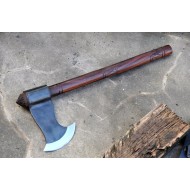
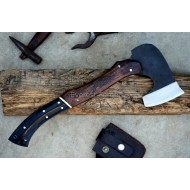
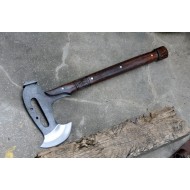
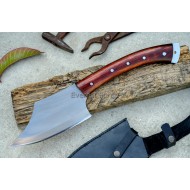
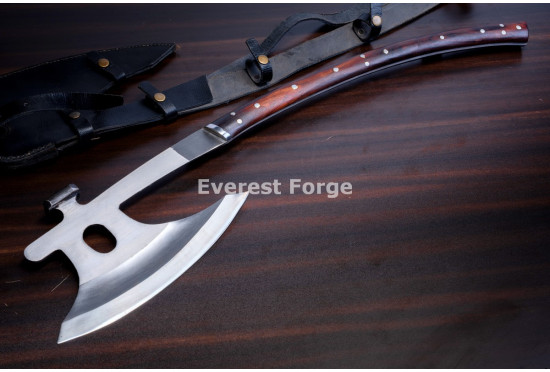
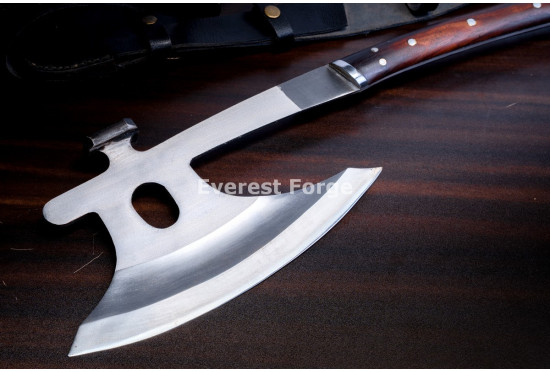
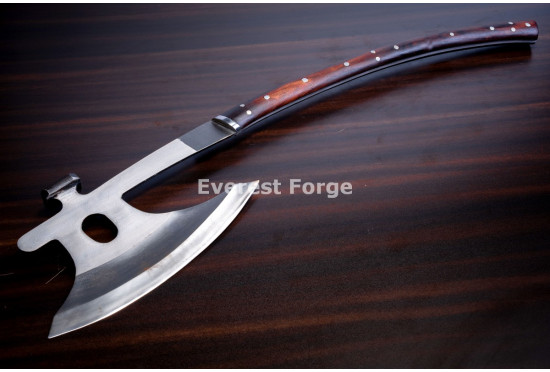
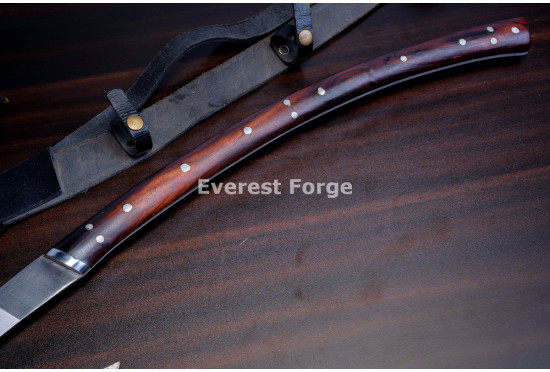
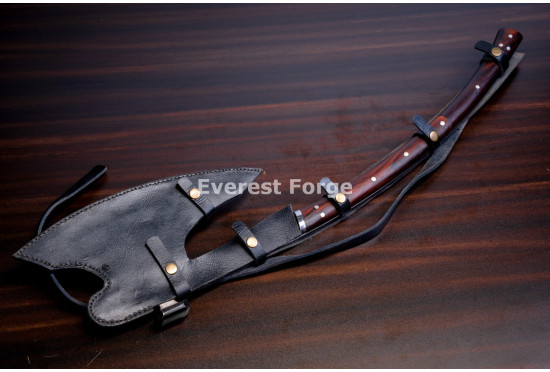
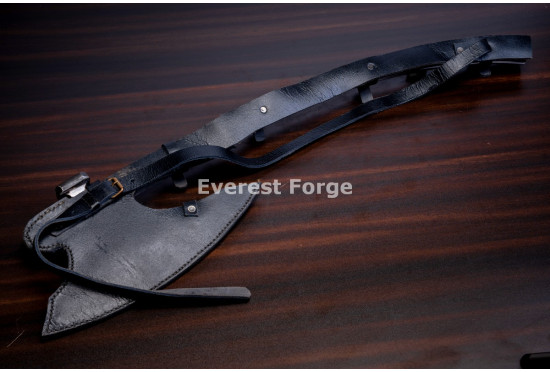
This is a hand-forged, fully functional bearded axe — the hooked Norse profile with the cutting edge extended downward below the haft line, forged in Nepal from 5160 high-carbon spring steel, oil-tempered, sharpened to a true edge, and finished satin. The head carries a cut-out through the blade and a squared poll at the back. Construction is full tang: the steel runs the whole length of the handle with contoured rosewood scales pinned through it. It ships with a black leather sheath with belt strapping. Every axe is made to order in your chosen size, finish, and engraving.

The standard head is 12 inches on a 19-inch handle, for an overall length around 31 inches at about 2.23 kg. That is a heavy axe — the head alone is 1.83 kg, which is felling-axe weight on a comparatively short handle. It hits extremely hard and it will tire you faster than a lighter one. The oil-tempered 5160 steel and full-tang construction make it a working tool rather than a wall piece.

An honest note. Three things worth knowing. The bearded profile is genuine — it is the Norse skeggox shape and it earns its keep, for reasons covered below. The construction is not: a historical axe head has an eye that the wooden haft is wedged through, where this is full tang with the steel running the length of the handle. That is a modern approach and it has real advantages, but it is not how a Viking axe was built and we would rather say so. And it is heavy. A Norse bearded axe head weighed somewhere between 500 and 900 grams because it was a weapon carried into a fight; this one is 1,830 grams because it is built to chop. If you want a light historical reproduction rather than a heavy working axe, tell us and we will forge one.

Bespoke Service

Forge an Axe to Your Own Design

Want a lighter historical head, a traditional eye-hafted build, a longer handle, or no cut-out in the blade? Our Custom Forge service builds to your spec, by hand in Kathmandu.

Request a Custom Forge →

What Makes It a Bearded Axe

The beard is the part of the cutting edge that hangs below the line of the handle, giving the head its hooked silhouette. Norse smiths called the type skeggox, and it is one of the more thoughtful pieces of design in early medieval toolmaking. Extending the edge downward rather than outward gives you a long cutting edge without adding the weight that a proportionally larger head would carry, which matters when the axe is swung all day or carried on a march. It also opens up the space behind the beard so a hand can grip the haft right up under the head for controlled work — carving, shaping, trimming — which turns a chopping tool into something far more versatile. And in a fight, the hook could catch a shield rim or a weapon shaft and pull it aside. This one takes that profile and builds it heavy, with a full-tang handle rather than the traditional eye.

Real Forged HeadHand-forged 5160 spring steel, oil-tempered and sharpened.
Bearded ProfileThe Norse skeggox shape — long edge, hooked below the haft line.
Full Tang ConstructionSteel running the whole length of the handle, scales pinned through it.
5160 Spring SteelTruck leaf-spring steel — tough, shock-resistant, holds an edge.
Contoured RosewoodShaped rosewood scales pinned to the tang with a curved profile.
Heavy Chopping Head1.83 kg of head — it hits considerably harder than it looks.

Specifications

TypeHand-forged bearded axe, full tang construction
Head Length12 inches standard (custom sizes to order)
Handle Length19 inches
Overall LengthApprox 31 inches as standard
WeightApprox 2230 g total, 1830 g head
Steel5160 high-carbon spring steel (truck leaf spring)
Heat TreatmentOil-tempered — hard edge, tough body
Head StyleBearded profile with hooked lower edge, cut-out through the blade, squared poll, satin finish, sharpened
ConstructionFull tang — steel through the handle with pinned scales, not eye-hafted
HandleContoured rosewood scales, curved profile
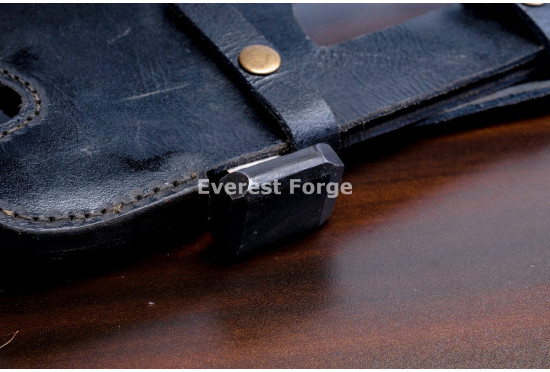
SheathBlack leather with belt strapping, included
OriginHand-forged in Tokha-3, Kathmandu, Nepal

Customize Your Axe

Every axe is forged to order. Set your options before you add to cart:

Head WeightStandard heavy chopping head, or a lighter historical head of 500 to 900 g.
Head LengthStandard 12 inches, or a smaller hand axe, or larger to your spec.
ConstructionFull tang as standard, or a traditional eye-hafted head on a wooden haft.
Cut-OutStandard cut-out through the blade, or a solid head with none.
Handle LengthStandard 19 inches, or longer for more reach and leverage.
Handle MaterialRosewood as standard, or walnut, ash, or buffalo horn.

Hand-Forged, Not a Wall-Hanger

This Axe

  • Hand-forged 5160 high-carbon spring steel
  • Oil-tempered — hard edge, tough body
  • Full tang with scales pinned through it
  • Edge geometry ground for cutting, not stamped from plate
  • Sharpened, balanced, made to your spec

A Wall-Hanger

  • Cast stainless, brittle under impact
  • No real heat treatment, edge rolls on first use
  • Head loose on the haft or glued in place
  • Flat plate profile with no edge geometry at all
  • Blunt, made for a shelf

How It Is Made

You set the spec — head weight and size, construction, cut-out, handle length and material.
A smith forges the head from a 5160 leaf-spring billet, drawing the beard and the edge geometry.
The head is oil-tempered, then finished to satin and hand-sharpened along the full edge.
We shape and pin the rosewood scales to the tang, cut the leather sheath, and ship worldwide tracked.

Who It Is For

  • Campers and bushcraft users who want serious chopping power in a short axe
  • Collectors of Norse and Viking-era arms who understand this is a modern build of a historical profile
  • Buyers who want a full-tang axe rather than a head wedged on a wooden haft
  • Anyone who has broken a hafted axe and does not want to do it again
  • Gift buyers personalizing a piece with a name, date, or engraving
  • Not for anyone wanting a light historical reproduction — order the lighter head instead

What Is Included

  • One hand-forged bearded axe, built to your chosen spec
  • Black leather sheath with belt strapping
  • Contoured rosewood scales pinned through a full tang
  • Any personalization or engraving you ordered
  • A satin-finished, sharpened head
  • Everest Forge manufacturer warranty

Explore More Hand-Forged Blades

Shipping, Returns & Care

Shipping

In-stock specs dispatch within 2 to 3 business days; fully custom builds take roughly 4 to 6 weeks to forge before dispatch. We ship worldwide by DHL or FedEx in 7 to 14 business days, tracked. This is a heavy item and shipping is priced accordingly. Import and blade laws vary by country, so please check your local rules before ordering.

Returns & Warranty

Every piece is backed by the Everest Forge warranty against forging and material defects. If something is wrong with your order, we will repair, replace, or refund it. Personalized and custom-engraved pieces are made to order, so please confirm your spec carefully before purchase.

Care

Wipe the head clean and dry after use and keep a light film of oil on it — 5160 is carbon steel and sap from green wood is acidic enough to mark it overnight. Pay attention to the cut-out and the join where the steel meets the scales, both of which trap moisture and are easy to miss with a cloth. Check the pins after heavy use. Give the rosewood an occasional wipe with oil, and store the axe out of its sheath rather than in it.

From The Forge

Build an Axe That Is Yours Alone

Beyond the options here, our Custom Forge service will build a light historical head, a traditional eye-hafted axe on a wooden haft, a longer handle for two hands, or a solid head with no cut-out. Roughly 4 to 6 weeks from order.

Start a Custom Forge →

Frequently Asked Questions

What is a bearded axe, and what is the beard for?

The beard is the part of the cutting edge that extends downward below the line of the handle, giving the head its hooked outline. Norse smiths called the type skeggox, and the shape does three things. It gives you a long cutting edge without the weight a proportionally bigger head would carry, which matters on a tool swung all day or carried on a march. It opens the space directly behind the beard so you can slide your hand up the haft and grip immediately under the head — that is called choking up, and it turns a chopping axe into something you can carve and shape with. And in a fight the hook could catch a shield rim or a weapon shaft and drag it aside. It is a genuinely clever piece of design and it is why the shape survived long after the Viking age, into carpentry and shipbuilding axes.

Why is this full tang rather than a head on a wooden haft?

Because it is a modern build, and we would rather explain the trade-off than pretend it is traditional. A historical axe has an eye — a shaped hole forged through the head — and the wooden haft is driven through it and locked with a wedge. That is how axes have been made for thousands of years and it works well: the wood absorbs shock, a broken haft is replaced in an afternoon, and the head can outlive several handles. Full tang runs the steel the whole length of the handle instead, with scales pinned to either side. What you gain is that the head cannot come off, cannot work loose, and cannot fail at the eye, which is where hafted axes break. What you give up is shock absorption — steel transmits impact straight into your hand where wood soaks some of it up — and repairability, because if you damage the scales you replace them rather than the whole handle. On a heavy chopper used hard, full tang is a defensible choice. On a light historical reproduction it would be the wrong one, and we build those eye-hafted.

What is the cut-out in the head for?

Honestly, mostly appearance. It removes a small amount of weight from the middle of the head where it contributes least, which is a real if minor effect, and it is a feature you see on a great many modern axes sold as battle axes. What it is not is historical — Viking and medieval axe heads were solid, because every hole is a place a crack can start and a smith working iron by hand was not going to add one for decoration. It also gives you one more surface to clean and oil. If you would rather have a solid head, that is a custom option and it costs nothing extra; we would build it that way ourselves.

Can I split firewood with it?

Some, but it is not what this shape is for, and understanding why will save you effort. Chopping and splitting are different jobs needing different geometry. A chopping axe — which this is — has a thin, keen edge that slices across the grain of standing or felled wood. A splitting axe or maul has a thick wedge-shaped cheek that forces wood apart along the grain, and it is deliberately blunt by comparison. Drive a thin chopping bit into a round of seasoned wood and it will bury itself and stick, because there is not enough taper behind the edge to force the halves apart. For kindling and small rounds you will manage. For serious splitting, use a splitting axe. Where this one excels is felling small trees, limbing, clearing brush and cutting across the grain, which is what a bearded profile was made for.

How do you sharpen an axe?

Differently from a knife, and this is where most axes get ruined. An axe edge is not a single flat bevel — it is a convex curve, thin at the very edge and thickening steadily back into the cheek, and that convexity is what stops the edge chipping when it meets a knot. Sharpening it flat on a bench stone destroys that curve and leaves you with a fragile edge that folds. Use a file or a coarse puck held at the angle the existing bevel already sits at, work in small circles from the edge back toward the cheek following the curve, and alternate sides evenly. Finish with a fine stone or a strop. Keep the whole thing wet or oiled while you work, and go carefully around the beard, where the curve tightens. If the edge has chipped rather than dulled, file the damage out completely before trying to raise a new edge on it — sharpening over a chip just makes a sharp chip.

It looks heavy. How does that affect the way it handles?

It is heavy, and we would rather be straight about it. The head alone is 1,830 grams, which is felling-axe weight, sitting on a 19-inch handle, which is a hatchet length. That combination is deliberately nose-heavy: the mass does the work for you, and a swing lands with real authority for the length of arc involved. What you pay is endurance — it is tiring to use for long stretches and slower to bring back between strokes, and after a while fatigue starts producing sloppy, unsafe swings. Work in short sessions. For comparison, a Norse bearded axe head weighed between 500 and 900 grams, because it was a weapon meant to be carried and used quickly rather than a tool meant to bite deep. If you want that lighter feel, order the historical head weight.

What is the squared section at the back of the head?

That is the poll — the flat or squared mass opposite the cutting edge. On this axe it serves two purposes: it counterbalances the bit so the head does not want to roll forward out of line during a swing, and it gives you a flat face that can drive a wedge or a stake in a pinch. It is not a hammer and should not be treated as one, particularly against hardened steel: the poll is not heat-treated for striking and repeated hammering will deform it. Historically many Viking axes had barely any poll at all, since the whole point of the design was to keep weight down. On a heavy modern axe like this one it earns its place.

Is this a real, functional axe?

Yes. It is hand-forged from 5160 high-carbon spring steel, oil-tempered, sharpened, and built on a full tang with rosewood scales pinned through it. It will fell small trees, limb, clear brush and take the abuse a working axe is meant to take. Do not use it on stone, metal, nails hidden in old timber, or as a hammer, and check the pins and the edge after heavy use.

What steel is it, and is it oil-tempered?

The head is forged from 5160 high-carbon spring steel, the same alloy used in heavy-duty truck leaf springs, prized for toughness and edge retention. It is oil-tempered for a hard cutting edge backed by a tough body. On an axe that toughness is more important than outright hardness: an axe edge takes repeated heavy impact against wood that may contain knots, grit or the occasional buried nail, and a very hard edge chips where a tougher one rolls slightly and can be filed back.

What are the handle and sheath made of?

The handle is contoured rosewood, shaped into a gentle curve and pinned through the full-length tang from either side. Rosewood is dense and hard-wearing and holds a fine finish, though on a full-tang axe the scales are doing less structural work than a traditional wooden haft would — the steel carries the load. The sheath is black leather with belt strapping, cut and stitched by hand to fit the head size you order. Because rosewood is a natural material, grain and colour vary between pieces.

Does it arrive sharpened, and can I order a traditional build?

It arrives sharpened along the full edge, finished by hand. Choose the display-blunt option if you need it unsharpened for display or to satisfy import rules where you live, at no extra charge. And yes to the traditional build: we will forge a proper eye-hafted head at historical weight, between 500 and 900 grams, and fit it to a wooden haft the way a Norse smith would have. That is a different axe from this one in the hand — lighter, quicker, more shock-absorbing — and it is the right choice if you are collecting or reenacting rather than chopping. Ask through Custom Forge and we will quote it.

Do you ship worldwide, and how long does it take?

Yes. We ship worldwide from Nepal by DHL or FedEx in 7 to 14 business days with tracking. In-stock specs dispatch within 2 to 3 business days; fully custom builds take roughly 4 to 6 weeks to forge first. This is a heavy item, so shipping is priced accordingly. Import and blade laws vary by country and axes are treated differently from blades in some jurisdictions, so please check your local rules before ordering.

Specification
Blade: 12 inch head. Hand forged from 5160 carbon steel
Handle: 19 inches. Full tang construction, contoured rosewood scales pinned through the steel
Weight: Approx 2230 grams total (head approx 1830 grams)
Note: As every piece is forged by hand, slight variation in weight, dimensions and finish may occur. Rosewood grain varies between pieces. This is a heavy axe - see the product description for handling notes. Keep the head lightly oiled when not in use.

Write a review

Note: HTML is not translated!
Bad Good
Captcha