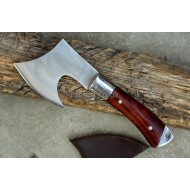
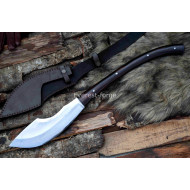
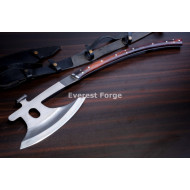
- Model: Axe set
- Product Code: AXEKARAMBIT001
- Location: Kathmandu, Nepal
Available Options
A Hand-Forged Axe and Karambit Set With a Ring Pommel
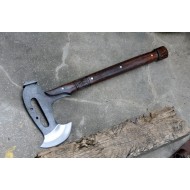
This is a two-piece set, hand-forged from 5160 high-carbon spring steel in our workshop in Tokha-3, Kathmandu, with a leather sheath for each blade. The large piece is a full-tang chopper in an axe silhouette: a broad, deep-bellied blade with a hammer-dimpled upper flat and a polished bevel, on a carved rosewood handle finishing in a steel ring pommel. The small piece is a karambit, a curved claw blade with twin pierced holes, rosewood scales and a steel finger ring. Nothing is held in stock and nothing here is fixed: both are forged after your order arrives, so the dimensions, the handle material, the blade flat and the edges are all yours to set at no extra cost.
The two share their materials rather than their job. The chopper is a two-handed tool built to cut through things and it does that very well — a thick head on a long handle, with the mass arriving where the edge does. The karambit is a small close-work blade from a completely different tradition, and it is here because it is made from the same steel, wears the same rosewood, and sits in matching leather. That is a good reason to own a pair. A coordinated fighting system it is not, and we will not sell it as one.
The most interesting thing about the chopper is what it is not. There is no axe eye and no separate haft: the blade and the tang are one continuous bar of steel with the rosewood pinned either side of it. That removes the failure that ends most axes, and it is worth a proper answer below.
An honest note. Three things, and one of them is unusually good news. The large piece is not an axe in the strict sense — no eye, no wedged haft — which is mostly an advantage, though it means it cannot be re-hafted if the handle is ever damaged. Second, the hammer dimpling is decoration. You will find it sold on the claim that it stops a blade sticking in the cut; on a heavy chopper that effect is essentially nil, and what the dimples definitely do is give rust more places to start. A plain flat is free if you prefer. Third, the good news: at 1,590 grams this chopper sits inside the weight band a felling axe of the same length occupies, which is not something we can say about every blade we make. It is not overweight for the job.
Why It Is Built This Way
Full Specifications
Figures are taken from the set shown and describe the standard build. Hand-forged work varies a little from piece to piece, so read these as close rather than exact. If a dimension matters, tell us before we start and we will build to it and measure the finished pieces for you.
Build It Your Way
None of this costs extra, because none of it is made before you ask for it. Work down these six and put what you want in the order note.
Think about a shorter handle
Nineteen inches makes the chopper a two-handed tool with real tip speed behind it, and that is the right build if you want maximum cutting power or a piece with presence on a wall. But 12 to 14 inches turns the same head into a big one-handed chopper that is far less tiring to work with and much easier to store and carry. It costs nothing, adds no time, and it is what we would build for most people who tell us they mean to use it.
Talk to the Forge →What It Does Well, and What It Does Not
What it does well
- A genuine pair rather than two unrelated blades in a box: same steel, same rosewood, matched leatherwork, made together.
- One-piece construction on the chopper, which removes the failure that ends most axes.
- Real chopping authority. A thick 12 inch head on a 19 inch handle cuts far above what the blade length suggests.
- Sensible total weight for the class — 1,590 grams sits inside the band a felling axe of this length occupies, which is not something we can say about every piece we make.
- Sheaths genuinely cut to these two outlines rather than made to a pattern and forced over them.
- Everything configurable at no extra cost, including the shorter handle that suits most buyers better.
What it does not do
- The chopper is not an axe. No eye, no haft, no wedge — which is mostly a strength, but it cannot be re-hafted if the handle is damaged.
- The dimpling is decoration. It does not stop the blade sticking in what it cuts, and it gives rust more places to start.
- The two pieces do not pair functionally. A chopper and a karambit do unrelated jobs; the set is aesthetic, not a system.
- Karambits are specifically restricted in some jurisdictions in a way choppers are not. Check the small blade separately before importing.
- A solid tang transmits more shock into the hands than a timber axe haft does. Noticeable over a long session.
- Neither is stainless. 5160 rusts if left wet, and the dimpled flat needs oiling more thoroughly than a plain one.
How to Order
Who It Is For
- Buyers who want a matched pair rather than two blades that happen to be in the same order.
- Collectors of large choppers who like the axe silhouette without the axe failure mode.
- Anyone who wants serious cutting capability from a tool short enough to hang on an ordinary wall.
- Buyers drawn to the hammer-dimpled look, who would rather know it is decorative than be told it reduces friction.
- Anyone who would rather be warned that the small blade may need checking against local knife law than find out at customs.
- Buyers who intend to actually use it — with the suggestion of a shorter handle and a micarta grip.
What Is Included
- The chopper, hand-forged in Tokha-3, Kathmandu, Nepal.
- The karambit, hand-forged to match in the same steel and handle material.
- A shaped black leather sheath for the chopper, with a riveted belt arrangement and brass studs.
- A shaped black leather sheath for the karambit, with a stud closure.
- A protective coat of oil on both blades for transit, wiped off before handling.
- Care instructions, and the Everest Forge manufacturer warranty against defects in materials and workmanship.
Want a different pair?
A chopper matched to a bowie instead of a karambit, three pieces rather than two, a single rig that carries both blades on one belt, or the same set in horn and micarta. Sets are one of the easier things to change because nothing is made until you ask. Tell us what you want in the box and we will quote it.
Start a Custom Forge Request →Related Blades and Reading
Shipping, Returns and Care
Dispatch and transit. Standard builds leave the workshop in 2 to 3 business days. Genuinely custom work — a different handle length or material, a plain flat, a different pairing — runs 4 to 6 weeks depending on the queue. Both pieces ship sheathed and braced in a rigid carton by DHL or FedEx with tracking, typically 7 to 14 business days from Kathmandu.
Duties, import and knife law. Import duty and local taxes are the buyer's responsibility and vary by country. Please check the karambit separately rather than assuming the set travels as one item: ring-handled and claw-shaped knives are specifically restricted in some jurisdictions in a way that a large chopper is not, and a set can be held up by its smallest piece. If an unsharpened build would make the difference, we will supply one at no extra cost, and we can supply the two pieces in separate shipments if that helps.
Returns and warranty. Because everything is forged after the order, a custom build cannot be restocked, so please make sure the specification is right before you confirm. Anything damaged in transit, or showing a defect in materials or workmanship, is covered by the Everest Forge manufacturer warranty and we will repair or replace it. Photograph the packaging as well as the blades if something has gone wrong on the way.
Care. 5160 is a high-carbon steel and it is not stainless. Wipe the transit oil off before handling and put a light film back on before either piece goes away. The dimpled flat needs more attention than a plain blade, not less: every dimple is a small reservoir where moisture can sit, and oil needs working into them rather than wiped across the top. On the karambit, the twin pierced holes and the inside of the curve are the equivalent traps. Do not store either blade in its sheath for long periods, since leather holds moisture against steel. Light surface rust comes off with oil and fine steel wool. The rosewood wants a rub of furniture or boiled linseed oil once or twice a year.
Questions About This Set
What is in the set?
Two pieces, each with its own leather sheath. The large one is a full-tang chopper in an axe silhouette: a broad deep-bellied blade with a hammer-dimpled flat and a polished bevel, on a long rosewood handle finishing in a steel ring pommel. The small one is a karambit — a curved claw blade with twin holes through it, rosewood scales and a steel finger ring at the butt.
They share their materials rather than their job. The chopper is a two-handed tool for cutting through things; the karambit is a small close-work blade. Anyone telling you a set like this is a coordinated fighting system is selling you a story. What it genuinely is, is two well-made blades that look like they belong together, which is a perfectly good reason to buy a pair.
Is the big one actually an axe?
Not in the strict sense, and the distinction is worth having because it is in your favour. A real axe is a head with an eye through it, wedged onto a separate haft. This is one continuous piece of steel: the blade and the tang are the same bar, and the rosewood is pinned on either side of it.
That removes the classic axe failure outright. Heads come loose because the haft dries, shrinks and works in the eye under repeated shock, and a loose head is both useless and dangerous. A full-tang chopper cannot do that. What you give up is the ability to re-haft it if the handle is ever damaged — on an axe you fit a new haft, on this you send it back to us — and a solid tang transmits more shock into your hands than a timber haft does. For most owners that is a good trade.
What is the dimpled texture on the blade for?
Looks, and we would rather say that than repeat the usual claim. Dimpled and scalloped flats get sold on the idea that they reduce friction and stop the blade sticking in what it cuts. On a thin kitchen knife going through something wet and dense there is a small real effect. On a heavy chopper swung through wood or bone there is effectively none — the blade is through and out before suction has a chance to matter.
So it is decoration, and it is handsome decoration: hundreds of overlapping hammer marks over the upper flat, with a clean polished bevel below them. The one thing worth knowing is that a dimpled surface has considerably more area than a flat one and every dimple is a place for moisture to sit, so it wants oiling more thoroughly than a plain blade. A plain flat is available at no extra cost if you would rather.
What is the karambit for, and does it pair with the axe?
A karambit is a small curved utility and close-work knife with a finger ring at the butt, from the Malay and Indonesian tradition, where it started as an agricultural blade before it became a fighting one. The ring lets you retain it in a way a straight handle cannot, and the curve means the point is always oriented for a pulling cut.
It does not pair with the chopper functionally — they do unrelated things. The pairing is aesthetic: same rosewood, same steel, matched leatherwork. Worth knowing before you order: karambits and ring-handled knives are specifically restricted in some jurisdictions in a way that a chopper is not, so if you are importing into somewhere with strict knife law, check the karambit separately rather than assuming the set travels as one thing.
How heavy is the chopper?
1,590 grams, and the complete set with both sheaths comes to 2,300. For once this is a weight we can report without a caveat: a two-handed chopping tool 31 inches long sits comfortably in the band a felling axe of the same length occupies, roughly 1,400 to 1,800 grams. It is not overweight for what it is.
The blade itself is thick, though. Work back from the total and the head carries something in the region of 80 to 95 grams for every inch of its 12 inch length, which is above what we put into a heavy kukri. That is deliberate on a chopping tool and it is where the authority comes from. Note also that grams per inch of BLADE is a useless figure on anything with a long handle — the handle carries a large share of the mass, and the honest number is the one measured over the whole length.
What size is it, and can I change it?
The standard build gives the chopper a 12 inch blade on a 19 inch handle, 31 inches overall. That is a default rather than a fixed specification — everything we make is forged after the order, so the dimensions are yours to set.
The handle length is the change worth thinking about. Nineteen inches makes this a genuinely two-handed tool with real tip speed behind the cut. Shorter — 12 to 14 inches — turns it into a big one-handed chopper you can work with for longer without fatigue, which suits a lot of buyers better. Tell us what you want to do with it and we will tell you what we would build.
What are the handles made of?
Rosewood as standard on both pieces, pinned through the tang, with the chopper's handle carved in a segmented pattern for grip and finishing in a steel ring pommel. Rosewood is our default across the range: dense, hard, dimensionally stable and about as handsome as timber gets.
There are other options at no extra cost — horn, bone, micarta, and leather over timber for a warmer and grippier hold. On a chopping tool specifically, micarta is worth considering: it is completely indifferent to damp and it grips better wet than dry, which timber does not. Whatever you choose, both pieces are made to match.
Do they arrive sharp?
Yes, both of them, sharpened and ready to use unless you tell us otherwise. On the chopper the edge is finished along the polished bevel below the dimpling; on the karambit it runs the full inside of the curve.
Unsharpened builds are free, for display or for an awkward import. So is a stage combat build — rebated edge, rounded tip — though on a 1,590 gram chopper a rebated edge does not make the weight any safer.
What steel is it, and how is it heat treated?
5160 high-carbon spring steel for both pieces, which we use across the whole range. Each blade is forged to shape, quenched, and then tempered back by hand as a separate operation afterwards. Those two steps are distinct and the second is what matters, and on a chopping tool it matters more than on almost anything else: a chopper takes repeated shock loads, and an untempered blade chips its edge or cracks rather than absorbing them.
5160 is not stainless and is not meant to be. It rusts if left damp — and see the note about the dimpling, which gives it more places to do so — and in exchange it takes and keeps an edge far better than any stainless we could sensibly forge. We do not make pattern-welded or laminated blades at all, by choice.
Where does the chopper balance?
Well forward of the hand, which is correct for the job. The head is heavy and the handle is comparatively light, so the mass arrives where the edge does. The steel ring pommel at the butt claws a little of it back.
We do not publish a single point-of-balance figure, because hand-forged work varies and a number two inches out is worse than none. Ask before dispatch and we will measure the actual piece we are sending you, from the front of the handle, and send you the figure.
What sheaths come with it?
Two, both in black leather. The chopper's is shaped to its broad blade with a riveted belt arrangement and brass studs; the karambit has its own small sheath with a stud closure, cut to the curve of the claw.
The chopper's sheath is built to that outline rather than made to a pattern, which matters on a blade this broad — a generic sheath will not take it. Colours and carry arrangements are yours to specify, and if you want a single rig that carries both pieces together rather than two separate sheaths, that is a custom forge item and we will quote it.
How long does it take, and how is it shipped?
Nothing is held in stock. Both pieces are forged after the order arrives, which is why the dimensions, the handle material, the finish and the edge specification are all free to change. Standard builds dispatch in 2 to 3 business days; genuinely custom work runs 4 to 6 weeks depending on the queue.
The set ships with both pieces sheathed and braced in a rigid carton, by DHL or FedEx with tracking, typically 7 to 14 business days from Kathmandu. Import duty and local taxes are the buyer's responsibility and vary by country, and please read the note in FAQ 4 about the karambit specifically.
| Specification | |
| Blade: | 12 inches. Hand forged from 5160 carbon steel |
| Total Length: | 31 inches |
| Handle: | 19 inches. Full tang, pinned rosewood scales, steel ring pommel |
| Weight: | 1590 grams the chopper, 2300 grams the set with both sheaths |
| Note: | Handmade variation in weight, dimensions and finish may occur. Keep blade lightly oiled when not in use. |

-190x190w.jpg "Hand-Forged Anime Combat Kama — 8\" 5160 Steel Twin-Ready Sickle")