Menu
Your Cart

Hand-Forged Fantasy Sword, Skeleton Guard

Hand-Forged Fantasy Sword, Skeleton Guard
$244.99
Ex Tax: $244.99
  • Model: Fantasy Swords
  • Product Code: FANTASY0024
  • Location: Kathmandu, Nepal

Available Options

A Hand-Forged Fantasy Sword With a Skeleton Guard

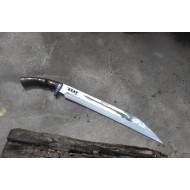
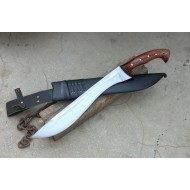
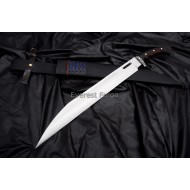
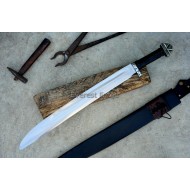
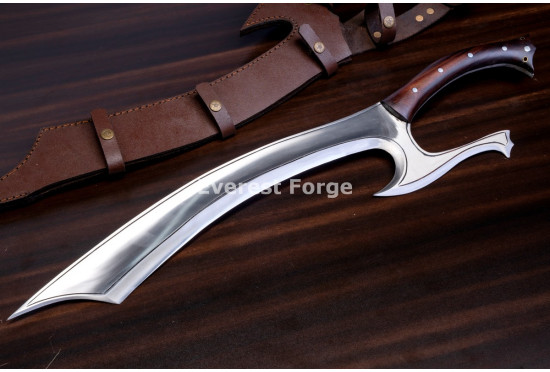
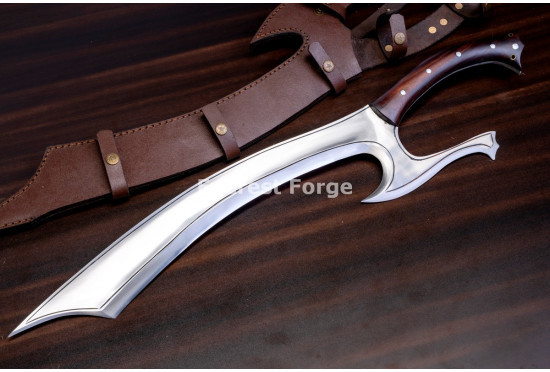
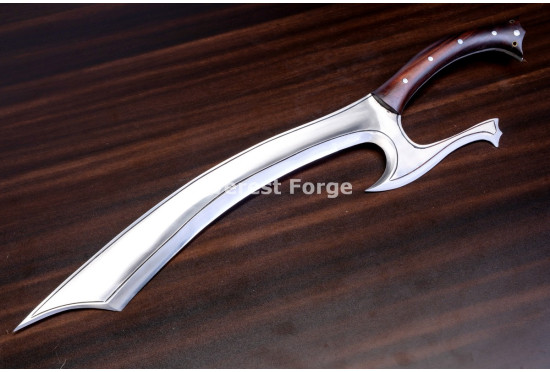
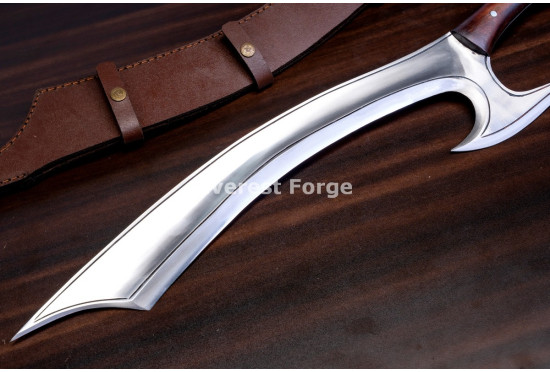
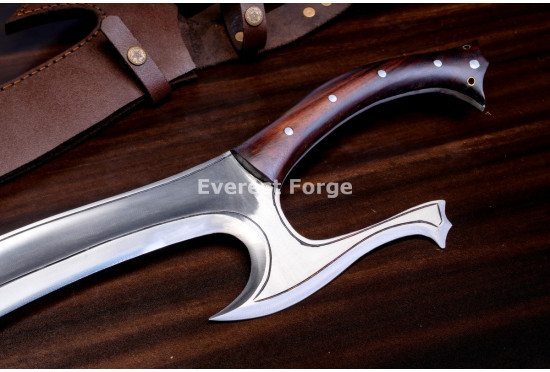
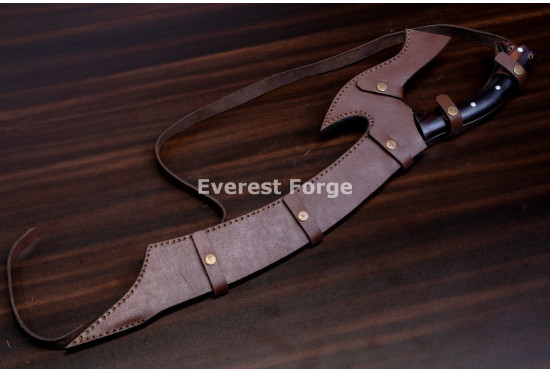
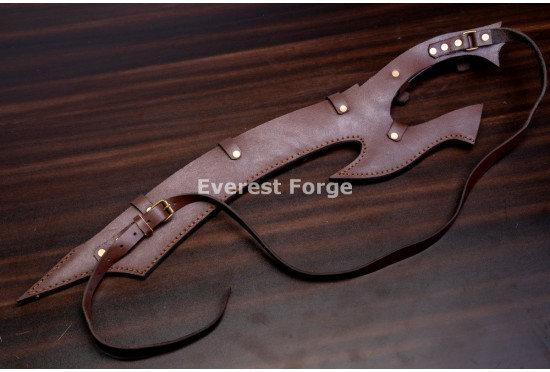
This is a single-edged fantasy sword with a 24 inch curved blade and a 32 inch overall length, hand-forged in Tokha-3, Kathmandu, Nepal from 5160 high-carbon steel, oil-quenched and tempered. The blade sweeps forward through a shallow recurve into a long clipped point, with a fine engraved line following the spine and a satin polish on the flats. The hilt is what sets the piece apart: a sculpted steel guard pierced through with a large open aperture, one branch sweeping down and forward into a hook and the other running back beneath the hand into a flared terminal, with bare rosewood scales riveted through the tang. It ships sharpened, in a fitted brown leather sheath.

An honest note. This is an original fantasy design, not a reconstruction of any historical sword, and the hilt in particular corresponds to nothing that was ever carried. What is real is the construction. The grip is built the way a large knife is built — a flat, full-width tang with rosewood scales riveted straight through it, rather than a narrow tang threaded through a grip and capped with a pommel. That is genuine messer construction, the same method that separates a historical Messer from a falchion, and it is stronger in the hand than the sculpted guard might suggest. The pierced guard is decorative first and functional second; we would rather say that plainly than claim a fighting pedigree the shape does not have.

Custom Forge

Have a Fantasy Design of Your Own?

This is the kind of piece our smiths most enjoy. Send a drawing, a screenshot, a character reference or a rough sketch on paper — blade profile, guard shape, grip and sheath can all be built to it. Concept art is enough to start from.

Start a Custom Build →

Why This Sword Is Built the Way It Is

Pierced Skeleton GuardThe aperture through the guard is cut, filed and polished on both faces rather than cast. It removes weight from the one place on a sword where weight does the least good and gives the hilt its silhouette.
Riveted Rosewood ScalesBare rosewood, shaped and riveted directly through a full-width tang. No wrap to wear through, no glue joint to fail, and the grain is visible rather than hidden.
Shallow RecurveThe blade eases forward rather than bending hard, which keeps the mass distributed along its length instead of piling it behind the point. It cuts cleanly without feeling like a chopper.
Long Clipped PointThe last third draws down into a fine point with the spine falling away to meet it, so the sword can still thrust despite the curve in the blade.
Knife-Style ConstructionA flat, full-width tang running the length of the grip with the scales pinned through it. This is how large working knives are built, and it is the strongest way to hang a grip on a blade.
5160 High-Carbon SteelSpring steel, oil-quenched and tempered. It takes an edge and flexes under load rather than shattering — the same family Nepali smiths have drawn from leaf spring for generations.

Full Specifications

Blade Length24 inches
Handle Length8 inches
Overall Length32 inches
Blade Steel5160 high-carbon spring steel, oil-quenched and tempered
Blade ProfileSingle-edged, shallow forward recurve with a long clipped point
EdgeSingle edge on the outer curve, sharpened and ready to use
ConstructionFull-width tang with scales riveted through, knife-style
GuardSculpted steel guard pierced with an open aperture, hooked forward branch and flared rear terminal
SheathFitted brown leather sheath
OriginHand-forged in Tokha-3, Kathmandu, Nepal
Standard Build24 inch blade, satin finish, rosewood scales. Blade length, blade finish and grip material are selectable above — the photographed piece shows the standard build.

How You Can Configure It

Blade LengthShorter for a faster single-hand sword, longer if the piece is going on a wall. The recurve is redrawn rather than stretched so the balance stays where it should be.
Blade FinishA bright satin that catches the sweep of the recurve and the engraved spine line, or a darker finish that gives the sword a colder, heavier presence.
Grip MaterialBare rosewood scales as standard, or hardwood, horn, micarta or a leather-wrapped grip. Bare scales show the grain; micarta handles wet use without moving.
Guard FinishPolished as photographed, or taken to a satin or darkened finish so the guard reads as a silhouette rather than catching the light.
Edge GeometryA keen cutting edge, or a blunted display edge if the sword is going into a case, a costume or a stage production.
MarkingsInitials, a name, a date or a small motif etched on the flat. Send the text with your order note.

Is This the Right Sword for You?

Buy This If You Want

  • A fantasy sword that is not a copy of anything anyone else is selling
  • A hilt with real hand work in it — the aperture is cut and filed, not cast
  • Knife-style riveted construction, which is the strongest way to hang a grip
  • Bare rosewood you can see the grain in rather than a wrap that wears through
  • Real forged 5160 with a proper heat treatment behind the styling
  • Something a smith will alter to your dimensions before it ships

Look Elsewhere If You Want

  • A historical sword — the hilt corresponds to no period pattern
  • A hilt that protects the hand fully; a pierced guard is styling first
  • A sword for steel-on-steel contact work, which this guard is not built for
  • A stainless blade that needs no oiling or care
  • A two-handed sword; the 8 inch hilt is single-hand
  • Identical units; every piece is forged and filed by hand and varies slightly

How to Order

Choose Your BuildSet blade length, finish, grip material and guard finish from the options above, then add to cart.
Add Any NotesEtching text, edge geometry or a blunted display edge go in the order note.
We Forge and FileStandard builds dispatch in 2 to 3 business days. Custom builds take 4 to 6 weeks from confirmation.
Tracked DeliveryDHL or FedEx, 7 to 14 business days worldwide, tracked door to door and covered by our manufacturer warranty.

Who This Sword Suits

  • Fantasy collectors who already own the licensed replicas and want something nobody else in the room will have.
  • Cosplayers and prop builders who need a silhouette that reads instantly on camera, with a blunted option available.
  • Gamers and worldbuilders putting a sword from a campaign, a novel or a screen into actual steel.
  • Knife collectors moving up in size, since the construction here is knife construction rather than sword construction.
  • Gift buyers looking for a display piece with visible hand work, etched with a name or a date.

What Is Included

  • One hand-forged fantasy sword, sharpened and ready to use
  • Fitted brown leather sheath
  • Care and oiling instructions
  • Everest Forge manufacturer warranty against defects in forging and heat treatment

Other Hand-Forged Curved and Fantasy Blades

Shipping, Returns and Care

Shipping. Standard builds dispatch in 2 to 3 business days. Custom builds take 4 to 6 weeks. We ship worldwide by DHL or FedEx, 7 to 14 business days, fully tracked. Sword laws vary by country and by state — please check what applies where you live before ordering, as we cannot deliver into a restricted address.

Returns. Standard builds can be returned unused and in the original sheath within 30 days. Custom builds, altered dimensions and etched pieces are made to your specification and cannot be returned unless there is a fault in forging or heat treatment.

Care. 5160 is a high-carbon steel and it will rust if you neglect it. Wipe the blade dry after handling and keep a thin film of oil on it in storage. Pay attention to the inside edges of the pierced aperture and the shoulders where the guard meets the blade — a cloth skips over both and moisture sits there. Bare rosewood scales need no wrap care, but a light coat of a hard wax or a furniture oil once or twice a year keeps the grain from drying. Do not store the sword sheathed for long periods, because leather traps damp against steel.

Frequently Asked Questions

Is this based on a sword from a film or a game?

No. It is an original design from our own workshop, and the hilt in particular corresponds to no historical pattern and no licensed property. We build inspired-by pieces on request, but this one is ours, which means you can own it without it being the same sword ten thousand other people bought from the same licence. If you are after a specific sword from a film, a game or a novel, send us the reference and our custom forge will quote it — we will tell you honestly if it is something we can build or something we should not.

What does piercing the guard actually do?

Three things, and the trade-offs are worth understanding before you buy any sword with a cut-out hilt. First, weight: metal removed from the guard comes off the part of the sword closest to your hand, which is where mass affects handling least, so a pierced guard lightens the piece without pushing the balance forward. Second, appearance: an open guard reads as a shape against the background rather than a solid block, which is why it photographs so well and why fantasy designers reach for it. Third, and this is the honest part, strength: every internal corner in a cut-out is a stress riser, a point where force concentrates instead of spreading. On a decorative or display sword that is irrelevant. On a sword taken into contact work it is not, which is why we say plainly that this guard is styled first and structural second. Ours is cut, filed and polished on both faces by hand, which rounds those internal corners far better than casting does — a cast pierced guard has sharp internal angles you cannot see under the finish.

Why is a 32 inch sword built like a knife?

Because the construction is genuinely knife construction, and it is a deliberate choice rather than a shortcut. The tang here is flat and full width, running the length of the grip with the rosewood scales riveted straight through it — the same way a large fixed-blade knife is built. The alternative, used on most European swords, is a narrower tang threaded through a solid grip and capped with a pommel that holds the assembly in compression. Historically this exact distinction is what separates a Messer from a falchion: the blades can look identical, and the difference is entirely in the hilt. Riveted-scale construction is extremely strong in the direction a blade is normally loaded, and it has no glue joint and no wrap to wear through. What it gives up is the pommel counterweight, which is why swords built this way carry their balance a little further forward than a pommelled sword of the same length.

How do I choose between your fantasy swords?

Start with how you will hold it, then with the silhouette. On grip length: this sword and the fantasy scimitar are single-hand pieces, while the fantasy messer and fantasy falchion carry two-hand grips of ten to eleven inches. On blade shape: this one is a shallow recurve with a long clipped point, the scimitar and dao families are more strongly curved, and the falchion and messer are broader and straighter-backed. On hilt: this is the only one in the range with a pierced open guard and bare riveted scales, which is also what makes it the most distinctive in a photograph. And on use: if the sword is going into contact work rather than display or cutting, none of the sculpted-guard pieces are the right answer — commission a purpose-built blunt from the custom forge instead.

What steel is it and how is it heat treated?

5160 high-carbon spring steel, oil-quenched and then tempered back. 5160 holds a working edge and flexes under load rather than snapping, which matters on a long single-edged blade. It is also the steel family Nepali smiths have traditionally drawn from vehicle leaf spring, so our forge reads it by colour and by sound at the anvil rather than by instrument alone. The guard is worked from steel and finished by hand, not cast.

Does it arrive sharp?

Yes. It ships with a working edge along the outer curve, sharpened by hand and ready out of the sheath. It is not a blunt wall-hanger with a sword-shaped profile ground into it. If the sword is going into a display case, a costume or a stage production where an edge is a liability, ask for it blunted in the order note before we ship and we will finish it that way at no extra cost.

Is the tang full length?

Yes — full width as well as full length. The tang is a flat continuation of the blade running the whole length of the grip, with the rosewood scales pinned through it. You can see the rivet heads on the scales in the photographs, which is the visible sign of the construction. There is no narrow hidden tang and no glued grip block. On a blade of this length that matters, because a 24 inch blade generates real leverage against the hilt, and a partial tang is where that leverage eventually finds the weak point.

Can I have it made longer or shorter?

Yes. Blade length is selectable, and beyond the listed options our smiths will forge to a dimension you specify. The recurve gets redrawn when the length changes rather than simply stretched — scaling a curve up without redrawing it puts the mass in the wrong place and the sword feels dead in the hand. That redrawing is included in a custom build. Going substantially longer will usually mean lengthening the grip too, and we will flag that before we start rather than surprise you with it.

Is the sheath included?

Yes. A fitted brown leather sheath comes with the sword, cut around this specific blade profile. A recurved blade with a clipped point is awkward to sheath safely, so it is made around the piece rather than being a generic sleeve the sword happens to fit. A belt frog, a baldric or a wall mount can be added on request, and if you change the blade length on a custom build the sheath is made to the new dimensions.

How do I look after the steel and the rosewood?

Wipe the blade dry after handling, since fingerprints are acidic enough to etch a satin finish within days, and keep a thin film of camellia, mineral or light gun oil on it in storage. Two places people miss on this hilt: the inside edges of the pierced aperture and the shoulders where the guard meets the blade, where a cloth skips over and moisture sits. Check both every time. Bare rosewood scales need no wrap care, but give them a light coat of a hard wax or a furniture oil once or twice a year so the grain does not dry and lift around the rivets. Do not store the sword sheathed for long periods.

Will every sword look exactly like the photograph?

No, and that is inherent to hand forging and hand filing. Every blade is drawn out under a hammer, so the depth of the recurve and the width through the belly carry small differences from piece to piece. The guard aperture is cut and filed by hand, so its exact curve differs on every one — this is the part where the variation is most visible. Rosewood is a natural timber, so grain and colour vary on every set of scales. Weights and dimensions vary by a few percent. What is consistent is the steel, the heat treatment, the construction and the edge.

Where is it made and by whom?

Hand-forged in Tokha-3, Kathmandu, Nepal, by our own smiths. Everest Forge is a working forge rather than a reseller putting a name on imported blanks — the steel is cut, drawn, quenched, tempered, ground, the guard cut and filed, the scales shaped and riveted, and the sheath stitched, all under one roof. That is why we can build to a drawing on a custom order: there is a smith at the anvil and a fitter at the bench rather than a catalogue of finished stock.

Specification
Blade: 24 inches. Hand forged from 5160 carbon steel
Total Length: 32 inches
Handle: 8 inches, full-width tang with rosewood scales riveted through, sculpted pierced steel guard
Weight: 1200 Grams Approx
Note: handmade variation in weight, dimensions and finish may occur; keep blade lightly oiled when not in use

Write a review

Note: HTML is not translated!
Bad Good
Captcha