The Oakeshott Typology Explained: How Medieval Swords Are Actually Classified
Names like "longsword" and "arming sword" describe how a sword is held. The Oakeshott typology describes what the blade actually is — its profile taper, its fuller, its cross-section and its point. They are two different axes, and confusing them is why so much sword discussion goes in circles. A Type XV can be an arming sword or a longsword. Saying "a Type XV is a longsword" is not wrong so much as incomplete.
This is the system serious collectors, curators and makers use to describe medieval European swords precisely. It runs from Type X to Type XXII, it is easier to learn than it looks, and once you have it you can ask a question that a maker can actually answer.
Why It Starts at Type X
The first question everyone asks, and the answer is more interesting than "he felt like it".
Oakeshott did not begin a new sequence. He continued an existing one. In 1919 the Norwegian archaeologist Jan Petersen classified Viking swords in De Norske Vikingsverd. In 1927 R. E. M. Wheeler condensed that work into a simplified typology of nine types, labelled I to IX. When Oakeshott came to classify the medieval knightly sword, he picked up where Wheeler stopped and numbered his first type X.
If you want the earlier half of the story, our guide to Viking sword types and the Petersen typology covers Types I to IX and the system Oakeshott was continuing. The two guides together span the whole sequence from the 8th century to about 1500.
So Types I to IX exist — they are Viking swords, and they are somebody else's work. The Oakeshott sequence is the medieval continuation of a Viking system, which is also a neat statement of what actually happened historically: the knightly sword did not appear from nowhere, it grew out of the Viking sword, and Type X is explicitly the transitional form.
What the System Actually Classifies
This is where most people go wrong, and getting it right makes everything else straightforward.
Earlier typologies classified swords by their hilts, because hilts are decorative and vary obviously while blades all looked broadly similar. Oakeshott inverted that. His numbered types classify the blade — profile, taper, fuller arrangement, cross-section and point.
Hilt components get their own separate systems:
Pommels are lettered, A through Z, describing shape — Brazil-nut, disc, wheel, scent-stopper, fishtail and so on. Our guide to pommel types covers them.
Crossguards are numbered in a separate style sequence, describing the shape and section of the cross.
So a full description looks like Type XVIIIa blade, Type J pommel, style 6 cross. Three independent facts about three independent components. That is the whole architecture, and once it clicks the system stops being intimidating.
The Types at a Glance
| Type | Blade | Built for | Roughly |
|---|---|---|---|
| X | Broad, flat, wide shallow fuller running nearly the full length, rounded point | Cutting | Late Viking age to 13th c. |
| XI | Slimmer and longer than X, with a narrower fuller | Cutting from horseback | 11th to 13th c. |
| XII | Steady taper to a functional point, fuller over two-thirds to three-quarters | Cut and thrust | 13th c. |
| XIII | Long and wide with near-parallel edges, rounded or spatulate tip, lens section | Cutting, with a longer grip | 13th to 14th c. |
| XIV | Short, broad, sharply tapering, often a wide flat blade | Cutting with a usable point | Late 13th to early 14th c. |
| XV | Diamond section, no fuller, acute point | Thrusting against plate | 14th to 15th c. |
| XVI | Hybrid — fuller in the upper half, diamond section below | Genuine cut and thrust | 14th c. |
| XVII | Long, slender, acutely tapering, hexagonal section, long grip, notably heavy | Punching through plate | c. 1360 to 1420s |
| XVIII | Broad at the hilt tapering to a sharp point, flattened diamond with a midrib | Cut and thrust, well balanced | 15th c. |
| XIX | Flat blade, hexagonal section, narrow fuller high on the blade, often a ricasso | Cut and thrust | 14th to 15th c. |
| XX | Large two-handed blade, usually multiple fullers | Two-handed cut and thrust | 14th to 15th c. |
| XXI | Cinquedea-related, tapering to an acute point, several wide shallow fullers | Civilian carry and status | Late 15th c. |
| XXII | Broad flat blade, graceful taper, two short deep narrow fullers | Cut and thrust, often ceremonial | End of the 15th c. |
Read the "built for" column top to bottom and you have the entire history of medieval armour. Broad cutting blades while opponents wore mail, then a transitional group, then stiff acute points once plate arrived, then a return to versatility as firearms made heavy armour less worthwhile. The typology is a chronology of a problem being solved.
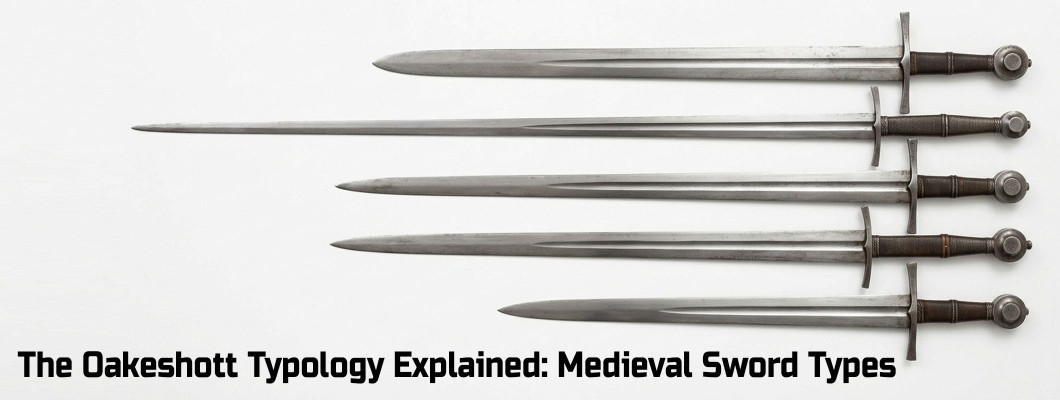
Set side by side, the sequence explains itself. The chart below draws all thirteen to relative scale with the guards on one line, so blade length, width, taper, point and fuller arrangement can be compared directly.
The Three Families
Thirteen types is a lot to hold in your head. Three families is not, and it is enough for almost every practical purpose.
The cutting swords: X, XI, XII, XIII, XIV. Broad, often fullered, made when the opponent wore mail. Mail resists a point better than people assume but distributes a cut badly, so a wide blade with mass behind the edge was the answer. Type X is the transitional form straight out of the Viking sword; Type XIII is the wide parallel-edged blade with a grip long enough for occasional two-handed use.
The thrusting swords: XV, XVI, XVII, XVIII, XIX. Plate armour arrived and cutting stopped working. Blades narrow, fullers disappear in favour of diamond and hexagonal sections that resist bending, and points become acute. Type XV drops the fuller entirely for a stiff diamond section. Type XVII is the extreme — long, slender, hexagonal, and stout enough that Oakeshott thought these swords were meant for cracking plate rather than slipping past it.
The versatile and late swords: XX, XXI, XXII. As firearms made full plate less worthwhile, blades broadened again and versatility returned. Type XX is the large two-hander; XXI and XXII belong to the late fifteenth century and the beginning of the Renaissance, often highly decorated and carried as much for standing as for fighting.
The middle family is where the interesting engineering lives, because Type XVI is a genuine hybrid: a fuller in the upper half for lightness where the blade does most of its cutting, and a stiff diamond section below for a point that will not fold. One blade, two jobs, and the shape tells you exactly which is which.
Weight, and the Type XVII Exception
Medieval swords were lighter than their reputation, and this is where the typology gives you a useful check.
A Type XIIIa knightly greatsword — a large two-handed blade — commonly runs around three and a half to four pounds. That surprises people who expect ten. Length is not weight, and a well-made sword distributes its mass rather than concentrating it.
Type XVII is the outlier. These run notably heavier, up to around five and a half pounds, which is why Oakeshott concluded they were designed to crack plate rather than to fence with. If you are told a medieval sword weighed six or eight pounds, the honest answer is that a very small number of specialised late-medieval blades approached the bottom of that range and essentially nothing else did.
Type and Name Are Different Questions
This is the section that matters most, and it is the correction almost every sword site needs.
A name describes proportions and handling. A type describes blade morphology. They are independent, and a single sword has both.
"Longsword" tells you the grip takes two hands. It says nothing about whether the blade is fullered or diamond-sectioned, broad or acute. Longsword blades appear across XIIa, XIIIa, XVa, XVIa, XVII, XVIIIb, XVIIIc and XX, among others.
"Arming sword" tells you it is a one-handed sidearm. Blades reasonably called arming swords appear across XII, XIV, XV, XVI, XVIII and XIX.
So "a Type XV sword is a longsword" is incomplete, because some XV-family swords have short one-handed grips. XVa is the long-gripped subtype. The type tells you about the steel; the name tells you about the handle.
Get this distinction and you can read any sword listing properly — and you will immediately notice how many sellers treat Oakeshott types as if they were another name in the list, alongside claymore and falchion. They are not. They describe those swords.
How to Identify a Type in Four Questions
Work through these in order, looking at the blade rather than the hilt. Hilt style can support an identification but should never replace analysis of the blade, because hilts were replaced and re-mounted throughout the medieval period and beyond.
1. Does the blade have a fuller, and how far does it run? A wide shallow fuller running nearly the whole length points at the early cutting types. A fuller over two-thirds to three-quarters suggests XII. A fuller only in the upper half suggests the hybrid XVI. No fuller at all points at the thrusting group.
2. What is the cross-section? Lens or flattened oval belongs to the cutting family. Flattened diamond with a midrib is XVIII. A plain acute diamond is XV. Hexagonal is XVII or XIX.
3. How does the profile taper? Near-parallel edges suggest XIII. A steady even taper suggests XII. A sharp aggressive taper from a broad base suggests XIV. A long slender taper to a needle point suggests XVII.
4. What is the point like? Rounded or spatulate belongs to the cutting types. Acute and reinforced belongs to the thrusting types. The point is the single clearest indicator of what the sword was meant to defeat.
Only then look at the grip length to decide whether you would call the finished sword an arming sword, a hand-and-a-half or a greatsword.
Subtypes, and Why They Exist
Several types carry letter subtypes: Xa, XIa, XIIa, XIIIa, XIIIb, XVa, XVIa, XVIIIa through XVIIIe, XXa.
The letters mean different things in different places, which is the system's one genuine inconsistency. Usually the letter marks a change in proportion rather than in kind — XIIIa is a Type XIII with a longer blade and grip, producing the knightly greatsword, the Grans espees d'Allemagne of fourteenth-century German, Spanish and English art. XIIIb is the same shape in a smaller single-handed sword.
Type XVIII is the busiest, running to five subtypes, because that shape proved adaptable enough to be built at every size from a one-handed sidearm to a large two-hander. XVIIIa is the one to know — a later knightly longsword of roughly 1410 to 1510, with a long slender blade and usually a partial fuller, combining a real cut with an armour-piercing thrust. It appears as heavy armour began to decline, and it is one of the most sought-after forms among modern collectors.
What the Typology Does Not Cover
Worth knowing, because people try to force blades into it that were never in scope.
It is a typology of straight, double-edged European knightly swords. Single-edged blades — falchions, messers, Grosse Messer — sit outside it. So do curved swords, sabres and every non-European tradition. A kukri, a katana and a shashka have no Oakeshott type, and anyone assigning one is inventing.
It ends around 1500. Rapiers, side swords, basket-hilted broadswords and everything after belong to later classification schemes.
And it describes rather than prescribes. Oakeshott built it from surviving blades, so real swords sit on boundaries, subtypes blur, and two experienced people can disagree about a specific piece in good faith. It is a language for discussion, not a law.
Why It Matters When You Buy
Practically, for anyone commissioning or collecting.
It is the only precise way to ask for what you want. "A medieval sword" could be any of thirteen types across five centuries. "A Type XIV with a wheel pommel" is a specification a maker can work from without a further conversation. It removes the ambiguity that causes disappointment.
It tells you what a sword is for before you handle it. If you intend to cut, the early types and XVIII suit you. If you want a display piece with a striking silhouette, XVII or XX. If you want the classic knight's sword of the popular imagination, that is XII or XIV.
And it is a competence test for a seller. Ask which Oakeshott type a listed medieval sword is. A maker or a serious dealer answers immediately. A reseller either does not know or gives you a name instead of a type — and now you know the difference between those two answers.
Commission a Sword by Type
Send us a type number, a museum reference or a written specification and we will confirm profile, taper, fuller, cross-section, point and hilt before anything is forged. Hand-forged in 5160 spring steel, oil quenched and tempered, full tang. We will also tell you honestly where a reproduction departs from the original.
Frequently Asked Questions
What is the Oakeshott typology?
The standard classification system for medieval European swords, set out by Ewart Oakeshott in The Sword in the Age of Chivalry in 1964 and revised in 1981. It sorts blades into thirteen main types, X to XXII, by profile taper, fuller arrangement, cross-section and point rather than by name or hilt. Pommels and crossguards are classified separately, by letter and by style number.
Why does the Oakeshott typology start at Type X?
Because Oakeshott continued an existing sequence rather than starting a new one. Jan Petersen classified Viking swords in 1919, and R. E. M. Wheeler condensed that into nine types labelled I to IX in 1927. Oakeshott picked up where Wheeler stopped and numbered his first medieval type X. Types I to IX exist — they are Viking swords, and they are somebody else's work, covered in our Petersen typology guide.
Is a longsword an Oakeshott type?
No, and this is the most common confusion. A name like longsword describes proportions and handling; an Oakeshott type describes blade morphology. They are independent. Longsword blades appear across XIIa, XIIIa, XVa, XVIa, XVII, XVIIIb, XVIIIc and XX among others, and blades reasonably called arming swords appear across XII, XIV, XV, XVI, XVIII and XIX. A single sword has both a name and a type.
Is there an Oakeshott type chart?
Yes, and the chart on this page draws all thirteen types to relative scale with the guards aligned on one line, so blade length, width, profile taper, point shape and fuller arrangement can be compared directly. Reading it left to right shows the fullers shortening and then disappearing as plate armour arrives, and returning as multiple narrow grooves on the late fifteenth-century types.
How do I identify an Oakeshott type?
Four questions about the blade, in order. Does it have a fuller and how far does it run? What is the cross-section — lens, flattened diamond, plain diamond or hexagonal? How does the profile taper — parallel, steady, sharp or long and slender? And what is the point like, rounded or acute? Look at the blade rather than the hilt, because hilts were replaced and re-mounted throughout the period and beyond.
What is the difference between a Type XII and a Type XIV?
Profile and proportion. A Type XII tapers steadily to a functional point with a fuller running two-thirds to three-quarters of the blade — the balanced classic knight's sword. A Type XIV is shorter and broader with a much sharper taper from a wide base, one of the last forms designed primarily against mail. Both are one-handed swords most people would call an arming sword.
Which Oakeshott types were made for fighting plate armour?
Mainly XV, XVI, XVII, XVIII and XIX. As plate replaced mail, cutting became ineffective, so fullers gave way to diamond and hexagonal cross-sections that resist bending, and points became acute enough to find the gaps. Type XV drops the fuller entirely for a stiff diamond section. Type XVII is the extreme — long, slender, hexagonal, and stout enough that Oakeshott believed it was meant to crack plate rather than slip past it.
How heavy were medieval swords?
Far lighter than their reputation. A Type XIIIa knightly greatsword, a large two-handed blade, commonly ran around three and a half to four pounds. Type XVII is the notable exception at up to roughly five and a half pounds, which is part of why Oakeshott concluded it was an armour-cracking weapon. Claims of six, eight or ten pound medieval swords do not survive contact with surviving examples.
What do the letters after a type number mean?
They mark subtypes, usually a change in proportion rather than in kind. XIIIa is a Type XIII with a longer blade and grip, producing the knightly greatsword; XIIIb is the same shape in a smaller single-handed sword. Type XVIII runs to five subtypes because that blade shape proved adaptable at every size. XVIIIa, a later knightly longsword of roughly 1410 to 1510, is the best known.
Do kukris, katanas or sabres have Oakeshott types?
No. The typology covers straight, double-edged European knightly swords only. Single-edged European blades such as falchions and messers sit outside it, as do curved swords, sabres and every non-European tradition. Anyone assigning an Oakeshott type to a katana or a kukri is inventing one.
Does the typology cover rapiers and later swords?
No. It ends around 1500. Rapiers, side swords, basket-hilted broadswords and everything after belong to later classification schemes. The typology also describes rather than prescribes — Oakeshott built it from surviving blades, so real swords sit on boundaries and two experienced people can disagree about a specific piece in good faith.
Can you forge a sword to a specific Oakeshott type?
Yes, and it is the most precise way to order one. Send the type number and any subtype, plus a pommel letter and cross style if you have preferences, and we confirm profile, taper, fuller, cross-section, point and hilt before forging. If you are working from a specific museum piece, send the reference and we will build from that rather than from a generic interpretation of the type.