What Is a Broadsword? The Most Misunderstood Sword in History
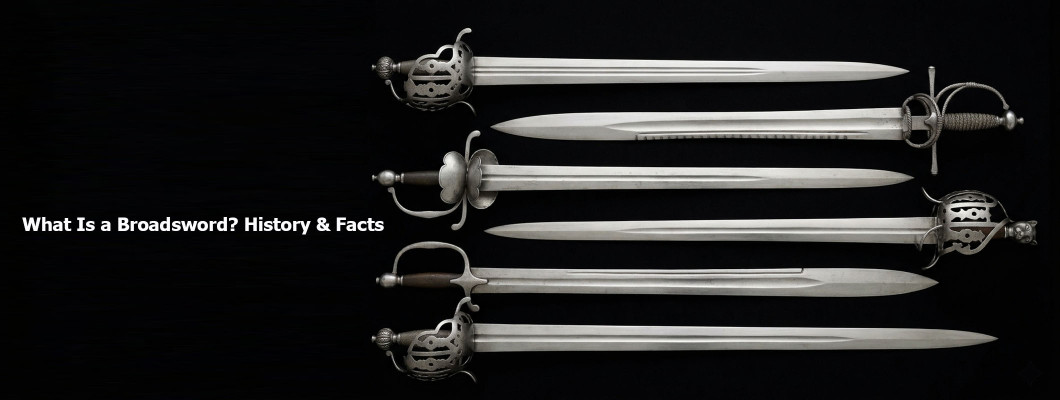
A broadsword, in the strict historical sense, is a broad, double-edged cutting sword of the 16th to 18th centuries — most famously mounted in a basket hilt, the cage of steel bars that protects the hand on the Scottish Highland broadsword and its cousins. That is the real, museum-catalogue broadsword. But it is almost never what people mean when they say the word, and that gap is why "broadsword" is the single most misused term in the world of swords.
Ask most people to picture a broadsword and they will describe a big, straight, double-edged medieval knight's sword — the kind a crusader carries in a film. That sword is real, but its name is not "broadsword." It is an arming sword or a longsword. This guide untangles the confusion, tells you what a broadsword actually is, and — more usefully — helps you find the sword you were really looking for.
Why the Word "Broadsword" Is So Confusing
Here is the fact that surprises people: no sword was ever called a "broadsword" during the Middle Ages. The word simply did not exist as a category then. Medieval texts occasionally described a "broad sword" — meaning a sword that happened to have a broad blade — but that is a description, not a type, the same way "a long knife" is not the name of a specific knife.
The term "broadsword" only became a proper category in the late 17th century, when it was coined to describe the broad-bladed, basket-hilted cutting swords then carried by cavalry. It was named partly to distinguish those wide cutting blades from the narrow thrusting blades of the rapier and small-sword that were fashionable at the time. So the word is early modern, not medieval — which is exactly backwards from how most people use it.
The modern muddle comes from fiction. Fantasy novels, films and games adopted "broadsword" as a romantic-sounding word for any large medieval blade, and it stuck. Today the word gets applied to arming swords, longswords, even two-handed greatswords — none of which a historian would call a broadsword. The word has become a vibe rather than a definition.
The True Broadsword — the Basket-Hilted Cutting Sword
The genuine article is a specific and handsome thing. A true broadsword has a broad, straight, double-edged blade built primarily for cutting, mounted in a basket hilt — an interlaced cage of steel bars that fully encloses and protects the hand. It developed from the simpler quillon crossguards of the late medieval period into the full basket by the 16th century.
Its most famous form is the Scottish broadsword, the basket-hilted sword of the Highlands often loosely called a claymore in modern usage (another confusion — the original claymore was a two-handed sword entirely). A close relative, the backsword, carries the same basket hilt on a single-edged blade with a thickened back. Both were cavalry and military swords across Britain and Europe well into the 18th century.
This is the sword the word actually names — and it is the one piece in this story we do not keep as a stock item. A basket-hilted Scottish broadsword is an intricate, specialised build, and it is exactly the kind of historical commission our smiths take on through the custom forge. If it is the true basket-hilt you are after, that is the route.
Do All Broadswords Have a Basket Hilt?
No — and this is worth getting right, because it is where casual definitions oversimplify. The feature that truly defines a broadsword is the broad, double-edged cutting blade. That wide blade, built to cut rather than thrust, is what the 17th-century word was coined to describe — specifically to set it apart from the narrow thrusting blades of the rapier and small-sword of the same period.
The basket hilt is the classic and most iconic mounting for that blade, and the one most people rightly associate with the broadsword — but it is a characteristic feature, not an absolute rule. Broad cutting blades of the era were fitted with a range of guards, from full enclosing baskets down to simpler half-baskets and shell guards. What makes it a broadsword is the blade; the basket is the famous dress it usually wears.
One related distinction is worth knowing, because it trips people up: a sword with the same basket hilt but a single-edged blade is not a broadsword but a backsword (the "back" being the thick, unsharpened spine opposite the single edge). So the basket hilt alone does not make a broadsword — a true broadsword is double-edged. This is exactly the kind of precision that separates the real historical picture from the loose popular one.
The Sword You Probably Actually Want
Here is the useful part. If you came looking for a "broadsword," there is a very good chance you had one of three swords in mind — and all three are ones we forge. Find your picture below.
You pictured a knight's one-handed sword? That's an arming sword.
The arming sword is the classic medieval knight's blade — a straight, double-edged, single-handed sword with a cruciform cross guard, built for both cutting and thrusting and carried across Europe from the 11th to the 15th centuries. This is what most people mean by "medieval broadsword." If a crusader's cross-hilted sword is the image in your head, this is the one.
You pictured a big two-handed sword? That's a longsword.
If your broadsword was a larger blade gripped in both hands, you were picturing a longsword — the two-handed cruciform sword of the late medieval knight, longer and heavier than the arming sword and built for versatile armoured combat and skilled dueling alike.
You pictured a broad single-edged chopper? That's a falchion.
If your "broadsword" was a wide, heavy, single-edged blade built to chop, you were thinking of a falchion — Europe's answer to the curved cutting swords of the East, combining the weight of an axe with the control of a sword.
Broadsword vs Arming Sword vs Longsword
The quick reference, so you can name what you are actually looking at.
| Sword | Era | Hand | Blade | Defining feature |
|---|---|---|---|---|
| True broadsword | 16th-18th c. | One hand | Broad, double-edged | Basket hilt enclosing the hand |
| Arming sword | 11th-15th c. | One hand | Straight, double-edged | Simple cruciform crossguard |
| Longsword | 14th-16th c. | Two hands | Straight, double-edged, long | Long grip for two hands |
| Falchion | 13th-16th c. | One hand | Broad, single-edged | Curved cutting edge, axe-like power |
For the full family of European blades and how they relate, see our guide to the types of medieval European swords and the broader ultimate sword guide.
Owning a Broadsword Today
Whether you want a true basket-hilted broadsword or the arming sword or longsword most people mean by the word, a hand-forged blade is a genuine object of history rather than a wall-hanger casting. Every sword we make is forged in Tokha-3, Kathmandu, Nepal from 5160 high-carbon spring steel — the same steel as our Gurkha kukris — oil-tempered, full tang, sharpened, and shipped with a scabbard. They suit collectors, historical European martial arts, reenactment and display alike.
If your heart is set on the authentic basket-hilted Scottish broadsword, that is a custom commission, and one our smiths would relish. Tell us the blade length, the hilt pattern and any decoration, and we will build it to your specification.
Commission a True Basket-Hilted Broadsword
Want the genuine article — a basket-hilted, double-edged Scottish or cavalry broadsword? Or an arming sword or longsword built to your exact specification? Send us your design, a reference image or a museum plate. Every custom sword is hand-forged in Nepal from 5160 spring steel, full tang and sharpened, with free engraving. We reply to every request within 24 to 48 hours with a free quote.
Request a Custom Sword →Frequently Asked Questions
What is a broadsword?
Historically, a broadsword is a broad, double-edged cutting sword of the 16th to 18th centuries, most classically mounted in a basket hilt as on the Scottish Highland broadsword. The broad cutting blade is what defines it; the basket hilt is its characteristic form. In popular usage the word is applied loosely to almost any large medieval sword, but those are more correctly called arming swords or longswords.
Is a broadsword the same as a medieval knight's sword?
No, though this is the most common confusion. A medieval knight's straight, double-edged, one-handed sword is an arming sword, not a broadsword. The true broadsword is a later, early-modern weapon defined by its basket hilt. When people call a knight's sword a "broadsword," they mean an arming sword.
Is a broadsword one-handed or two-handed?
A true broadsword is a one-handed sword. If you are picturing a large two-handed blade, that is a longsword (or, at the largest, a greatsword or claymore). The one-handed-versus-two-handed distinction is one of the quickest ways to tell which sword someone actually means.
What is the difference between a broadsword and a longsword?
A broadsword is a one-handed, basket-hilted cutting sword of the 16th to 18th centuries. A longsword is a two-handed, cruciform-hilted sword of the 14th to 16th centuries. Different eras, different hilts, different number of hands. They are frequently confused because "broadsword" is used loosely for any big medieval sword.
Did medieval knights use broadswords?
Not by that name. The word "broadsword" did not exist as a sword type in the Middle Ages; it was coined in the late 17th century for basket-hilted cavalry swords. Medieval knights carried arming swords and, later, longswords. So while knights used broad-bladed swords, they did not use "broadswords" in the historical sense of the term.
I want to buy a broadsword — what should I actually get?
It depends on the image in your head. For a knight's one-handed sword, buy an arming sword. For a big two-handed blade, buy a longsword. For a broad single-edged chopper, buy a falchion. For the genuine basket-hilted historical broadsword, which is a specialist piece, commission one through our custom forge. All are hand-forged from 5160 spring steel.
Do all broadswords have a basket hilt?
No. The defining feature of a broadsword is its broad, double-edged cutting blade, not the hilt. The basket hilt is the classic and most iconic mounting — as on the Scottish Highland broadsword — but broad cutting blades were fitted with a range of guards. Note too that a basket hilt on a single-edged blade makes a backsword, not a broadsword; a true broadsword is double-edged.
Is a claymore a broadsword?
Not originally. The original Scottish claymore was a large two-handed sword. The word "claymore" later got attached to the basket-hilted one-handed Scottish broadsword too, which is a separate weapon — so "claymore" carries its own confusion. If you mean the basket-hilted sword, that is the Scottish broadsword; if you mean the giant two-hander, that is the earlier claymore.
Shop Hand-Forged Medieval Swords
Arming Swords, Longswords & Falchions — Forged in Nepal
Whatever you mean by "broadsword," the blade is here — straight knightly arming swords, two-handed longswords, and broad falchions, hand-forged from 5160 spring steel, full tang and battle-ready, with free personalisation and worldwide shipping.
Shop Viking & Medieval Swords →