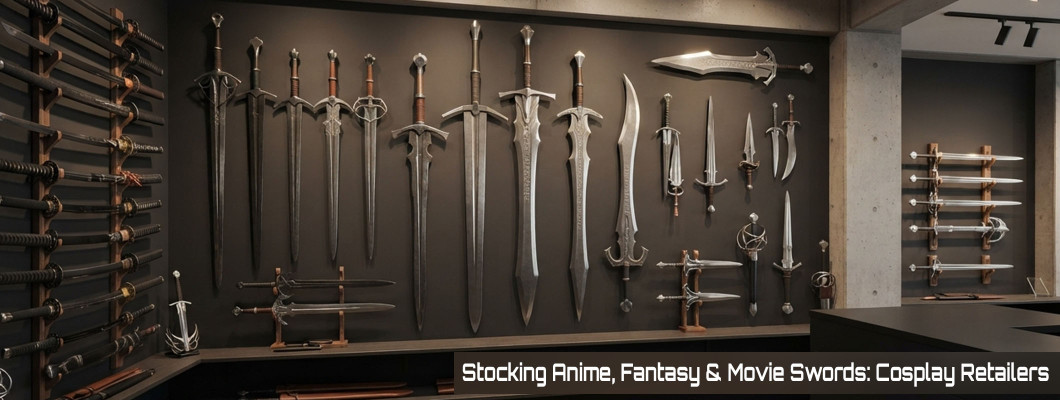
Stocking Anime, Fantasy and Movie Swords: A Guide for Cosplay Retailers
This is the fastest-moving blade category in retail and the only one carrying a risk the others do not. Anime, fantasy and film-inspired blades sell quickly, to a young and enthusiastic audience, at good margins. They also sit closer to somebody else's intellectual property than any historical sword ever will, and that exposure lands on the retailer rather than the supplier.
This guide is for cosplay, convention, gaming and pop-culture retailers sourcing blades in bulk. It covers the licensing question nobody in wholesale supply wants to discuss, the convention rules that decide whether your customers can carry what you sold them, how release timing drives this category, and what to specify before ordering.
Why Real Steel Sells in a Category Full of Props
Most cosplay weapons are foam, resin, plastic or lightweight stainless, made to photograph well and to survive a weekend. There is a real market for those and we are not competing with it.
What we supply is different: forged 5160 spring steel, full tang, with the weight and balance of an actual weapon. For a retailer the commercial point is that this is a distinct customer rather than a better version of the same one. A buyer choosing a steel piece over a prop is spending several times more, keeping it permanently, and is far more likely to come back for a second. Our real steel cosplay guide covers the argument as your customers will hear it.
The trade-off is honest: steel is heavier to carry all day, more restricted at events, and more expensive. A shop serving casual convention-goers should stock props. A shop serving collectors, serious costumers and display buyers should stock steel. Many do both, and describe each accurately.
The Licensing Question Nobody in Wholesale Wants to Discuss
This is the most important section in this guide and the one you will not find on a wholesale supplier's website.
Recognisable weapons from films, games and anime are usually protected. The character, the name and often the distinctive design belong to a studio or publisher. A licensed replica exists where a maker has paid for the right. Everything else is a reproduction, and the legal position varies by design, by country and by how it is marketed.
The exposure is not evenly shared. A supplier in one jurisdiction shipping to another is difficult to pursue. A retailer selling in the customer's own country is not. In practice that means three risks land on you.
Marketplace takedowns. Amazon, eBay and Etsy all operate IP complaint systems where a rights holder can have a listing removed quickly and with limited appeal. Repeated complaints put the whole selling account at risk, not just the listing. For a shop with an established marketplace presence, that is the single largest exposure in this category.
Customs seizure. Goods believed to infringe can be detained at the border in many jurisdictions, and the importer of record on a trade order is you.
Direct approach from a rights holder. Less common, more serious, and considerably more likely if you are using the studio's names and imagery in your marketing.
How to Stock This Category Sensibly
The practical answer is not to avoid the category, which would mean giving up its best margins. It is to understand which end of it you are buying from.
Original designs in a style. A blade with anime proportions and styling that is not a specific character's weapon carries the least exposure and often sells just as well, because most buyers are shopping for a look rather than a licence. This is the safest and most profitable place to build a line.
Generic fantasy. Dark fantasy broadswords, elven-styled longswords, oversized statement blades. Enormous demand, no rights holder, and it photographs as well as anything licensed.
Historical blades used by fictional characters. A Viking sword, a katana-profile blade, a Roman gladius. The historical form is not anyone's property, and a customer costuming a character who carries one is well served.
Tribute pieces, described honestly. Our own naming is deliberate — "inspired by", "an original artisan tribute" — because the piece is our interpretation rather than a licensed replica, and it is described that way. If you resell these, keep that framing in your own listings. A retailer who takes an inspired-by piece and markets it under the studio's character name has moved the risk onto themselves unnecessarily.
Own-design commissions. The strongest position of all. A pattern developed with us and forged to your specification belongs to your shop, has no rights holder behind it, and cannot be price-matched anywhere. For a cosplay retailer, that is the line worth building.
Convention Rules and Why Blunt Matters
The second thing that decides whether this category works for you is whether your customers can actually carry what you sold them.
Most conventions publish a weapons policy, and the common requirements are that blades be unsharpened, peace-tied, sheathed, or some combination. Policies vary widely between events and change year to year, so a retailer serving convention-goers should know the rules for the events their customers attend.
We supply blunt at no difference in price, and a blade ground blunt from the start is a different object from a sharpened one with the edge taken off later. An experienced event steward can tell, and so can a customer. If you are selling into a convention audience, order blunt from the outset for that portion of your stock rather than converting after the fact.
It is worth listing edge condition prominently on your own product pages too. A customer who buys a sharpened blade and is turned away at a door blames the shop, not the event.
Release Timing: The Rhythm This Category Runs On
Anime, fantasy and movie blades do not sell evenly through the year, and this is the difference between a good season and dead stock.
Demand spikes around releases — a new season, a film, a game launch, a convention date. It then decays, sometimes fast. A retailer who orders at the peak of interest receives stock as it fades, which is the commonest way money is lost in this category.
Because we forge to order rather than shipping from a warehouse, lead time is real and must be planned into that rhythm. The practical approach is to order ahead of a known date — a convention, a release you can see coming — rather than reacting to a spike that is already happening. Tell us the date you need stock landed and we will work backwards from it.
The compensating advantage is that you carry no inventory in a property whose moment has passed. A shop buying from stock has to guess which series will still matter in six months. You do not.
What Actually Sells
| Type | Sells to | Notes for a buyer |
|---|---|---|
| Original anime-style blades | Cosplay, anime and gaming retail | Style without a rights holder. The safest line to build and it sells on look |
| Dark and heroic fantasy swords | Cosplay, gaming, display buyers | Constant demand, no licensing question, photographs extremely well |
| Oversized statement blades | Convention display, photography, collectors | High ticket and highly shareable. See the section below on what can be forged |
| Matched pairs and dual sets | Cosplay, martial arts crossover | Higher basket value than two singles and a natural upsell |
| Fantasy daggers and short blades | First-time buyers, convention traders | Lower price point. The easiest entry purchase in this category |
| Historical blades used in fiction | Cosplay crossing into historical retail | Viking, katana-profile, gladius. No rights issue and a second audience |
| Kamas, sickles and unusual forms | Anime and martial arts retail | Underserved. Few suppliers make these in real steel |
| Tribute pieces to known designs | Dedicated fans | Highest demand and highest exposure. Read the licensing section first |
Oversized Blades: What Can and Cannot Be Forged
Fantasy and anime design ignores metallurgy, and a retailer taking custom requests needs to know where the line is.
Very large blades are forgeable and we make them, with reinforced tangs and thicker spines to keep them functional rather than ornamental. What cannot be done is a design that is impossibly thin at a stress point, or so blade-heavy that no tang could hold it. In almost every case there is a version that keeps the silhouette a customer recognises while being a real object.
For a retailer this is a service you can offer that most cannot. Take the customer's reference, send it to us, and we will say what is possible before anyone takes a deposit. That conversation is far cheaper than a refund on a piece that could never have been made.
Your Own Brand, and Why It Matters More Here
Engraving is free on every blade and you can supply your own logo. In this category that is worth more than in any other.
Cosplay and anime buyers photograph what they own and post it. A blade carrying your shop's mark travels through exactly the audience you are trying to reach, in images you did not have to pay for. It also puts the piece outside price comparison, which matters in a category where the same generic fantasy sword appears on a dozen sites.
There is no tooling, minimum run or setup charge. Own patterns are quoted through custom anime weapons, and once a specification is agreed we hold it so repeat batches match.
What to Agree Before a Bulk Order
The full list is in our guide to buying blades in bulk from Nepal. These are the ones specific to this category.
Edge condition per line. Sharp for collectors and display, blunt for convention stock. Decide it per pattern, not for the whole order.
How pieces are described. Agree the product naming with your supplier. Inspired-by pieces should be listed as inspired-by, in their listings and in yours.
Lead time against a date. A convention or a release, not a general figure.
Tolerance. Hand-forged pieces vary. In this category the finish is a large part of what the customer is buying, so ask what variation to expect and see photographs before shipping.
Incoterms, payment and claims. Most Nepali quotes are FOB Kathmandu, which excludes freight, insurance, handling and clearance.
Anime, Fantasy and Movie Blades on Trade Terms
Tell us your company and country, whether you are serving conventions, collectors or both, rough volume and any fixed dates. Free logo engraving, blunt or sharp at no difference in price, and own-design patterns quoted so nobody else can list them.
Frequently Asked Questions
Can I buy anime and fantasy swords wholesale?
Yes. Everest Forge supplies cosplay, convention, gaming and pop-culture retailers on trade terms directly from our workshop in Kathmandu. Blades are forged 5160 spring steel with full tangs rather than props, blunt or sharpened at no difference in price, and own-design patterns can be quoted so that nobody else can list them.
Is it legal to sell replica swords from films, games and anime?
It depends on the design, the country and how it is marketed, and it is a question for proper legal advice rather than a supplier. What matters commercially is that the exposure falls on the retailer rather than the overseas supplier: marketplace IP complaints can remove listings and threaten a selling account, goods believed to infringe can be detained at customs, and using a studio's character names in your marketing raises the risk considerably.
What is the safest way to stock this category?
Build the line on original designs in a style rather than on specific characters. Anime-styled blades that are not a named character's weapon, generic dark and heroic fantasy, historical forms used by fictional characters, and own-design patterns commissioned for your shop all sell on look rather than on licence. Most buyers in this category are shopping for an aesthetic, not for a rights-cleared replica.
Why do you name pieces "inspired by" rather than by the character?
Because that is what they are. Our pieces are original interpretations rather than licensed replicas, and describing them accurately is both honest and prudent. If you resell them, keep the same framing in your own listings — a retailer who takes an inspired-by piece and markets it under a studio's character name has moved risk onto themselves for no commercial gain.
Should I stock sharp or blunt for convention customers?
Blunt for anything a customer intends to carry at an event. Most conventions require blades to be unsharpened, peace-tied, sheathed, or a combination, and policies vary by event and change year to year. We supply blunt at no difference in price, and a blade ground blunt from the start is a different object from a sharpened one with the edge removed later — stewards and customers can both tell.
How do I time orders around releases and conventions?
Order ahead of a known date rather than reacting to a spike that is already happening. Demand in this category is release-driven and decays quickly, so a retailer ordering at peak interest receives stock as it fades. Because blades are forged to order, tell us the date you need stock landed and we will work backwards. The compensating advantage is that you carry no inventory in a property whose moment has passed.
Can you forge oversized fantasy blades?
Yes, with reinforced tangs and thicker spines to keep them functional rather than ornamental. What cannot be forged is a design that is impossibly thin at a stress point or so blade-heavy that no tang would hold it. In almost every case there is a version that keeps the silhouette a customer recognises while being a real object, and we will tell you what is possible before anyone takes a deposit.
Can I get my shop's logo on cosplay blades?
Yes, and engraving is free with no tooling, minimum run or setup charge. It matters more in this category than any other, because cosplay and anime buyers photograph what they own and post it. A blade carrying your mark travels through exactly the audience you are trying to reach, in images you did not pay for, and it puts the piece outside price comparison.
What is the minimum order for wholesale fantasy swords?
There is no single figure, because it depends on the patterns and the model. Dropshipping has no minimum in the usual sense, since blades are forged individually. Wholesale and own-design orders are quoted on volume. For a category this release-driven, a smaller repeating order timed to events usually works better than one large speculative one.