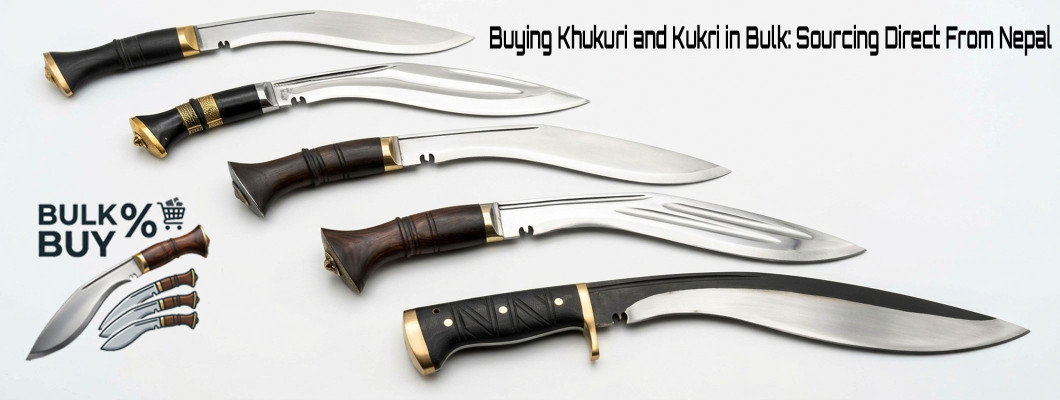
Buying Khukuri and Kukri in Bulk: A Retailer's Guide to Sourcing Direct From Nepal
Almost every kukri sold in a Western shop has passed through two or three hands before it reaches the shelf, and every wholesale kukri price you have been quoted reflects that. A forge in Nepal makes it, a trading house in Kathmandu buys it, an importer in your country buys from them, and you buy from the importer. Each step adds margin, and none of them adds anything to the blade.
Buying wholesale khukuri direct from the forge removes those steps. It also removes the people who were absorbing risk on your behalf, which is the part nobody mentions. This guide is for retailers, distributors and dropshippers sourcing kukris in bulk: how the supply chain actually works, how to tell a genuine khukuri supplier in Nepal from a middleman, which patterns sell to which customers, and what changes when you order fifty rather than one.
How the Wholesale Kukri Supply Chain Actually Works
Understanding this is most of the value in this article, because it explains where your money currently goes.
The forge. A workshop, usually in or near Kathmandu, where kami blacksmiths forge blades by hand. Most are small — ten smiths is a normal size. Very few of them sell internationally, because export, marketing and customer service are entirely different skills from forging.
The trading house. A Kathmandu business that buys from several forges, holds stock, and exports. Most companies presenting themselves as a wholesale kukri supplier in Nepal sit at this layer, and this is who most international buyers are actually dealing with when they think they are buying from a forge. They add real value in logistics and consolidation. What they do not add is control over how a blade was made.
The importer or distributor. Buys in volume, clears customs, holds stock in your country, and sells on to retailers. Genuinely useful if you want small quantities delivered quickly.
The retailer. You.
Each layer needs a margin. By the time a kukri that cost a forge a certain amount to make reaches your purchase order, it has been marked up two or three times. Buying direct removes those markups — but it also means customs, shipping, lead times and quality questions are now yours rather than someone else's. That trade is the whole decision, and it is worth making with your eyes open.
How to Tell a Real Khukuri Supplier From a Middleman
Every site selling wholesale kukris claims to be a forge. Most are not, and there are five questions that sort them quickly.
Ask who does the heat treatment, and how. A forge answers immediately and specifically — quench medium, whether the spine is differentially treated, how tempering is done. A reseller gives you marketing language. This is the single most revealing question you can ask, because heat treatment is where a kukri is made or ruined and it is invisible in a photograph.
Ask for photographs of the workshop with your name in them. Not stock photos of a forge. A written note held in shot takes two minutes for a real workshop and cannot be produced by a trading house.
Ask what happens when a blade fails. A forge that makes its own blades can tell you what typically fails, why, and what they do about it. A middleman has to ask someone else.
Ask about a pattern they do not list. A forge can quote a Bhojpure or a Hanshee that is not on their site, because they make blades rather than sell inventory. A reseller will tell you it is unavailable.
Ask about the kami. Kukris are forged by the kami, a hereditary blacksmith caste, and any genuine Nepali forge can talk about who works there and for how long. Vagueness here is telling.
Which Khukuri Patterns Actually Sell at Retail
This is the part most wholesale kukri suppliers will not tell you, because they would rather sell you what they have. Different kukri patterns serve completely different customers, and stocking the wrong ones is how money gets tied up.
| Pattern | Buys it | Why it sells |
|---|---|---|
| Service No.1 / standard issue | Militaria buyers, gift buyers, first-time buyers | The recognisable Gurkha blade. The safest first order in any market |
| Working and bushcraft khukuri | Outdoor, camping and bushcraft stores | Bought to be used. Repeat customers and word of mouth |
| Chirra (fullered) kukri | Enthusiasts and collectors | Visibly difficult to forge; the fullers are a talking point that sells the piece |
| Historical replicas | Collectors, reenactors, militaria | Higher value per unit, slower moving, strong margins |
| Kukri swords (18 in and up) | Collectors and display buyers | Presence on a wall. Photographs well, which matters online |
| Small EDC kukri | Knife and EDC retailers | Lower price point, easier first purchase, good basket filler |
| Kothimora (ceremonial) | Presentation, regimental, corporate gifts | Highest value per unit by a wide margin. Low volume, high ticket |
| Tactical and hybrid | Tactical and survival retailers | Modern styling brings in buyers who would not consider a traditional kukri |
If you are starting a kukri line from nothing, the pattern most retailers find works is a small spread rather than depth: a standard service pattern, a working khukuri, one chirra, and one kukri sword. That tells you within a season which direction your particular customers pull, and it avoids committing to a pattern that suits someone else's market.
What Hand-Forged Means When You Order Fifty
Worth being blunt about, because it is the commonest source of trade disputes.
Hand-forged blades vary. Within an agreed specification, individual pieces differ slightly in finish, in grain on a wooden handle, in the exact curve of a blade. That is not a defect — it is the definition of the thing, and it is what your customers who care are paying for.
It does mean that if your customers expect machine-identical units, hand-forging is the wrong supply chain and you should know that before your first order rather than after your first complaint. Factory kukris exist, they are cheaper, and they are consistent. They are a legitimate product for a market that wants them.
The practical answer for a retailer is to sell the variation rather than apologise for it. A line stating that each piece is individually forged and no two are identical converts better than silence, and it sets the expectation before the parcel is opened.
The Seven Terms to Agree Before Any Bulk Order
Whoever you buy from, these are the points that decide whether a trade relationship works. Ask every supplier for all seven in writing before the first order. A supplier who cannot answer them has not done this before.
1. Samples. Can you get standard patterns as samples quickly, and what happens with a custom design? Sampling on a bespoke pattern realistically takes weeks, not days, because the piece has to be forged from nothing. Ask what a sample costs and whether it comes off a first order.
2. Tolerance. Hand-forged blades vary, so ask by how much and get it in writing. A stated tolerance in shape, size and weight protects both sides — it tells you what to expect and it stops a supplier calling any complaint unreasonable.
3. Capacity. How many pieces per month, per pattern? This is where suppliers differ enormously, and bigger is not automatically better. A factory-scale workshop turning out tens of thousands of pieces a month is making a different product from a workshop of ten smiths. Decide which one your customers actually want before you choose on volume.
4. Lead time. Ask separately for small and large orders. Suppliers who hold safety stock can ship small orders quickly; suppliers who forge to order cannot, and will be slower on the first order and more flexible on the specification. Neither is wrong, but you must build the real number into what you promise your own customers.
5. Incoterms. Most Nepali quotes are FOB Kathmandu, which means the price covers the goods delivered on board and nothing else — no freight, no insurance, no handling, no customs clearance in your country. A quote without the Incoterm stated is not a comparable quote, and this is the commonest way two prices that look different turn out to be the same.
6. Payment terms. Nepali exporters generally require payment before shipping, because an advance payment certificate has to be produced at customs. Expect bank transfer or an irrevocable letter of credit, and expect to bear bank charges outside Nepal. Ask who covers what.
7. Claims. What is the window for reporting damage, and is the remedy a refund or a replacement? Twenty days from shipment is a common term. Agree it before you need it.
Photographs Before Shipping Beat a Tolerance Clause
Point two above is the one that causes the most trade disputes, and there is a better answer to it than a percentage.
A stated tolerance — five per cent variation in shape, size and weight, say — is a reasonable term and most Nepali suppliers use one. But it only tells you what you are obliged to accept. It does not tell you what is actually coming.
We photograph blades before they ship and send them to you for approval. For a retail customer that is reassurance. For a trade buyer it is something more useful: you see the actual pieces in your order before they leave Kathmandu, rather than agreeing in advance to accept whatever falls inside a tolerance band. If something is not right, it is corrected before it is on a plane, which is the only point at which correcting it is cheap.
It is worth asking any supplier whether they will do this. A workshop that makes your blades can photograph them; a trading house consolidating stock from several forges usually cannot, because the pieces are not in one place and were not made for you.
Your Logo on the Blade, at No Extra Cost
This is the point most retailers miss on our site, so we will state it plainly.
Engraving is free on every Everest Forge blade, and you can supply your own logo. That means a retailer can have their own mark engraved on the blade, the handle or the scabbard without paying for private-label tooling, minimum runs or setup charges.
For a shop, that is a meaningful thing. A kukri carrying your name is not a product a customer can price-match against twelve other sites, and it turns a supplier relationship into something that looks like your own line. It also travels — a blade with your mark on it is still advertising you in five years when it is resold or handed down.
If you want to go further than a logo, own-design patterns are quoted through custom forge and a specification is held so repeat batches match.
Wholesale Lead Times, Minimum Orders and the Made-to-Order Model
We hold no stock. Every blade is forged after the order is placed, and that shapes what a trade relationship with us looks like.
What it gives you. No warehoused inventory, no capital tied up in a pattern that turned out not to sell in your market, and the ability to test a line at low volume before committing. For a shop adding kukris to an existing range, that is a much smaller risk than buying a pallet.
What it costs you. Time. There is no shelf to pick from, so lead times are real and must be built into what you promise your own customers. A retailer advertising fast dispatch on a made-to-order blade creates a problem that becomes theirs, not ours.
What to tell us when you enquire. There is no fixed minimum order quantity across the range, because it depends on the patterns and the model. Rough volume per order, whether it repeats, which patterns, your market, and any fixed dates. A repeating order at modest volume is often more useful to a forge than a large one-off, and quotes reflect that.
Importing Kukris in Bulk: What to Check Before You Order
Importing khukuri in bulk brings rules that do not apply to a single retail blade. Import rules vary considerably and some categories are restricted regardless of how they ship. A few things worth confirming for your own market before committing to a first order.
Blade length thresholds. Several jurisdictions treat blades above a certain length differently, which can matter for kukri swords in the 18 to 24 inch range even where a 10 inch working khukuri is unproblematic.
Edge and category definitions. Kukris are single-edged, which is generally the easier category — double-edged blades attract restrictions in the UK, Australia and Germany that single-edged ones do not.
Who is the importer of record. On a trade order this is you, and duties, clearance and any licensing are your responsibility rather than the forge's. Factor it into landed cost rather than unit price.
Tell us your destination market when you enquire and we will flag anything in your intended range that is likely to be a problem there. It is far cheaper to find out at the quoting stage.
Buying Wholesale Khukuri Direct From a Kathmandu Forge
We should declare our interest: we are a forge, so this is not a neutral section. Judge the specifics rather than the conclusion.
Everest Forge is a workshop in Tokha-3, Kathmandu, with around ten kami blacksmiths, forging since 2010. Everything is 5160 high-carbon spring steel reclaimed from vehicle leaf springs, oil quenched and tempered by hand, full tang. We have supplied official-issue patterns to the Nepal Army and the Nepal Police, which is a matter of record rather than a marketing line.
What that means for a trade buyer is narrow but real. We can answer technical questions about how a blade was made because we made it. We can quote a pattern that is not in the catalogue. We can hold a specification across repeat batches. And when something goes wrong we can tell you why rather than asking someone else.
What we cannot do is beat a factory on unit price, ship from a warehouse in your country, or guarantee identical units. If those are your requirements, an importer is the better answer and we would rather say so.
Kukris and Khukuris on Trade Terms, Direct From the Forge
Tell us your company and country, which patterns you are interested in, rough volume per order and the market you serve. We will come back with a quote and an honest answer about whether we suit you. Free logo engraving on every blade, own-design patterns quoted separately.
Frequently Asked Questions
Can I buy kukris and khukuris wholesale direct from Nepal?
Yes. Everest Forge supplies retailers, online stores, distributors and dropshippers on trade terms directly from our workshop in Tokha-3, Kathmandu. Buying direct removes the trading house and importer markups, but it also means customs, shipping and lead times become your responsibility rather than an importer's. That trade-off is the real decision.
How do I know if a supplier is really a forge?
Ask who does the heat treatment and how — a forge answers specifically about quench medium and tempering, a reseller gives you marketing language. Ask for workshop photographs with your name written in shot. Ask what typically fails on a blade and why. Ask them to quote a pattern that is not on their site. And ask about the kami who work there.
Which kukri patterns should a retailer stock first?
A small spread rather than depth in one pattern: a standard service kukri, a working khukuri, one chirra with fullers, and one kukri sword. That covers militaria, outdoor, enthusiast and display buyers, and within a season it tells you which direction your particular customers pull without committing capital to a pattern that suits someone else's market.
Will every kukri in a bulk order look identical?
No, and no honest hand forge will tell you otherwise. Within an agreed specification, individual pieces vary in finish, in handle grain and in the exact curve of a blade. That variation is what customers buying hand-forged work are paying for. If your customers expect machine-identical units, factory kukris are the right product and hand-forging is the wrong supply chain.
What terms should I agree before a bulk kukri order?
Seven, in writing: sampling and what a sample costs, stated tolerance for handmade variation, monthly capacity per pattern, lead times for small and large orders separately, the Incoterm the price is quoted on, payment terms and who bears bank charges, and the claims window and remedy. A supplier who cannot answer all seven has not done this before.
What does FOB Kathmandu mean on a kukri quote?
It means the quoted price covers the goods delivered on board at Kathmandu and nothing beyond that — no freight, no insurance, no handling, and no customs clearance in your country. Most Nepali exporters quote this way. A quote with no Incoterm stated is not comparable to one that has it, and this is the commonest reason two prices that look different turn out to be the same.
How is variation handled on a hand-forged bulk order?
Most suppliers state a tolerance — a percentage of variation in shape, size and weight that you agree to accept. That is reasonable, but it only tells you what you are obliged to take. We photograph blades before they ship and send them for approval, so you see the actual pieces in your order before they leave Kathmandu rather than accepting whatever falls inside a band. Ask any supplier whether they will do the same.
Can I have my own logo on the blades?
Yes, and engraving is free on every blade. You can supply your own logo to be engraved on the blade, handle or scabbard with no private-label tooling, minimum run or setup charge. A kukri carrying your mark is not something a customer can price-match against other sites, and it keeps advertising you long after the sale.
What is the minimum order for wholesale kukris?
It depends on the model and the patterns. Dropshipping has no minimum in the usual sense, since blades are forged individually. Wholesale and own-design orders are quoted on volume, and a repeating order at modest volume is often more useful to a forge than a single large one. Tell us what you are planning and we will tell you whether it works.
How long does a bulk kukri order take?
Lead times depend on volume, patterns and complexity, and we quote them per order rather than promising a blanket figure. Because everything is forged after ordering rather than picked from stock, lead time is the single most important thing to build into your own listings and customer communications. Tell us any fixed dates at the enquiry stage.
Are kukris difficult to import?
Generally less so than many blades, because they are single-edged — double-edged blades attract restrictions in the UK, Australia and Germany that single-edged ones do not. Watch blade length thresholds, which can matter for kukri swords in the 18 to 24 inch range even where a 10 inch working khukuri is fine. On a trade order you are the importer of record, so duties and clearance are yours.
What is the difference between a kukri and a khukuri?
Nothing. They are two spellings of the same word — kukri is the common English rendering, khukuri is closer to the Nepali pronunciation. Nepali makers generally write khukuri and Western retailers generally write kukri. For a shop it is worth using both in your product titles and descriptions, because your customers search for both.