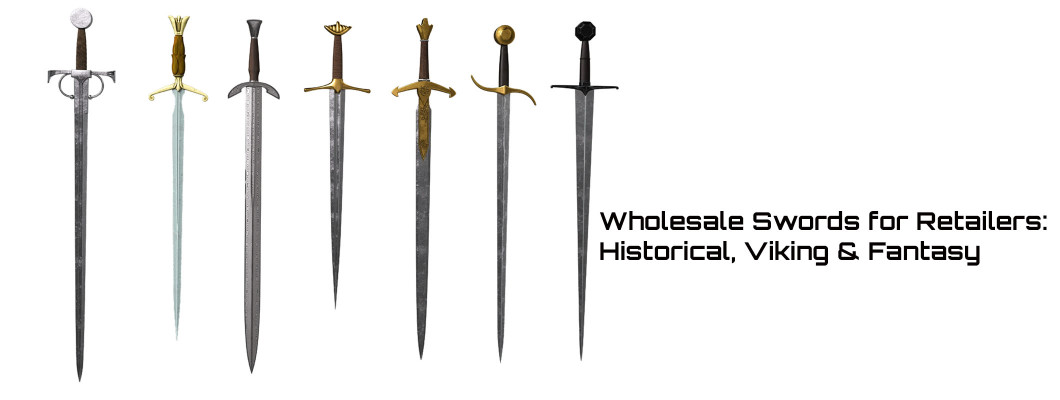
Wholesale Swords for Retailers: Historical, Viking and Fantasy
There are two wholesale sword markets and they have almost nothing in common. One supplies decorative swords made in volume, sold in bulk at a fraction of retail, and intended to hang on a wall. The other supplies functional hand-forged blades made to order. Both are legitimate. Stocking the wrong one for your customers is how a sword line loses money.
This guide is for retailers, distributors and dropshippers deciding which wholesale sword supplier to work with. It covers how the two markets differ, why cheap swords are cheap, which categories actually sell in which kind of shop, and the specification questions that decide whether a blade suits your customer before you order a single unit.
The Two Wholesale Sword Markets
| Volume-produced swords | Hand-forged swords | |
|---|---|---|
| Made | In batches, to inventory | Individually, usually to order |
| Bought from | Importers and distributors holding stock | The forge, or a trading house |
| Unit cost | Low. Often marketed as a large discount off a notional retail price | Higher, and it reflects labour rather than materials |
| Consistency | Near identical | Varies within a specification |
| Typically | Display and decorative; stainless or soft steel; rat-tail or partial tang | Functional; high-carbon steel; full tang |
| Customer | Gift buyers, decor, casual fantasy buyers | Collectors, reenactors, martial artists, serious gift buyers |
| Lead time | Ships from stock | Forged after ordering |
| Risk to you | Returns and complaints if sold as functional | Capital and lead time on a slower-moving line |
Neither column is the right answer for every shop. A gift shop or a decor retailer is well served by the left. A militaria dealer, an outdoor store or a HEMA supplier is not, and will spend the difference on returns. The failure that costs money is buying from the left and describing it as the right.
Why Cheap Wholesale Swords Are Cheap
This is worth understanding as arithmetic rather than as an opinion, because it tells you what you are actually buying.
Work backwards from a retail price. If a sword sells at retail for forty dollars, the retailer bought it for perhaps half that, the distributor for less again, and the maker received somewhere in the region of twelve to fifteen. Out of that comes steel, fittings, packaging, shipping and the maker's own margin.
There is no version of that arithmetic that includes days of a skilled smith's time. It is not that anyone is cheating — it is that the price only supports one method of production. Our sword price guide works through the bands in detail.
What it means for a retailer is that the wholesale price tells you the production method before anyone describes it to you. A sword landing in your warehouse at a very low unit cost is a volume-produced sword, whatever the listing says about hand-forging, and it should be sold as what it is.
What Mis-selling Costs You
Swords carry a reputational risk that most product categories do not, and it is worth naming.
A customer who buys a decorative sword believing it is functional will eventually try to use it. When a soft-steel blade takes a set, or a rat-tail tang snaps at the shoulder, that becomes a return, a negative review, and occasionally a safety complaint. None of that reaches the wholesaler. It lands on you.
The two defences are straightforward. Describe accurately — display, decorative, functional, battle-ready — and know which you have bought. And ask your wholesale sword supplier direct questions about steel and tang construction, because a supplier who cannot answer them is selling you something they have not examined either.
Which Sword Categories Sell, and Where
Sword buyers are not one market. A shop that sells Viking swords well will often move almost no Roman blades, and the reason is the customer rather than the product.
| Category | Sells well in | Notes for a buyer |
|---|---|---|
| Viking and medieval | Norse and historical shops, LARP and reenactment traders, gift | The largest single segment. Broad appeal beyond serious collectors |
| Roman gladius and Greek xiphos | Museum shops, education, classical collectors | Steady rather than fast. Strong with schools and heritage sites |
| Arming swords and longswords | HEMA suppliers, reenactment, collectors | Buyers know specifications. Expect questions about balance and weight |
| Fantasy, anime and movie | Cosplay, convention traders, gaming and pop-culture retail | Fastest-moving segment. Driven by releases, so timing matters |
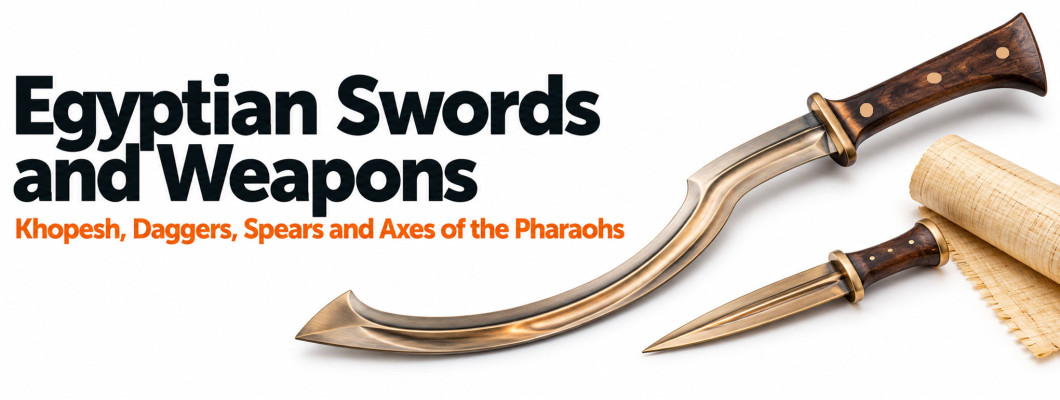
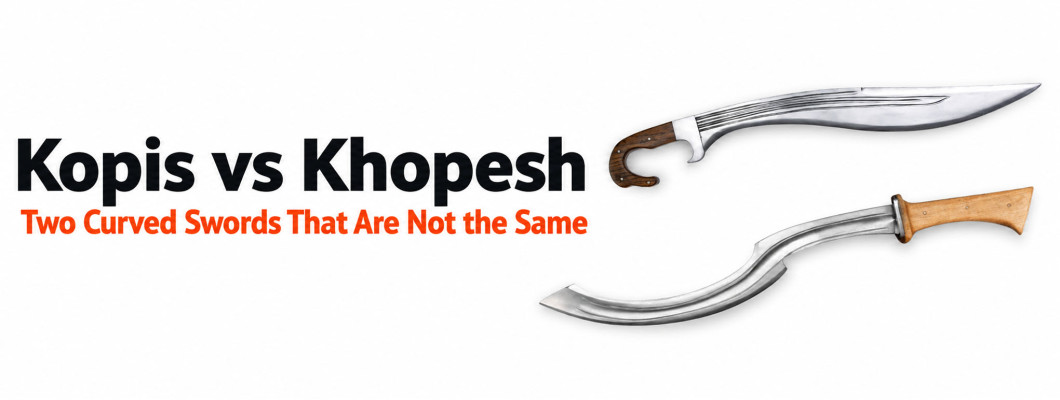
| Scimitars, talwars, khopesh | Collectors, cultural and regional retail | Distinctive silhouettes photograph well, which matters online |
| Seaxes and short swords | Outdoor and bushcraft as well as historical | Lower price point and easier first purchase than a full sword |
| Training and blunt swords | HEMA clubs, martial arts, stage combat, schools | Repeat institutional buyers. Least price-sensitive segment on this list |
| Kukri swords and Nepalese blades | Outdoor, militaria, Gurkha collectors | Covered in our wholesale khukuri guide |
If you are opening a sword line from nothing, most retailers find breadth beats depth on a first order: one Viking, one medieval arming sword, one fantasy or movie piece, and one short sword or seax. Within a season that tells you which direction your particular customers pull, without capital committed to a category that suits somebody else's shop.
Sharp or Blunt: The Specification That Decides the Sale
More returns come from this than from any other single factor, and it is free to get right.
Sharpened suits collectors, cutting practice and display buyers who want the real object. Blunt or rebated is required for stage combat, most reenactment groups, HEMA sparring and a great many conventions, and it is often a legal advantage at import as well.
A blade ground rebated from the start is a different object from a sharpened blade with the edge taken off afterwards, and an experienced buyer can tell. If your customers are event traders, clubs or convention sellers, order blunt from the outset rather than converting later.
We supply either at no difference in price, and we would rather be told which at the point of order than guess. Our training blades range shows the blunt versions.
Your Own Line Without Tooling Costs
Two things a forge can do for a retailer that an importer holding stock cannot.
Free logo engraving. Engraving is included on every blade and you can supply your own logo, so a retailer can have their own mark on the blade, guard or scabbard with no private-label tooling, minimum run or setup charge. A sword carrying your name is not a piece a customer can price-match against a dozen other sites.
Patterns nobody else lists. Send a sketch, a museum reference or a written specification and we will quote it. Once agreed, the specification is held so repeat batches match. For a retailer, an exclusive pattern is worth considerably more than a few points of discount on an item twelve other shops also carry, because it gives you something to market rather than something to price against.
Wholesale Lead Times and Why We Hold No Stock
Everything is forged after the order is placed. For a sword line specifically, that matters more than it does for smaller blades.
Swords span a very wide range — historical, Viking, fantasy, movie, regional — and a retailer buying from stock has to guess which of those their customers will want, then live with the guess. Forging to order removes that. There is no minimum you must warehouse, no dead capital in a category that turned out not to sell in your market, and you can test a pattern at low volume before committing to it.
The cost is time. There is no shelf to pick from, so lead times are real and have to be built into what you promise your own customers. A retailer advertising fast dispatch on a made-to-order sword creates a problem that becomes theirs. Plan the forging time into your listings and this model suits a sword line very well; ignore it and it does not.
What to Agree Before Your First Bulk Sword Order
Whoever you buy from, get these in writing. We set them out in full in our guide to buying blades in bulk from Nepal, and they apply to swords equally.
Steel and tang. Which steel, and full tang or not. For swords this matters more than for any other blade, because a sword is long and leveraged and a partial tang is where it fails.
Edge treatment. Sharp, blunt or rebated, decided per pattern rather than for the whole order.
Tolerance. Hand-forged pieces vary. Ask by how much and get it in writing.
Capacity and lead time. Separately for small and large orders, and per pattern rather than in total.
Incoterms. Most Nepali quotes are FOB Kathmandu, which excludes freight, insurance, handling and clearance. A quote without the Incoterm stated is not comparable to one that has it.
Payment and claims. Terms, who bears bank charges, the window for reporting damage and whether the remedy is refund or replacement.
Buying Wholesale Swords Direct From a Kathmandu Forge
We should declare our interest: we are a forge, so judge the specifics rather than the conclusion.
Everest Forge is a workshop in Tokha-3, Kathmandu with around ten kami blacksmiths, forging since 2010. Every blade is 5160 high-carbon spring steel reclaimed from vehicle leaf springs, oil quenched and tempered by hand, full tang. The sword range runs to several hundred patterns across historical, Viking and medieval, Roman, Greek, Celtic, fantasy, movie and regional categories, and anything outside it can be quoted as an own-design piece.
What that gives a trade buyer is narrow but real. We answer technical questions about how a blade was made because we made it. We photograph pieces before shipping so you see your actual order before it leaves Kathmandu. We hold a specification across repeat batches. And we can quote a pattern that is not in the catalogue.
What we cannot do is beat volume production on unit price, ship from a warehouse in your country, or supply identical units. If those are your requirements, a stock-holding distributor is the better answer and we would rather say so than take an order that disappoints you.
Wholesale Swords, Forged to Order in Nepal
Tell us your company and country, which categories interest you, rough volume per order and the market you serve. We will come back with a quote and an honest answer about whether we suit you. Free logo engraving on every blade, sharp or blunt at no difference in price.
Frequently Asked Questions
Can I buy swords wholesale direct from the manufacturer?
Yes. Everest Forge supplies retailers, distributors and dropshippers on trade terms directly from our workshop in Kathmandu. Buying direct removes the trading house and importer margins, but customs, shipping and lead times become your responsibility rather than a distributor's. That trade-off is the real decision, not the unit price.
Why are some wholesale swords so cheap?
Because the price only supports one method of production. Work backwards from a forty dollar retail sword: the retailer paid perhaps half, the distributor less again, and the maker received somewhere around twelve to fifteen dollars, out of which comes steel, fittings, packaging and margin. No version of that arithmetic includes days of a skilled smith's time. The wholesale price tells you the production method before anyone describes it.
What is the difference between decorative and functional wholesale swords?
Decorative swords are made in batches to inventory, usually in stainless or soft steel with a rat-tail or partial tang, and are intended to hang on a wall. Functional swords are high-carbon steel with a full tang and are built to be used. Both are legitimate products for different customers. The expensive mistake is buying the first and describing it as the second.
Which sword categories sell best for retailers?
Viking and medieval is the largest single segment and has appeal well beyond serious collectors. Fantasy, anime and movie swords move fastest but are release-driven, so timing matters. Training and blunt swords are the least price-sensitive segment, because the buyers are clubs and schools ordering repeatedly. Roman and Greek pieces are steady rather than fast and do well with museum and education buyers.
Should I order sharp or blunt swords for resale?
It depends entirely on your customer. Sharpened suits collectors, cutting practice and display buyers. Blunt or rebated is required for stage combat, most reenactment groups, HEMA sparring and many conventions, and is often an advantage at import. A blade ground rebated from the start is a different object from a sharpened blade with the edge removed later, and experienced buyers can tell. Decide per pattern rather than for a whole order.
Can I get my own logo on wholesale swords?
Yes, and engraving is free. You supply your own logo and it is engraved on the blade, guard or scabbard with no private-label tooling, minimum run or setup charge. For a retailer that is effectively an own-brand line without the usual cost of one, and a sword carrying your mark is not something a customer can price-match against a dozen other sites.
What is the minimum order for wholesale swords?
There is no single figure across the range, because it depends on the patterns and the model. Dropshipping has no minimum in the usual sense, since blades are forged individually. Wholesale and own-design orders are quoted on volume, and a repeating order at modest volume is often more useful to a forge than one large one-off. Tell us what you are planning and we will tell you whether it works.
How long does a bulk sword order take?
Lead times depend on volume, patterns and complexity, and we quote them per order rather than promising a blanket figure. Because everything is forged after ordering rather than picked from stock, lead time is the single most important thing to build into your own listings. Tell us any fixed dates, such as a convention or a season, at the enquiry stage.
Are swords difficult to import for resale?
It varies considerably by country and some categories are restricted regardless of how they ship. Blade length thresholds and curved-blade rules catch people out most often, and blunt blades are sometimes treated more favourably than sharpened ones. On a trade order you are the importer of record, so duties and clearance are yours rather than the forge's. Tell us your destination market at the quoting stage and we will flag likely problems.