How Much Does a Sword Cost? A Forge's Honest Price Guide
A sword can cost thirty dollars or thirty thousand, and both prices are real. The thirty-dollar sword is a stainless casting that will break if you swing it. The thirty-thousand-dollar sword is a licensed Japanese smith's life's work. In between sit five distinct price bands, each with its own logic, and the difference between them is almost never the steel — it is the hours of skilled labour, and where in the world those hours were bought. This guide sets out what each band actually gets you, where the money goes, and how to judge whether a given price is fair.
The Five Price Bands
| Price | What it is | Can you use it? |
|---|---|---|
| Under $50 | Stainless wall hanger, cast fittings, rat-tail tang | No — display only |
| $50–150 | Entry functional, mass-produced, quality varies enormously | Sometimes — check construction |
| $150–400 | Genuinely hand-forged or good production functional | Yes |
| $400–1,500 | Western production and semi-custom, established brands | Yes, with better fit and finish |
| $1,500–5,000 | One-off custom from a named smith | Yes — and built to your spec |
| $5,000+ | Collector and art swords, licensed Japanese smiths | Yes, but nobody does |
Under $50 — the wall hanger
Stainless steel, usually cast rather than forged, with a thin rod tang and zinc alloy fittings. It is sold with words like "battle ready" and "hand forged" that mean nothing, and it will fail the first time it meets resistance.
This is not a scam if you know what you are buying. A costume prop, a stage dressing piece, a display sword above a fireplace — all legitimate uses, and $40 is a fair price for them. The problem is only that the listing rarely says so.
$50–150 — entry functional, buyer beware
The most variable band on the market. Some swords here are genuinely functional: mono-steel 1045 or 1060, through-hardened, full tang, made in volume in China, Pakistan or India. Others are wall hangers with better photography.
The difference is invisible in the listing and visible in the construction. Ask the questions in our guide to tangs before buying anything in this band.
$150–400 — real working swords
Where most functional swords actually live. High-carbon steel named specifically, proper heat treatment, full-length tang, fittings that are assembled rather than glued. Both hand-forged blades from smaller workshops and well-made production swords from established manufacturers sit here.
For the overwhelming majority of buyers — collectors, cutters, reenactors, people who want one good sword — this band is the answer. Above it you are buying refinement, not function.
$400–1,500 — Western production and semi-custom
Established Western brands, historically researched reproductions, differential hardening, tighter tolerances, better fittings and scabbards. Some semi-custom work where you choose from set options.
You are paying for design research, quality control, brand reliability, and Western labour rates. It is not a rip-off. A sword built in the United States or Germany carries American or German wages in every hour of its making, and that is most of what a sword costs.
$1,500–5,000 — one-off custom
A named smith building a single blade to your specification. Weeks of one person's time, custom fittings, a scabbard made for that blade, and a conversation that runs through the whole build. At this level you are buying someone's individual skill and their waiting list.
$5,000 and up — collector and art swords
Master smiths, exhibition pieces, and the top of the Japanese market. A genuine nihonto made by a licensed Japanese swordsmith typically starts in the tens of thousands, because Japanese law restricts how many blades each smith may produce per month and the polishing alone is a separate multi-week craft performed by a specialist.
Antiques are a different market again, priced on provenance and condition rather than on making. An authenticated medieval European sword is an artefact, not a product.
Where the Money Actually Goes
Here is the part that surprises people: the steel is one of the cheapest things in a sword. The raw material in a large blade is a small fraction of what you pay, even at the top of the market.
What you are actually buying:
- Skilled labour, and lots of it. Forging, grinding, fitting and finishing a sword by hand is days of work by someone who took years to learn. This is the dominant cost in every band and the main reason prices differ between countries.
- Heat treatment time. Normalising cycles, the quench, and two or three tempering cycles occupy hours of oven and forge time per blade — and, since it is invisible in the finished product, it is the first thing cut. Our guide to heat treatment explains why that matters.
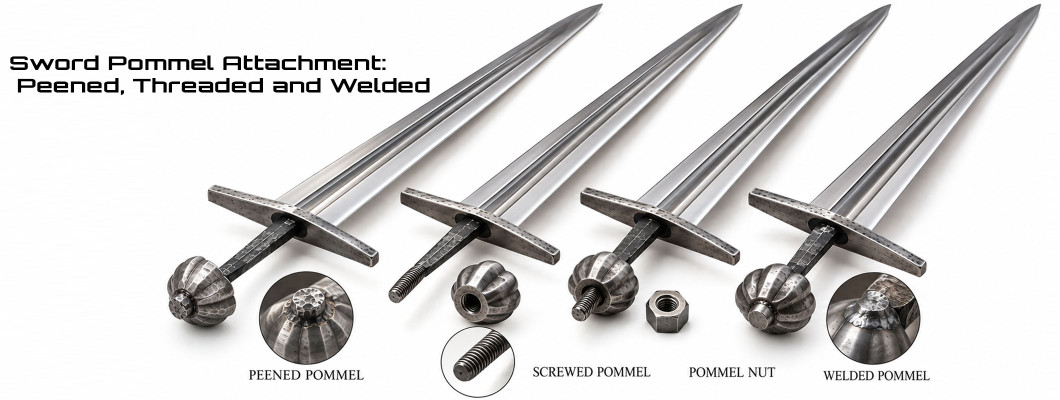
- Fittings and assembly. A peened pommel is hand work. A threaded one is a screw. That difference is minutes on a production line and it is one of the clearest markers of which band a sword belongs to.
- The scabbard. Often underestimated. A leather-over-wood scabbard fitted to a specific blade can take as long as a simple blade does.
- Failure rate. Blades crack in the quench. Every forge loses some, and the cost of the lost ones sits in the price of the ones that survive.
- Shipping, duties and tariffs. Swords are long, heavy and awkward, and international rates reflect that. See our duties and import information.
- Distribution margin. If you are buying from a retailer rather than a maker, someone in the middle is taking a cut. It is a legitimate cost — they hold stock and handle returns — but it is part of what you pay.
Why a $40 Sword Is $40
Work backwards. If a sword retails at $40, the maker received perhaps $12 to $15. Out of that comes steel, fittings, labour, packaging and margin.
There is no version of that arithmetic that includes days of a skilled smith's time. So the corners are not optional, they are structural: cast stainless instead of forged carbon steel, a thin welded rod instead of a full tang, zinc alloy fittings, a screwed-on pommel, and no real heat treatment at all — because heat treatment is oven time and oven time is money.
None of this makes cheap swords fraudulent. It makes them a different product. The dishonesty, where it exists, is in the description rather than the price.
Where We Sit, and Why
We should declare our position rather than pretend to be neutral. Everest Forge ready-made swords run roughly $100 to $350, with most sitting in the middle of that range. That means our cheapest blades start inside the band above where the usual advice is to be careful — and everything we sell is genuinely hand-forged in 5160 spring steel, full-length tang, heat-treated by hand. It is the specification you would normally expect several hundred dollars higher up the table.
Two reasons, and neither is a trick.
Labour costs less in Nepal than in the United States or Germany. That is the whole of it. The same hours of skilled hand work carry a different wage, and since labour is most of what a sword costs, the finished price lands lower. It says nothing about the smith's skill — the kami who work in our Kathmandu workshop learned the craft from the previous generation, and the same is true of the Western smiths charging four times as much.
You are buying from the forge, not from a shop. There is no distributor and no retailer margin between the anvil and your door.
Which is also why the bands above are a guide rather than a law. A $110 sword usually deserves the scepticism that band attracts, because at Western labour rates nobody can hand-forge one for that. The questions at the end of this guide are what settle it — not the price on the listing.
The honest flip side: a $900 sword from an established Western maker will typically have finer finishing, tighter historical research behind the design, and easier warranty service in your own country. If those things matter to you, that money is not wasted. We would rather say that than pretend nothing above our band is worth buying.
What Custom Costs
Custom pricing has no list price by definition, and the honest market range runs from about $50 for a simple small blade to $10,000 and beyond for a premium maker's one-off.
What moves the number, in roughly descending order of impact: overall size, design complexity, handle material, guard and pommel style, scabbard type, engraving, blade finish, and shipping weight. A plain working sword to a straightforward pattern sits near the bottom of a maker's range; an oversized fantasy blade with a decorated scabbard and engraving sits near the top.
For our own work, most custom orders fall between roughly $125 and $900 including standard shipping. Rather than guess, you can put your specification through our custom forge price estimator and get a budget range in about a minute, then submit a custom forge request for a real quotation. If you are unsure what the options mean, the customization options guide explains them.
The Costs Nobody Mentions
- Import duty and tax. Depending on your country this can add meaningfully to an international order, and it is charged on the declared value.
- Shipping on a long parcel. Some sellers absorb it, some do not. Compare delivered prices, not listed prices.
- A stand or wall mount, if the sword is going on display.
- Oil and basic care kit. Small, but high-carbon steel is not optional to maintain.
- Sharpening. Many swords ship unsharpened or with a working edge only. Professional sharpening is a real cost if you cannot do it yourself.
How to Judge Whether a Price Is Fair
Price on its own tells you very little. These five questions tell you which band a sword actually belongs in, whatever the listing says.
- What steel, by name? A specific number, not "high carbon". See the sword steel guide.
- Full-length tang, peened or threaded? The single best value indicator there is.
- Forged or stock removal, and heat treated how? A maker answers; a reseller changes the subject.
- Who actually made it? If the seller cannot say, they bought it from someone who can.
- What is the warranty against breakage? Confidence in the work shows up here.
A $200 sword that answers all five well is better value than a $600 sword that answers none. What "battle ready" should actually mean is set out on our battle ready standard.
Get a Price Range in About a Minute
Answer a few questions about your blade and our free estimator gives you a budget range based on real quote history — swords, kukris, daggers, machetes, spears and axes. Then submit a custom forge request for a firm quotation. Hand-forged in Kathmandu, shipped worldwide.
Try the Price Estimator →Frequently Asked Questions
How much does a good sword cost?
For a genuinely functional sword you should expect to spend at least $150, and the $150 to $400 band covers most real working swords — named high-carbon steel, proper heat treatment, full-length tang. Above roughly $400 you are buying refinement, historical research and Western labour rates rather than additional function. Below about $100, check the construction carefully before assuming a sword is usable.
Why are some swords so expensive?
Because a sword is mostly labour, and skilled labour is expensive. Forging, grinding, fitting and finishing by hand takes days of work from someone who spent years learning it, and heat treatment adds hours of forge and oven time per blade. Where those hours are worked matters enormously: the same craftsmanship carries American or German wages in one country and Nepali wages in another. Custom work adds a smith's individual time and waiting list on top.
Why are some swords so cheap?
Work backwards from the price. A sword retailing at $40 leaves the maker perhaps $12 to $15 for steel, fittings, labour, packaging and margin, which does not accommodate any skilled hand work. So the shortcuts are structural rather than optional: cast stainless instead of forged carbon steel, a thin welded rod instead of a full tang, alloy fittings, and no real heat treatment. As a display piece that is fine; as a usable sword it is not.
Does the steel account for most of a sword's price?
No, and this surprises most buyers. The raw steel in even a large sword is a small fraction of the retail price at every level of the market. What you are paying for is skilled hours, heat treatment time, hand-fitted furniture, the scabbard, the blades lost to quench cracks, shipping, and any distribution margin. Steel choice matters enormously for performance and hardly at all for price.
How much does a custom sword cost?
Across the market, anywhere from about $50 for a simple small blade to $10,000 or more from a premium maker. The main drivers are size, design complexity, handle material, guard and pommel style, scabbard type, engraving and finish. At Everest Forge most custom orders fall between roughly $125 and $900 including standard shipping, and our free price estimator will give you a budget range for your own specification.
How much does a real katana cost?
It depends entirely on what "real" means. A functional, well-made katana-style sword in high-carbon steel can be had in the low hundreds. A genuine nihonto made in Japan by a licensed swordsmith typically starts in the tens of thousands, because Japanese law limits how many blades each smith may produce per month and the polishing is a separate multi-week craft performed by a specialist. Antique nihonto are priced on provenance and condition instead.
Are expensive swords always better?
Not necessarily, and price alone is a poor guide. A $200 sword with named steel, a peened full-length tang, real heat treatment and a warranty is better value than a $600 sword whose seller cannot answer those questions. Above the functional threshold you are buying finishing quality, historical research, brand reliability and local warranty service, all of which are worth something but none of which make a blade cut better.
What extra costs should I budget for?
Import duty and tax on international orders, charged on declared value. Shipping, since swords are long and awkward parcels and some sellers absorb it while others do not — compare delivered prices rather than listed ones. A stand or wall mount if it is going on display. Oil and basic care supplies, which are not optional for high-carbon steel. And professional sharpening, if the blade ships with only a working edge and you cannot sharpen it yourself.