Private Label Knives and Swords: OEM Manufacturing From Our Forge
There are three levels of putting your own brand on a blade, and most retailers only know about the most expensive one. You can have your logo engraved on an existing pattern. You can buy forged blanks and finish them yourself, which makes the completed knife genuinely your product. Or you can commission an original design that exists nowhere else. Each costs a different amount, takes a different length of time, and gives you a different degree of ownership.
This guide is for retailers, brands and makers looking for a private label knife supplier or an OEM manufacturer for knives, swords, kukris, machetes or daggers, and wanting products that are theirs rather than someone else's catalogue. It covers all three routes honestly, explains where a hand forge beats a factory and where it does not, and sets out what to agree before you commit to an own-brand line.
Three Routes to Private Label Knife and Sword Production
| Logo engraving | Forged blanks | Own design | |
|---|---|---|---|
| What you get | Our pattern, your mark on the steel | Our blade, your handle and finish | Your pattern, forged from scratch |
| Setup cost | None. Engraving is free | None | Design and sampling time |
| Minimum | None in the usual sense | Low, and bulk priced | Quoted on volume |
| Lead time | Standard forging time | Standard, plus your own finishing | Longest. Sampling before production |
| How much is yours | The branding | The completed knife | The design itself |
| Can it be copied | The pattern is in our catalogue | Your handle work is yours | Held for you as a specification |
| Best for | Any retailer, immediately | Makers, workshops, finishers | Brands building a knife or sword line |
Most private label buyers should start at the left and move right. Logo engraving costs nothing and tells you within a season whether your customers respond to a branded blade at all. That answer is worth having before you commission a design.
Level One: Private Label by Engraving, at No Cost
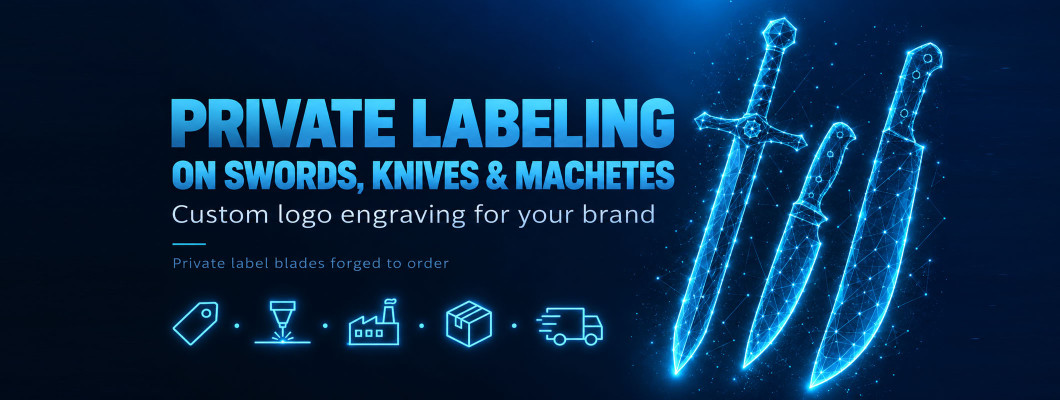
Engraving is included on every blade we make — swords, kukris, machetes, daggers, knives and spears alike — and you can upload your own logo. There is no tooling, minimum run or setup charge.
What matters here is that it is not a decal. The engraving is hand-applied and recessed into the steel, on the same blade we would ship without it — same 5160 spring steel, same oil temper, same full tang, same handle materials. It is not a laser-etched surface mark that wears off, and it is not a sticker. You also receive a preview for approval before any work begins on the blade.
For a retailer this is the cheapest private label experiment available anywhere. Every unit ships with your name permanently on it, at no cost, and blades are kept, displayed, photographed, lent and handed down — so a marked blade keeps advertising you for years, in hands that were never your original customer's.
The limit is honest: the pattern underneath is still in our catalogue, so another shop can sell the same blade without your mark. If exclusivity is the point, move to level three.
Level Two: Forged Blanks, Finished by You
This is the least understood route and, for the right buyer, the best one.
We supply forged and heat-treated blanks with no handle, across the whole range — sword blanks, kukri blanks, machete blanks, dagger, knife and spear blanks. You fit the handle, the fittings and the sheath, and finish the piece to your own standard. The completed knife is genuinely your product, because the part your customer holds and sees was made by you.
The specification is yours to set before we forge. Tangs can be threaded, drilled, or left blank for peening. Pommel ends can be square, rounded, or shaped to your handle design. Full tang or partial, depending on what you are building. Edges can arrive unsharpened, semi-sharpened or fully sharpened.
Who this suits: custom knife makers who want to skip forging and heat treatment, handle and scabbard makers building complete pieces, workshops and craft schools needing consistent blanks in quantity, restoration work replacing a damaged blade, and anyone producing knives for resale under their own brand, handle and finishing work.
It is also the cheapest way to test whether our steel and heat treatment suit your work before committing to finished pieces. A maker who dislikes how a blade grinds or sharpens has learned it for the price of a blank rather than the price of a production run.
Level Three: Full OEM, Your Design Forged From Scratch
The strongest position, and the one worth building a brand on.
Whether it is a sword, a kukri, a machete or a knife, send a sketch, a reference photograph, a museum piece, a written specification with dimensions, or a rough drawing. We convert it into a forging plan, tell you honestly what is and is not possible in steel, and quote it. Once the specification is agreed we hold it, so repeat batches match rather than drifting between orders.
What you get is a pattern that exists only on your store. It cannot be price-matched, because there is nothing to match it against, and it gives you something to market rather than something to defend on price. For a retailer competing against shops listing the same imported SKUs, that is the only structural advantage available.
Be realistic about the timeline. An original design needs sampling before production, and a bespoke pattern takes weeks rather than days to sample because the piece is forged from nothing. Build that into your launch plan rather than discovering it.
Where a Forge Beats a Factory, and Where It Does Not
Most searches for an OEM knife manufacturer lead to factories, usually with substantial minimums, tooling charges and long production runs. That is a different proposition and it is right for some buyers.
| Factory OEM | Forge OEM | |
|---|---|---|
| Minimum order | Often hundreds or thousands of units | Low. Quoted on what you actually need |
| Tooling and setup | Charged, and often substantial | None. Nothing is tooled |
| Unit consistency | Near identical, machine-made | Varies within a specification |
| Unit cost at volume | Lower | Higher, and it reflects hand labour |
| Design changes | Expensive once tooled | Free. There is no tooling to change |
| Small runs | Uneconomic | Normal |
| The story | Manufactured to your spec | Hand-forged by named smiths |
If you need five thousand identical knives or swords at the lowest possible unit cost, use a factory. We will not compete on that and would rather say so. Where a forge wins is small runs, no setup cost, free design iteration, and a product whose making is part of what you are selling.
There is no CNC in our workshop and no shortcuts — every blade is shaped and finished by hand. That is the reason for both columns above: it is why units vary, and it is why there is nothing to tool.
What to Send Us
The more complete your first message, the faster and more accurate the quote.
The design, in whatever form you have it. A sketch is enough. Reference photographs, concept art, a museum catalogue entry or a written description with dimensions all work.
The dimensions that matter to you. Blade length, overall length, spine thickness, weight or balance point if any of those are fixed requirements rather than preferences.
What it is for. Display, working use, training, presentation. This changes the edge, the tip and sometimes the heat treatment brief, and it is the single most useful line in any enquiry.
Volume and repeat. Rough quantity per order and whether it recurs. A repeating order at modest volume is often more useful to a forge than one large one-off, and quotes reflect that.
Your market and your timeline, including any fixed dates.
What to Agree Before a Private Label or OEM Order
Six points, in writing, with any manufacturer. Our fuller list is in the guide to buying blades in bulk from Nepal.
Who owns the design. If you commissioned an original pattern, agree explicitly whether the manufacturer may sell it to anyone else. This is the most important term in any own-brand arrangement and the one most often left vague. Get it in writing before sampling, not after.
Whether the specification is held. A design is worth little if batch two does not match batch one. Agree that the spec is recorded and repeated.
Sampling. Cost, timeline, and whether it comes off a first production order.
Tolerance. Hand-forged pieces vary. Ask by how much, as a number, and ask whether you see photographs before shipping.
Minimums and lead times, separately for sampling and production.
Incoterms, payment and claims. Most Nepali quotes are FOB Kathmandu, which excludes freight, insurance, handling and clearance. A quote without the Incoterm stated is not comparable to one that has it.
Your Design, Forged by Hand in Kathmandu
Send a sketch, a photograph or a specification and we will tell you what is possible in steel before anyone commits. No tooling costs, no large minimums, free logo engraving on every blade, and forged blanks if you would rather finish the piece yourself.
Frequently Asked Questions
Do you offer OEM and private label manufacturing for knives and swords?
Yes, across the whole range — swords, kukris, machetes, daggers, knives and spears — at three levels. Free logo engraving puts your mark on our patterns with no tooling or minimum. Forged blanks let you fit your own handle and finish, which makes the completed knife genuinely your product. Own-design production forges your pattern from scratch and holds the specification so repeat batches match. Most retailers start with engraving and move up.
What is the minimum order for private label knives and swords?
There is no single figure and no tooling charge, which is the main difference from a factory. Logo engraving has no minimum in the usual sense, since blades are forged individually. Blanks are bulk priced from low quantities. Own-design production is quoted on volume, and a repeating order at modest volume is often more useful to a forge than one large one-off.
Is engraving a laser mark or a sticker?
Neither. It is hand-applied and recessed into the steel, on the same blade we would ship without it — same 5160 spring steel, same oil temper, same full tang. It does not wear off. You receive a preview for approval before any work begins on the blade, and there is no charge for standard engraving.
What are forged blade blanks and who buys them?
Blades forged and heat treated with no handle fitted, for you to hilt and finish yourself. They are bought by custom knife makers skipping forging and heat treatment, handle and scabbard makers building complete pieces, workshops and craft schools needing consistent blanks in quantity, restoration work, and anyone producing knives for resale under their own finishing. Tang and edge specifications are yours to set.
Can I specify the tang and edge on a blank?
Yes. Tangs can be threaded, drilled, or left blank for peening, and pommel ends square, rounded or shaped to your handle design. Full tang or partial depending on what you are building. Edges arrive unsharpened, semi-sharpened or fully sharpened. Note your preference at order, or use custom forge for a configuration beyond the standard options.
Should I use a forge or a factory for OEM production?
A factory if you need thousands of identical units at the lowest unit cost — they will beat a forge on both and we would rather say so. A forge if you want small runs, no tooling or setup charges, free design changes, and a product whose making is part of what you are selling. The trade is real: hand-forged units vary within a specification, because there is no CNC involved.
Who owns a design I commission?
Agree this explicitly, in writing, before sampling rather than after. It is the most important term in any own-brand arrangement and the one most often left vague — whether the manufacturer may sell your commissioned pattern to other buyers. Ask any manufacturer to put their position in writing, and treat reluctance as an answer.
How long does own-design production take?
Longer than a catalogue order, because an original pattern needs sampling before production and a bespoke piece is forged from nothing rather than adjusted from stock. Expect weeks rather than days for a sample, then production time on top. Build both into your launch plan, and tell us any fixed date at the enquiry stage so we can work backwards from it.
What should I send with a private label or OEM enquiry?
The design in any form — a sketch is enough — plus any dimensions that are fixed requirements rather than preferences, what the blade is for, rough volume and whether it repeats, your market and your timeline. What it is for is the single most useful line, because it changes the edge, the tip and sometimes the heat treatment brief.