Sword Pommel Attachment: Peened, Threaded, Welded and Other Methods Explained
A pommel looks like decoration. It is actually the part that holds the whole hilt together. Guard, grip and pommel are stacked onto the tang, and whatever fixes the pommel at the end decides whether that stack stays tight for decades or starts to rattle after a season. From the outside, most of the methods look much the same.
This guide covers every common way a sword pommel is attached — peened, threaded, nutted, welded, pinned, glued, forged in one piece and riveted — what each one does well, how each one fails, and how to tell which one you are holding. For what sits inside the grip, see our guide to sword tang types.
What a Pommel Actually Does
A pommel has three jobs, and only one of them is how it looks.
It locks the hilt. The guard sits against the blade shoulders, the grip sits against the guard, and the pommel closes the stack from the far end. If the pommel is fixed under tension, the whole hilt is clamped between it and the blade. If it is not, every part of the hilt is free to move a little, and a little becomes a lot.
It balances the sword. A pommel is a counterweight. Moving mass to the back of the hilt pulls the point of balance towards the hand and makes a long blade feel lighter than it is. That is why historical pommels are often surprisingly heavy.
It stops the hand sliding off. On a cut, the grip wants to slip out of the fingers. The pommel is the stop at the end of it.
The attachment method matters because of the first job. A pommel can be beautiful and well weighted and still be the reason a hilt comes loose.
Peened Pommel
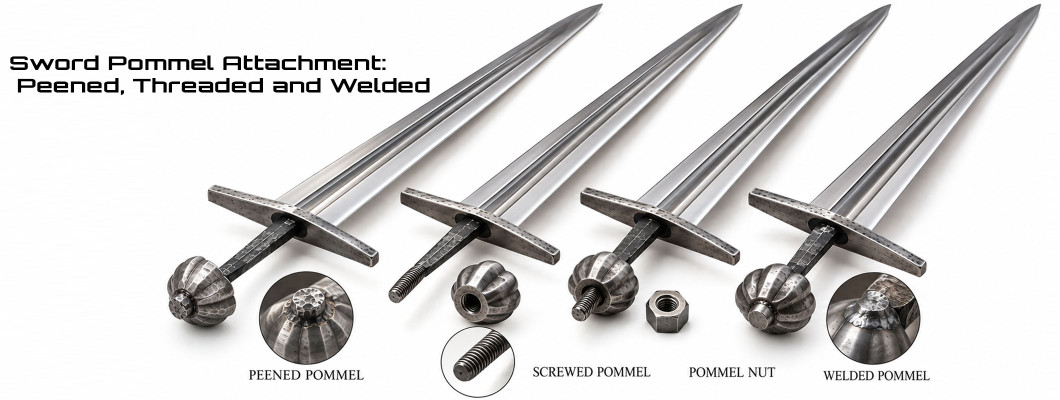
How it is done. The tang runs the full length of the grip and passes right through a hole in the pommel. The smith tightens the stack, then hammers the protruding tip of the tang so that it spreads into a small rivet head — the peen — against the top of the pommel. Sometimes a small plate or peen block sits under it to spread the load.
What it achieves. The peen pulls the pommel towards the blade and holds it there. Guard, grip and pommel are locked under compression between the blade shoulders and the peened end. Nothing can turn, because there is no thread to turn on.
Strengths. Cannot unscrew under impact. Uses the steel of the blade itself as the fastener. The historical European standard for around a thousand years, and still the right answer for a sword that will be swung.
Weaknesses. Permanent. Replacing a cracked grip means grinding or drilling the peen off and re-peening. It takes skilled hand work, which is why cheap swords avoid it. And the grip can still shrink over years — a well-seasoned grip matters.
How to recognise it. A small hammered dome of steel at the top of the pommel, often slightly irregular and sometimes a different colour from the pommel around it. Be aware that a decorative button can imitate one.
Threaded or Screwed Pommel
How it is done. The end of the tang is cut with a thread, and the pommel itself is drilled and tapped with a matching thread. The pommel is screwed down onto the tang until it tightens against the grip.
What it achieves. Done tightly, it puts the hilt under the same kind of compression as a peen, and it is quick to assemble.
Strengths. Can be taken apart. A grip can be replaced, a guard changed, or the hilt re-tightened without special tools. It suits people who like to customise or service their own swords.
Weaknesses. A screw thread can unwind. Every impact sends a small rotational shock down the blade, and hundreds of them can walk a threaded pommel loose the way vibration backs a bolt out of a machine. The pommel itself is the nut here, so if its thread wears or the pommel is soft brass, it loosens faster. Threads also make a small weak point at the end of the tang, which matters more on a light tang than a heavy one.
How to recognise it. A smooth pommel top with no hammered dome, sometimes a small visible end of threaded rod, or a pommel that can be felt to turn if it has loosened.
Threaded Tang With a Nut
How it is done. The tang is threaded as above, but the pommel is simply drilled through. A separate nut is tightened down on top of the pommel, either visible as a feature or hidden under a decorative cap or finial. Some makers use a locking nut or thread-locking compound.
Strengths. Stronger clamping than a threaded pommel, because a steel nut takes the thread load rather than the pommel. Still fully serviceable. Many modern production swords that are marketed as take-down use this method.
Weaknesses. A nut can still back off under repeated impact, especially without a locking method. A decorative cap can hide the fact that the nut has loosened until the whole hilt rattles.
How to recognise it. A visible nut, a small flat-sided cap, or a finial that is clearly a separate part from the pommel.
Welded Pommel
How it is done. The stack is assembled and the pommel is welded to the end of the tang, usually with a bead run around the top of the tang where it comes through, then ground and finished.
What it achieves. The pommel cannot unscrew and cannot come off without cutting the weld. If the stack was clamped tight before welding, the hilt is held under compression in much the same way as a peen.
Strengths. Quick, permanent and strong at that point. A weld at the pommel end sits far from the blade shoulder, where the heaviest bending loads are, so it is under much less strain than a welded rat-tail rod.
Weaknesses. Everything depends on weld quality, and weld quality is invisible once it has been ground and polished. The heat can scorch a wooden or leather grip, and if the stack was not pressed tight first, the weld simply locks in a loose hilt. It cannot be serviced. And welding is sometimes used to fix a pommel onto a separate rod rather than onto a true tang — which moves the real weakness to where that rod joins the blade.
How to recognise it. A slightly different texture or colour ring where the tang meets the pommel top, sometimes faint grinding marks. Well-finished welds can be very hard to spot, so ask.
Welding is not the same as a welded tang. A pommel welded onto a full-length forged tang is a reasonable, if permanent, construction. A thin rod welded onto the base of the blade is the construction behind most sword breakages, whatever holds the pommel on. Our guide to full tang vs rat-tail tang explains that failure in detail.
Other Ways a Pommel Is Attached
Forged in one piece. On some full flat tang swords and many knives, the pommel end is simply part of the tang — forged or cut from the same bar, with scales riveted on either side. There is no joint at the pommel at all, so nothing there can loosen. Heavier in the hand, but about as secure as it gets. The kukri or khukuri equivalent is the panawal butt, covered in our kukri tang types guide.
Pinned. A pin is driven crosswise through the pommel and the tang. Simple and mechanical, but the hole weakens the tang at that point, and the pin does not pull the stack tight — it only stops the pommel coming off. Usually a secondary fixing rather than the main one.
Multi-part riveted pommels. Many Viking-age hilts used a two- or three-part pommel. The tang was peened over an upper guard, and a decorative pommel cap was then riveted onto that upper guard. The structural fixing is still the peen; the cap is attached to it.
Glued or press-fitted. The pommel is pushed onto the tang or into the end of the grip and held by adhesive or friction. On short-tang swords the pommel is often fixed this way into the grip, with no steel reaching it. Acceptable on a display piece, not on anything swung.
Japanese swords. The kashira — the end cap of a Japanese handle — is not what holds the sword together. The handle is secured to the tang by bamboo pegs through the handle and tang, and the kashira is mostly a fitting. It is a different system entirely, and a sound one when well made.
The Methods Compared
| Method | Clamps the hilt | Can work loose | Serviceable | Best for |
|---|---|---|---|---|
| Peened | Yes | No | Only by removing the peen | Any sword that will be swung |
| Threaded pommel | Yes, if tight | Yes, under repeated impact | Yes, easily | Light use, customisers |
| Threaded tang with nut | Yes | Possible without a locking method | Yes | Take-down swords, regular maintenance |
| Welded | Yes, if pressed tight first | No | No | Permanent builds on a full-length tang |
| Forged in one piece | Not needed — no joint | No | Scales only | Heavy use, full flat tang builds |
| Pinned | No | Grip can still move | Yes | Secondary fixing |
| Multi-part riveted | Yes, via the peen underneath | Cap rivets can loosen | Partly | Viking-era patterns |
| Glued or press-fit | No | Yes | Re-glue only | Display only |
No single method is always right. A peened pommel is the safest choice for a sword that will cut. A threaded one is the most practical for a sword you want to take apart. A welded one is permanent and fine on a proper tang. The one to avoid for real use is any pommel that is only glued on.
How to Tell How a Pommel Is Attached
Look at the top of the pommel. A hammered dome suggests a peen. A nut, a flat-sided cap or a finial suggests a thread. A ring of different texture suggests a weld. A pin head on the side of the pommel means a pin. A perfectly smooth, featureless top tells you little on its own.
Grip the pommel and try to turn it. A peened or welded pommel will not move. A threaded one that has started to loosen will. Any movement at all means the hilt is no longer clamped.
Shake the sword gently near your ear. A rattle or click from the hilt means something in the stack is loose, whatever the method.
Ask the maker. "Is the pommel peened, threaded or welded, and does the tang run through it?" A maker answers that in one sentence. Vague phrases like "securely fitted" usually mean threaded or glued.
Our guide on how to test a sword covers the full hilt inspection before any cutting.
Looking After a Pommel
Check before every session. Twist the pommel, twist the grip, listen for a rattle. Stop the moment anything moves.
Tighten a threaded pommel gently. Snug it down by hand or with a padded tool. Overtightening can crack a wooden grip or strip a soft pommel thread. A drop of thread-locking compound on a nut helps it stay put.
Do not try to re-peen at home. A loose peened hilt usually means the grip has shrunk. A smith can re-set and re-peen it properly; hammering on it yourself risks cracking the pommel or the grip.
Keep moisture out. Water trapped between the pommel and the tang corrodes the steel where you cannot see it. Dry the hilt after use and store the sword somewhere dry. Our blade care guide covers the rest.
How We Attach Pommels
The great majority of swords we forge have peened pommels, with the tang running through the pommel and hammered over. If the fixing matters for how you intend to use a sword, ask us to confirm it for that specific piece before you order — we would rather answer than have you assume.
If you want a take-down hilt, or a specific fixing on a specific pattern, that is a custom forge request, and we will tell you plainly whether it suits the work you have in mind.
Hand-Forged Swords, Hilt Construction Confirmed
Every sword is forged to order from 5160 spring steel in our Kathmandu workshop. Ask us how any hilt is built — tang, guard and pommel fixing — and we will tell you in one sentence. If you want a specific construction, send it through custom forge.
Frequently Asked Questions
What is the difference between a peened and a threaded pommel?
A peened pommel has the tang passing through it with the tip hammered over into a rivet head, so it cannot unscrew and can only be removed by grinding the peen off. A threaded pommel screws onto a threaded tang end. It can be taken apart and re-tightened, but repeated impact can gradually unwind it. Peened is the safer choice for a sword that will be swung.
Is a threaded pommel bad on a sword?
Not bad, but it needs checking. Done tightly, a threaded pommel clamps the hilt well and lets you service the sword. The weakness is that repeated impact can walk it loose, especially if the pommel itself carries the thread. A steel nut with a locking method is more secure. Check a threaded pommel before every session and tighten it gently when needed.
Is a welded pommel strong?
It can be, if it is welded onto a full-length forged tang and the hilt was pressed tight before welding. The weld sits far from the blade shoulder, where the heaviest loads are. The drawbacks are that it cannot be serviced and that weld quality is invisible once finished. A pommel welded onto a thin rod that is itself welded to the blade is a different matter, and should be avoided.
How do I know if my sword pommel is peened?
Look for a small hammered dome of steel on top of the pommel where the tang was spread. Then try to turn the pommel — a peened one will not move. Be aware that a decorative button can imitate a peen, so if the sword matters, ask the maker whether the tang runs through the pommel and is hammered over.
Why is my sword pommel loose?
On a threaded pommel, repeated impact has usually unwound it. On a peened pommel, the grip has usually shrunk so the stack is no longer tight. On a glued pommel, the adhesive has failed. Stop using the sword. A threaded pommel can often be tightened at home; a peened one should go to a smith.
Can I tighten a threaded pommel myself?
Usually yes. Hold the blade safely, wrapped in a cloth, and turn the pommel clockwise until it is snug. Do not overtighten, as that can crack a wooden grip or strip a soft thread. A drop of thread-locking compound helps it stay tight. If it keeps loosening, have the thread checked.
Can a peened pommel be taken off?
Only by removing the peen, usually by grinding or filing it flat, after which the pommel comes off. Re-assembly means re-peening the tang, which needs enough tang left to spread. It is a job for a smith rather than a home repair.
What is a pommel nut?
A separate nut tightened onto a threaded tang above the pommel, sometimes visible and sometimes hidden under a cap or finial. It clamps the hilt more firmly than a pommel that is threaded itself, because the steel nut takes the load. It can still work loose without a locking method, so it should be checked regularly.
How were Viking sword pommels attached?
Many Viking-age hilts used a pommel made in two or three parts. The tang was peened over an upper guard, and a decorative pommel cap was riveted onto that upper guard. The peen was the structural fixing, and the cap was attached on top of it.
Which pommel attachment is best for a battle-ready sword?
A peened pommel on a full-length tang, or a one-piece pommel on a full flat tang. Both are permanent and cannot unscrew. A well-made nut on a threaded tang is acceptable if you check it regularly. Avoid any pommel held only by glue or press fit on a sword that will be swung.