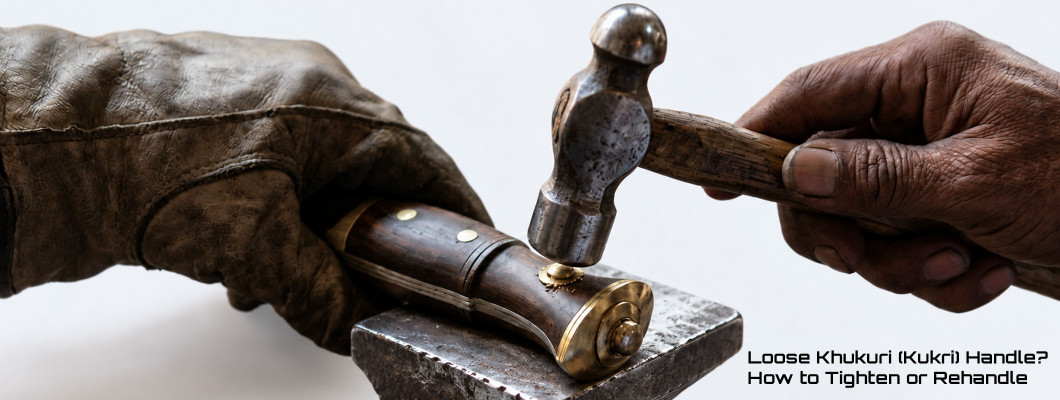
How Do You Fix a Loose Khukuri (Kukri) Handle?
A loose khukuri (kukri) handle is fixed by closing the gaps and then tightening the metal that holds the handle together. First, clean the joints and fill any gaps with a slow-setting two-part epoxy such as Araldite. Then tighten the handle according to how it was built. On a panawal handle, where the scales are riveted through a full-width tang, you hammer (peen) the rivets. On a parowal handle, where the tang runs through the handle to the butt cap, you hammer (peen) the end of the tang. Clamp it, let the epoxy cure for a day, and the handle is solid again.
Quick Answer: Fixing a Loose Khukuri Handle
- Find out which handle you have. Steel visible along the handle with rivets means panawal; a solid handle with the tang end showing at the butt cap means parowal.
- Glue first: clean the joint, then work slow-setting two-part epoxy (Araldite Standard) into every gap.
- Panawal: peen each rivet head with light taps of a ball-pein hammer, with the other head resting on a steel block.
- Parowal: clamp the blade below the bolster and peen the tang end at the butt cap.
- Light, repeated taps — never heavy blows, and never hammer the blade.
- Cure for at least 24 hours before using the khukuri.
- Replace the handle if the wood or horn is cracked through, the butt cap is split, or the tang is damaged.
Key Terms
- Tang
- The part of the blade's steel that runs into the handle.
- Panawal
- A khukuri handle built on a full-width flat tang, with two scales (usually wood or horn) riveted through it. The steel is visible along the handle.
- Parowal
- A khukuri handle built on a narrower tang that runs through a solid handle and is hammered over onto the butt cap.
- Peening
- Hammering the end of a rivet or tang so it spreads and locks the parts together.
- Bolster
- The metal collar where the blade meets the handle.
- Butt cap
- The metal plate at the end of the handle.
- Araldite
- A brand of two-part epoxy adhesive. Any slow-setting two-part epoxy does the same job.
Why Do Khukuri Handles Go Loose?
Most loose khukuri handles are caused by the wood or horn shrinking, not by a failure of the steel. Wood and horn move with humidity. A handle fitted in Kathmandu, where the air is often damp, can dry out and shrink after it arrives somewhere drier. That opens small gaps around the tang, the rivets or the butt cap, and the handle starts to click or shift.
Other common causes are:
- Chopping shock. Every heavy blow sends a jolt through the handle, and over time that works the joints loose.
- Wetting and drying. A khukuri that gets soaked and dried again and again swells and shrinks each time.
- Storage in a damp dap. Moisture trapped in the scabbard reaches the handle as well as the blade.
- Heat. Leaving a khukuri near a fire or in a hot car dries the handle quickly.
How Do You Know the Handle Is Loose?
A handle is loose if it clicks, rattles, twists, or shows a gap you did not see before. Check for these signs:
- A click or knock when you chop, or when you tap the butt on your palm.
- Movement when you hold the blade (carefully, by the spine, with a glove) and twist the handle.
- A visible gap at the bolster, along the scales, or under the butt cap.
- A rivet that turns, sits higher than the others, or has a gap around it.
- Rust stains or dark lines appearing at a joint, which mean water is getting in.
Fix it as soon as you notice it. A loose handle gets worse with every chop, and water getting into the joint rusts the tang where you cannot see it.
Panawal or Parowal: Which Handle Do You Have?
If you can see steel running along the handle between the scales, it is a panawal; if the handle is solid and the tang only shows at the butt cap, it is a parowal. The repair is different for each, so check this first. Our guide to kukri tang types explains the construction in more detail.
| Panawal | Parowal | |
|---|---|---|
| Tang | Full-width, flat, visible along the handle | Narrower, runs through the handle, hidden |
| Handle | Two scales riveted through the tang | Solid handle with a butt cap |
| What holds it | Rivets | The peened tang end |
| Where to hammer | Each rivet head | The tang end at the butt cap |
| Where the glue goes | Between the scales and the tang | At the bolster and the butt cap |
What Do You Need?
You need epoxy, a ball-pein hammer, something solid to support the work, and clamps. The full list:
- Slow-setting two-part epoxy, such as Araldite Standard. The slow version is stronger and gives you time to work; the rapid version is fine for small gaps.
- A ball-pein hammer, small to medium weight. The rounded end spreads metal neatly.
- A steel block or small anvil to support rivet heads (panawal).
- A vice with padded jaws — wood, leather or folded card over the jaws (parowal).
- Clamps, plus scrap wood or leather so they do not mark the handle.
- Acetone or isopropyl alcohol and a cloth, for cleaning before gluing and wiping squeeze-out.
- Masking tape to protect the blade and handle faces.
- A toothpick, thin card or a small syringe to push epoxy into gaps.
- Gloves and eye protection.
How to Fix a Loose Panawal Handle
On a panawal khukuri, fill the gaps between scale and tang with epoxy, clamp the scales, then peen the rivets tight.
- Find the gaps. Look along both sides for gaps between the scales and the tang, and check which rivets move or sit proud.
- Clean the joints. Wipe the edges of the scales and the tang with acetone or alcohol to remove oil. Epoxy will not bond to an oily surface. Tape the blade and the faces of the scales.
- Mix and apply the epoxy. Mix equal amounts of the two parts thoroughly. Work it into every gap with a toothpick or thin card, pressing it in rather than smearing it over the top.
- Clamp the scales. Clamp them firmly against the tang, with scrap wood or leather under the clamp jaws. Wipe away any squeeze-out with alcohol straight away — it is much harder to remove once it sets.
- Peen the rivets. Rest one head of the first rivet on a steel block. With the ball of the hammer, tap the other head lightly and repeatedly, working around its edge so it spreads evenly and pulls the scales tight. Then do the next rivet. Keep the blows on the rivet only — a missed blow will dent the scale.
- Check and cure. The handle should no longer move at all. Leave it clamped for at least 24 hours.
On brass rivets, go gently — brass spreads quickly and can split if hit too hard. Steel rivets need more taps but the same light touch.
How to Fix a Loose Parowal Handle
On a parowal khukuri, fill the gaps at the bolster and butt cap with epoxy, then peen the tang end over the butt cap to pull the handle tight.
- Clamp at the bolster. Clamp the blade in padded vice jaws just below the bolster, with the handle pointing straight up and the bolster resting on top of the jaws. This way, every blow compresses the handle against the bolster instead of travelling down the blade. Wrap the blade in a cloth for safety.
- Clean and fill. Clean any gap at the bolster and the butt cap with alcohol. Work epoxy into those gaps with a toothpick or push it in with a syringe. If the handle turns on the tang, try to work epoxy down alongside the tang too.
- Peen the tang end. The end of the tang shows as a small steel dome or disc in the middle of the butt cap. Tap it with the ball of the hammer, lightly and many times, working around its edge. As it spreads over the cap, it draws the whole handle down tight.
- Check as you go. Stop every few taps and try to move the handle. Stop as soon as it is solid — overdoing it can split the butt cap or the wood.
- Clean and cure. Wipe off any squeeze-out and leave the khukuri upright in the vice for at least 24 hours.
Keep heat away from the blade. Some repair guides suggest heating the tang or butt cap. The edge of a khukuri gets its hardness from heat treatment, and too much heat can soften it. If heat is used for any reason, wrap the blade in a soaking wet cloth and keep the heat at the butt end only. For a simple tightening, no heat is needed.
Can You Just Use Glue?
Epoxy on its own is a temporary fix; it lasts much longer when the rivets or tang end are tightened as well. A khukuri handle takes heavy shock every time it chops. Epoxy fills gaps and keeps water out, which is valuable, but the metal parts are what hold the handle together under impact.
Use the right glue. Slow-setting two-part epoxy such as Araldite Standard bonds wood, horn and steel and stays slightly tough once cured. Superglue is brittle and cracks under chopping shock. Wood glue does not bond to steel. Traditionally, Nepali smiths set handles with laha, a natural resin; epoxy does the same job and is easier to use at home.
When Should You Replace the Handle Instead?
Replace the handle when the handle material or the tang itself is damaged, not just loose. Tightening will not help if:
- The wood or horn is cracked right through.
- The butt cap or bolster is split.
- The tang is broken, bent or badly rusted inside the handle.
- The handle still moves after a proper repair.
- The handle was simply glued onto a short tang with nothing peened or riveted, as on many cheap kukris. Such a handle cannot be made safe by tightening.
Rehandling means removing the old handle, fitting a new one to the tang, and peening or riveting it again. It takes woodworking tools and some metalwork experience. If you are not confident, ask a local knifemaker, or contact us — we can advise you on the right route for your khukuri.
How Do You Stop It Happening Again?
Keep the handle away from extremes of wet, dry and heat, and oil it regularly.
- Wipe the handle dry after use, and never leave the khukuri soaking.
- Rub a little oil into wooden handles every few months so they do not dry out and shrink.
- Keep the dap dry inside, and store the khukuri out of direct sun and away from heaters.
- Check the handle before each trip, and fix any movement straight away.
Our khukuri (kukri) maintenance guide covers handle and scabbard care in full, and How to Sharpen a Khukuri (Kukri) covers the edge.
Need a New Handle, or a New Khukuri?
Every khukuri/kukri we make is hand-forged from 5160 spring steel, with the handle riveted or peened, not just glued. Tell us what you need and we will forge it to suit.
Request a Custom Forge →Explore More Kukri & Khukuri Guides
Frequently Asked Questions
Why has my khukuri (kukri) handle gone loose?
Most often the wood or horn has shrunk. A handle made in humid Kathmandu can dry out and shrink in a drier climate, which opens small gaps around the tang, the rivets or the butt cap. Repeated chopping shock and cycles of getting wet and drying out make it worse.
What glue should I use on a khukuri handle?
Use a slow-setting two-part epoxy such as Araldite Standard. It fills gaps, bonds wood, horn and steel, and seals the joint against water. Avoid superglue, which is brittle under chopping shock, and avoid wood glue, which does not bond to steel.
Can I just glue a loose handle without peening?
On a panawal handle, epoxy in the gaps plus tightened rivets is the right fix; glue alone can crack loose again under chopping. On a parowal handle, epoxy fills the gaps but the peened tang end is what actually holds the handle together, so it should be tightened as well.
What is the difference between a panawal and a parowal handle?
A panawal handle has a full-width flat tang with two scales riveted through it, so you can see the steel along the handle. A parowal handle has a narrower tang that runs through a solid handle and is hammered over (peened) onto the butt cap at the end.
Will hammering the tang or rivets damage the blade?
Not if the work is supported correctly. Clamp the blade in padded vice jaws just below the bolster so the blows compress the handle, and use light, repeated taps. Never support the khukuri on its tip, and never hammer the blade itself.
How long should the epoxy cure before I use the khukuri?
Clamp it for at least 24 hours and leave it a further day or two before hard chopping. Slow-setting epoxy is strongest once fully cured, and a warm room helps it set.
When should I replace the handle instead of tightening it?
Replace it when the wood or horn is cracked through, the butt cap has split, the tang is broken or badly rusted, or the handle still moves after a proper repair. A handle that was only glued onto a short stick tang, as on many cheap kukris, usually cannot be made safe by tightening.
Is a loose handle covered by Everest Forge?
If your Everest Forge khukuri arrives with a loose handle, or loosens under normal use, contact us before working on it so we can look at it with you.